
2025 Taiwan NGO Fellowship Program
In the fall of 2025, the Taiwan Alliance in International Development (Taiwan AID, 台灣海外援助發展聯盟)—a membership association for 30 Taiwanese non-governmental organizations (NGOs)—concluded the third round of its NGO Fellowship Program, inviting 12 young NGO workers from 11 countries in South and Southeast Asia to spend a month in Taiwan. The program’s goal is to provide them with knowledge and practical experience of Taiwan’s vibrant NGO community, as well as to expand Taiwanese collaboration with NGOs in the region. After a week-long workshop, during which local NGO professionals spoke on issues such as NGO accountability, fundraising strategies, organizational development, and advocacy work, the fellows were each separately placed within specific local NGOs in their own areas of expertise. The fellows from South and Southeast Asia spent three weeks at these Taiwanese NGOs in order to gain on-the-ground experience and connections with local civil society actors. At the closing ceremony, Taiwan’s Ministry of Foreign Affairs (MOFA, 外交部) hosted a celebratory dinner for the NGO fellows who were presented with certificates of participation in the program.
According to a brochure obtained by this author, Taiwan AID received more than 1,300 applications (from 57 countries) for the 2025 program cycle—a number similar to the interest received last year—demonstrating that there remains strong demand for such a program in Asia. Each of the 12 fellows selected had many years of experience working in NGOs in their own countries, on issues ranging from various health and environmental problems to childhood education, digital training, women’s empowerment, and rural development. Notably, this group included one wheelchair-bound fellow—who, despite becoming disabled after an accident 12 years ago, went on to open up a small orchid business, teach English, pursue graduate studies abroad, and work with an NGO to provide training and career support for others with disabilities in Vietnam. Another 2025 fellow works with an international NGO to deliver humanitarian assistance to communities in conflict-affected areas of Myanmar. Additionally, this cohort included an NGO fellow who is an advocate for independent media and press freedom in Cambodia.
Despite initial budget challenges, Taiwan AID was eventually able to obtain funding for the third iteration of the NGO Fellowship Program from the American Institute in Taiwan (AIT, 美國在台協會) and Taiwan’s MOFA—as had been the case in the past two rounds. In order to allow for continued American support, AIT shared with this author that it had worked with MOFA to move the program into the US Congressionally-funded Global Cooperation and Training Framework (GCTF) for this year. The GCTF bilateral cooperation platform was established in 2015 to give Taiwan an opportunity to share its technical and policy expertise with various government officials and professionals in the Indo-Pacific region. Over the past decade, training areas have included public health, law enforcement, e-commerce, energy efficiency, humanitarian assistance, disaster relief, anti-corruption, women’s empowerment, and combating disinformation. By incorporating the NGO Fellowship Program into its framework, GCTF has thus expanded its mission to include the training of NGO professionals in the region. At the same time, support for the NGO Fellowship Program has now been broadened to include Japan, Australia, and Canada, which each joined GCTF after its inception.
Setting up an NGO Fellowship Alumni Network
With its notable success over the past three years, the Taiwan NGO Fellowship Program has significantly expanded grassroots people-to-people ties between Taiwan and regional NGOs in Asia. Since its inception, this program has attracted nearly 3,000 applicants and, with the completion of the latest round in 2025, now counts 37 alumni fellows working in different NGOs across 15 countries in Asia. As the program continues in the years ahead, people-to-people ties between NGOs in the region will expand even further.
At the same time, however, it has become clear that more can be done to sustain and strengthen ties that are built through participation in the program. Understanding this, Taiwan AID has informed this author that it is setting up active alumni network that will sustain communication and collaboration among the NGO fellows themselves, as well as with Taiwanese NGOs long after they return to their own countries. Taiwan AID has thus reached out to program alumni to begin discussion on such a project. With this objective in mind, it invited a fellow from a previous cohort to speak at the 2025 closing ceremony on the subject of setting up an alumni network.
In this fellow’s own words (shared with this author), “programs like this show us that collaboration isn’t just possible—it’s powerful. The bonds forged here between Taiwanese organizations and regional changemakers are proof that shared values can transcend political boundaries.” Noting that while he has personally continued to maintain contact with other fellows from previous years, “what we need now is to nurture and structure that momentum—turning individual achievements into collective impact, and alumni connections into an enduring regional community.”
2025 Asia NGO Forum on International Development
Apart from the NGO Fellowship Program, Taiwan AID also hosted the “Asia NGO Forum on International Development” in June 2025. Launched by Taiwan AID in 2014, this biennial two-day regional conference attracted more than 250 NGO experts from 11 Asian countries this year and focused on the practice and challenges of achieving the UN’s Sustainable Development Goal 16+: “Promoting peaceful, just and inclusive societies.” The forum included NGO leaders from the United States, Korea, Japan, Cambodia, Pakistan, India, Indonesia, and Vietnam, as well as Taiwan, who shared their views and experiences on this subject. Representatives from the Embassy of Saint Vincent and the Grenadines, the Indonesian Economic and Trade Office to Taipei, and the American Institute in Taiwan also attended the event.
Speakers at this forum underscored the importance of assisting marginalized and disadvantaged groups within society, such as migrants, women and children. They also highlighted corporate anti-corruption actions and strengthening civil society as the foundation for achieving other sustainable development goals. At the same time, many noted that the global humanitarian aid system is currently facing a shortage of manpower and unprecedented challenges due to major funding constraints. Participants at the forum thus not only addressed sustainable growth issues but also emphasized the need for greater cross-border support and collaboration in order to promote and sustain a just and inclusive world society.
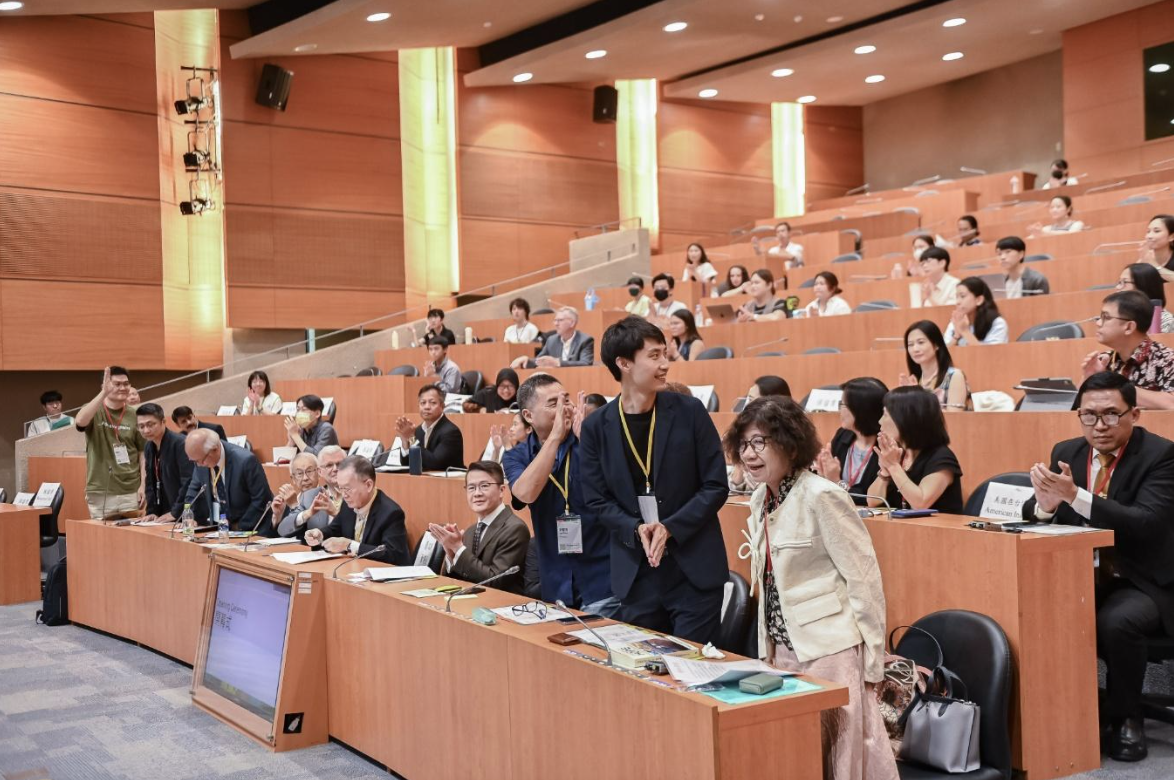
Image: Participants in the “2025 Asian NGO International Development Forum,” held on June 27-28 at National Taiwan University in Taipei. (Image source: Taiwan AID)
Establishing an INGO Center in Taiwan
In June 2025, Taiwan’s MOFA announced that it is now planning to establish an international nongovernmental organization (INGO) center in Taipei to attract more INGOs to Taiwan and to promote unofficial Track II (non-governmental people-to people) diplomacy. Charlie Chiang (江振瑋), head of MOFA’s Department of NGO International Affairs, indicated that the ministry has been trying to get more INGOs to open offices in Taiwan since 2020. Thus far, MOFA has attracted 13 INGOs, and is in discussion with another 37. Chiang said the ministry is presently searching out locations for the INGO center that would be spacious enough to house multiple INGO offices. Once finalized, the ministry will allocate funds in the fiscal year 2026 budget for its construction and opening.
Chiang added that MOFA is considering additional incentives to attract more INGOs to Taiwan. It is planning to offer rent subsidies to INGOs while streamlining regulations to make the entry process easier. For example, MOFA will make it possible for foreign national INGO leaders to move to Taiwan to open an office even before being granted residency, as long as they have MOFA’s endorsement. Requirements have also been revised to significantly lower the financial threshold for a foreign foundation to open an office in Taiwan, and MOFA has now set up a bilingual website to help INGOs apply to open an office in Taiwan.
With the influx of INGOs, Taiwan will thus be able to further strengthen its role as a regional NGO hub. Given that most of these INGOs are likely to be primarily focused on carrying out work beyond Taiwan, their presence will simultaneously expand Taiwan’s collaboration with other countries in East and Southeast Asia. At the same time, this opens up opportunities for Taiwan NGOs to work with Taiwan-based INGOs in the region and beyond, thus expanding Taiwan’s track II ties with the rest of the world.
Conclusion
In the 21st century, Taiwan is emerging as an NGO hub in Asia. It has achieved this not only by holding conferences but also by training regional NGO professionals and establishing itself as a headquarters for INGOs in the region. The long-term goal is to enable Taiwan’s vibrant NGO community—along with Taiwan-based INGOs—to enhance collaboration with regional NGOs to address the needs of disadvantaged communities and strengthen civil societies in Asia.
Given the unfortunate rise of regional and global political forces that seek only to promote their own narrow interests while denying the rights and needs of others (such as refugees, immigrants and other disadvantaged communities), regional NGO collaboration is more important than ever. According to Freedom House, the world has witnessed a continuous rise of autocracy and a decline in democracy over the past two decades. Moreover, we are again seeing the rise of autocratic regimes that seek to pursue their national ambitions and territorial claims by force and coercion without regard for the rules and values of the liberal international order—such as in the recent cases of Russia invading Ukraine, and China’s multi-faceted campaigns of coercion directed against Japan and other countries across Asia.
At the same time, with the inclusion of the NGO Fellowship Program in the GCTF, cooperation between Taiwan, the United States, and countries across Asia is deepening. The proposal to establish an INGO Center in Taiwan promises to further expand the Taipei’s global ties and its space for international engagement, especially in the face of increasing cross-Strait pressure.
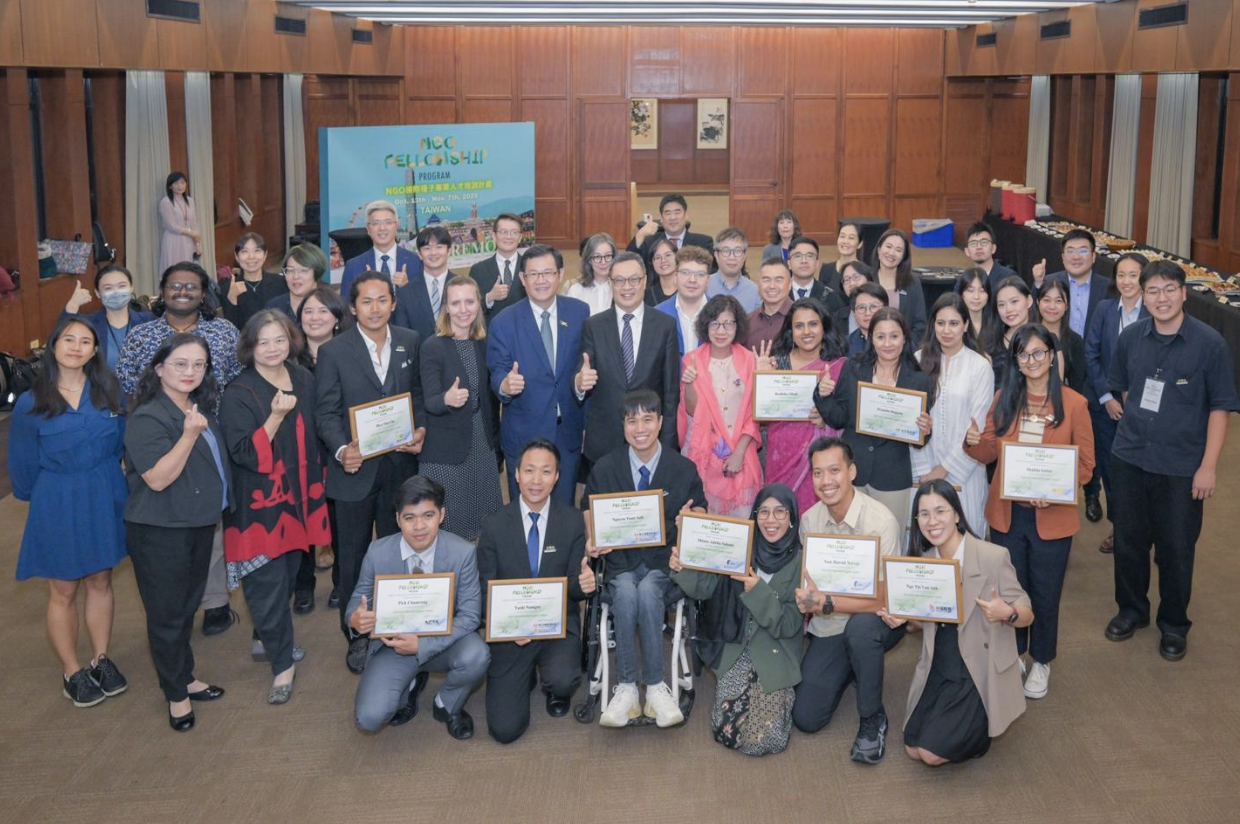 Image: MOFA Vice Minister Chen Ming-chi, Director General of NGO International Affairs Department Chiang Zhen-Wei AIT Public Diplomacy Officer Jennifer Steffensen, and Taiwan AID Chairperson Rebecca Wang (middle) attend a 2025 NGO Fellowship Program ceremony (Image Source: Taiwan AID, sent to this author)
The main point: Taiwanese NGOs, with the support of the government, AIT and international NGOs, are building an NGO hub in Taiwan that will enhance cross-border civil society collaboration and strengthen democratic values. Concurrently, this effort will expand Taiwan’s people-to-people ties in the region and beyond.
The author would like to thank Taiwan AID for allowing him to observe the 2025 NGO Fellowship Program.