
Taiwan faces near-daily threats from the rising number of incursions by the People’s Liberation Army (PLA), including aircraft, vessels, and unmanned platforms. To strengthen deterrence and rapidly prototype and adopt emerging technologies and capabilities at scale, Taiwan cannot afford to base its defense innovation and dual-use technology efforts on American institutional models alone. In particular, Taiwan should not seek to establish an exact replica of the Pentagon’s Defense Innovation Unit (DIU) in the Ministry of National Defense’s (國防部, MND) new Defense Innovation Office (國防創新小組, DIO).
As a middle power with an economy driven by small and medium-sized enterprises (SMEs), Taiwan should leverage its strengths to design a more agile defense innovation system. To achieve this, Taiwan should look to the defense innovation ecosystem of another middle power: Canada. Specifically, Taipei should draw from the Canadian Department of National Defence’s (DND) programs: Innovation for Defence Excellence and Security (IDEaS) and Mobilizing Insights in Defence and Security (MINDS).
To address threats from across the strait, Taiwan’s President William Lai (賴清德) launched the MND’s DIO on February 1, 2024. The entity’s existence was only revealed seven months later, on September 18, 2024. Nearly two years after its establishment, the MND’s 2025 National Defense Report (NDR, 114年國防報告書), defined and outlined DIO’s principal mission as follows:
The DIO will incorporate innovative operating concepts, conduct survey studies on the development of domestic and overseas defense industries, and make announcements or hold industry roundtable meetings to request technology solutions, including mature technologies, prototype development, and finished products, which will be acquired if they are determined to meet needs after evaluation.
The NDR further notes that Taiwan is actively engaging and collaborating with DIU and the US Indo-Pacific Command to stay abreast of emerging defense technologies. Furthermore, the NDR states that US defense innovation connections are the foundation for introducing, adapting, and integrating future technology into Taiwan’s defense system. DIO’s core mission and focus areas closely align with those of the Pentagon’s DIU, as both an inspiration and a blueprint.
Nonetheless, Taiwan should not seek to replicate the US DIU wholesale, but rather build on its successes while integrating defense innovation lessons from other small and medium powers with SME-driven economies. Canada’s DND IDEaS and MINDS programs emphasize ecosystem development, workforce and policy pipelines, and export-oriented growth, offering a more relevant model for Taiwan’s economic, military, and geopolitical realities. Practical defense innovation can bridge Taiwan’s military and civilian economies, fuel economic growth, strengthen deterrence against the PLA, and enable exports to like-minded partners.
DIU Limitations
Founded in April 2015 as the “Defense Innovation Unit Experimental,” America’s DIU states that its mission is “accelerating the adoption of commercial technology throughout the military and bolstering our allied and national security innovation bases.” To achieve this, DIU seeks to “rapidly prototype and field dual-use capabilities that solve operational challenges at speed and scale” for US military customers. Although DIU is framed as an “innovation” organization, akin to Pentagon-wide and service-level innovation components such as the Defense Advanced Research Projects Agency (DARPA) or AFWERX, functionally it is a rapid dual-use technology acquisition entity, which is a tension DIO can avoid as it clarifies its roles and missions.
To cover all nine Technology Readiness Levels (TRLs) of (COTS) technologies, DIU comprises three components: the main DIU, the National Security Innovation Network (NSIN), and the National Security Innovation Capital (NSIC). Overall, DIU focuses on TRLs six through nine (mature technologies), while NSIN and NSIC concentrate on TRLs one through five (nascent technologies). NSIN emphasizes talent development and engagement with startups, academic institutions, and venture capital communities, whereas NSIC provides capital to early-stage companies keen on specific dual-use applications. DIU primarily relies on acquisition mechanisms such as “Commercial Solutions Openings” and “Other Transactions” authority to transition dual-use and COTS technologies from prototypes to programs of record, bypassing many traditional acquisition bottlenecks.
According to a Congressional Research Service report, DIU’s progress is hampered by the roughly 300 innovation-related entities under the Pentagon, which operate without a unified outreach, industry engagement, and funding strategy. While DIO should adopt parts of DIU, it should expand its focus to align firmly with the national priority of developing a strong indigenous drone industry that benefits both civilian and military applications, while promoting economic growth. Canada’s IDEaS and MINDS offer relevant frameworks to emulate to pursue these goals.
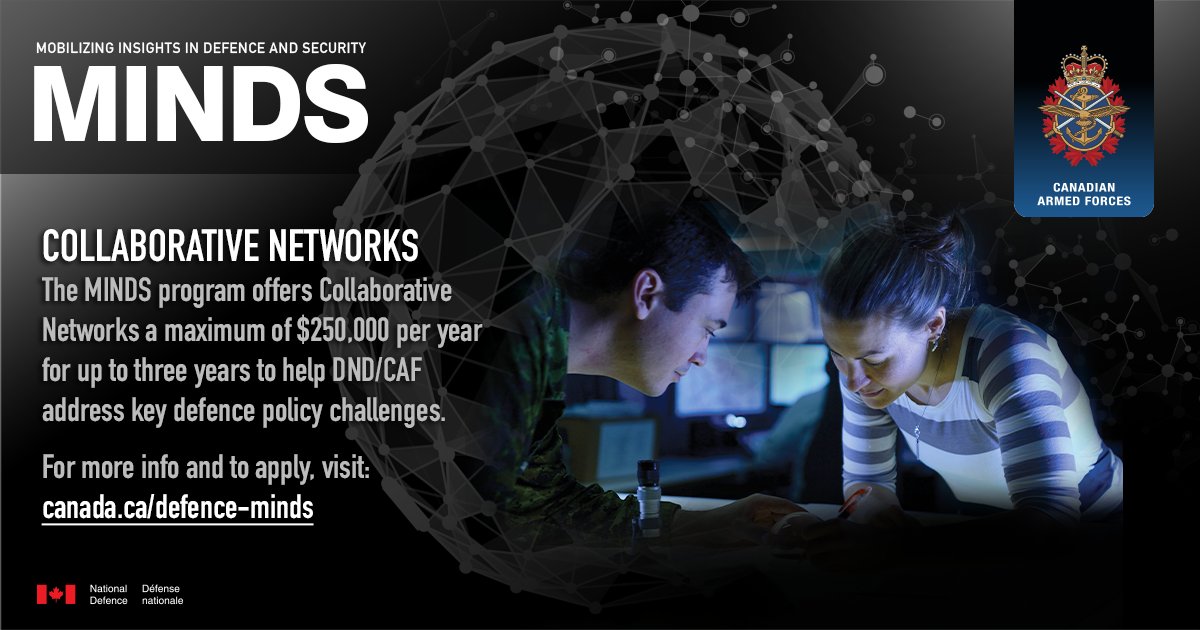 Image: A Canadian government promotional graphic for the “Mobilizing Insights in Defence and Security” (MINDS) program. (Image source: Canadian Ministry of Defence X account)
Innovative IDEaS & MINDS
Created through the Canadian DND’s 2017 Strong, Secure, Engaged defense policy paper, IDEaS was designed not only to equip the Canadian Armed Forces (CAF), but also to explicitly create “well-paying jobs for Canadians” and “export opportunities for Canadian Industry,” and to “grow and support Canada’s innovation community.” To achieve this, IDEaS comprises five funding elements that diverge from DIU, including competitive projects, innovation networks, contests, sandboxes, and test drives. Each component is part of the puzzle in providing potential solutions to the problem sets and challenges faced by the DND and CAF. However, unlike DIU, IDEaS is not focused on a single set of TRLs but rather on all levels from one to nine, depending on the particular solution sought. Although the focus is on Canadian industry, IDEaS also accepts proposals from abroad, provided they have a Canadian content aspect of roughly 50-80 percent.
Some of IDEaS’ solution examples include a call for research into the barriers to the adoption of autonomous defense systems, a contest to accelerate the development of low-cost and scalable first-person view aerial drones and control unit solutions, and a sandbox to counter Uncrewed Aerial Systems through detection and elimination. Public data on how many IDEaS projects transition into large-scale production is limited. Still, IDEaS’ prioritization of ecosystem development, workforce pipelines, and export-oriented growth aligns well with Taiwan’s SME-concentrated economic and defense innovation needs.
Complementing IDEaS, MINDS addresses a different yet critical gap, which is somewhat fulfilled by DIU’s NSIN component. Launched in 2017 alongside IDEaS, MINDS funds policy solution calls that tap into academic research networks, support emerging subject-matter experts, scholars, and students, and facilitate dialogue among civil society, academia, government, and the military on defense and security topics. The five components that make up MINDS include the expert briefing series, targeted engagement grants, collaborative networks, rapid response mechanism, and scholarships. These components represent engagement pathways that Taiwan’s MND currently lacks when soliciting solutions for doctrine, tactics, operations, and strategy from civilians.
By incorporating elements of MINDS to complement DIO’s rapid-acquisition mandate, Taiwan would better institutionalize its science and technology parks and university research and development hubs. Without formal mechanisms to harness this centralized talent, given Taiwan’s advanced AI workforce development and higher education levels, critical assets to address national security and economic growth challenges remain untouched.
Recommendations
- Clarify DIO’s Role to Avoid Innovation and Acquisition Tensions: Drawing on a core lesson from DIU’s early development, Taiwan should clearly delineate DIO’s innovation and ecosystem-building mandate from the acquisition and production roles already performed by the state-owned corporations Aerospace Industrial Development Corporation (漢翔航空工業股份有限公司) and the National Chung-Shan Institute of Science and Technology (國家中山科學研究院). Doing so frees DIO to leverage Taiwan’s SME-heavy economy, workforce development, and a dual-use innovation pipeline without inheriting the constraints of acquisition-centric approaches.
- Cover All of the TRL Spectrum: Learning from IDEaS, DIO should promote solutions that seek TRLs relevant to that specific issue, regardless of the TRL, to strengthen Taiwan’s SME ecosystem and diversify away from large foreign defense technology companies.
- Solutions from IDEaS: DIO should follow IDEaS’ solutions toolkit of competitive projects, contests, sandboxes, test drives, and innovation networks. This allows for more diverse solutions to address defense problems by flattening the distance between operational end users and counterparts in industry, academia, and civil society.
- Foster Policy, Talent, and Research Through MINDS: Fostering policy, talent, and research requires novel defense innovation solutions from across industry, academia, and civil society, similar to what MINDS provides for DND and CAF. Therefore, DIO should seek to emulate MINDS’s five components of expert briefing series, targeted engagement grants, collaborative networks, rapid response mechanism, and scholarships. This will allow DIO and other MND components to seek direct policy solutions across Taiwan’s civilian population.
The Future of Taiwan’s Defense Innovation
The Lai Administration’s priorities, such as the development of the drone industry, the establishment of the Whole-of-Society Defense Resilience Committee (全社會防衛韌性委員會), and the implementation of the Taiwan Open Government National Action Plan (臺灣開放政府國家行動方案), highlight the need for mechanisms that extend beyond MND. While DIO’s DIU-inspired model ensures compatibility with the Pentagon and INDOPACOM, its exclusive focus within MND risks hindering the growth of a national innovation ecosystem that bridges military and civilian applications. To meet its strategic and economic goals, Taiwan should pursue a hybrid innovation model, combining DIU’s technical strengths with Canada’s IDEaS and MINDS, whose middle-power approach aligns more closely with Taiwan’s structure and ambitions.
Canadian DND’s initiatives, such as IDEaS and MINDS, aim to promote a broader innovation base. Unlike DIU, IDEaS funds multi-stage innovation competitions that connect SMEs directly to the procurement pipeline, mapping domestic supply chains to mitigate foreign dependencies. Meanwhile, MINDS finances academic research networks and policy dialogues that align national innovation priorities with defense needs, capabilities that Taiwan currently lacks. While DIU emphasizes speed and prototype transition, IDEaS and MINDS focus on ecosystem development, open competition, and talent pipelines, which are better suited to Taiwan’s SME-dominant economy, robust university system, and whole-of-society defense vision.
DIO’s evolution should aim to accelerate acquisition for MND while fostering a globally competitive dual-use technology sector capable of exporting Chinese component-free drones and other defense technologies to like-minded democracies. By bridging the gaps between defense innovation and national innovation as well as civilian and military economies, Taiwan can employ DIO as a cornerstone of economic growth and strategic deterrence in the Indo-Pacific and beyond.
The main point: Taiwan’s Defense Innovation Office should not strictly follow the model of the US Defense Innovation Unit. Instead, Taiwan should adopt defense innovation and dual-use technology lessons from similar middle powers such as Canada, including the country’s Innovation for Defence Excellence and Security (IDEaS) and Mobilizing Insights in Defence and Security (MINDS) initiatives, to foster civilian and military economic development by promoting a robust ecosystem, talent pipeline, and policy bench to build up its dual-use technology ecosystems.