
At some point around July 2018—the exact date is unclear—the government of Georgia began barring Taiwanese nationals from entry to the Caucasus nation. Since then, several Taiwanese travel vloggers have documented their experiences of trying to enter Georgia across the Armenian border. The reason behind the decision to deny entrance to Taiwanese nationals remains obscure.
However, former officials and scholars who spoke with the author in autumn 2025 have offered their views as to when and why this policy began. The consensus among these observers is that the ruling Georgian Dream party—a populist party that has held power in Tbilisi since 2012—adopted this approach to curry favor with Beijing, while citing Georgia’s own sovereignty concerns as a factor, knowing that this remains a sensitive issue with the public.
The “Piggy Team Mates” Case
On one occasion in 2020, a vlogger pair employing the handle “Piggy Team Mates” (豬豬隊友生活日常, AKA Scott & Wendy) managed to enter Georgia using a US visa. However, on a subsequent trip they were turned back at a checkpoint between Bavra in Armenia and Ninotsminda in Georgia, despite Georgian immigration laws permitting entry for third country nationals traveling with a valid US visa. Border officials invoked Article 11 of Georgia’s law on the Legal Status of Aliens and Stateless Persons, claiming the couple’s status was that of “foreigners without nationality.”
Yet, there is no such provision under this or any other article of Georgian law (except as pertains to people applying for residence in the country.) In the end, the deportation document cited Article 11, specifically Section 1, Subsection i, which refers only vaguely to “other cases envisaged by Georgian legislation.” The couple’s requests for clarification were met with the recommendation that they lodge a protest with “your consulate”—an impossible task since Taiwan does not maintain a diplomatic presence in Georgia (The couple was then promptly sent back across the border, where further obstacles confronted them when Armenian officials argued that they could not return, as they had single-entry visas. Eventually, they were allowed to apply for new ones—ending several hours in limbo in freezing cold conditions).
Quite why Tbilisi found it necessary to take these unprecedented measures is unclear. Nevertheless, those who have challenged the government on this policy have found themselves branded agents for Taipei in Georgian state-backed media. Elsewhere, some analysts believe security concerns and the desire for an alliance with Moscow, Beijing, and Tehran—in the face of deteriorating relations with Europe—could have played a role.
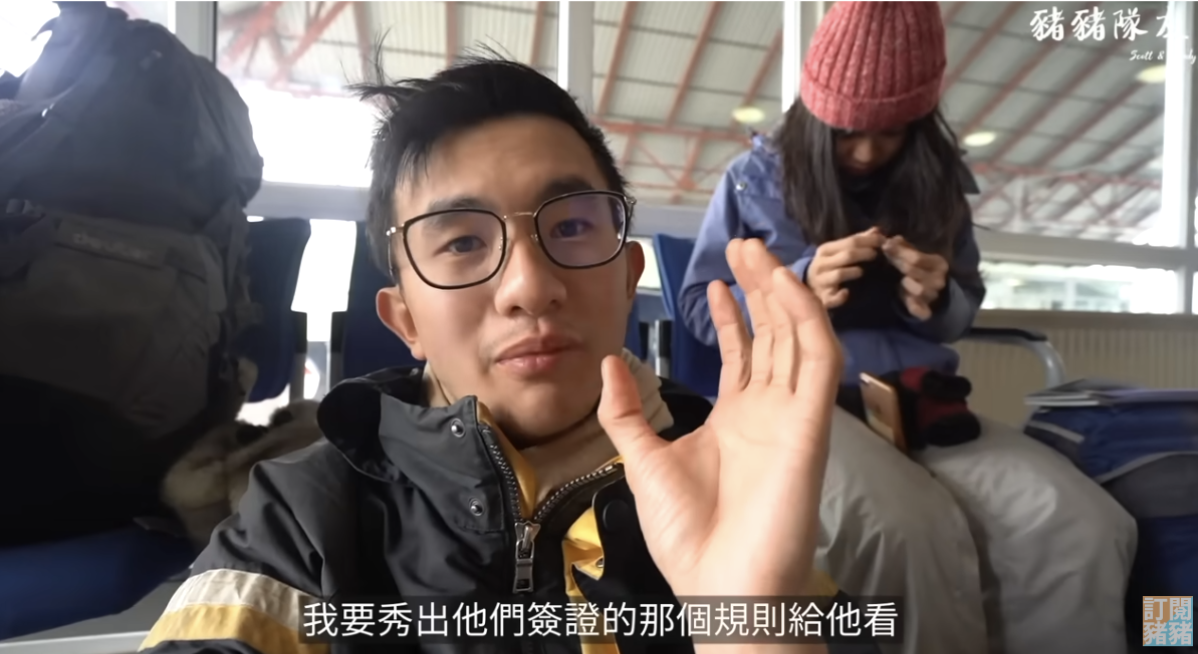
Image: A still image from a posted video by the vloggers “Piggy Team Mates,” discussing how they were denied entry to Georgia on ROC (Taiwan) passports in spring 2020. (Image source: “Piggy Team Mates” YouTube Channel)
The “Travel North Taiwan” Case
Another Taiwanese vlogger, part of a duo called Travel North Taiwan, fared better on a visit to Georgia by using a workaround: a temporary travel document issued by the Chinese consulate in Tbilisi. The vlogger was required to declare himself as a “Chinese compatriot” and was admitted by the Georgian immigration authorities with minimum fuss. However, the vlogger stressed that he would not encourage people to follow his example, as others had been rejected outright when pursuing this course. When I reached out to him to offer his thoughts for this article, he regretfully declined, stating that he had experienced considerable online “backlash” for documenting his experience. “It is pretty sad that even travel content is taken as political propaganda by some people,” he told me—though he was unsure as to the identity of the trolls.
Multiple inquiries to Georgia’s Ministry of Foreign Affairs and its parliament’s Foreign Relations Committee remained unanswered at the time of writing. Georgia’s parliament and its committees and organs are essentially an extension of the ruling Georgian Dream party, given that the main opposition parties have boycotted the legislative body following the disputed October 2024 parliamentary elections that sparked ongoing protests within the country.
A Turning Point in Georgia-Taiwan Relations
Some observers point to the 5th Open Government Partnership (OGP) Global Summit in Tbilisi in July 2018 as a concrete turning point in Georgia’s stance toward Taiwan. The OGP, an initiative that promotes open and accountable governance, holds an annual gathering in different cities worldwide, with participation from government bodies and civil society organizations (CSOs). Although Taiwan is not an OGP member, it has regularly participated in the summits through delegations from agencies such as the National Development Council (國際發展委員會), under the Executive Yuan (EY, 行政院).
“I know for a fact there were many Taiwanese representatives there that year, because I was a keynote speaker and they approached me after the conference,” Tinatin Khidasheli, chairperson of Civic Idea, told me in an interview. Civic Idea is a think tank that advocates for security and defense reform in Georgia, with a focus on Russian malign influence. “That was the last time a non-sportsman Taiwanese came to Georgia for an official international event,” she says. [1]
As a former member of the Republican Party of Georgia, which was part of the Georgian Dream coalition government from 2012 to 2016, Khidasheli served as minister of defense from 2015-2016. In 2016, the Republican Party of Georgia, alongside other parties, abandoned the coalition over its increasingly authoritarian, pro-Moscow turn.
Although Georgia was granted candidate status for membership of the European Union in 2023, the process was subsequently put on hold over EU concerns regarding Tbilisi’s democratic backsliding. In November 2024, the Georgian government announced that it was suspending the EU accession process until 2028. Key to these developments was Georgian Dream’s introduction of a repressive “Foreign Agent Law” in August 2024, designed to gag dissent from CSOs, as well as widespread questions over the legitimacy of the parliamentary elections two months later.
Khidasheli has been a frequent target. Georgian Dream allies ramped up pressure after Khidasheli made a Facebook post following a visit to China by then-Georgian Dream chairman and current Prime Minister Irakli Kobakhidze. The post claimed that Kobakhidze “must have been sent to receive Beijing’s blessing.” A weeks-long vilification campaign ensued, stoked by Georgian Dream legislators’ state-backed media—independent media has been slowly circumscribed in the country—which portrayed Khidasheli as a stooge of Taiwan. “They started this massive attack, talking about me being bribed and conspiring with Taiwanese security agencies and spies on behalf of the Japanese government,” she says. “It was like the Soviet-era accusations where it makes no sense at all.” [2]
Allegations that Civic Idea had been compromised by a grant from Doublethink Lab, a Taiwanese NGO that receives a reported 5 percent of its funding from the Taiwan government, compounded matters. However, as clarified by Doublethink Lab, a one-time grant was given to Civic Idea to undertake research for the China In the World Network, which analyses Beijing’s malign influence and disinformation strategies across more than 100 countries. Doublethink cofounders Wu Ming-hsuan and Puma Shen—now a legislator with Taiwan’s ruling Democratic Progressive Party (DPP, 民進黨)— met with Khidasheli in Tbilisi, providing further ammo for her detractors.
Leveraging Sovereignty Concerns
Like other observers, Khidasheli connects the regime’s anti-Taiwan stance to Georgia’s own disputes over the sovereignty of the “breakaway” republics of Abkhazia and South Ossetia (commonly referred to as the Tskhinvali Region in Georgia)—both of which are backed by Moscow. While China does not officially recognize either state, it maintains an ambiguous approach, voting against or abstaining from Georgian resolutions at the United Nations on the return of some 200,000 internally displaced people (IDPs). [3]
Informal exchanges, including a September 2025 visit to China by the Abkhaz Chamber of Commerce and Industry, have underscored Beijing’s ambiguous approach. The timing of these interactions must have particularly rankled Georgian leaders, with the visit occurring just as China’s ambassador to Georgia, Zhou Qian (周谦), was trumpeting the strength of relations in Tbilisi to commemorate the 76th anniversary of the founding of the People’s Republic of China.
While Beijing keeps its options open, Georgian Dream continues to make comparisons between the sovereignty questions regarding Abkhazia and Taiwan, aware that it resonates with the public. “Taiwan is a great case for them to put an equal mark with Abkhazia, by saying that whatever the attitudes of different countries and different people are towards Taiwan, it is exactly the same for Abkhazia,” says Khidasheli. “So, how can you support those who support Taiwan?” Yet this rings hollow in the face of Chinese ambivalence. “Of course, every time China votes [against the IDP resolutions], we go public with the information that China is not our friend,” she says. “That is another reason why [the authorities] attack us.”
However, with the Georgian public largely unconcerned about China and oblivious to cross-Strait issues, the Taiwan parallel is a red herring, Khidasheli emphasizes. The fact is, “nobody in the world is even saying hello to them”—and legitimation, along with alternatives to EU trade (which has dropped dramatically under Georgian Dream), is the real goal. [4]
Hedging on Security, Eyeing Alternative Alliances
George Melashvili, founder and president of the Europe-Georgia Institute, and the author of an upcoming book, Taiwan: Island of Freedom, told me that, “They [Georgian Dream] utilize any situation for their own benefit, and since they need Beijing right now, they are of course pushing narratives on Taiwan that are understandable to China.” Like Khidasheli, he notes the similarities to Tbilisi’ stance on Kosovo – which is also shunned, based on alleged similarities to Abkhazia and South Ossetia. As with Taiwan, these parallels are unfair and spurious, as the historical circumstances are very different, says Melashvili.
Still, the longstanding policy of successive Georgian regimes on the non-recognition of the “breakaway” regions, and the strength of public feeling on these sovereignty questions, makes the Georgian Dream’s strategy a win-win gambit for placating China and earning public support. “Most people do not know or care about Taiwan, so appeasing China at all costs makes sense,” says Melashvili. There is also a security angle. “Although I don’t think they realize how grievous the threat from Russia is, they do understand there is some threat,” he says. “By at least adding some additional security hedging factors through China, they might hope to slow down any Russian plans to attack Georgia.” [5]
Such concerns might superficially make sense, says Giga Bokeria, a former Secretary of the National Security Council of Georgia—an advisory body to the president, which was slated for abolishment in 2025. “The fear factor is not being protected and, if China and Russia are both against us, then that adds to the insecurity,” Bokeria tells me. “Too proactive or positive an attitude toward Taiwan could provoke China, so I would not criticize this government on that just because I’m an opponent.” However, the current position “goes far beyond that,” he says. The refusal to grant entry to Taiwanese nationals, which makes Georgia the only country in the world to adopt such a position, exemplifies this. “This has nothing to do with rational cautiousness,” says Bokeria. “It is not just cultivating an image of China, Russia and even Iran as being at minimum equal to the West, but saying that this is the alliance we need to survive.” [6]
Conclusion
The precise logic behind Georgian Dream’s extreme stance toward Taiwan remains murky, but all roads from Tbilisi inevitably lead to Beijing. While the legitimacy of Tbilisi’s sovereignty concerns is questionable, the issue remains emotionally provocative among Georgians. Beijing’s foreign relations maneuvers are carefully calibrated and, as such, the ambiguous approach to the “breakaway” regions is not accidental. The reception of Abkhaz officials to China is one clear example that will doubtless have caused consternation in Tbilisi.
Tbilisi’s approach to Beijing may be part of a hedging approach. With EU relations rapidly deteriorating and Moscow looming large, Tbilisi’s strategy on China—and, by association, Taiwan—may just be part of a precarious balancing act to keep a powerful partner onside. This could be just for symbolic value, as Georgia has seen scant benefits from warmer relations with Beijing since the inking of a Strategic Partnership in 2023. If toeing a tougher line on Taiwan gives Georgian Dream an achievement to brandish before domestic audiences, expect more Taiwanese travelers to be turned away at the door.
The main point: Georgia’s ruling Georgian Dream party began denying entry to Taiwanese nationals circa 2018. The government and state-controlled media have also accused former officials and civil society actors who criticize its pro-China policies of being agents for Taiwan. While the reasons for Georgian Dream’s extreme stance on Taiwan are unclear, analysts cite sovereignty concerns, linked to the “breakaway” regions of Abkhazia and South Ossetia, which Georgia claims as its own territory. Tbilisi may also be pursuing a hedging approach to keep authoritarian powers such as China, Russia, and Iran onside in the face of strained relations with Europe.
[1] In the interim, Taiwanese athletes have competed in international competitions in Georgia under the Chinese Taipei banner—as required by most sporting bodies, which follow the lead of the International Olympic Committee in denying Taiwan’s sovereignty at Beijing’s behest. Examples of Taiwanese participation in such events include the yearly Tbilisi Grand Slam, a tournament on the International Judo Federation World Tour.
[2] During the Great Terror of 1936 to 1938 in the Soviet Union, trumped-up accusations of spying for Japan were commonplace. For discussion of this, see: Hiroaki Kuromiya and Andrzej Pepłoński, “The Great Terror”, Cahiers du Monde Russe, 50/2-3 / 2009, https://journals.openedition.org/monderusse/9736?lang=en.
[3] These IDPs are ethnic Georgians who were driven from the regions during the conflicts that that erupted between 1991 and 1993, in the wake of Georgia’s independence from the Soviet Union, and during renewed hostilities in 2004 and 2008. The latter conflagration serving as a pretext for Russia’s invasion of Georgia in 2008.
[4] Author’s interview, conducted in Tbilisi on September 3, 2025.
[5]. Author’s interview, conducted in London on October 22, 2025.
[6]. Author’s interview, conducted online on September 14, 2025.