
This article was originally published on March 12, 2026; it has been updated as of March 23, 2026.
Introduction
In late November 2025, the Executive Yuan (行政院) of Taiwan’s government unveiled a proposed 1.25 trillion NTD (approximately $40 billion USD) supplemental defense budget, titled the “Program of Acquisition Special Regulations for Strengthening Defense Resilience and Asymmetric Combat Capacity” (強化防衛韌性及不對稱戰力計畫採購特別條例) (hereafter “special budget”). If implemented, the special budget—which would be projected to extend over 8 years, operating in tandem alongside the regular annual budget—would represent a significant increase in Taiwan’s defense spending, up to an estimated 3.3 percent of GDP in 2026.
There is a precedent in Taiwan for this sort of supplemental budget for defense acquisitions, outside the bounds of the regular military budget: in 2021, Taiwan’s government adopted an NTD $240 billion (USD approximately $8.6 billion) supplemental defense budget for the years 2021-2026. That budget focused heavily on funding further acquisitions of indigenously-manufactured anti-ship and anti-aircraft missile systems, as well as indigenous naval construction. However, the special budget proposed in November 2025 is far larger than its 2021 predecessor, and is oriented to a significant degree towards arms purchases from the United States (see details further below).
While there has been frequent mention of the defense budget in relation to Taiwan policy, there has been, to date, little discussion (at least in English) as to what this latest special budget actually contains. This article is intended to shed further light on the contents of the budget, as well as the continuing political controversies surrounding it.
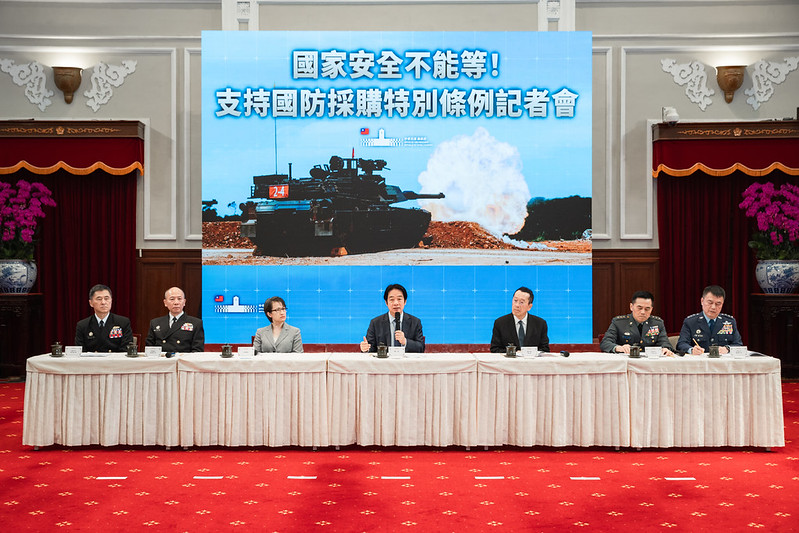
Image: Taiwan President Lai Ching-te (center), Vice President Hsiao Bi-khim (center left), and Defense Minister Koo Li-hsiung (center right), and senior officers of the armed forces at a press conference to promote the special defense budget (February 11, 2026). (Image source: ROC Presidential Office)
The Contents of the Supplemental Defense Budget
Per the Executive Yuan, the budget is intended to respond to “the menace of combined ‘gray zone and military’ methods” (「灰帶併軍事」之複合式威脅手段) by the People’s Republic of China (PRC): “[M]any countries realize that traditional war-fighting concepts and armaments cannot address such conflicts,” and “asymmetric capabilities must be the main focus” (不對稱戰力為主軸) of Taiwan’s defense posture. The special budget does indeed appear to represent a shift away from past purchases of force-on-force, conventional platforms—such as F-16 fighter aircraft, and Abrams tanks—and towards more asymmetric systems.
The intended purchases of the special budget are divided broadly into seven categories, as shown below.
Major Components of Taiwan’s Supplementary Special Defense Budget | |
Program Categories | Major Weapons Systems / Equipment |
Category 1: Precision Munitions (精準火砲) | · M109A7 Paladin self-propelled howitzers (60 units) · Precision ordnance (4080 units) · Ordnance vehicles (60 units) · Support vehicles (13 units) · High explosive ammunition and associated equipment |
Category 2: Long-Range Precision Strike Missiles (遠程精準打擊飛彈)
| · M142 High Mobility Artillery Rocket System (HIMARS) (82 units) · Precision rockets (1203 units) · Tactical-range missiles (420 units) |
Category 3: Unmanned Vehicles and Countermeasures Systems (無人載具及反制系統)
| · Anti-armor UAV missile systems o ALTIUS-700M (loitering anti-armor system) (1554 units) o ALTIUS-600ISR system (loitering reconnaissance system) (478 units) · Coastal reconnaissance and coastal attack UAVs of various types: approx. 200,000 units, and 1,000 unmanned boats · Various UAV counter-measures systems |
Category 4: Anti-Air, Anti-Missile, and Anti-Armor Missile Systems (防空、反彈道及反裝甲飛彈) | · Javelin anti-armor missiles (70 systems, 1050 missiles) · TOW-2B anti-armor missiles (24 systems, 1545 missiles) · Various anti-air missile systems |
Category 5: Artificial Intelligence-Assisted C5ISR (AI輔助與C5ISR) | · AI decision-making support systems · Tactical networks and unit-level information sharing systems |
Category 6: Equipment Related to Strengthening Operations Continuity Capacity (強化作戰持續量能相關裝備)
| · “Expanding military production lines to respond to high rates of wartime consumption”: increasing production capacities for ammunition, missile propellants, small arms ammunition, “new model armored vehicles” (note: not defined), high explosives, chemical protective masks, night vision goggles, etc. · “Mobile blocking equipment” (機動阻絕器材) intended “to enhance battlefield blocking capabilities.”* · Increasing stockpiles of required ammunition, including: 120mm tank ammunition, 105mm tank ammunition, 30mm artillery ammunition, 155mm grenade propellant charges, and high-energy explosives. |
Category 7: Equipment and Systems from US-Taiwan Joint Development and Sales Cooperation (台美共同研發及採購合作之裝備, 系統) | · “Acquiring new technology systems, to strengthen operations resilience and promoting asymmetric combat capability.”
|
* Author’s note: “Mobile blocking equipment” (機動阻絕器材) is not further defined, but could refer to tactical obstacle equipment for coastal areas, and/or tactical beach/shallow water mining equipment. | |
Source: Adapted / translated by the author, from Taiwan’s Central News Agency (Jan. 19, 2026). | |
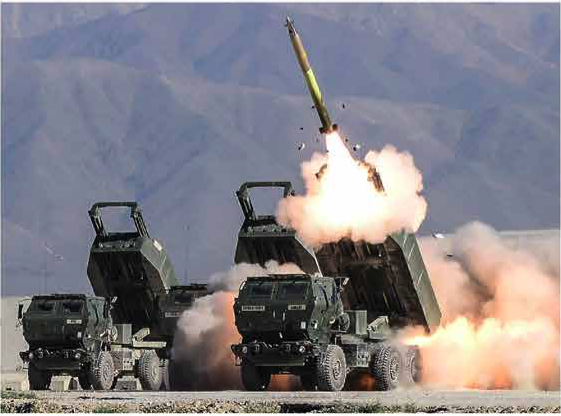
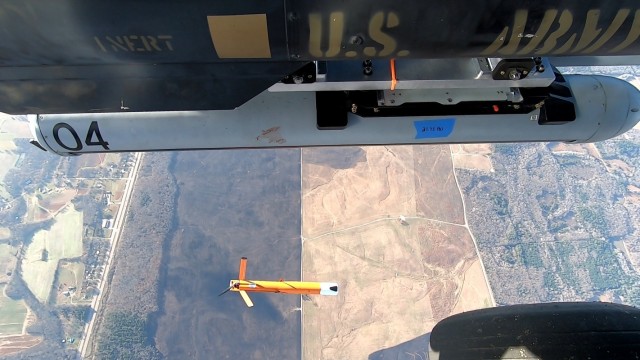
Image top: An undated file photo of an M142 HIMARS system (Source: US Army). / Image bottom: A test launch of an ALTIUS 700 drone from a Black Hawk helicopter at Fort Campbell, Kentucky (Dec. 2023) (Source: US Army). The HIMARS long-range rocket system and ALTIUS drones are included among the major arms purchases proposed in the 8-year supplemental defense budget.
The list of intended equipment purchases in the first four categories are particularly noteworthy for the capabilities that would be offered (or amplified), in three fundamental respects:
- The longer-range strike capabilities provided to the ROC Army in the form of the M109A7 Paladin howitzers (range: 24 km with standard munitions, 30 km with rocket-assisted munitions) and M142 HIMARS (range: 32km to 128km, depending on ammunition type)—which could be directed against hostile naval forces, hostile landing forces, and potential amphibious staging areas (using longer-range HIMARS munitions).
- The multiple variants of ALTIUS unmanned aerial vehicle (UAV) systems, with capabilities in both anti-armor and possibly anti-ship roles, as well as for tactical reconnaissance. The additional coastal surveillance and attack unmanned systems are not specifically identified, but would significantly benefit reconnaissance and counter-landing capabilities.
- The FGM-148 Javelin and TOW-2B anti-armor tactical missiles would not represent a new capability for Taiwan, but the intended purchases would dramatically increase the inventories of systems that have proven their value in destroying Russian armored vehicles throughout the war in Ukraine.
The specific contents of categories #5-#7 are more difficult to assess, as the publicly-released information about budget provides far fewer specifics about the systems to be acquired in these categories. However, military upgrades in C5ISR systems (command, control, communications, computers, and cyber; and intelligence, surveillance, and reconnaissance) would seem sensible, given the need more faster and accurate targeting information and multi-unit coordination in a chaotic modern battlefield environment. The sixth category, geared towards increasing stockpiles of ammunition and other basic equipment, is not as flashy as the other categories—but would be essential for ensuring adequate supplies in a high-consumption combat environment.
The seventh and last category is the most vague—but could refer, at least in part, to evolving US-Taiwan programs for cooperation in UAV development. It has also been widely reported in press outlets that the budget is intended partially to fund research and development of a “Taiwan Dome” missile defense system (modeled on the “Iron Dome” defense system employed by Israel). President Lai seemed to suggest as much in November: stating, within the context of the budget, his support for a “T-Dome” defense system. [1] Lin Fei-fan (林飛帆), deputy secretary-general of Taiwan’s National Security Council, reiterated this linkage in a March article in which he described “a landmark $40 billion special budget dedicated to the development of the ‘T-Dome’ – a multi-layered, AI-integrated air defense shield – and other asymmetric capabilities” intended to boost Taiwan’s defense posture.
If the budget is intended to support an anti-missile defense system, it is not clearly indicated within the 7 identified budget categories – but might possibly be included within the vaguely-worded, catch-all final category. However, this is speculative, and the specifics of potential “T-Dome” funding are currently unclear.
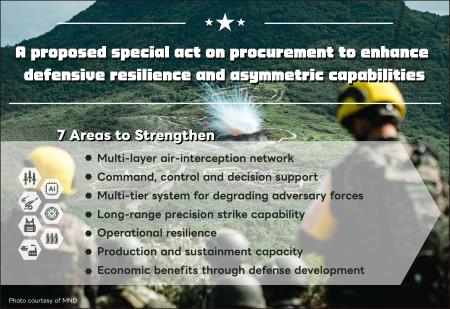
Image: A Taiwan government graphic produced to promote passage of the special supplemental defense budget. (Image source: Executive Yuan / ROC Ministry of Defense)
The Political Controversies Surrounding the Special Budget
The Political Impasse in Taipei
Taiwan’s January 2024 elections produced a divided government: with President Lai Ching-te (賴清德) of the Democratic Progressive Party (民主進步黨) controlling the executive branch; and a joint opposition caucus of the Kuomintang (國民黨) and Taiwan’s People’s Party (台灣民眾黨) holding the majority of seats in Taiwan’s legislature, the Legislative Yuan (立法院, LY). Accordingly, budget measures proposed by the Executive Yuan have often faced an uphill climb in the legislature—including the proposed special budget, which has been blocked repeatedly in the LY. (As of the publication of this article, the budget has yet to pass.)
The administration of President Lai is investing significant political capital in promoting the budget initiative: both domestically through public events in Taiwan, and internationally via measures such as a November 25 op-ed in the Washington Post. In a speech delivered on February 11, Lai stated that:
I want to emphasize that political parties can compete, and policies can be fully debated so that citizens can make their choice; but in matters of national defense – which are vital to our national security, sovereignty, and basic survival – there must be unity and solidarity against external threats. […] But now, because the budget has not been passed, in addition to Taiwan possibly losing its place on priority lists, and the delivery of critical weapons and equipment being delayed, the international community may question Taiwan’s determination to defend itself.
Opposition legislators have demanded that President Lai appear personally in the LY to answer questions about the budget. In conversations held by the author in late 2025 with KMT-affiliated persons, these interlocutors complained that the Executive Yuan proposal did not offer enough specific information about the proposed purchases or their intended usage, and that the budget ran the risk of producing wasteful spending. Conversely, persons affiliated with the DPP complained that KMT tactics were blindly obstructive, without either meaningful dialogue or constructive efforts to ensure efficient spending; and that blocking the budget was damaging both Taiwan’s national security and its international image among its allies. [2]
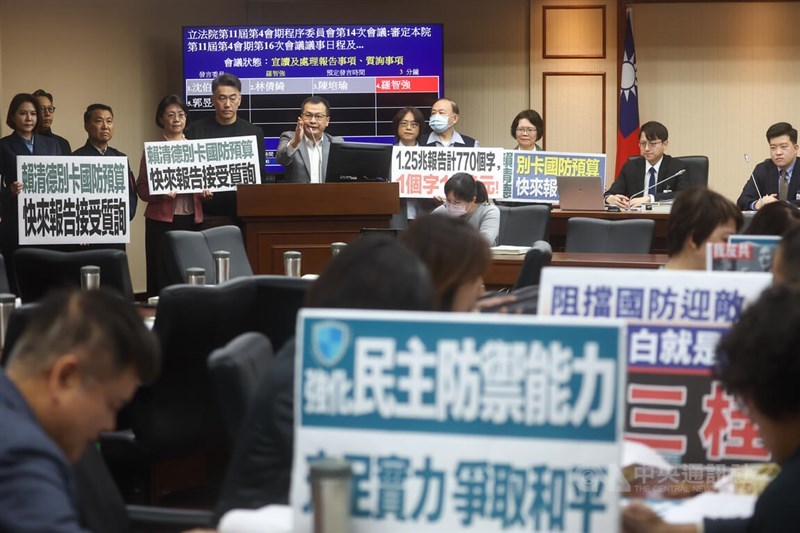
Image: Opposition legislators (background, around the podium) and DPP legislators (foreground, seated) hold up rival signs opposing and supporting the special defense budget, during a meeting in the Legislative Yuan (Dec. 30, 2025). (Image source: Central News Agency)
Since the beginning of this year, the opposition parties have put forth competing supplemental budgets of much more limited scope. In late January, the LY passed a TPP-proposed plan of $400 billion NT (less than a third of the administration’s proposed budget), which would include funding for 5 out of the 8 systems listed in a series of approved US arms sales to Taiwan announced in mid-December. [3] [4] In early March, the KMT legislative caucus announced it would be setting forth a proposed budget of $350 billion NT, intended to cover the costs of the announced December arms sales (see here and here)
On March 5, the Ministry of National Defense (國防部, MND) took the unusual step of speaking out on these political controversies, by issuing a response to the proposed KMT special budget. The MND statement criticized the KMT plan on grounds that 3 of the 8 US arms sales announced in December were in fact already covered under the regular defense budget. The statement also criticized a piecemeal approach to arms purchases, stating that it could harm Taiwan’s ability to “obtain priority in production lines, which would be detrimental to the rapid construction of combat capabilities.” The statement appealed for legislative support, asserting that “the relevant plan has [already] undergone more than two years of internal assessment and research, and has completed operational requirements analysis based on enemy threats.”
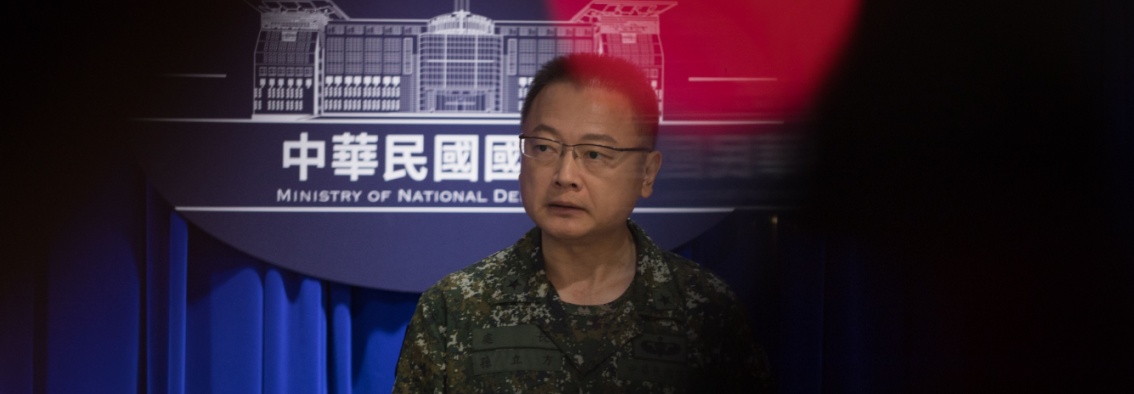
As of March 23, the LY had resumed debate on the special budget, with Defense Minister Koo Li-hsiung (顧立雄) appearing before the legislature to speak in favor of the budget, and to answer legislators’ questions. As of the publication of this article, the prospects for passage of the special budget remain unclear.
The Political Back-and-Forth in Washington
The stalling of the defense bill has also attracted negative attention in Washington DC, where many commentators have long been critical of Taipei’s alleged lack of urgency regarding increases to defense spending. In November, U.S. Senator Roger Wicker (R-Miss.) released a statement praising the proposed special budget, in which he “encourage[d] our colleagues in Taiwan’s parliament to work with the Lai Administration on a bipartisan basis to swiftly enact this special budget into law.” In early February, Wicker made a social media post stating that “I’m disappointed to see Taiwan’s opposition parties in parliament slash President Lai’s defense budget so dramatically […] Taiwan’s parliament should reconsider.” At the same time, Senator Dan Sullivan (R-Alaska) posted that: “Taiwan’s legislature adjourned last week without passing the budget necessary for Taiwan to defend itself. Meantime, the leadership of the opposition party responsible for this, the KMT, is in Beijing meeting with the [Chinese Communist Party] […] short-changing Taiwan’s defense to kowtow to the CCP is playing with fire.”
The debates over the special budget have been further complicated by actions by the US executive branch. Although no official announcement has been made, press reporting in late February indicated that the Trump Administration had placed a pause on approval of arms sales—including an additional major package of sales valued at USD $13 billion—pending the Trump-Xi summit originally planned to take place in Beijing from March 31 – April 1. (In mid-March, the summit was reportedly postponed due to the ongoing U.S.-Israel-Iran conflict in the Middle East.) At the same time, the Defense Security Cooperation Agency (DSCA), the Pentagon agency that has traditionally managed arms sales, made an posting on its website that future announcements of arms sales would be handled by the State Department—thereby suggesting a tighter linkage of arms sales with diplomatic initiatives by the administration.
Conclusions
The military special budget proposed by Taiwan’s presidential administration in November is significant for the substantial increase it would represent in Taiwan’s overall defense spending. But arguably of even greater importance, it would represent a decisive shift in the direction of applying resources towards more asymmetric defensive capabilities—such as precision artillery platforms, and unmanned systems—that could make life difficult for an amphibious invasion force. On both counts, these acquisitions would go a long way towards answering persistent American criticisms (including from this author) regarding Taiwan’s defense posture.
However, political uncertainties on both sides of the Pacific have put the prospects for the supplemental budget in doubt. Unlike the last go-round for a major supplemental defense budget in 2021 (when the DPP held unified control over Taiwan’s central government), this far larger budget (more than 4.5 times the size of its predecessor) has faced gridlock in the face of determined legislative opposition. With the Legislative Yuan grappling with the special budget once again this spring, there is a better-than-even chance that the budget will eventually pass—although perhaps in a scaled-back form.
There is equal uncertainty, however, in the policies emerging from the United States—which, due to sustained Chinese diplomatic pressure, is the only major arms manufacturing country willing to sell systems to Taiwan. The apparent decision in late February to pause arms sales—presumably pending the outcome of a Trump-Xi summit sometime in 2026—would represent a major step back from the greater bureaucratic regularity of arms sales seen during the first Trump and Biden Administrations. If such a practice holds, this would hearken back instead to the start-stop pace of US-Taiwan arms sales in earlier decades—when such matters were decided within the context of Washington-Beijing relations, rather than on the basis of Taiwan’s most pressing defense needs.
These issues may become clearer once the presumed Trump-Xi summit is passed, and the contending caucuses in Taiwan’s legislature have had more time to wrangle over the specifics of the budget. But for the time being, the prospects for the supplemental defense budget remain in doubt.
The main point: In November, Taiwan’s executive branch proposed a major (USD $40 billion) supplemental defense budget, focused largely on acquiring unmanned systems and other “asymmetric” capabilities from the United States. The proposed budget currently remains on hold in the opposition-controlled legislature. Additional uncertainties have also been raised by apparent U.S. policy shifts regarding foreign arms sales. The ultimate prospects for passage of the budget may become clearer later this spring, following the Trump-Xi summit and further deliberations in Taiwan’s legislature.
[1] In a November 25 Washington Post op-ed, President Lai stated that: “I am accelerating the development of ‘T-Dome,’ a multilayered, integrated defense system designed to protect Taiwan from PLA missiles, rockets, drones, and combat aircraft. Together with other AI-driven and unmanned platforms, these capabilities bring us closer to the vision of an unassailable Taiwan, safeguarded by innovation and technology.”
[2] Meetings conducted by the author in Taipei, December 2025. Specific participants have been left unnamed in order to protect confidentiality. The reasons for KMT opposition to proposed DPP defense spending bills are too complex to address in detail in this article, but run a spectrum: from genuine concerns about wasteful spending (at the most respectable end); to polarized partisanship; to a belief that cross-Strait peace would be better secured by engagement with Beijing; to, in some cases, direct CCP influence on particular KMT members (at the most sinister end). There are conscientious members of the KMT who agree with the need to increase defense spending, but disagree with the DPP-led administration on particular priorities. Addressing such complexities would require a lengthy article in its own right.
[3] The TPP’s January proposal offered funding for 60 M109A7 howitzers and accompanying munitions; 82 HIMARS systems; ALTIUS anti-armor loitering UAVs; 70 Javelin anti-armor missile launchers and 1,050 missiles; and 24 TOW 2B anti-armor missile launchers and 1,545 missiles. (See: “Legislature Snubs Cabinet, Advances TPP’s Special Defense Budget Bill,” CNA (Jan. 30, 2026), https://focustaiwan.tw/politics/202601300011.)
[4] The U.S. Defense Security Cooperation Agency (DSCA), a Pentagon agency, announced a large package of 8 different arms sales to Taiwan on December 17, 2025, valued at approximately US $11 billion. The specifics of the sales are available at these URLS: