
US-Taiwan Task Force (2022-2023)
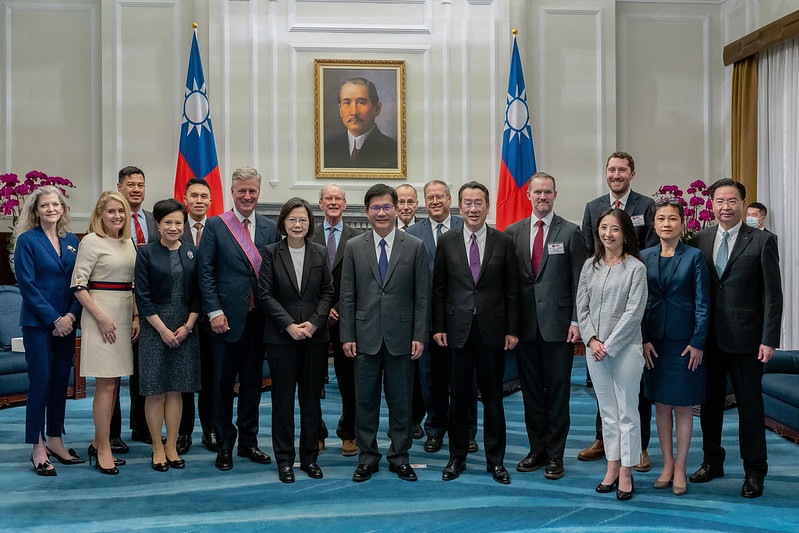
In 2022, GTI assembled an expert Task Force on US-Taiwan relations, chaired by Ambassador Robert C. O’Brien (ret.), with the goal of evaluating the current state of the relationship and providing recommendations for strengthening it. The bipartisan Task Force includes a diverse range of policy experts and practitioners, hailing from the government, private businesses, and academia. Together, its members possess a wealth of experience on Taiwan, China, and the broader Indo-Pacific region. Each member participated in a personal capacity; their views do not represent or necessarily reflect the views of their respective organizations and affiliations.
This report is the product of more than a year of discussions and briefings, during which participants engaged on a range of issues, including Taiwan’s diplomatic status, role in the global economy, military capabilities, and efforts to combat Chinese coercive measures, among others. The report was also informed by a task force delegation visit to Taiwan, which featured top-level meetings with Taiwanese government officials, military leaders, business figures, academics, and civil society groups. These meetings provided invaluable insights into Taiwan’s economic, political, and security priorities, as well as key areas in which the US-Taiwan relationship could be bolstered.
Executive Summary:
The objective of this report is to identify and submit specific recommendations for areas in which the United States and Taiwan can cooperate bilaterally, improve cultural and economic ties, and preserve regional security. The report divides these research areas and subsequent recommendations into the following categories: Diplomatic and Political, Defense and Security, and Trade and Economics.
Upon comprehensively evaluating these aspects of the US-Taiwan relationship, the task force found that:
Diplomatic and Political:
- The United States should continue to expand contacts between US and Taiwanese officials.
- The United States should continue to expand its efforts to include Taiwan in international organizations and public-private sector initiatives.
- The United States and Taiwan should work to expand the Global Cooperation and Training Framework, both in membership and in frequency of its workshops.
- The United States should work to facilitate academic-industry partnerships between universities and high-tech companies, and their Taiwanese counterparts.
- The United States and Taiwan should work to pinpoint overlaps between the US Indo-Pacific Strategy and the Taiwanese New Southbound Policy.
Military and Security:
- The United States should continue to streamline and simplify the Foreign Military Sales (FMS) process.
- The United States should work to reinvigorate its military-industrial infrastructure.
- The United States should greatly expand its combined training operations with Taiwan.
- The United States should provide Taiwan with a larger variety of modern weapons and platforms, with a particular focus on more affordable, flexible armaments.
- The United States and Taiwan should collaborate to develop a defense strategy suited to the precision strike era and Taiwan’s operational challenges.
- Taiwan should partner with a private-sector driven, US-based institution to accelerate the innovation and commercialization of dual-use technologies.
- The United States should work with allies and partners to ensure that Taiwan has the supplies necessary to maintain a strong and vital democracy.
Trade and Economics:
- The United States and Taiwan should take substantive steps to liberalize their trade ties in a targeted manner.
- The United States should negotiate a double taxation agreement with Taiwan, which is already making headway in Congress.
- The United States and Taiwan should develop stronger, more substantive mechanisms to engage on semiconductors and supply chain security.
- The United States should advocate for Taiwan’s inclusion in regional multilateral economic groupings.
- The United States and Taiwan governments should work to foster expanded private sector connections between US and Taiwanese companies.
Task Force Members:
- Robert C. O’Brien, Task Force Chair, Former US National Security Advisor
- Allison Hooker, Task Force Vice Chair, Former Deputy Assistant to the President and National Security Council Senior Director for Asian Affairs
- Carolyn Bartholomew, Commissioner, US-China Economic Security Review Commission
- Lanhee Chen, David and Diane Steffy Fellow in American Public Policy Studies, Hoover Institution
- Shihoko Goto, Director for Geoeconomics and Indo-Pacific Enterprise and Deputy Director for the Asia Program, the Wilson Center
- Jerrold Green, President & Chief Executive Officer, Pacific Council on International Policy
- Jamieson Greer, Former Chief of Staff, Office of the U.S. Trade Representative
- Wallace (Chip) Gregson, Lt. Gen. USMC (ret.)
- Jennifer Hu, Chair of the Board of Directors, Global Taiwan Institute
- Ivan Kanapathy, Former National Security Council Deputy Senior Director for Asian Affairs
- Keith Krach, Former Under Secretary of State and Chairman & Co-Founder, Krach Institute for Tech Diplomacy at Purdue University
- Derek Mitchell, Former Acting Assistant Secretary of Defense for Asia Pacific Security Affairs
- Kurt Tong, Managing Partner, The Asia Group
- Stephen Young, Ambassador (ret.)