
Taiwan’s latest diplomatic push in the Pacific has come with developments in maritime infrastructure. Between 2024 and 2025, Taiwan pushed the number of high-voltage shore power systems at its ports to 11, relaunched a solar-powered research yacht for Palau, and helped finance Tuvalu’s first international submarine internet cable. These initiatives underscore a deliberate strategy: Taipei is leveraging green-technology projects and sustainable infrastructure as diplomatic levers. By exporting port-based renewables and connectivity, Taiwan hopes to cement ties with allied nations—at a time when climate change and economic development are urgent challenges among the Pacific island states.
Taiwan’s Domestic Green-Port Capacities
Taiwan has been building up its own ports as green-energy hubs. The state-run Taiwan International Ports Corporation (TIPC, 台灣港務股份有限公司) launched a Green Port Incentive Program to reward “clean vessels” and shore power usage. Under this program, ships berthing at Taiwan’s commercial ports are encouraged to plug into shore power instead of running diesel generators. By the end of 2024, 11 high-voltage shore-power systems were operational across TIPC ports—a tangible metric of Taiwan’s domestic readiness. Such systems can slash at-berth ship emissions by up to 98 percent, according to the US Environmental Protection Agency.
Concurrently, Taiwan is repurposing the Anping Port in Tainan for its offshore wind industry. Under Taipei’s net-zero plan, four wharves at Anping Port (wharves number 10, 11, 17 and 18) have been leased to offshore wind companies for storing and handling turbine components. Wharves 10 and 11, for example, were upgraded to handle heavy blades and towers. All four wharves are now engaged in the wind sector—a project that helped Anping Port’s cargo volume jump 556 percent in early 2024 as wind shipments poured in. Anping Port is even home to Taiwan’s new domestic wind-turbine installation vessel, the Green Jade. These moves mean that Taiwan’s ports not only reduce emissions (via shore power) but also serve as bases for the clean-energy industry. TIPC also reported that it had leased nearly 463 hectares of port land to green-energy firms by 2024, and had saved roughly 1,116 metric tons in CO₂ emissions annually through its own solar installations (in addition to 56,000 tons saved for port tenants). These figures underscore the scale of TIPC’s renewable commitments.
Case 1: Palau – Solar Power, Eco-Tourism, and Green Shipping
Taiwan’s eco-diplomacy in Palau has focused on renewable energy and green transport. In September 2024, the TaiwanICDF (the nation’s development fund) completed a solar photovoltaic system at Palau’s National Aquaculture Center. At the inauguration, Taiwanese experts demonstrated the panels to 30 Palauan students and teachers, instructing them in how renewables can power aquaculture and cut carbon emissions. This hands-on training reflects Taiwan’s emphasis on capacity building, in which youth are explicitly involved in green tech and climate education.
Building on this, Taiwan and Palau signed a memorandum of understanding in February 2025 to introduce colored solar panels that double as advertising displays. The first such panel—a photovoltaic unit coated with a decorative layer—was slated for installation by the third quarter of 2025. Palauan officials note these panels will both generate power and showcase cultural images or advertisements, blending sustainability with tourism appeal. Taiwan’s energy official praised the move as a “new chapter of energy transformation” in Palau, highlighting bilateral friendship and innovation.
Taiwan has also innovated in green shipping for Palau’s tourism. In May 2025, Kaohsiung officials relaunched the Porrima P111, a zero-emissions yacht powered by wind, solar, and hydrogen energy. Acer founder Stan Shih (施振榮), who is now a senior economic advisor to Palau, said the zero-emissions yacht will soon ferry high-end tourists in Palauan waters. Palau’s president and Taiwan dignitaries attended the launch, signaling that this project is part of Taiwan’s Diplomatic Allies Prosperity Project to boost the economies of partner nations. The Porrima P111 thus serves dual purposes: it exemplifies Taiwanese tech prowess and provides eco-tourism infrastructure for Palau.
Beyond these projects, Taiwan has offered financial backing for Palau’s climate resilience. In February 2023, Taipei disbursed a USD 1 million grant to fund Palau’s “Climate Change and Disaster Risk Reduction Project.” This grant, drawn from Taiwan’s “Adaptation and Contingency Fund for Climate Change,” financed seawalls, rainwater tanks and firefighting equipment in vulnerable communities. Palauan officials publicly praised Taiwan’s quick support as a model for regional cooperation. In March 2025, Palau’s president thanked Taiwan for its continued partnership on clean energy and sustainable development, reflecting how these green initiatives translate into diplomatic goodwill.
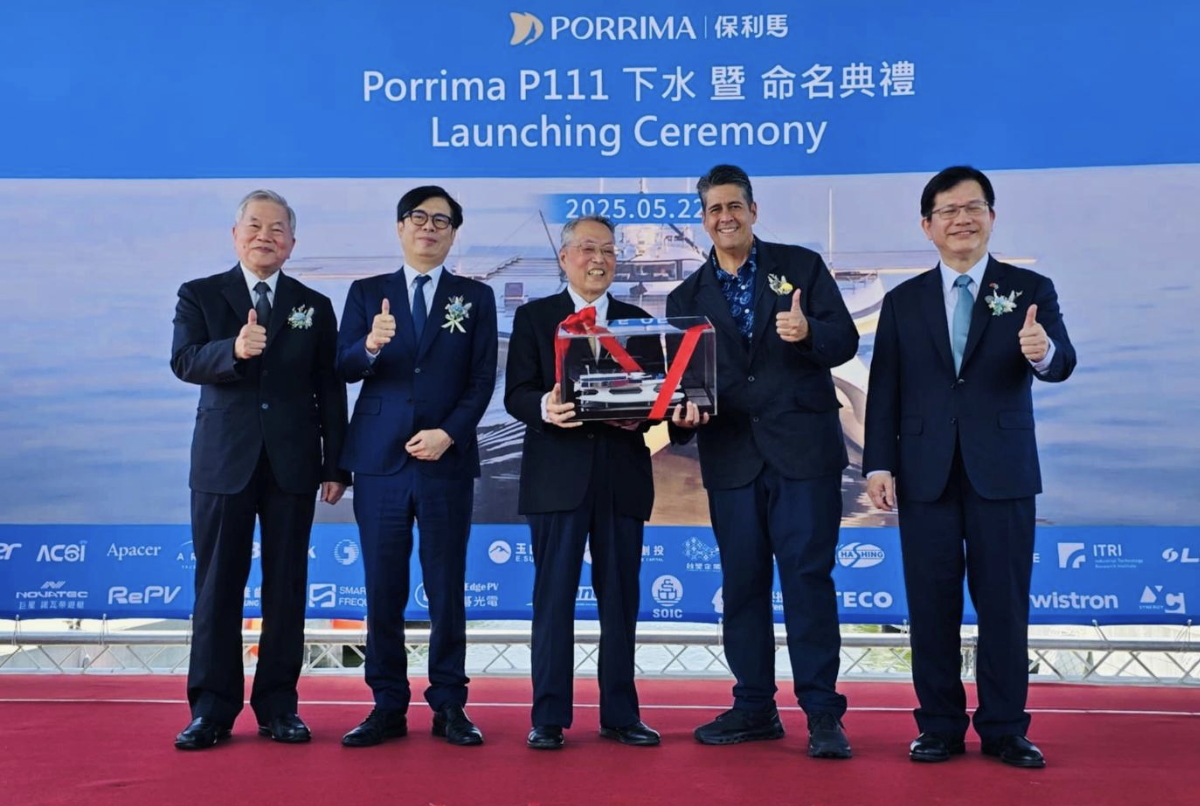
Image: Palau President Surangel S. Whipps, Jr. (second from right), ROC Foreign Minister Lin Chia-lung (right), and other Taiwanese officials at the launch ceremony in Tainan for the Porrima P111 green energy ship donated to Palau (May 22, 2025). (Image source: President of Palau Facebook Page)
Case 2: Tuvalu – Connectivity, Clean Energy, and Climate Resilience
Taiwanese green diplomacy in Tuvalu has a digital and climate focus. A major breakthrough was Tuvalu’s Vaka submarine cable, launched in October 2023. This USD 56 million international subsea cable—backed by Australia, Japan, New Zealand, Taiwan and the United States (with Google serving as a technical partner)—is Tuvalu’s first direct global internet link. By connecting Funafuti to high-speed fiber, the Vaka cable promises faster, cheaper internet across all islands—thereby boosting education, healthcare and commerce. Tuvalu’s communications minister celebrated the cable as more than just infrastructure, stating that it lays “the foundation for our transformation into a digital nation.” Taiwan’s role in this project highlights how it leverages international partnerships (here, with like-minded donors) to provide tangible benefits to a diplomatic ally.
On the climate front, Taiwan co-led a Global Cooperation and Training Framework (GCTF) climate workshop in Tuvalu in August 2024. Hosted by Taiwan’s embassy and the Tuvalu government (in collaboration with the United States, Australia and Japan), the “Building Climate Change Resilience” workshop drew around 60 participants—including government officials, scholars, and NGO representatives from Tuvalu and regional neighbors. Sessions focused on adaptation strategies for small islands, and delegates toured key sites. Destinations included the ongoing Tuvalu Coastal Adaptation Project (TCAP)—a UN-backed initiative to raise islands and protect coasts—and a new floating solar power installation. Taiwan’s experts and visiting officials saw firsthand how solar farms and improved infrastructure address Tuvalu’s flood and power challenges. This hands-on exchange under the GCTF underscores Taiwan’s approach of linking its technical expertise with local projects.
In terms of funding and policy, Taiwan has also begun to tie down longer-term support for Tuvalu’s climate needs. Taiwan is a partner in the TCAP and works closely with Tuvalu on coastal protection. Moreover, at the first Pacific Climate Change Forum in Taipei in July 2023, Taiwan announced plans to establish a Just Transition Fund with its Pacific allies—explicitly including Tuvalu—to finance climate adaptation in island nations. This gesture follows Taiwan’s prior adaptation funding (e.g. the Palau grant) and signals Taipei’s intent to contribute to multilateral climate solutions for its friends.
In short, Taiwan’s engagement with Tuvalu spans infrastructure, renewable power, and governance, all tailored to Tuvalu’s unique vulnerabilities. Such cooperation aligns with Tuvalu’s partnership frameworks like the Australia–Tuvalu Falepili Union, which also emphasize collective climate action.
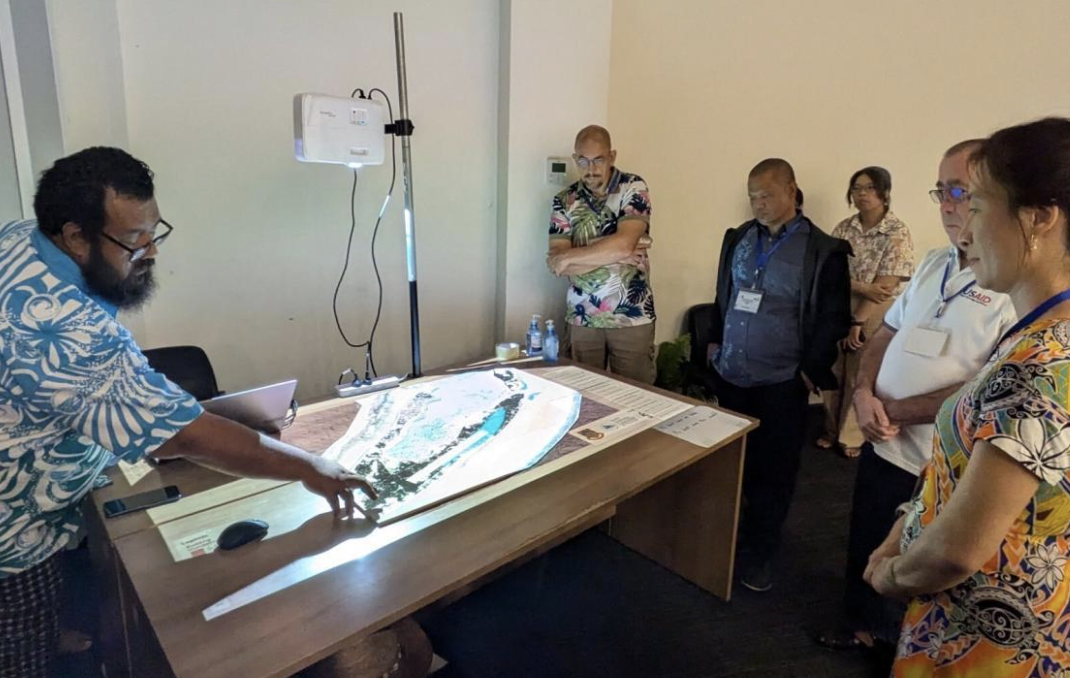
Image: Participants in the August 15-16, 2024 “Building Climate Change Resilience in Small Island States” workshop in Funafuti, Tuvalu, co-sponsored by Taiwan’s embassy and convened under the Global Cooperation and Training (GCTF) Framework. (Image source: GCTF)
China’s Pacific Strategy: Scale and Contrast
For context, China’s role in the Pacific is characterized by projects and funding instruments far larger in scale. According to Lowy Institute data analyzed by Denghua Zhang, China invested around USD 1.05 billion in Pacific Island countries between 2011–2016—nearly four times Taiwan’s aid volume of USD 271 million during the same period. Beijing typically channels funds through state loans and Belt and Road Initiative deals, financing mega-infrastructure (highways, ports, stadiums) and extractive ventures. In one expensive project, China funded a USD 46 million university dormitory in Papua New Guinea. China’s influence often comes via large construction contracts and trade ties. Meanwhile, Taiwan seeks to win favor through expertise and grants.
Importantly, Palau and Tuvalu are not part of China’s Belt and Road Initiative. Unlike some neighbors that received Chinese-built bridges or hydropower dams, these diplomatic allies of Taiwan have largely avoided Chinese mega-projects. Taiwan has sought to fill the void. Even so, the disparity in scale is stark. Chinese funders can offer hundreds of millions of dollars per project, whereas Taiwan’s annual aid to the Pacific historically averages in the tens of millions (though it dipped to USD 7.2 million in 2022), according to the Lowy Institute Pacific Aid Map. Taiwan does not pretend to compete on raw spending. Instead, it emphasizes normative leadership on issues like climate and health. In policy terms, this means Taiwan should measure its success by different yardsticks: not how many miles of highway it builds, but by how many tons of carbon emissions it averts or the number of lives it protects.
Impact and Lessons for Policy
Even though data points are still emerging, the effectiveness of Taiwan’s green-port diplomacy can be gauged by concrete outputs and outcomes. Domestically, Taiwan can cite precise metrics, such as “11 shore-power berths installed by 2024,” plus hundreds of megawatts of offshore-wind capacity planned around its ports under the Ministry of Economic Affairs’ (經濟部) national targets. TIPC also tracks land leased to renewables projects (462.7 hectares by 2024) and CO₂ reductions from solar (over 57,000 tons of CO₂ saved by all PV projects). These numbers demonstrate Taiwan’s own green transition, a credibility that it can then project abroad. In Palau and Tuvalu, metrics might include the number of solar systems deployed, local technicians trained, or emissions avoided. For instance, the Palau aquaculture solar array directly reduces diesel use on the island, and the 30 students trained there is a small-scale but measurable outcome. Taiwan International Windpower Training Co. Ltd. (TIWTC, 台灣風能訓練股份有限公司), a Taichung-based training provider in renewables development, has issued around 3,900 offshore wind certificates (TIPC 2024)—and with AmCham Taiwan reporting that around 30 percent of trainees are foreign workers, the center is effectively building a regional talent pool.
These outputs translate into soft-power gains. In Palau, government statements have praised Taiwan’s “invaluable support” in clean energy. Each completed solar project or eco-yacht launch has a positive effect on Taiwan’s image. But Taiwan must guard against viewing projects as ends in and of themselves. To make these projects truly effective soft power tools, Taiwan should monitor usage and benefits, such as how much port pollution is cut by shore power or how internet speeds changed after the installation of the undersea cable in Tuvalu. For example, TIPC could report the annual tonnage of emissions avoided by its 11 shore-power systems. It could tabulate how many Tuvaluan households use solar, or how many Palauans ride new electric buses. These metrics can be cited in diplomatic reports and media to reinforce Taiwan’s regional contributions.
At the same time, Taiwan must be candid about its limitations. Its funding for Palau and Tuvalu is still in the low millions of USD, which restricts scale. It cannot outcompete China on flashy infrastructure or loans. Moreover, Taiwan’s exclusion from bodies like the United Nations or Green Climate Fund means it needs creative workarounds. Hence, frameworks such as GCTF workshops are critical for Taiwan’s diplomacy. The value of Taiwan’s approach lies in niche diplomacy. Taiwan has positioned itself to promote responsible norms in foreign aid, introducing cutting-edge green technology and standards in fora where it has a seat. In practice, this means continuing to seek partnerships (as with the Vaka cable consortium) and co-funding (through TaiwanICDF and allied donors) for each project.
The main point: Taiwan is leveraging its domestic green-port expertise to support allies Palau and Tuvalu in renewable energy and connectivity. While Taiwan’s dollar contributions are dwarfed by China’s infrastructure loans, these eco-technology projects and training programs allow Taiwan to deliver practical benefits and win goodwill in niches where it has a comparative edge. By measuring impacts, Taiwan can make a tangible positive impact for its Pacific friends.