


Introduction
In early October this year, Netflix released The Resurrected (回魂計), a Taiwanese thriller set against the backdrop of Southeast Asian scam compounds. Since its release, the drama—which follows the story of two mothers whose desperation leads them to seek to resurrect their daughters’ trafficker to make them pay further for their misdeeds—has already captivated viewers both in Taiwan and abroad.
Coincidently, the topic of these scam compounds re-entered the global news cycle less than a week after the drama’s release. On October 13, the Korea Herald published a scathing editorial on the South Korean government’s response to the scam center crisis: stating that “Seoul’s task is not only to repatriate the dead, but to protect the living,” and insinuating that Korean authorities have so far failed in their responsibility to protect citizens. The associated uproar led to the mass repatriation of Korean nationals in Cambodia and reignited the debate as to whether or not those found in the compounds should be treated as victims or scammers.
Most recently however, it has been a Cambodian conglomerate called the Prince Group that has dominated headlines. Both the United States and the United Kingdom have recently imposed sanctions on the company and some of its executives on the basis of their involvement in the scam outfits.
Prince Group and its relationship to the compounds
In 2022, reports and testimonies on so-called scam compounds in Southeast Asia began making their way into international headlines. These compounds have since garnered a reputation for their brutality and violence, with workers often forced to work long hours running online scams under the threat of physical violence—regardless of whether they were trafficked into the compound or arrived willingly. Despite the various waves of media coverage this issue has received, these compounds are growing in number and have now spread beyond Southeast Asia. Similar compounds have been found, for example, in Africa and South America. As the industry expands, so does its reliance on human trafficking. Victims belonging to over 70 different nationalities have now been reported.
Among these victims are Taiwanese nationals. Due to the lack of international recognition of Taiwan, these victims face additional obstacles in trying to get home. Not only does this lack of recognition have an impact on how Taiwanese authorities are able to assist their victims, it also imposes a psychological effect on victims themselves—who may decide against going to the local authorities for assistance because of their perceived inability to support Taiwanese citizens. This situation is not aided by confusion within the Taiwanese government as to who is responsible for helping these victims—with the Ministry of Foreign Affairs (MOFA, 外交部) and National Police Agency (NPA, 警政署) both claiming that the other agency is responsible.
Clear from onset of this crisis, however, is the involvement of the Prince Group and its founder Chen Zhi (陈志). Since 2022, a number of media reports have connected the Prince Group to the scam compounds in Cambodia through other companies under the conglomerate’s umbrella, such as the Cambodian Heng Xin Estate Company and the Jin Bei Group. Just this year, NGOs, journalists, and think tanks have all warned of Prince Group’s involvement not just in Cambodia—but also further afield, in Palau.
This is not the first time the Prince Group has found itself in hot water. People’s Republic of China (PRC) law enforcement reportedly set up a task force in 2020 to investigate the source of the group’s funds. But China has also accused the United States of stealing bitcoin from Chen in 2020. In a 2024 interview with the Australian Broadcasting Company, a former member of the PRC’s Political Security Protection Bureau (國安局政治安全保衛局) explained how he was instructed to lure an exiled Chinese dissident to Cambodia by offering them a job opportunity within Prince Group’s real estate arm, so that they could ultimately be forced back to China.
The United States’ Department of the Treasury’s decision to sanction the Prince Group and designate the conglomerate as a transnational criminal organization combined with the Department of Justice’s recent unsealing of a federal indictment against Chen Zhi signals that this issue is beginning to be taken more seriously. Western sanctions have encouraged action in East Asia: with Korea now considering sanctions of its own, and Taiwanese authorities opening an investigation into the Prince Group’s Taiwan-based activities.
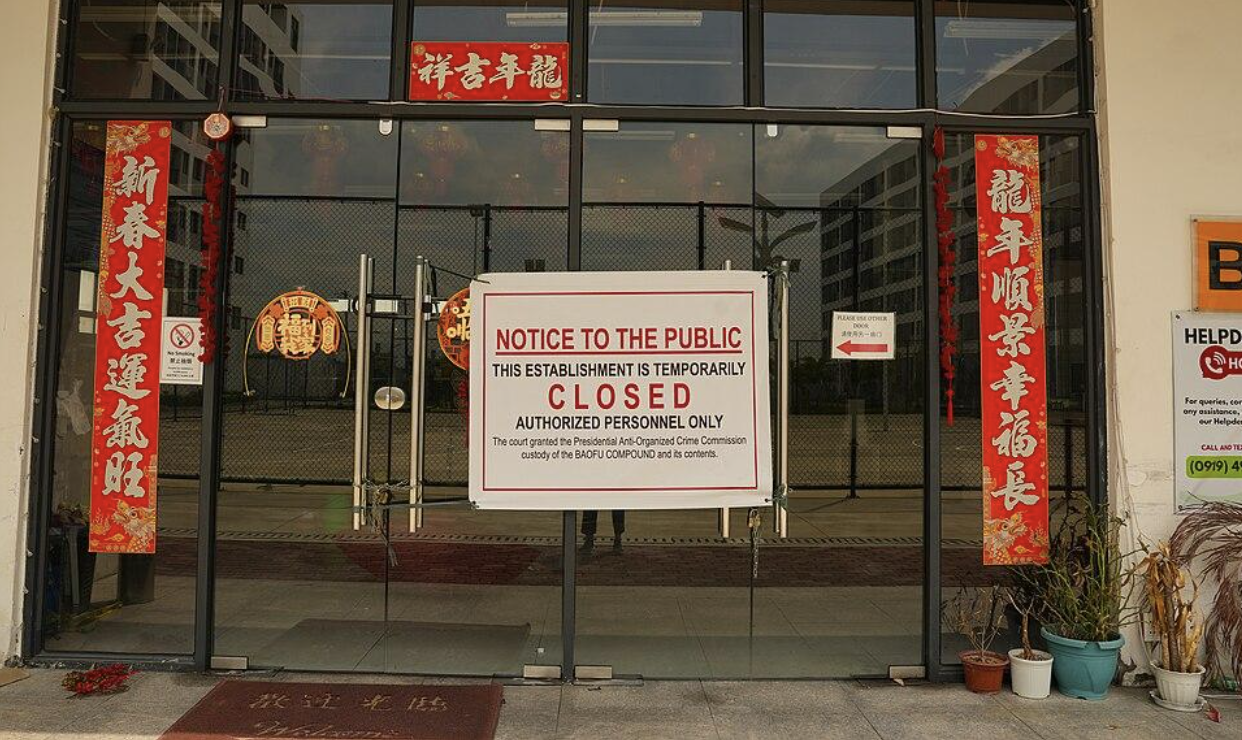
Image: A scam center in Bamban (northern Philippines) after it was raided by police (May 2024). Such scam centers, operated by organized crime figures and frequently involving human trafficking, have proliferated through parts of southeast Asia. (Source: Wikimedia Commons)
The Domino Effect of Enforcement
The scam industry in Cambodia may be “too big to fail,” with revenues allegedly accounting for the equivalent of 60 percent of the country’s GDP. Nonetheless, the US Treasury’s decision to classify Prince Group as a transnational criminal organization, along with coordinated US/UK sanctions targeting the group and its associates, have set off a domino effect of enforcement in Asia.
Unlike the UK’s sanctions announcement—which only named four companies as well as Chen Zhi—the US announcement contained an extended list of companies and individuals targeted by this latest wave of sanctions. This includes nine Taiwan based-companies as well as three Taiwanese nationals, who are believed to be connected to a Palau-based company controlled by Chen Zhi. The international network of sanctioned entities hints at the possible expansion of these compounds into other countries and regions of the globe.
Taiwan’s reaction to this announcement was immediate, with the Taipei District Prosecutors’ Office (臺北地方檢察署) standing up a dedicated task force involving various branches of law enforcement the very next day (October 15, 2025). This investigation uncovered two additional Taiwan-based companies linked to the Prince Group and led to a series of raids on November 4, in which 11 people were arrested and assets seized. These arrests were not the end of the story, however, as the low bail amount granted for one of those arrested—and a photo of another smiling at her bail hearing—created public outcry both in Taiwan and abroad.
However, none of the high-level executives of Prince Group reside in Taiwan. Therefore, those now facing legal enforcement in Taiwan are arguably dispensable and may simply be replaced by the organization in due time. As a result, it is difficult to foresee how effective Taiwan’s sanctions and police actions will be.
A Slow Start
For years, NGOs have been advocating for the sanctioning of those involved in the scam compounds. While a step in the right direction, and a sign that the international community is willing to finally face this issue, these recent sanctions appear to act more as a band-aid solution rather than as a cure.
A Human Research Consultancy report, published in May of this year, recommended the imposition of sanctions on 28 individuals for their alleged involvement in the compounds. As of November 10, 2025, only nine among them have been sanctioned by the US—and some of those nine were sanctioned prior to their involvement in the compounds coming to light (see here and here). Such is the case of Try Pheap, a Cambodian tycoon who owns a special economic zone in which a major scam compound is located, and who was sanctioned by the United States in 2019 for environmental destruction and large-scale corruption. While a group of US legislators have introduced the Dismantle Foreign Scam Syndicates Act (which would sanction 27 of the 28 recommended in the May report as well as others), the bill is yet to pass.
Sadly, as time passes, the number of those trafficked to staff the compounds continues to grow, meaning that the longer it takes for this crisis to be taken seriously, the more victims will be snared. If past crackdowns have taught us anything, it is that scam compounds facing crackdowns will simply re-locate or lay low for a while before re-emerging exactly where they were before. Attention therefore also needs to be paid to the environment that allows this industry to thrive, and how it could potentially be disrupted. Scam compounds, while similar in their “business model,” are usually independent from one another. Consequently, bringing down the Prince Group is far from enough to shut down the industry as a whole.
There are a number of other reasons why this issue so hard to tackle. The most cited of these reasons is the corruption and complicity of the government in Cambodia. Anti-trafficking investigations suffer from unreliable funding, rendering local law enforcement susceptible to corruption. Meanwhile, many of the businessmen with known connections to the compounds also have strong relationships with the Cambodian political elite. For example, one compound director was the subject of an INTERPOL Red Notice in 2013, but is thought to receive special treatment in Cambodia thanks to his close ties to military and government officials. It is also important to highlight that the Cambodian government has been quietly suffocating local civil society groups, leaving very few people willing to partake in advocacy against this issue. Meanwhile, the recent cuts to USAID have cut off oxygen to local civil society, which was already on life-support. Cuts have limited media coverage of the issue, and stripped financial resources from rescue groups.
The ongoing Prince Group case in Taiwan highlights that Taiwanese are involved on both sides of this crisis—as both victims and perpetrators. It also shows the willingness of Taiwanese authorities to contribute to the global response to this issue. Nonetheless, Taiwan’s exclusion from international law enforcement frameworks like INTERPOL forces Taipei into a reactionary position. Taiwan’s exclusion from global criminal information networks hinders its ability to be proactive in such transnational cases. However, Taiwan’s sluggish response also raises questions. One may ask why it took the United States imposing sanctions and indicting Chen Zhi for Taiwan to open a case of its own, especially as MOFA was made aware of the allegations against Prince Group and Chen Zhi in a Pacific Economics report from March this year.
Conclusion
In order to cure a disease, you need to tackle the cause, not just the symptoms. It is the same for the so-called “scamdemic” in Southeast Asia. While the international community may have little other recourse to tackle scam centers than through sanctions, this action alone is not enough to defeat the leadership of these operations. Even if sanctions have marked the beginning of the end for Chen Zhi and the Prince Group, the sad reality is that another network will probably emerge to take their place. If this issue is to be taken seriously, increased efforts need to be made to disrupt the environment that allows the compounds to thrive. Governments whose citizens are victims in this crisis—both of human trafficking and the online scams themselves—also need to look at how they are failing victims and indirectly contributing to an environment that allows these companies to thrive, whether through foreign aid cuts or an unclear distribution of government agencies’ responsibilities in handling these cases.
The main point: The US government’s decision to implement sanctions on Prince Group and a number of its executives for their role in Southeast Asia scam compounds has set off a domino effect, prompting Taiwanese authorities to open an investigation of their own into the group’s activities in Taiwan. While a step in the right direction, this action cannot solve the crisis on its own and fails to disrupt the environment that allows the compounds to thrive.
.jpg)