
Introduction
Taiwan is highly reliant on energy from abroad, importing nearly 97 percent of its energy annually. Under current reserves, Taiwan could sustain its energy usage for about two weeks without new supply. As of 2024, Taiwan’s energy mix is dominated by fossil fuels. Oil makes up 35.87 percent, coal makes up 31.75 percent, gas 23.73 percent, solar 2.91 percent, nuclear 2.38 percent, and wind and hydropower together represent 3 percent. Although renewables constitute a small share of Taiwan’s current energy mix, recent years have seen rapid growth in capacity and deployment.
Taiwan’s energy challenges are further complicated by a growing imbalance between industrial and residential electricity consumption. Taiwan’s industrial sector accounts for more than half of its electricity consumption, and its most valuable export—semiconductor chips—consumes nearly half of the sector’s energy supply. The growth of artificial intelligence is projected to increase electricity consumption in Taiwan’s advanced manufacturing industry, particularly in semiconductor production. Government data from 2024 shows that overall power demand in Taiwan is expected to grow about 1.7 percent annually over the next decade, underscoring the need for creative solutions to meet energy demands. Taiwan’s energy debate is no longer focused on the transition to lower-carbon energy sources—it is about testing resilience under crisis and overcoming deficiencies in existing policy.
Taiwan’s Energy Vulnerabilities and Taipower
Taiwan faces structural vulnerabilities when it comes to securing and maintaining its own energy supply. Its dependency on energy imports makes Taiwan especially vulnerable to any blockade, supply chain disruption, or price shock. In addition, there are geographic and infrastructural constraints in power generation and demand. Northern Taiwan is densely populated and home to most of Taiwan’s critical infrastructure and industry, while most domestic power generation is in the south. Consequently, energy is lost in transit from south to north. This energy waste demonstrates critical inefficiencies in a system that is limited in domestic production and reliant on external inputs.
With industrial customers making up 55 percent of energy consumption, and with some estimates projecting that Taiwan Semiconductor Manufacturing Company Limited (TSMC, 台灣積體電路製造股份有限公司) accounts for 10 percent of total energy consumption, Taiwan’s energy system is increasingly shaped by the needs of advanced manufacturing rather than residential users. This concentration of demand heightens systemic risk; disruptions to power supply disproportionately affect a small number of energy-intensive facilities whose operations are deeply embedded in global supply chains. At the same time, the growing electricity needs of the semiconductor sector place additional strain on already vulnerable north-south transmission lines, amplifying concerns over reliability, efficiency, and security. Together, these dynamics underscore how Taiwan’s energy vulnerabilities are not merely a function of import dependence, but of a highly centralized and geographically imbalanced system that leaves limited margin for error during crises.
Managing these structural vulnerabilities is the job of Taiwan’s state-owned power company, Taiwan Power Company (Taipower, 台灣電力公司). Taipower generates almost 80 percent of its electricity through imported energy sources, leaving it vulnerable to external shocks. The full-scale Russian invasion of Ukraine in 2022 caused input prices to rise considerably, and exposed the depth of this vulnerability. Due to Taipower’s status as a state-owned company and the sole electricity provider to most of Taiwan, the government did not allow Taipower to increase electricity prices to match the increase in its input costs. This disparity made Taipower’s financial situation untenable. From 2022 to 2024, when the price shock hit, the utility accumulated over NTD 350 billion (USD 11.08 billion) in losses. Taipower is structurally constrained by long-standing government subsidies that keep electricity prices low. Taiwan already has some of the lowest residential and industrial electricity prices in the world, ranking fifth and third lowest in the world respectively. While Taipower posted a profit for 2025, recent losses have reduced the utility company’s capacity to invest in grid upgrades, storage, and resiliency. Meanwhile, the financial instability slows progress on Taiwan’s energy goals, including plans to decarbonize its energy sources.
Government Action Plans
Under President Lai Ching-te (賴清德), resiliency has been promoted to a national priority. In June 2024, the administration established the National Climate Change Committee (國家氣候變遷對策委員會), which aims to coordinate Taiwan’s climate and energy transition strategy. The Lai Administration also established the Whole of Society Defense Resilience Committee (全社會防衛韌性委員會), which broadens the scope of resiliency to include critical infrastructure. While these institutional frameworks reflect an effort to integrate energy resilience into both climate governance and national security planning, translating high-level coordination into concrete infrastructure and grid reforms remains an ongoing challenge.
TSMC’s Path to Net Zero
With TSMC accounting for roughly 10 percent of Taiwan’s energy consumption, its decision to align with the environmental and climate goals of Taiwan’s government and commit to net zero greenhouse gas emissions by 2050 is a major undertaking.
To achieve this commitment, TSMC aims to reach peak carbon emissions by 2025, use 60 percent renewable energy for its global operations by 2025, achieve RE100 by 2040, before reaching net-zero emissions by 2050. There are three distinct categories in which TSMC measures its impact on the environment: Scope 1 (direct greenhouse gas emissions), Scope 2 (indirect greenhouse gas emissions), and Scope 3 (supply chain greenhouse gas emissions). For Scope 1 emissions, TSMC installs local carbon scrubbers at their facilities and uses carbon-neutral natural gas. TSMC’s international operations have been net zero for Scope 1 and 2 since 2022. For Scope 2 emissions, TSMC joined the RE100 initiative to expand renewable energy usage to 100 percent by 2040. For Scope 3 emissions, TSMC has invited their suppliers to sign the TSMC Greenhouse Gas Reduction, Emissions Elimination & Neutrality (GREEN) Agreement, which aims to help their suppliers reduce their greenhouse gas emissions. As of April 2025, 50 suppliers have signed onto the initiative, representing 90 percent of TSMC’s supply chain emissions.
Nuclear Energy
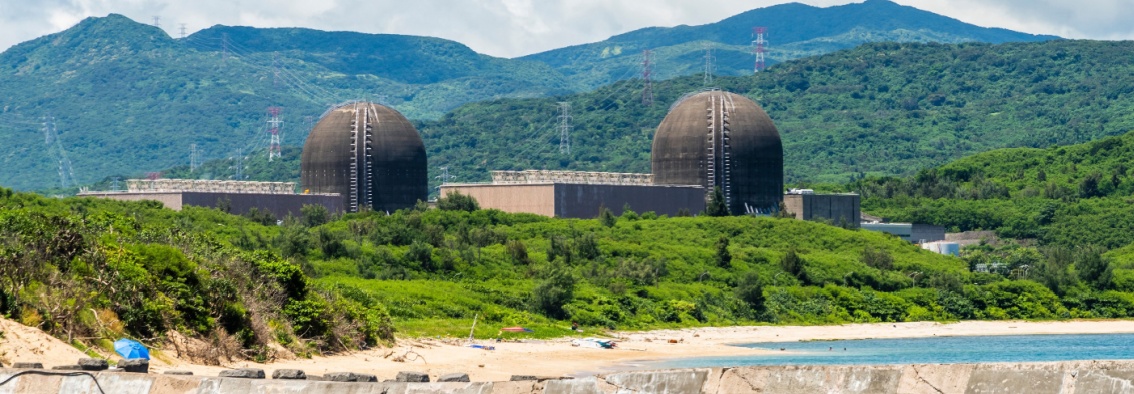
Nuclear energy is politically sensitive in Taiwan. Public opinion in Taiwan on nuclear energy has been divided since the Fukushima nuclear accident in 2011, when a tsunami triggered a nuclear meltdown in Japan. In 2018, a referendum asked Taiwanese voters if they would support the closure of all nuclear power plants by 2025. A clear majority—well past the 5 million threshold needed—voted to keep Taiwan’s nuclear power plants running. However, Taiwan’s government nevertheless continued to shut down Taiwan’s nuclear power plants. In August 2025, the government held another referendum on reopening a nuclear plant. The measure failed to meet the minimum voter threshold to pass (however, of those who did vote, an overwhelming majority supported reopening the plant). With no operational nuclear power plants, the question of nuclear power seems to be strategically unresolved and politically precarious.
Closing down Taiwan’s nuclear power plants rules out a source of clean domestic energy, while leaving the island more dependent on imported fuel. Before its phaseout, nuclear power was a steady contributor to Taiwan’s energy mix—though not free from controversy during Taiwan’s martial law era. In 1982, the government began storing nuclear waste on Lanyu Island without the express consent of the indigenous people. At the time, the government falsely represented to Lanyu Island’s residents that the waste site was a fish cannery. This historical controversy further complicates Taiwan’s ongoing domestic debates on ethical nuclear energy usage.
Policy Recommendations
In order to enhance Taiwan’s energy resilience, the author recommends the following measures:
- Improve Grid and Infrastructure Resilience
- Expedite north-south high-voltage transmission line construction
- Invest in grid resilience (i.e. power generation in the north) and microgrids
- Be proactive and invest in grid resiliency before crises occur
- Diversify Energy Mix and Supply Security
- Reopen closed nuclear plants while addressing safety and waste management concerns
- Continue to invest in renewable sources of energy while shifting fossil fuel consumption away from coal to liquefied natural gas (LNG)
- Promote Institutional and Governance Reform
- Reform Taipower’s financial and structural constraints
- Improve transparency and communication with the Taiwanese public on energy resiliency efforts and the challenges that Taiwan faces in the future
- Implement Demand Management and Pricing
- Gradually shift away from government subsidies for electricity prices for both industrial and residential customers
- Require industrial users—the majority consumers of energy—to bear more of the cost of the transition and encourage power efficiency in heavy-energy use sectors
The main point: Taiwan’s path to energy resilience is hampered by structural weaknesses in its energy system, including being almost entirely reliant on imports, energy grid inefficiencies, and politically-driven electricity subsidies. While government initiatives and corporate commitments signal that Taiwan is aware of these challenges, the questions of nuclear power, infrastructure investment, and demand management will have to be resolved in order to further Taiwan’s energy resilience in the coming years.