
In theory, international aid should shift in accordance with need. In practice, it moves through diplomatic channels, United Nations coordination mechanisms, and bilateral agreements between governments. When disaster strikes, who gets help depends not only on who needs it, but on who has the institutional access to deliver it.
Taiwan’s status as a country lacking widespread diplomatic recognition creates a strange reversal of this logic. It’s blocked from nearly every major international health institution, cannot send representatives to World Health Organization (WHO) meetings, and can only watch as other nations coordinate disaster responses through official channels. Yet, Taiwanese doctors and nurses continue working in disaster zones, often arriving before representatives from larger countries and better-funded organizations.
Few of these medical teams are sent by Taiwan’s government—instead, most are deployed by independent organizations that developed precisely because the island had to build its own humanitarian infrastructure outside official channels. The largest of these is the Tzu Chi Foundation (慈濟基金會), which is now one of the world’s biggest relief organizations, operating across dozens of countries. But the organization did not begin with global ambitions or institutional backing. Rather, the origin story is the opposite of what one might expect for an organization of this scale.
How Bamboo Banks Became a Global Network
Tzu Chi started in 1966, when a Buddhist nun named Cheng Yen (證嚴) convinced thirty housewives to save spare change in bamboo coin banks. The money went to help poor families in their local area. This was happening in Hualien, on Taiwan’s east coast—an impoverished rural area where over 1.3 million people lived in poverty and medical care was scarce. There was no grand vision of global humanitarian work, merely neighbours helping neighbours with whatever they could spare. The bamboo banks would grow into activism on a much larger scale, but the core idea stayed the same: ordinary people contributing what they can to help others in need.
Today, Tzu Chi mobilizes over 9,000 physicians and health professionals to provide free medical services to more than 4 million people worldwide. Taiwan Root Medical Peace Corps (TRMPC) has conducted 422 medical missions across 50 countries since 1995, with the participation of over 17,000 volunteers. Participants pay their own travel expenses and use their vacation time to work in refugee camps, remote villages, and disaster zones. The scale of Tzu Chi’s work is comparable to what many governments accomplish through their entire foreign aid budgets, despite relying primarily on volunteer participation.
Even in the People’s Republic of China (PRC), Tzu Chi operates on a huge scale. Despite the ongoing cross-Strait tensions, the organization has conducted humanitarian work, such as the construction of schools and hospitals, in 28 Chinese provinces since 1991. Tzu Chi maintains a strict policy that volunteers are not to discuss business, politics, or preach religion while giving aid, which allows it to operate where overtly political or religious organizations cannot. In 2010, Tzu Chi became the first overseas non-governmental organization to receive permission to set up an office in China, where it identifies as a charity rather than as a religious group. At the same time, Beijing authorized the organization to become the first overseas non-profit organization to establish a nationwide charity foundation across the PRC.
Buddhist Values Guide Service across Global Communities
Its disaster relief efforts have opened doors in China, but Tzu Chi’s largest impact has been in Taiwan. The organization has built eight major hospitals that provide quality healthcare at affordable prices, based on Buddhist principles prioritizing compassion and service. Yet, these principles are not pushed on to patients. There is no religious pressure and patients are not required to be Buddhist. The medical care itself remains secular even though Buddhist values guide the volunteers.
This orientation matters when working internationally because it allows Tzu Chi to operate in places where overtly religious organizations face restrictions. Volunteers receive training not just in medical procedures but in the core philosophy of service that need not accompany religious outreach—such as humility, treating every person with dignity regardless of background, and giving without expecting credit or return. That philosophical foundation creates consistency across hundreds of missions in dozens of countries with different religious and cultural contexts.
Because Tzu Chi combines practical medical expertise with values that most cultures respect, the Buddhist organization from Taiwan has been able to provide care in Muslim, Christian, Hindu, and secular communities without friction.
Meanwhile, the grassroots nature of the organization has allowed Tzu Chi to largely—but not entirely—circumvent the political currents holding back the Taiwan government’s international engagement. Ultimately, a grassroots approach was exactly the model Taiwan needed when it lost its UN seat in 1971 and diplomatic doors began closing. The government could not work through normal diplomatic structures, but civil society organizations like Tzu Chi were not bound by those restrictions. Taiwanese civil society learned to operate independently, building relationships directly with communities and local organizations rather than working through governmental channels. The Taiwanese government has sometimes supported civil society with logistics, and occasionally takes credit for their work, but NGOs have performed the actual services and continue to operate on their own terms.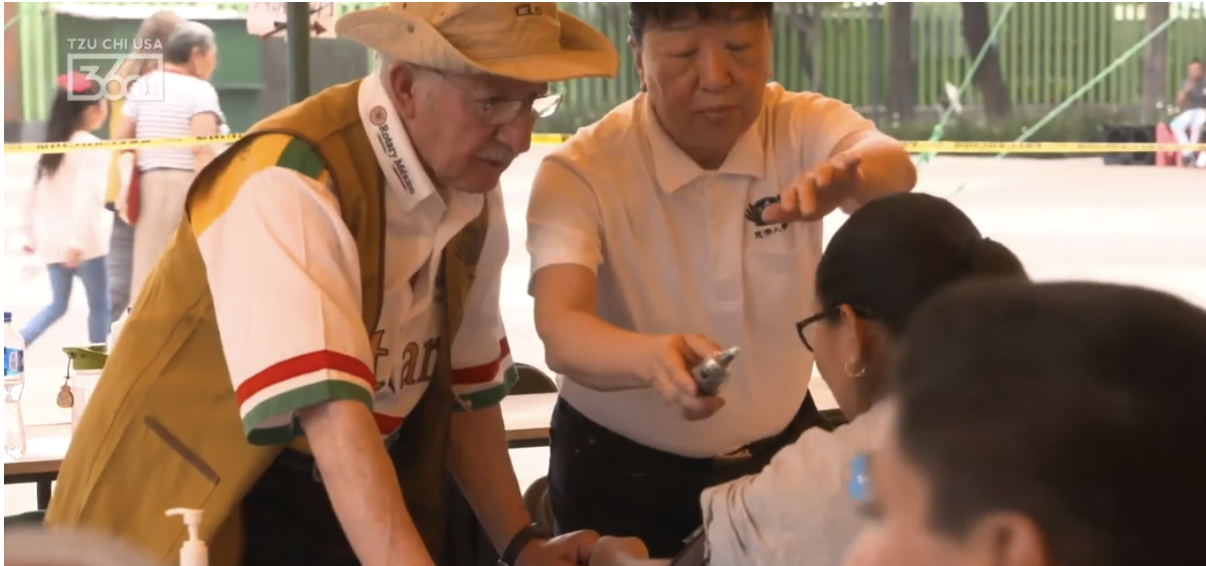
Image: Volunteers at a Tzu Chi Foundation-supported health clinic in Xochimilco (a borough of Mexico City) provide basic healthcare services to local residents (undated, 2019). (Image source: Tzu Chi Foundation / YouTube)
China’s Aid Seeks Alignment, While Taiwan’s Aid Builds Trust
Most international aid—whether from China or the West—comes attached with conditions and political calculations. China does not provide aid without strings attached: build a port with PRC money, and Beijing may ask for political concessions; take a loan from the Bank of China and expect PRC diplomats to call for your support in the United Nations. Similarly, Western aid moves through governmental and multilateral channels that require formal relationships and coordinating structures. Even Western “untied” aid (aid without political conditions) is criticized for its slow-moving, bureaucratic nature. However, Taiwan’s medical NGOs are not constricted in this way.
The founder of Taiwan Root Medical Peace Corps, Liu Chi-chun (劉啟群), explicitly stated that “medical services should transcend national borders and exceed the limitations of politics, race, and religion,” illustrating how Tzu Chi’s humanitarian programs are free from political agenda. This approach fosters a different kind of international relationship between foreign countries and Taiwan: one built on trust and practical help, rather than formal agreements or political leverage.
When Political Pressure Overrides Emergency Needs
The real test of this model comes during disasters, when speed matters most and Taiwan’s teams are often among the first that are ready to deploy. Unfortunately, being ready does not necessarily mean being allowed in. Countries hit by earthquakes or floods have faced pressure from Beijing to reject Taiwanese assistance, even when people are still trapped under rubble. In such cases, political considerations tend to outweigh medical qualifications.
For example, when an earthquake in Nepal killed over 8,700 people in 2015, authorities in Nepal turned down an experienced Taiwanese rescue team despite having few of their own response teams on the ground. When an earthquake in Myanmar killed over 3,600 people in March 2025, Taiwan assembled a 126-member rescue unit with six search dogs and 15 tons of specialized equipment. Myanmar’s military government made them wait 48 hours, then denied them permission to enter the country. The rescue team returned to Taiwan unused.
This is a well-documented pattern: disaster strikes, Taiwan offers help, and governments calculate whether accepting the aid will upset Beijing. More often than not, remaining on good terms with China takes precedence over utilizing Taiwan’s experienced rescue teams.
Decades of Tzu Chi’s Work Reach Millions Globally
Despite working against these political constraints, Taiwan’s medical NGOs find ways to help – working through informal channels and partnering with local organizations when governments prefer not to cooperate directly. Tzu Chi operates through a network of local branches and volunteer organizations in over 50 countries. This gives them grassroot access that does not require government approval. When there is an emergency, Tzu Chi volunteers often coordinate with local religious groups, community leaders, or existing NGOs already on the ground rather than waiting for official invitations from national governments.
The organization follows five principles of disaster relief: direct, focused, respectful, practical and timely; and volunteers bow to recipients at a 90-degree angle to show their respect and dedicate themselves wholeheartedly to the mission. They show up in places that will accept them and do the work regardless of official recognition. It has operated in this manner for three decades.
This reflects the moral clarity at the heart of the issue: Taiwan is restricted from accessing WHO surveillance networks or technical guidelines in real time, yet Taiwanese medical professionals are present in refugee camps and disaster zones, undertaking essential work to save lives.
Year after year, Tzu Chi sends additional volunteers to new places. The scale of their operations continues to grow. What started as housewives with bamboo banks, now reaches millions of people across dozens of countries. It is important to note that none of this aid moves through official channels, nor does it count toward formal international health coordination. Nevertheless, patients get treated, surgeries happen, and education work advances. Over decades, Tzu Chi has proven that institutional access is not always necessary when the goal is to show up and help people. Effective humanitarian work does not need to depend on diplomatic status.
It Is Time to Remove Politics from Humanitarian Relief
While Tzu Chi has reached more locations than it has been turned away from, the organization suffers from its own challenges. Because it relies heavily on volunteers, response capacity can be uneven depending on local branch strength and volunteer availability. In some regions, Tzu Chi struggles to maintain a long-term presence after an initial disaster response.
The strict apolitical stance, while necessary for access, sometimes prevents Tzu Chi from addressing the root causes of humanitarian crises that are fundamentally political. Volunteers cannot talk about politics or criticize governments while providing aid, which is exactly why authoritarian regimes let them in. They’re rebuilding schools in regions where the government won’t fund education and treating patients in areas where the government stopped funding medical care. But mentioning those connections would cost them access. So the help continues, while the systems creating the need for help stay in place. The choice to stay completely apolitical lets them work in more countries and reach more people, but it means they sometimes provide relief in situations where the real solution would require political change for which they are not allowed to advocate.
In addition, funding remains heavily dependent on donations from Taiwan and the Taiwanese diaspora. That narrow donor base means less flexibility and smaller reserves than groups that fundraise globally. The organization has also faced criticism for lack of financial transparency in some operations, particularly regarding how donations are allocated across different programs and countries. Better coordination with international health organizations could improve efficiency, but Tzu Chi’s informal structure sometimes makes it difficult to integrate into broader relief efforts.
The solutions are not complicated, though they require political will. Taiwan’s medical NGOs have spent decades proving what they can do in disaster zones. What is missing is not capability or willingness to help, but the framework that lets them do their work without getting blocked by political calculations at the worst possible moment. A few practical changes could make that difference.
- Countries facing natural disasters should establish pre-approved humanitarian corridors that allow certified medical NGOs like Tzu Chi to deploy regardless of diplomatic status, based on their track records and capabilities.
- Taiwan’s government could create a formal “Humanitarian Passport” program that gives medical volunteers from recognized NGOs expedited entry to disaster zones. International bodies like the WHO should develop a registry of pre-certified disaster response organizations that can deploy immediately without case-by-case government approval.
- Taiwan issuing special passports for aid workers will not change anything if recipient countries still refuse entry. What matters is whether governments facing disasters are willing to set up humanitarian visa systems that let qualified rescue teams through customs based on their expertise, not their diplomatic standing.
- Taiwan itself could strengthen Tzu Chi’s capacity by offering tax incentives for medical professionals who participate in international missions, and creating humanitarian leave programs that allow doctors to take extended leave without career penalties.
The main point: Medical professionals should not require diplomatic recognition to tackle an epidemic or treat earthquake victims. While Taiwanese disaster response organizations have been turned away by certain countries, Tzu Chi has built a thriving grassroots model that allows it to carry out humanitarian work around the world—in spite of Taiwan’s diplomatic isolation.