
Researchers have come to rely on digital trace data for understanding many of the topics capturing public attention. Digital trace data are the records internet users leave when they interact with the internet. Among these, search engine trends are among the most useful indicators for what topics are commanding public attention. In politics, economics, public health, and other fields, scholars have used search behavior to detect when issues move from the realm of background awareness—and become targets of active information-seeking. Google Trends is useful for this purpose, since Google is the most widely used search engine in the world. Google Trends also distinguishes between top searches, rising searches, and breakout searches, thereby allowing researchers to separate steady interest from sudden spikes.
This article examines Google search interest among Americans for the topic “Taiwan,” from the years 2004 (when data first became available) to 2026, along with related search queries. Data regarding the topic “Taiwan” also captures multiple languages and related word forms. I combined Google Trends data with raw search volumes provided from Glimpse. (Glimpse is a third-party Google Trends enhancement tool that estimates absolute search volumes and related trend metrics, supplementing Google Trends’ normalized search-interest index.) I then grouped search queries into thematic categories using the OpenAI API model gpt-5.4-mini. The results reveal the precise moments when the topic “Taiwan” becomes salient enough for Americans to actively seek out information. It also reveals the contexts—whether political, technological, cultural, etc.—under which Taiwan attracts attention.
The results are relevant for both American and Taiwanese policy, since public attention is one of the conditions under which foreign policy debates become comprehensible to broader audiences. The United States maintains a robust relationship with Taiwan under the legal framework of the Taiwan Relations Act and other elements of declaratory policy. Taiwan is also increasingly central to US-China strategic competition, One China policy debates, and semiconductor supply chain vulnerabilities. Search behavior helps to show when those policy issues break through to a wider US public.
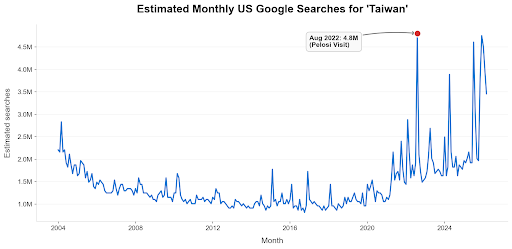
Figure 1: Estimated monthly US Google searches for “Taiwan.” (Image Source: Produced by the author, using Google Trends and Glimpse)
Taiwan’s US Search Profile is No Longer Only Episodic
The overall search volume for “Taiwan” between 2004 and 2026 (see Figure 1) reveals a decline in interest over the 2000s, followed by a major late resurgence in the 2020s. In 2004, estimated US monthly searches for “Taiwan” ranged from roughly 1.68 million to 2.83 million. That early high point was not simply generic curiosity: rather, it plausibly reflected interest in Taiwan’s 2004 presidential election and coinciding cross-Strait tensions. The policy lesson is that Taiwan’s democratic calendar can generate US public attention when elections are understood as having implications for cross-Strait stability. In those moments, American audiences are more likely to seek out more information on Taiwan’s democratic system, as well as the relevance of China and the United States.
From 2005 through 2010, interest generally moved downward, falling from approximately 1.60 to 1.90 million monthly searches in early 2005 to about 1.00 million by late 2010. Between 2011 and 2019, the pattern shifted from decline to stabilization at a lower baseline, with most months falling between 800,000 and 1.2 million searches. (For comparison, during this same period, US search interest for China ranged from 3.1 million to 6.6 million monthly searches; Germany from 1.8 million to 8.3 million; Hong Kong from 426,000 to 1.5 million; Austria from 277,000 to 461,000; Japan from 2.9 million to 32 million; Mexico from 18 million to 33 million; Türkiye from 379,000 to 2.6 million; Russia from 1.3 million to 4.5 million; and Canada from 4 million to 6.9 million.)
Taiwan occupied a mid-to-lower tier of public search attention: being more visible than some smaller or less frequently searched countries and political entities, but well below major US public reference points such as China, Japan, Mexico, Canada, and Russia. This does not mean Taiwan became strategically unimportant. Rather, it means the US public’s active information-seeking about Taiwan remained limited outside major triggering events. For policymakers, that is a warning that quiet periods should be treated as moments where public understanding can be shaped, so that awareness does not have to be built from the ground up during crises.
A clear break in search trends emerged around 2020, and became unmistakable by 2021 and 2022. From 2022, Taiwan moved into a different class of US search attention. In February that year, the topic reached 2.88 million searches, and in August surged to 4.8 million—the highest volume since records began in 2004. The August 2022 peak corresponded to US Speaker Nancy Pelosi’s visit to Taipei and the ensuing military escalation by the People’s Republic of China (PRC), widely described as a “Fourth Taiwan Strait Crisis.” The scale of this spike becomes clearer when compared with US search interest for other countries and political entities during the same period: Hong Kong ranged from 358,000 to 784,000 monthly searches, Japan from 5.5 million to 8.4 million, South Korea from 2.4 million to 9.3 million, China from 4 million to 15 million, Germany from 2.9 million to 5.6 million, Russia from 1.3 million to 19 million, Israel from 814,000 to 20 million, Austria from 346,000 to 1.1 million, and Türkiye from 715,000 to 4.2 million.
This comparison suggests that Taiwan’s 2022 search peak placed it much closer to countries that regularly occupy US public attention, such as Japan, South Korea, Germany, and Türkiye, rather than remaining in the lower-attention category associated with quieter periods. At that moment, Taiwan entered US search behavior not merely as a place, but as a central node curiosity regarding US-China relations. This is relevant for policy, since crisis moments are also learning moments. The explanations, official statements, and media frames available during spikes can shape how Americans understand deterrence, escalation risk, and US commitments.
The 2024-2026 period reveals that Taiwan’s visibility in American society can no longer be understood as the product of isolated news shocks. A January 2024 spike was shaped by Taiwan’s presidential election, while the much larger April 2024 spike aligned with the Hualien earthquake (which the US Geological Survey identified as the strongest in the area in twenty-five years). These two peaks point to different but complementary forms of relevance: Taiwan as a democracy whose elections affect regional stability, and Taiwan as a society facing humanitarian and resilience challenges. Therefore, US and Taiwanese public diplomacy must factor in both facets of American interest. Security messaging alone cannot explain all US attention to Taiwan. Disaster response, civil resilience, and people-to-people ties also shape how Taiwan becomes visible to Americans.
The most dramatic phase runs from 2024 through March 2026 (the final month of analysis). April 2024 registered 3.89 million searches, followed by a sequence of peaks that included July 2025 at 4.61 million, December 2025 at 4.75 million, and January 2026 at 4.51 million. Search volumes in the first three months of 2026 all remained above 3.40 million, suggesting that heightened interest persisted into the most recent period of observation. Indeed, this persistence is the most important shift in trends across the 2004-2026 period. It suggests that Taiwan has moved from episodic visibility toward sustained salience in American conversations about military deterrence, supply-chain resilience, semiconductors, and the future of US-China relations.
What Americans Search for Shows How Taiwan is Understood
Further analysis into what themes accompanied searches of “Taiwan” reveal a generally stable trend in specific interests (see Figures 2-4). Across the whole period, the most persistent accompanying themes were basic reference queries regarding Taiwan: such as its identity, naming differences, and close geographical neighbors. In these searches, accompanying terms included “China,” “Formosa,” and “Hong Kong.” This baseline suggests that when looking up Taiwan, many Americans begin with basic questions regarding geography and identity. For US policymakers, this reveals a communication challenge. Explanations of the Taiwan Relations Act, the One China policy, cross-Strait deterrence, and Taiwan’s democratic system cannot assume that the audience already has a clear conceptual map of Taiwan’s status.
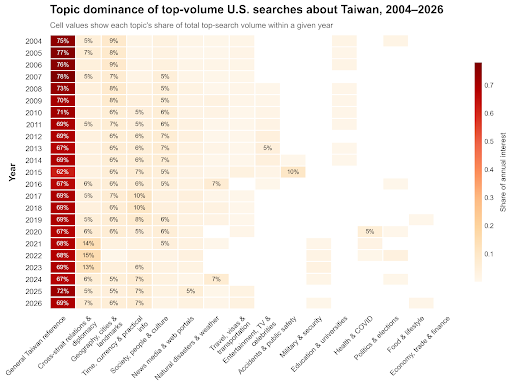
Figure 2: Topic dominance of top-volume US searches about Taiwan, 2004-2026. Each cell shows the topic’s share of total top-search volume in that year: for example, if politics & elections sums to 50 and the full year’s top-query total is 1000, the cell value is 50/1000 = 5%. (Image Source: Produced by the author, using Google Trends.)
In earlier years, accompanying terms were more often related to entertainment, especially Taiwanese dramas and celebrities. Though it is not obviously “policy” content, the pattern is still politically relevant. Cultural and entertainment searches create soft power entry points through which US audiences encounter Taiwan—before they see it as a security issue. However, in the later years of the dataset (2018-2026, and especially 2020-2026), elections, diplomatic tension, military-security language, and Taiwan’s technology sector grow more prominent among searches. This shift in themes tracks Taiwan’s changing place in US policy debates. Taiwan is increasingly visible not only as a cultural or geographic object, but as a democratic partner, a potential flashpoint, and a core node in the global semiconductor system.
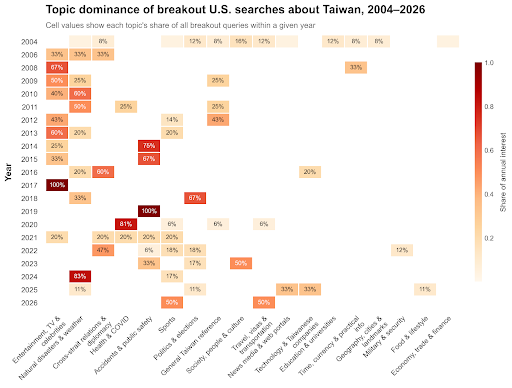
Figure 3: Topic dominance of breakout US searches about Taiwan, 2004-2026. Each cell shows the percentage of all breakout queries in that year for that topic. For example, if a year has 20 breakout queries in total and 5 of them are in military & security, the cell value is 5/20 = 25%. (Image Source: Produced by the author, using Google Trends.)
The distinction between breakout and rising searches is especially important. Breakout terms capture sharp, event-specific bursts of attention, while rising terms reveal the deeper thematic direction of change. A single spike may reflect a disaster, a celebrity story, or one diplomatic event. By contrast, a sustained rise in security or semiconductor-related searches suggests a more durable change in how Taiwan is being framed. US and Taiwanese policymakers should therefore avoid reading search interest only through the lens of the biggest monthly peaks. A more useful policy signal is the combination of volume, topic, and persistence—i.e., what Americans search for when attention spikes, and whether those searches fade quickly or become part of a longer-term pattern.
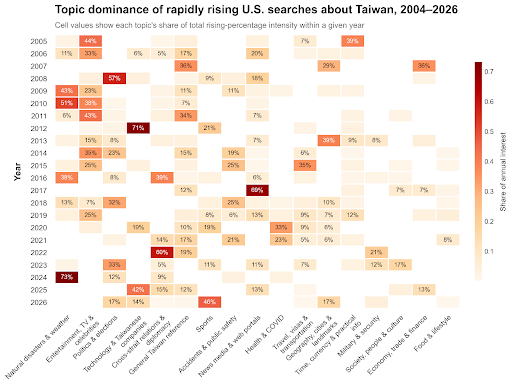
Figure 4: Topic dominance of rapidly rising US searches about Taiwan, 2004-2026. Each cell shows the topic’s share of all rising-percentage intensity in that year. For example, if one topic has rising values of +300% and +200% (= 500) and the whole year sums to 2,000, the heatmap cell is 500/2,000 = 25%. (Produced by the author, using Google Trends.)
Policy Relevance: Search Spikes Are Windows for Public Explanation
Search data is best understood as an indicator of attention, rather than endorsement. For Taiwan, the practical implication is that US public attention is higher overall, albeit punctuated by spikes tied to particular events. Americans do not search for Taiwan evenly over time. They search when events make Taiwan newly relevant: including elections, acts of military coercion, senior US visits, natural disasters, or concerns over the semiconductor trade. Each of these moments creates a short window in which the public is more receptive to explanation.
That should influence policy communication in at least three ways. First, US and Taiwanese officials should prepare public-facing explanations before predictable attention cycles, especially Taiwanese elections and pre-planned military exercises. Second, crisis communication should connect immediate events to durable policy concepts such as deterrence, peace and stability across the Taiwan Strait, supply-chain resilience, and the legal foundations of US-Taiwan relations—rather than treating each spike as a stand-alone news episode. Third, since many searches remain basic or reference-oriented, public communication should be accessible and explanatory, not only aimed at specialists already familiar with cross-Strait policy.
The data also suggests that Taiwan’s public image in the United States is multidimensional. Security issues may drive the most strategically consequential attention, but elections, disasters, culture, and technology all shape the search environment. A policy strategy that presents Taiwan only as a military flashpoint risks narrowing public understanding. A stronger approach would link Taiwan’s democracy, technological importance, resilience, and social connections to the United States. In that sense, search behavior does not dictate policy, but it identifies where public understanding is thin, when Americans are paying attention, and which narratives are most likely to reach them.
Conclusion
Google search interest among Americans towards “Taiwan” has undergone a major historical transformation. A data series from 2004 to 2026 shows high but declining attention in the mid-2000s; a lower and more stable baseline during much of the 2010s; and a sharp and sustained rise from 2021 onward, culminating in record-setting peaks from 2024 through early 2026.
The deeper point is that the meaning of US searches about Taiwan has changed. Taiwan remains anchored by a stable layer of general geographic awareness, but the drivers of heightened US attention have shifted toward elections, disasters, diplomatic crises, military coercion, and semiconductors. Taiwan therefore appears in the American search imagination not as a routine object of continuous public engagement, but as a place that becomes intensely visible when broader events make it strategically, technologically, or culturally important. Over time, those moments of visibility have become more frequent, sustained, and geopolitically charged.
For policymakers, the implication is clear. Search interest should be treated as a real-time signal of when the US public is seeking information about Taiwan and what kinds of explanations it may need. Taiwan policy depends on deterrence, diplomacy, and material capabilities, but it also depends on public understanding during moments of heightened attention. The search record shows that those moments are no longer rare. They are becoming a recurring feature of Taiwan’s place in US public and policy debates.
The main point: Since 2021, US Google search interest in Taiwan has shifted from mostly episodic, low-intensity attention to sustained and record-high salience. This suggests Taiwan has become increasingly visible to Americans not just as a place, but as a strategic, democratic, and technological focal point shaped by elections, crises, and the trade in semiconductors.