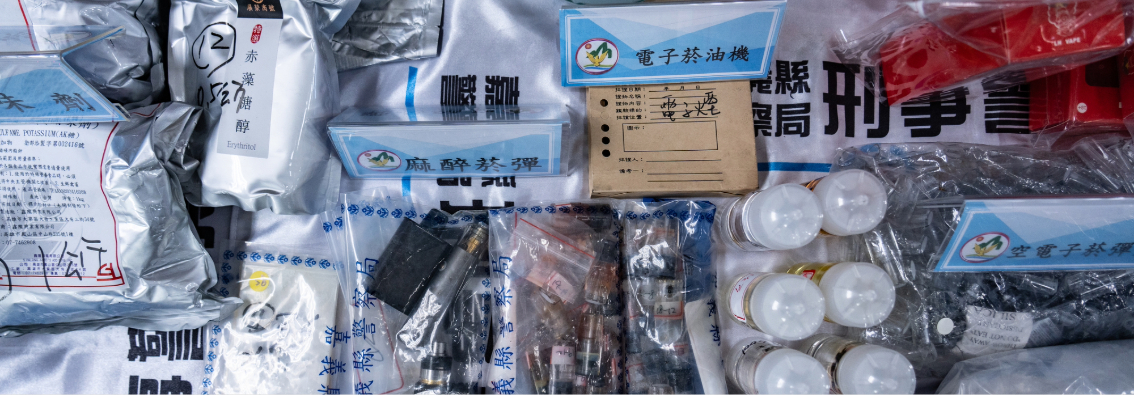

In recent years, Taiwan has observed a significant and concerning surge in the abuse of the synthetic drug etomidate. Etomidate is an emerging synthetic drug that is used in medical settings as a depressant to the central nervous system, but has also been abused as a recreational narcotic throughout Southeast and East Asia, including Taiwan. According to Taiwan’s Ministry of Health and Welfare (衛生福利部), there were only 22 cases of etomidate abuse in 2023; in 2025, abuse cases had increased to 20,727, and 8,608 cases were recorded in the first four months of 2026. Traffic accidents caused by driving under the influence of drugs have also risen in Taiwan: drug-impaired driving has increased 123 times from 2023 to 2025, causing 17 casualties from January to May of this year. High-profile vehicular accidents occurring due to illicit use of etomidate have caught considerable public attention.
In response to the rising danger to public safety brought about by etomidate abuse, the Taiwanese government has initiated several policy responses. The Executive Yuan (EY, 行政院) officially changed the classification of etomidate from Class Two to Class One in June of this year, in the hope of deterring abuse through harsher criminal consequences. The Legislative Yuan (LY, 立法院) has also passed an amendment to the Road Traffic Management and Penalty Act (道路交通管理處罰條例) to elevate criminal penalties for drug-impaired driving.
What is “Zombie Vape”?
In medical terms, etomidate is a short-acting intravenous (IV) sedative-hypnotic drug. In contrast to the effects of nervous system stimulants like amphetamines, the symptoms of etomidate abuse range from body tremors, to an inability to think clearly or control the body, to unconsciousness. In order to attract a broader base of users, especially teenagers, drug traffickers exploit various types of paraphernalia to make etomidate more attractive and accessible. Alongside surging increases in the use of nicotine equivalents, vapes have become the most common paraphernalia for etomidate abuse in Taiwan.
As etomidate vape users have been witnessed undergoing psychotic episodes as well as seizures, the substance has earned the popular nickname “zombie vape” (喪屍煙彈) among the Taiwanese public. A 2025 report by the Ministry of Health and Welfare indicates that so-called zombie vapes have become the second-most used drug among Taiwanese citizens under 19 years old. This phenomenon is likely associated with the younger generations’ perception of vape usage as harmless. Both the popularity of zombie vapes within certain teenagers’ communities, and the continuously-evolving characteristics of the synthetic manufacturing process, have posed significant challenges to the government’s countermeasures.
Challenges to Taiwan’s Resilience and State Capacity: Exhaustion and Opportunities
The sudden prevalence of zombie vape in Taiwan has posed undeniable challenges to government capacity and societal resilience in areas like policing and forensics, corrections and public health, and border control. In the context of the People’s Republic of China’s (PRC) unrelenting maritime coercion in Taiwan’s near seas, combating drug smuggling by sea may place extra burdens on the island’s already-strained enforcement agencies. However, the zombie vape crisis could also be an opportunity for Taiwan to showcase its policy adaptability and growing societal resilience.
Police Interdiction and Forensic Testing
Police are at the front line of countering emerging drugs, including zombie vapes. Taiwan’s National Police Agency (警政署) has expanded its enforcement campaigns against drug-impaired driving by mobilizing more officers and increasing traffic checkpoints. Additionally, the EY has submitted an amendment to make mouth swabs a legal measure in drug screening, aiming to improve police’s efficiency in identifying individuals under the influence. Taiwan’s interdiction efforts have brought about positive results. Drug-impaired driving decreased 33 percent after just the second month of the enforcement campaign. Still, as the physical safety of on-duty officers is put on the line during traffic stops and illicit drug activity crackdowns, the National Police Agency needs to ensure that the drug enforcement effort does not overwhelm a police system that has been struggling with an existing overwork culture.
Meanwhile, forensic units are striving to catch up with the ever-evolving number of synthetic drugs. Limited testing capacity has placed forensic units under immense pressure. Currently, there are only three national testing agencies in Taiwan, and the zombie vape crisis has further increased testing demand. In addition, drug traffickers are able to manipulate the chemical composition of emerging drugs, forcing forensic laboratories to adapt techniques to identify illicit drugs.
Fortunately, Taiwan has already laid the groundwork for responses to emerging illicit substances. The New Generation Anti-Drug Strategy Guidelines (新世代反毒策略) were a policy framework launched in 2017, investing in testing technologies for emerging, synthetic drugs. Taiwan’s national laboratories have also started delegating testing work to privately-owned laboratories, appointed by the Ministry of Justice (法務部). To further support private laboratories in emerging drug testing, the Food and Drug Administration (食品藥物管理署) established an inventory of reference standards for emerging drugs, which has been maintained and updated with newly-identified illicit drugs. These standards are shared with laboratories nationwide. Meanwhile, the government continues to promote integration across ministries and has invested more in forensic capacity through Phase Three of the New Generation Anti-Drug Strategy Guidelines, which runs from 2025 to 2028.
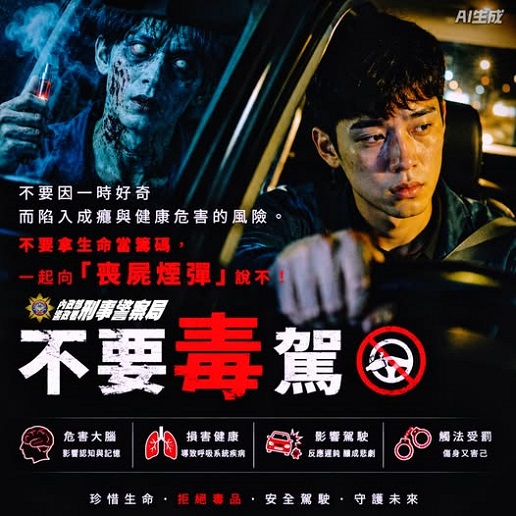
Image: A Taiwan government social media graphic warning against the dangers while driving under the influence of “zombie vapes.” (Image source: ROC Criminal Investigation Bureau / National Immigration Agency)
Criminal Punishment vs. Medical Treatment for Drug Abuse
Taiwan has traditionally endeavored to find a balance between treating drug users as criminals and patients. The legal framework in Taiwan categorizes illicit drugs into four classes, with consumption of Class One drugs bringing about the most severe criminal penalties. Since the passage of the Narcotics Hazards Prevention Act (毒品危害防制條例) in 1998, Taiwanese governance has enforced the “dual track of patient and criminal” (病犯雙軌制), recognizing that drug users are also in need of medical and mental health treatment. Therefore, rather than sentencing, court-ordered “observation and rehabilitation” (觀察勒戒)—which isolates influenced individuals from accessing drugs while providing medical support at rehab centers— has been a prevalent measure for first-time users of Class One and Class Two drugs. Besides the judicial system, Taiwan’s Executive Yuan (EY) has also committed to rehabilitation support. All three phases of the New Generation Anti-Drug Strategy Guidelines expand recovery measures aimed at reintegrating former drug users into society, such as job search assistance and family support services.
Similar to the spirit of the Criminal Code, the Juvenile Justice Act ( 少年事件處理法) prioritizes rehabilitation treatment over sentencing in cases of teenage drug use. For juveniles between the age of 12 and 18 who have committed Class One and Class Two drug offenses, courts usually order juvenile protection dispositions: such as consultations, probation, and corrective education. Courts may also require drug-influenced teenagers to go through treatment at teenage rehab centers. The Education Ministry (教育部) also requires schools to support the recovery of drug-using juveniles through mandatory reporting to local social welfare departments, and the establishment of counseling groups consisting of teachers, parents, and counselors.
In spite of the government’s efforts to rehabilitate drug users, correctional penalties for abuse have still resulted in strains on the prison system, even before the emergent zombie vape crisis. As of April 2022, more than 40 percent of Taiwanese prisoners were serving sentences for drug-related offenses. Most correctional facilities are also suffering from a shortage of case management personnel who can provide the necessary support to former drug users. The Taiwanese government has tried to alleviate this systemic overload by promoting integration across governmental agencies and partnerships with private medical facilities and rehab centers. However, intragovernmental coordination is still hindered by jurisdictional overlap as well as uncertainty over division of responsibility, while many hospitals are unwilling to establish care units for drug addiction due to insufficient economic incentives.
Border Control Against Drug Smuggling
In early July of this year, Taiwan’s National Security Bureau (NSB, 國家安全局) revealed that the majority of etomidate precursors are smuggled from the PRC. The PRC-origin chemical materials are then transported to Taiwan-based factories for processing into finished etomidate. Although few details have been made public, increasing smuggling activities from the PRC have stirred heated public debates regarding the possible involvement of the PRC government in etomidate trafficking. Not surprisingly, the PRC authorities have rejected the findings in the recent announcement by Taiwan’s NSB.
The NSB has identified three main routes of etomidate precursor and finished product smuggling into Taiwan. First, sea or air cargo has been the main channel of smuggling activities, as large amounts of illicit drugs can be falsely registered as permissible traded goods, and then enter the borders along with other cargo. Secondly, drug traffickers liberally exploit international package deliveries by vaguely labeling mailed shipments or by using individuals—knowing or unknowing—to carry drugs through customs. Lastly, smugglers also transfer illicit drugs onto Taiwanese fishing boats out at sea, after which the fishing boats return to port on the island.
Multiple governmental agencies are involved in the interdiction of drug and precursor-chemical smuggling into Taiwan. Under the Regulations for the Inspection and Examination of Imported Medicaments (輸入藥物邊境抽查檢驗辦法), active pharmaceutical ingredients must be randomly examined at the border in order to catch illegal precursors arriving under fake labels. Taiwan’s Customs Administration (關務署) utilizes advanced technologies, such as handheld Raman narcotics detectors, to examine international packages, cargo, and luggage for smuggled substances. While the Coast Guard Administration (海巡署) actively monitors maritime activities and intercepts maritime smuggling, the NSB has also been heavily involved in drug interdiction by collecting and exchanging intelligence with local law enforcement entities. The NSB is also developing and training drones to improve technological reconnaissance of maritime drug smuggling.
Moreover, the Taiwanese authorities have cooperated with international partners in combating drug smuggling. Supported by a Memorandum of Understanding (跨境緝毒合作備忘錄) signed between Taiwan and the United States in 2025, Taiwan’s Coast Guard Administration and the Ministry of Justice Investigation Bureau (法務部調查局) have successfully conducted interdictions against smuggling activities at sea, using intelligence provided by the US Drug Enforcement Administration (DEA). The Interior Ministry (內政部), which runs Taiwan’s national police force, has also cooperated with law enforcement of India, Malaysia, Vietnam, and Laos in efforts to intercept transnational smuggling. Nonetheless, due to the PRC’s continuous efforts to coercively restrain Taiwan’s diplomatic status, Taipei has been prevented from participating in official multilateral platforms, such as drug-related conferences held by the United Nations and the International Criminal Police Organization (Interpol).
Policy Implications
The emerging zombie vape crisis constitutes a challenge to Taiwan’s national security through the exhaustion of state capacity and the diversion of attention from other crises, such as ongoing Chinese gray zone aggression against the island. Nevertheless, the Taiwanese government can turn this crisis into an opportunity by showcasing societal resilience and policy adaptability. To better counter the issue of etomidate abuse, the government should pursue the following policy actions:
- Improving integration across agencies: While intragovernmental networks have been established, the government should continue to establish clear differences in jurisdiction among different agencies, as well as encourage transparent communication. In addition, to further alleviate the burden on public sectors, the government should encourage the participation of private partners in forensics, education, and public health. Obstacles to entry for private sectors can be addressed with greater financial incentives and better-coordinated information sharing systems.
- Investing more in professional development in policing, forensics, and rehabilitation treatment: The government should procure more protective gear and update safety measures for police officers carrying out drug enforcement campaigns at traffic checkpoints. In order to stay a step ahead of the emergence of new illegal drugs, additional financial and training support should be provided to both national and privately-owned forensic laboratories. Investment in rehabilitation programs is also critical for addressing the issue of short-staffing in treatment systems.
- Expanding awareness education: The Ministry of Education should coordinate with local government entities to expand awareness training programs and counseling services on school and university campuses. Governmental agencies, including in education as well as in health and welfare, should support schools and universities in providing rehabilitation and mental health resources on campuses.
Furthermore, Taiwan’s efforts in countering the zombie vape crisis highlight the importance of Taiwan’s ability to conduct international cooperation. Given the transnational nature of drug trafficking, international cooperation is critical in addressing the problem. The exclusion of Taiwan from multilateral fora will hold back global responses to the narcotics crisis. Since it is unlikely for Taiwan to be allowed to participate in intergovernmental organizations or conferences in the near term, international partners should seek collaboration with Taiwan through flexible diplomatic mechanisms, such as memoranda of understanding or regional cooperation frameworks. It is time for the international community to learn from the experience of the COVID-19 pandemic: when Taiwan strived to contribute to the world with an early warning on the outbreak to the World Health Organization (WHO), and engaged in resource sharing through “mask diplomacy.” In these moments, international cooperation with Taiwan proved highly advantageous to global public health.
The main point: Taiwan has seen a huge increase in etomidate abuse, which constitutes a national security threat to the island. As Taiwan demonstrates its resilience through state capacity and policy adaptability, the international community should cooperate with Taipei in combating the trafficking of emerging drugs.