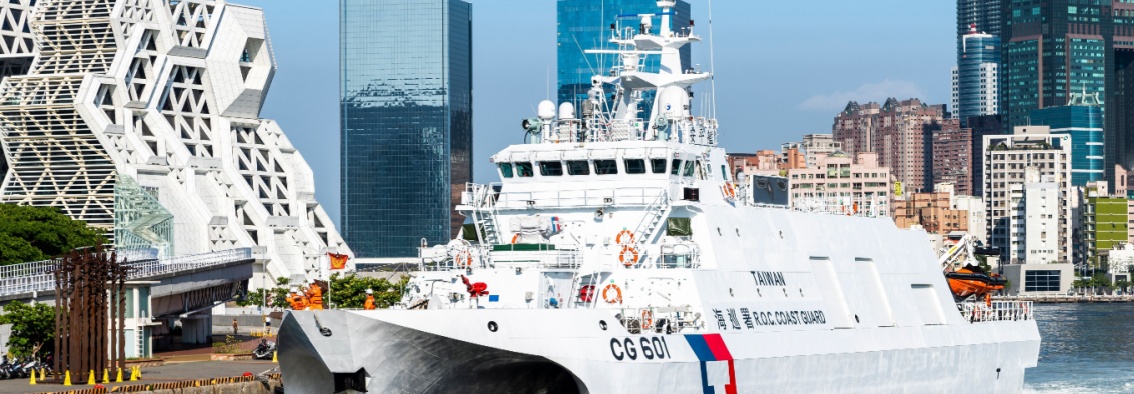

Taiwan’s leading maritime law enforcement agency is the Coast Guard Administration (海洋委員會海巡署), or simply the CGA. The CGA has a handful of responsibilities that are typical of most other coast guards: including maritime public security, search and rescue, protection of fishing rights, and marine conservation. Since the administration of former President Tsai Ing-wen (蔡英文), the CGA has undergone modernization and expansion. This policy has continued with the strong support of President Lai Ching-te (賴清德) and Taiwan’s Ocean Affairs Council (海洋委員會), which has sought an additional NTD 29.56 billion (USD 973.55 million) under a special budget. Proposed in September 2025, the new budget would help fund the construction of 40 domestically-produced patrol vessels.
The special budget is part of the CGA’s plan, first announced in 2018, to build 141 new vessels by 2027 in order to safeguard Taipei’s maritime rights and interests. However, maritime crime does not respect borders, and the CGA often must deal with transnational crime—and this is where “white hull diplomacy” comes into play. “White hull diplomacy” is the use of coast guard vessels (the “white hulls”) for maritime presence and influence. It can emphasize collaboration or it can take on a more confrontational nature. With the CGA currently undergoing modernization, the opportunity for Taipei to expand its diplomatic footprint using “white hull diplomacy” is ideal. By expanding cooperation with other maritime law enforcement agencies Taipei can more effectively combat maritime crime and address the growing challenge of gray zone operations in the maritime domain.
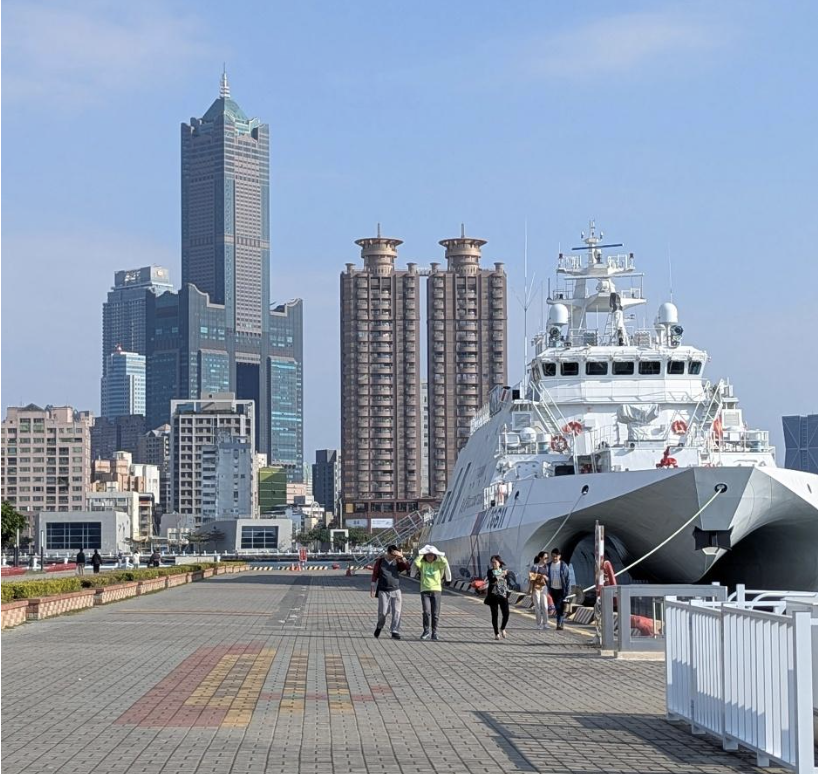
Image: A modern CGA Anping-class offshore patrol vessel docked in Kaohsiung, Taiwan (Image Source: Author’s photo)
Maritime States under Increasing PRC Pressure
The CGA’s modernization seeks to enhance its capabilities to better meet its core responsibilities, with a primary focus on enhancing the CGA’s ability to counter the People’s Republic of China (PRC) gray zone operations. Gray zone tactics fall into an ambiguous zone between war and peace: they are activities that are more aggressive than routine state-to-state interactions, but remain below the threshold of open warfare. Increased Chinese military drills around Taiwan, regular ADIZ (Air Defense Identification Zone) violations, and encirclements of Taiwan with naval vessels are examples of Chinese gray zone activities employed against the island. As gray zone operations grow in frequency, the CGA has become indispensable for Taipei as it seeks to resist ongoing pressure from Beijing.
Taiwan is not the only nation that is facing the growing challenge of China’s gray zone operations—the Philippines has long faced the same tactics. Manila has almost daily encounters with the China Coast Guard (CCG, 中國海警局) and the People’s Liberation Army Navy (PLAN, 中國人民解放軍海軍). Chinese ships have rammed and harassed numerous Philippine vessels in the disputed waters around the Spratly Islands. In one case near Scarborough Shoal, the aggressive maneuvers of Chinese vessels resulted in a collision between a PLAN warship and a smaller CCG vessel, leaving the smaller CCG vessel severely damaged.
Meanwhile, the small island states of Oceania are facing the challenge of how to deal with illegal Chinese fishing in their exclusive economic zones. PRC fishing fleets have been sighted across the Pacific, from Taiwan to the Galápagos Islands of Ecuador—some 10,000 miles (16,000 km) from China. These illegal fishing fleets are often attended by elements of Chinese Maritime Militia (中國海上民兵), a paramilitary force including modified fishing vessels that has been used extensively to conduct gray zone operations. Taiwanese media has reported that the CCG has also escorted fishing vessels operating illegally in the contested waters of the South China Sea. This indicates that illegal fishing operations likely have PRC state backing. Though they are not always a feature of China’s gray zone operations, these illegal fishing activities pose a threat not only to the environment and protected aquatic life, but also to the sovereignty of nations. Illegal fishing jeopardizes national sovereignty by damaging food and economic security, it also threatens port and maritime security, because criminal organizations may use similar trade routes for trafficking people and illegal goods.
The states that struggle the most to meet the challenges of illegal PRC fishing are the small Pacific island nations. For example, Palau and the Marshall Islands have had run-ins with illegal fishing vessels from China—the latter of which joined the Port State Measures Agreement (PSMA) in 2024 in response. The PSMA seeks to deter illegal, unreported, and unregulated (IUU) fishing by preventing vessels engaged in IUU fishing from using ports and landing their catches. It should be noted that Palau and the Marshall Islands also maintain official diplomatic relations with the Republic of China (Taiwan) instead of the People’s Republic of China (two of only 12 states to do so). This renders these nations more ready targets for Chinese coercion. However, even island nations that are diplomatic allies with Beijing, like Vanuatu, have arrested illegal Chinese fishermen.
White Hull Diplomacy
Like the United States Coast Guard (USCG), Taiwan’s Coast Guard can be used in times of war to augment the navy. However, Taiwan’s CGA is fundamentally a law enforcement agency, and this law enforcement role means that the CGA can conduct bilateral and multilateral operations in a more discreet manner than the Republic of China Navy. This “white hull diplomacy,” or “coast guard diplomacy,” employs coast guard vessels (“white hulls”) as an alternative to naval warships (“gray hulls”) for maritime patrols and law enforcement, and offers a less escalatory way to assert sovereignty and promote stability. White hull diplomacy emphasizes cooperation and the maritime rule of law over military force. In this realm, Taiwan can become a leader in countering not just PRC gray zone activities, but also illegal fishing and transnational maritime crime.
Taiwan has already signed numerous coast guard cooperation agreements with other states. Taiwan has inked such agreements with its three diplomatic allies in the Pacific: Palau, the Marshall Islands, and Tuvalu. These partnerships focus on the exchange of personnel for visiting and training, maritime search and rescue, fisheries law enforcement, and cooperation in combating transnational crime. As part of the cooperation between Taiwan and these island nations, Taipei has donated or transferred patrol vessels. In 2021, Palau received two coastal multi-purpose boats, and has expressed interest in more joint patrols with Taiwan. Two years later, the then-Taiwanese Ambassador to the Marshall Islands, Steve C.C. Hsia (夏立言), donated an official vehicle to the Marshall Islands Marine Resources Authority. In 2024, Tuvalu received two donated patrol boats from Taiwan.
Notably, the CGA also signed a cooperation agreement with Somaliland in 2025. Somaliland is an internationally-unrecognized state in the Horn of Africa. Taiwan and Somaliland established unofficial diplomatic relations in 2020, and the coast guard agreement between the two states illustrates Taiwan’s willingness to cooperate with actors beyond the Pacific. The cooperation agreement will bring about greater collaboration on training, maritime exercises, and mutual visits by official personnel. During the announcement ceremony, President Lai Ching-te called for deeper bilateral partnerships between Taiwan and Somaliland to “demonstrate the resilience of democratic alliances.”
Taiwan has also made an effort to expand coast guard cooperation with Japan, the United States, and the Philippines. The CGA and the Japan Coast Guard have moved to normalize joint coast guard training, with Taipei and Tokyo boosting their cooperation in response to the PRC’s coercive activities in the East and South China Seas. Meanwhile, the CGA continues to closely work with the USCG—with the two sides signing a memorandum of understanding (MOU) in 2021 to establish a Coast Guard Working Group. The most recent National Defense Authorization Act, signed into law by President Donald Trump in December 2025, includes authorization for up to USD 1 billion (NTD 31 billion) for the Taiwan Security Cooperation Initiative, and directs the US Department of Defense to develop a plan for enhanced joint coast guard training.
This show of support from Japan and the United States is important in the absence of official diplomatic ties with Taiwan. Law enforcement agreements are less politically-sensitive than military agreements, and help underscore Taiwan’s status as a responsible global partner. Meanwhile, in December 2025, it was reported that Taiwan and the Philippines held a meeting in Manila to discuss potential areas of cooperation between the Philippine Coast Guard and Taiwan’s CGA. Taiwan’s “white hull diplomacy” is steadily growing—but there is more yet to be done.
Policy Recommendations
For “white hull diplomacy” to thrive, Taiwan must continue to be an active global partner. Therefore, using the CGA to support diplomatic allies and partners in their maritime law enforcement efforts is paramount. Taiwan can expand its maritime diplomatic presence and build goodwill through the following measures:
- Increasing the number of coast guard joint patrols and personnel exchanges with its existing partners. Successful recent initiatives include the recent Taiwan-Palau joint maritime rescue drill and the Goodwill and Training Mission with Palau. Similar activities should be conducted across the region with Taiwan’s current diplomatic allies and partners, both large and small. Maintaining strong relations with current partners helps to build a solid base for the CGA to expand collaboration with other nations.
- Focusing on providing maritime patrol vessels to partners in need across the region. Taiwan has already donated small patrol vessels to Palau and Tuvalu, but more can be done. As the CGA is modernizing, it has decommissioned several older ships. These older vessels can be modernized and refitted with the eventual goal of donating them to friendly nations.
Alternatively, Taiwan could design a class of ships specifically for donation to regional partners, much like Australia’s Pacific Maritime Security Program (PMSP) and its Guardian-class patrol boats. The PMSP is “a comprehensive package of capability, infrastructure, sustainment, training and coordination designed to increase national and regional maritime security for 16 partner nations.” By designing and building ships, Taiwan can support its domestic shipbuilding, assist in training foreign personnel on the new vessels, and improve the maritime law enforcement capacity of regional partners.
- Establishing coast guard agreements and MOUs with new partners across the Indo-Pacific. Taipei can build a network of agreements that protect the environment, fight criminal activity, protect sovereignty, and assist nations in profound ways. Taiwan can share its expertise in countering illegal fishing and its expansive knowledge of PRC gray zone activities, with the additional benefit of constructing lasting relations with international maritime law enforcement figures and organizations.
By building a network of partners, Taiwan can support other nations in their efforts to combat illegal fishing and, in some cases, push back against Chinese gray zone tactics. “White hull diplomacy” is an important tool to advance Taiwan’s diplomatic objectives, and can illustrate that Taiwan is a reliable partner and a responsible nation that respects international law. Expanding collaborative efforts with like-minded allies and partners will support Taiwan’s diplomatic efforts more subtly and practically.
The main point: As Chinese maritime gray zone tactics grow in number and scope, and as illegal fishing and transnational crime continue to pose a global challenge, Taiwan’s Coast Guard Administration is at the frontline. Taiwan is not alone in facing these challenges and should expand its “white hull diplomacy” of coast guard cooperation with partner nations. These efforts can challenge transnational crime, confront Chinese gray zone operations, and showcase Taiwan’s role as a responsible partner that respects international law.