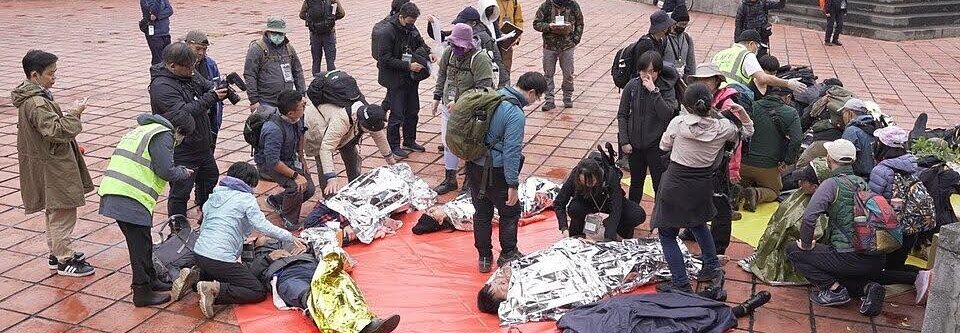

Top Image: Participants engage in first aid training during a Kuma Academy-hosted training scenario in Taipei titled “Operation Blue Magpie” (藍鵲行動) (Jan. 27, 2024). (Image source: Wikimedia Commons)
Introduction
Since the end of Taiwan’s martial law era in the late 1980s and the island’s gradual transition into a free and democratic society, the island has seen the flowering of one of the most vibrant civil societies in Asia. The wide network of grassroots non-governmental organizations (NGOs) in Taiwan has not only made progress possible on a host of challenging social issues within Taiwan itself, but has also made the island an example for other regional civil society activists (see Ben Sando’s article “Taiwan as an Exporter of Democracy in Southeast Asia,” elsewhere in this issue) and a regional NGO hub for international organizations.
As a state that faces a broad variety of natural disasters—ranging from typhoons to earthquakes—in recent decades Taiwan has developed a range of civil society organizations that contribute to disaster relief, as exemplified by the Buddhist relief charity Tzu Chi Foundation (慈濟基金會). In times of need, Taiwan has also seen an outpouring of effort from individual volunteers, as demonstrated by the “shovel heroes” (鏟子超人) who contributed to relief efforts following severe flooding in the Hualien region in autumn 2025.
Amidst the multi-faceted threats to Taiwan posed by the People’s Republic of China (PRC)—threats that have steadily escalated since 2019 [1]—an increasing number of civil defense NGOs have also emerged to help prepare Taiwan’s population for the challenges of a possible future war or other major crisis. These NGOs have arisen to fill a gap in preparedness produced both by the weakness of Taiwan’s military reserve forces, which have long been criticized for a lack of meaningful training, and plans for effective integration alongside active duty military units; [2] as well as the weakness of local-area civil defense structures (such as auxiliary police personnel), which have similarly been criticized for a lack of serious training and employment in emergencies. [3]
Civil Defense NGOs in Taiwan
Any effort to list the civil defense NGOs of Taiwan will inevitably omit many organizations engaged in valuable work. However, some of the more prominent organizations include:
- Kuma Academy (黑熊學院): Perhaps the largest civil defense NGO is Kuma Academy, which describes its mission as grounded in the belief that “If you want peace, prepare for war.” The organization “aims to prepare a pre-war mentality for civilians [and] to cultivate self-defense capability and will to defend Taiwan.” Kuma Academy provides training seminars for the public on matters such as basic first aid, and understanding the nature of modern warfare (as observed from conflicts such as the war in Ukraine). One of the distinctive aspects of the work of Kuma is its focus on psychological resilience, in terms of recognizing and countering hostile authoritarian efforts to sow confusion through propaganda and disinformation.
- Forward Alliance (壯闊台灣聯盟): Founded by former investment banker and army soldier Enoch Wu (吳怡農), Forward Alliance (FA) is another civil defense organization with an extensive presence in Taiwan, albeit one with a lower public profile than Kuma Academy. FA organizes training activities for the public in skill sets such as first aid and basic firefighting. FA is also engaged in training activities for local public sector personnel, such as local police precincts and firefighting companies.
- Academia Formosana (福摩薩學院): Academia Formosana is a civil defense organization closely linked with the Presbyterian Church in Taiwan. The organization describes its efforts as being focused on “community-based civil resilience,” intended to “strengthen the resilience and security of small communities throughout Taiwan.” Through initiatives such as the “Ark Plan,” Academia Formosana seeks to build out logistical support networks and other forms of resilience capacity that could be leveraged in the event of a major conflict.
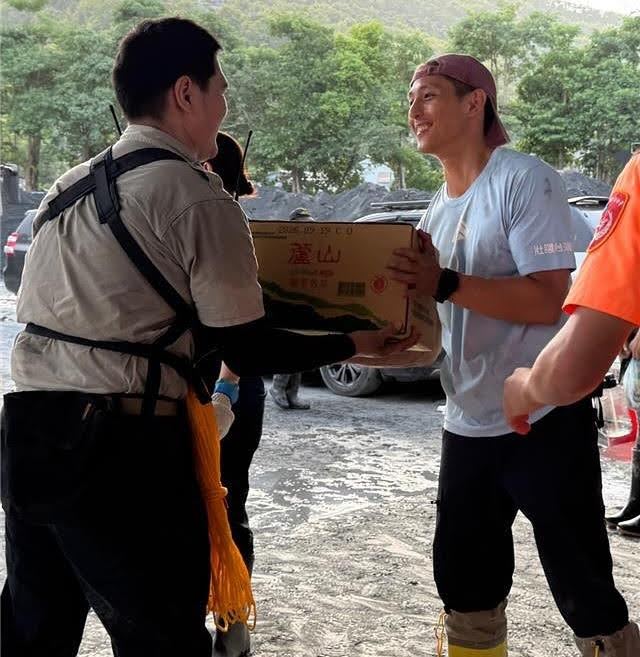 Image: Forward Alliance founder Enoch Wu (吳怡農) (right) takes part alongside volunteers in a civil defense training event (undated). (Image source: Spirit of America)
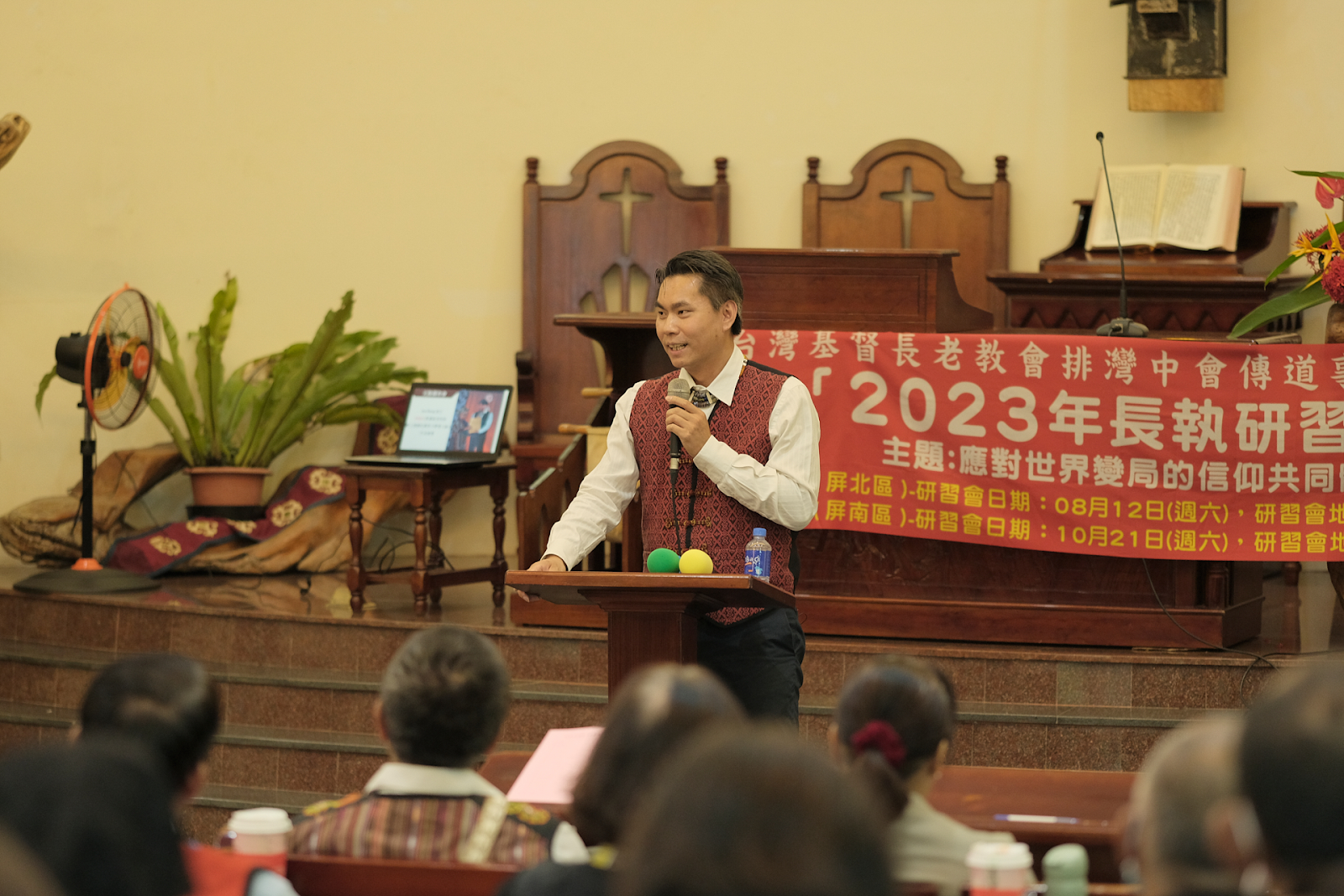
Image: Ljavakaw Tjaljimaraw (謝易宏), CEO of the civil defense organization Academia Formosana, speaks to a church congregation about AF’s “Ark Plan” for building civil defense capacity (Aug. 12, 2023). (Image source: Academia Formosana)
While such organizations perform valuable work in helping to prepare the public (or at least a small, more engaged element of the public) for a major crisis, they continue to face many challenges of a structural social nature. One such problem that continues to inhibit their work is the high degree of polarization in Taiwan’s political system. Many of the people most engaged with civil defense NGOs are linked to the “Pan-Green” side of Taiwan’s political spectrum. For example, Forward Alliance founder Enoch Wu is currently the Taipei City chairman of the Democratic Progressive Party (DPP), and a candidate for Taipei City mayor; and Kuma Academy co-founder Puma Shen is currently a DPP legislator in the Legislative Yuan (LY). Conversely, their most vocal critics are on the “Pan-Blue”—i.e., Kuomintang (KMT) and Taiwan People’s Party (TPP)—side of the divide, with figures from these parties criticizing civil defense organizations on alleged grounds that they are profit-making ventures, and/or making military conflict more likely.
The Lai Administration’s Moves to Engage “All of Society” in Taiwan’s Defense
The administration of Taiwan President Lai Ching-te, in office since May 2024, has made improving “civil defense and resilience” (社會防衛韌性) one of its key policy initiatives. One aspect of this has been a series of 17 measures, announced in a March 2025 speech, to combat espionage and subversive united front activity within Taiwan. The second, and more institutionalized, effort has been centered on the “Whole of Society Defense Resilience Committee” (全社會防衛韌性委員會, WSDRC), first unveiled in June 2024. The WSDRC aims to “serve as a platform for social participation, a bridge for social communication, and an engine for policy effectiveness” by fostering collaboration between government and civil society. Comprising 27 representatives from both government agencies and NGOs, the committee has formally convened six times since its creation, most recently in December 2025.
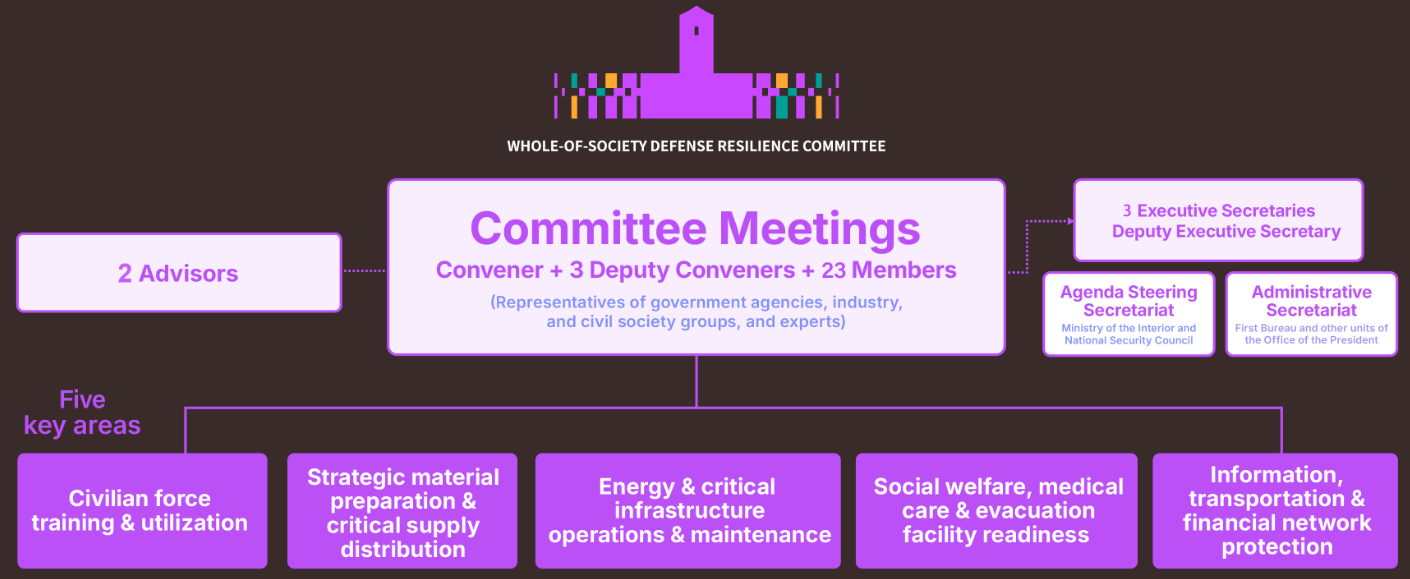
Image: An organization chart for the Lai Administration’s “Whole of Society Defense Resilience Committee,” intended to improve coordination between government agencies and NGOs in critical capacities in the event of a potential crisis. (Image source: ROC Presidential Office)
Beyond the WSDRC as an institution, President Lai has also invested personal time and political capital in the larger project of promoting civil defense awareness and involvement. Examples of this include Lai’s appearance at a civil defense drill held on March 27, 2025, at the Anping Port Facility (安平港) in Tainan, which simulated the response to a massive explosion at the port’s passenger terminal. This has also included attempts at international outreach through events such as the “Resilient Taiwan for Sustainable Democracy International Forum” held on September 20, 2025, which sought to promote international cooperation in facing both “extreme climate-related disasters” and “the expansionary ambitions of authoritarian regimes.” And, while such efforts are still halting, the government sought to give a more prominent role to civil defense and disaster response scenarios in the 2025 iteration of Han Kuang, the largest annual military exercise conducted by Taiwan’s armed forces.
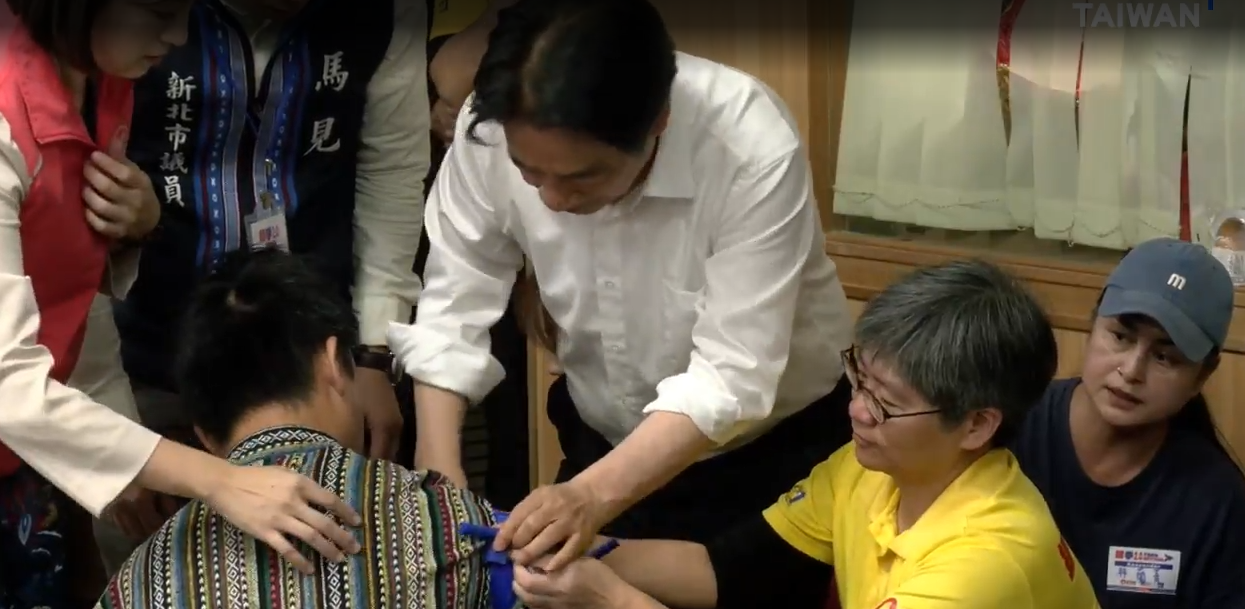
Image: Taiwan President Lai Ching-te (who was a doctor before entering politics), takes part in simulated first aid treatment during a civil society disaster response drill (November 24, 2024). (Image source: TaiwanPlus News)
Government agencies operating under the executive branch have also become more public-facing in terms of promoting public awareness in responding to potential crises. In 2025, the All-Out Defense Mobilization Agency (國防部全民防衛動員署)—the Ministry of Defense’s lead agency charged with “planning, supervising and executing all-out defense manpower mobilization policies”—released a civil defense handbook titled When Crisis Comes (當危機來臨時). The handbook includes information on topics such as basic first aid, dealing with shortages of consumer goods, and how to respond to air raid alarms.
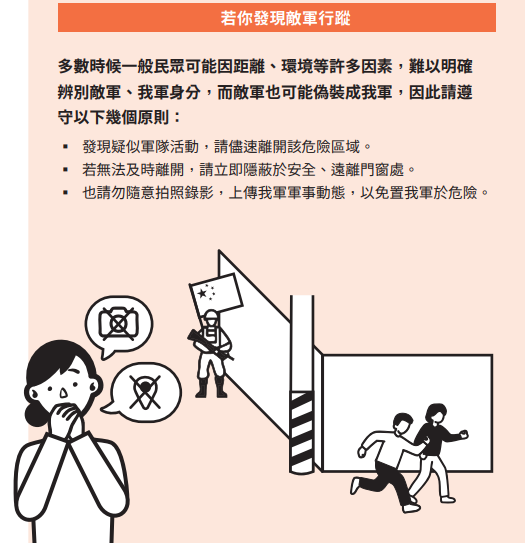
Image: “If You Discover the Location of Enemy Troops” (若你發現敵軍行蹤)—a page from the 2025 Civil Defense Handbook, which recommends leaving the area and against attempting to photograph or film suspected enemy soldiers. (Image source: Ministry of Defense All-Out Defense Mobilization Agency)
Another significant initiative intended to harness the contributions of civilian volunteers—and an effort that demonstrates the intersection of government and NGO efforts—is the “Taiwan Community Emergency Response Team” (T-CERT) (臺灣民間自主緊急應變隊) program.
Modeled on the “Community Emergency Response Team” (CERT) program of the U.S. Federal Emergency Management Agency (FEMA), T-CERT seeks to provide civilian volunteers with basic training in skill sets such as emergency search-and-rescue, medical triage, and firefighting. While the T-CERT program is sponsored by the Ministry of Interior’s National Fire Agency, much of the training is facilitated by Forward Alliance and the U.S.-based NGO Spirit of America. Interlocutors in Taiwan conversant in civil defense issues have identified T-CERT as one of the more promising civil defense training initiatives on the island. [4]
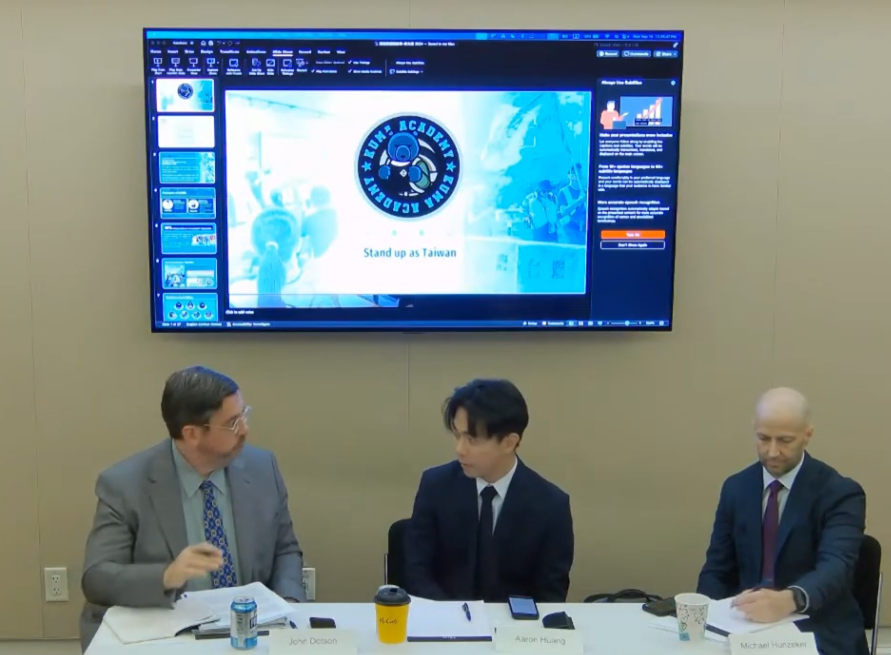
Image: Kuma Academy Director of International Affairs Aaron Huang (center) speaking at a Global Taiwan Institute public seminar on civil defense issues (Sep. 10, 2025). (Image source: Global Taiwan Institute / YouTube)
Continuing Challenges for Civil Defense in Taiwan
Despite such positive signs of progress, Taiwan’s civil defense efforts are a work in progress, and many fundamental challenges remain. One such challenge is the still-nascent level of coordination between many of the government agencies responsible for public safety, and their volunteer counterparts in civil society. Some defense policy and civil society stakeholders have expressed criticism that government initiatives such as the “Whole of Society Defense Resilience Committee” represent pro forma publicity efforts rather than substantive measures, and that close coordination at the working level between government agencies and NGOs remains lacking. [5]
There is also an issue with bureaucratic resistance within some agencies to cooperation with civil society organizations—with the Ministry of National Defense (MND) coming in for particular criticism as an insular institution resistant to change, and to the additional capacities that could be gained from leveraging the logistical, medical, and other resources of civil society. (However, multiple interlocutors have indicated a much greater openness from Interior Ministry bodies—such as the National Police Agency and the National Fire Agency—to engage with civil society groups, and to benefit from resulting training opportunities, as compared to the MND.) [6] Additionally, there is the need to integrate and deconflict the overlapping roles of legacy state institutions—such as auxiliary police (義警) and auxiliary fire personnel (義防) [see endnote #3] —and competing newer organizations like T-CERT.
Finally, there is the need to overcome the barriers presented by Taiwan’s polarized political climate. Government and civil society coordination on civil defense initiatives has been hampered by KMT attacks on some NGOs (particularly Kuma Academy), and opposition to government funding for civil defense initiatives. [7] As long as civil defense preparation is treated as a project for only one side of the political spectrum, rather than as a unifying effort in the face of a common threat, Taiwan’s quest for greater “social resilience” will be fighting with one hand tied behind its back.
Both the agencies of Taiwan’s government, and the activists and volunteers of its civil society organizations, face a daunting task in seeking to prepare Taiwan for a military conflict or other major crisis. Much remains to be done, particularly in terms of breaking down the institutional and cultural barriers between government and private organizations unaccustomed to working with another. But, in halting and uneven steps, progress towards greater “social resilience” is being made.
The main point: In response to increasing threats from the People’s Republic of China, Taiwan’s civil society has produced a number of active civil defense NGOs focused on skills such as first aid, logistical support, and psychological resilience. Taiwan’s government is supporting a series of measures, such as the T-CERT program and the “Whole of Society Defense Resilience Committee,” which are intended to better leverage the resources of civil society to support civil defense. While progress has been made, much remains to be done in terms of better coordination between government agencies and civil defense NGOs.
[1] In 2019, the CCP leadership staked out a more assertive political position demanding “unification” with Taiwan—with escalating levels of military activity and subversive political warfare following from this. For a discussion of this, see: John Dotson, The Chinese Communist Party’s Ideological Frameworks for Taiwan Policy (Global Taiwan Institute, August 2024), pp. 7-9, https://globaltaiwan.org/wp-content/uploads/2024/08/OR_CCP-Ideological-Frameworks-for-TW-Policy.pdf.
[2] Taiwan’s military reserve forces have long been subject to criticism, including from this author, on such grounds. See: John Dotson, “Taiwan Contemplates Reforms to Its Reserve Forces,” Global Taiwan Brief (April 6, 2022), https://globaltaiwan.org/2022/04/taiwan-contemplates-reforms-to-its-military-reserve-forces/; and John Dotson, “Taiwan’s Defense Policies in Evolution,” Journal of Indo-Pacific Affairs (Spring 2025), https://media.defense.gov/2025/Apr/24/2003696549/-1/-1/1/FEAT-JIPA-DOTSON.PDF.
[3] Taiwan has long possessed auxiliary public safety personnel, such as auxiliary police (義警) and auxiliary fire/rescue personnel (義防). These organizations are primarily managed by local (i.e., city/county/township)-level governments. Per multiple conversations held by the author with civil defense stakeholders in Taiwan in 2024-2025, multiple interlocutors offered similar criticisms of such organizations: that they were often tied to local political patronage networks; that their members were often older and conducted little real training; and even that they functioned more as social networks (“mahjong clubs,” as stated by one observer) rather than as groups engaged in meaningful ways with public safety. The author has withheld the names of such persons to maintain their confidentiality.
[4] Author’s interviews in Taiwan, December 2025.
[5] Author’s interviews in Taiwan, 2024-2025.
[6] Ibid.
[7] Ibid. See also: Brian Hoie, “Pan-Blue Camp Continues to Target Kuma Academy, Focuses on Links with AIT,” New Bloom Magazine (March 15, 2025), https://newbloommag.net/2025/03/15/kuma-academy-attacks/; and
“KMT Pans Kuma Academy Disaster Prevention Kits,” Taipei Times (June 20, 2025), https://www.taipeitimes.com/News/taiwan/archives/2025/06/20/2003838933.