
This article was originally published on April 27, 2026 and was updated on May 5, 2026.
Taiwan’s President Lai Ching-te (賴清德) was supposed to embark on his first diplomatic trip to Africa on April 22. The delegation was heading to the Kingdom of Eswatini for several days in honor of the 40th anniversary of King Mswati III’s accession to the throne. Eswatini, the last of Taiwan’s official diplomatic allies in Africa, is an absolute monarchy located in southern Africa. Mswati, who has 16 wives and over 30 children, attended Lai’s 2024 inauguration, and then-President Tsai Ing-wen visited the country in September 2023 before the end of her second term in office. For a moment, it looked as if Lai was going to do what a typical head of state does—carry out state-to-state diplomatic relations—which, given Taiwan’s diplomatic isolation, is a rare occurrence for its president. The Eswatini celebration will have many other leaders from around Africa in attendance, which would have granted Lai potential exposure to other heads of state on the continent.
Not so fast.
At the eleventh hour, Taipei announced that the entire trip was canceled because Lai’s plane could not get to Eswatini. There were no mechanical issues with the aircraft. Rather, three countries on Lai’s flight route—Seychelles, Mauritius, and Madagascar—revoked permission for Lai to fly through their airspace. Without these flight permits, Lai could not easily reach Eswatini, as these three countries control a significant portion of the airspace in the Indian Ocean, and diverting to another route would have likely resulted in more countries following suit.
There is a debate that rightfully questions the purpose of Taiwan’s official relationship with Eswatini given its history of violence against democratic protests and activism. Indeed, there is an element of hypocrisy that Taipei must address for supporting such an anti-democratic government while it paints itself as a global bastion of democracy elsewhere.
This article does not seek to analyze the Taiwan-Eswatini relationship. Instead, it focuses on the implications for Taiwan of Lai’s canceled trip. The forced cancellation of this trip marks a new type of coercion carried out by the People’s Republic of China (PRC) in its effort to constrain Taipei’s ability to carry out normal international relations.
Chinese Coercion at High Altitude
How did a typical diplomatic visit get upended so drastically? Why would three separate countries revoke a sitting president’s ability to fly through their airspace? Taiwan’s answer is simple: China bullied them into doing it. In a press conference held on April 21, Pan Meng-an (潘孟安), the secretary-general to President Lai, blamed the PRC government for the abrupt cancellation, stating that:
President Lai was originally scheduled to depart on April 22 for a visit to Eswatini. However, flight permits for certain countries along the charter flight’s route were abruptly canceled. […] According to our understanding, three countries, Seychelles, Mauritius, and Madagascar, canceled the flight permits for the president’s charter plane without prior notice or justification. The real reason behind their decisions was intense pressure from the authorities in China, including economic coercion. […] The government of the Republic of China (Taiwan) strongly condemns the crude and coercive actions of the authorities in Beijing.
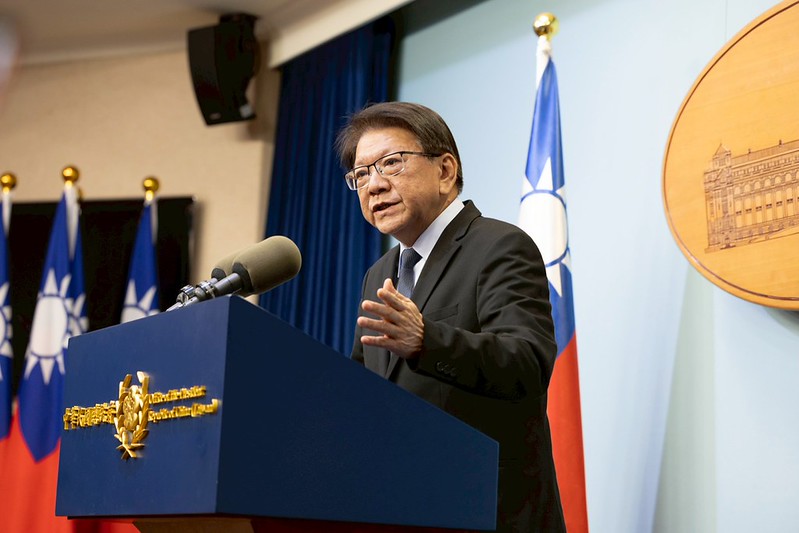
Image: Secretary-General to the President Pan Men-an speaking at a press conference at the presidential office, announcing the cancellation of President Lai’s planned trip to Eswatini (April 21, 2026). (Image source: ROC Presidential Office)
It is currently not known what sort of coercion Beijing implemented to get the three countries to revoke overflight permission. Seychelles and Madagascar did not allow overflight because they do not recognize Taiwan as a country, so they banned the president from using their airspace for the diplomatic delegation. A Madagascar Ministry of Foreign Affairs official said, “Malagasy diplomacy recognises only one China. The decision was made in full respect of Madagascar’s sovereignty over its airspace.” And a Seychelles official said, “The decision was taken independently and in accordance with established procedures.”
However, according to Taipei, there’s more to the story than three countries all independently making the same decision at the same time. According to one official in Taipei, Beijing threatened to revoke debt relief for these countries if they did not block Lai’s flight.
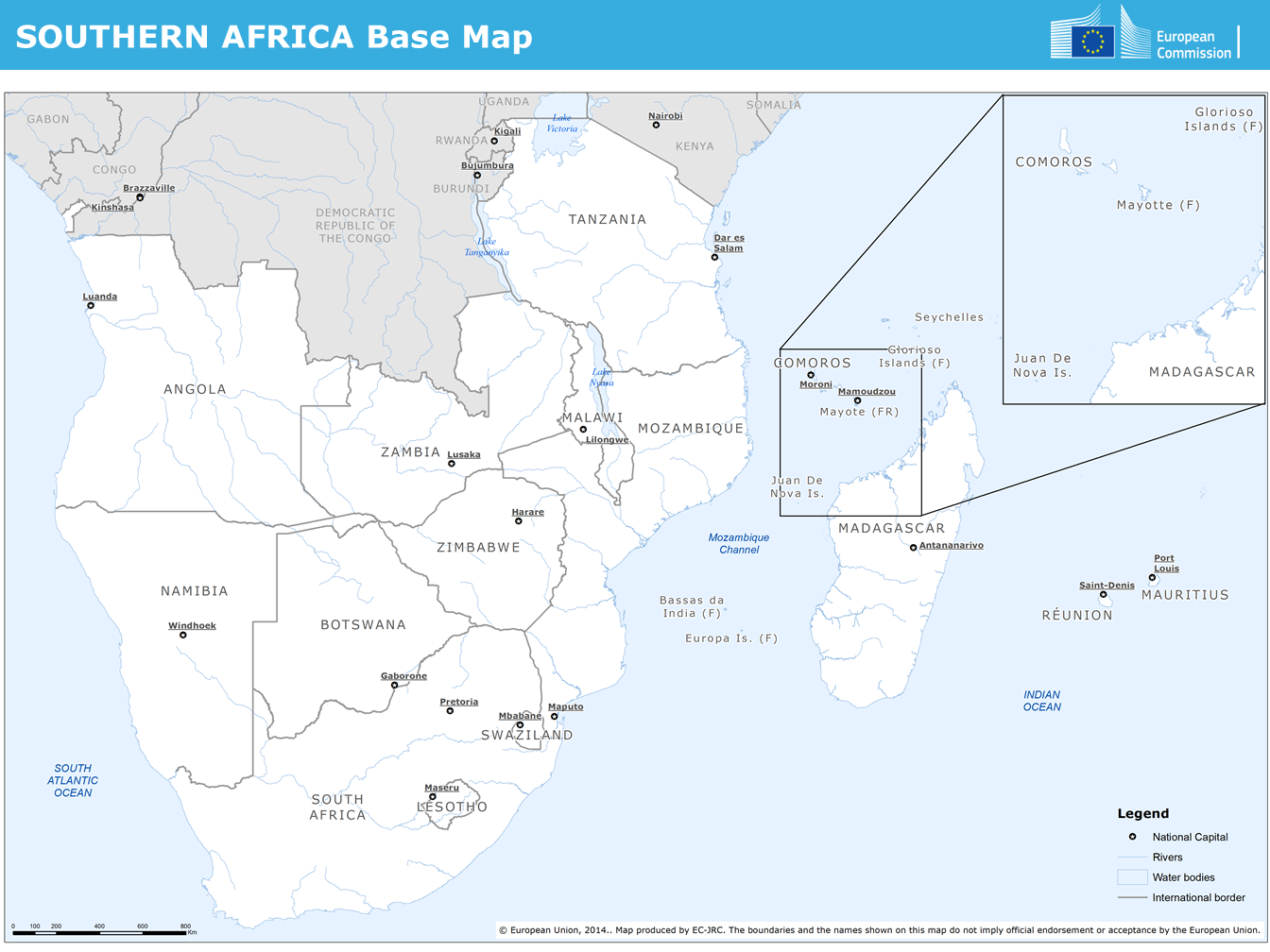
Image: A map of southern Africa showing Eswatini (labeled here as Swaziland, the country’s name prior to 2018). As a landlocked country, flights to Eswatini’s capital Mbabane must pass through the airspace of one of its neighbors. Flights from Asia would approach from the east, and would need to pass through the airspace of the Seychelles, Comoros, Mauritius, and/or Madagascar, unless employing a circuitous route. (Image source: European Commission / Wikimedia Commons)
Beijing’s Economic Coercion in Relation to Taiwan’s Diplomatic Contacts
The use of debt as leverage has, of course, played no part in official PRC commentary about the denied overflight permissions—which has instead praised the three African states for making a correct diplomatic decision. PRC Foreign Ministry Spokesperson Guo Jiakun (郭嘉昆) applauded the decision by the three countries when asked about it during a regular press conference on April 22, and used it as an occasion to once more assert PRC sovereignty claims over Taiwan:
All African countries, with the sole exception of Eswatini, have established diplomatic ties with China [and] have reiterated on many occasions that they firmly uphold the one-China principle, there is but one China in the world, Taiwan is an inalienable part of China’s territory, the Government of the People’s Republic of China is the sole legal government representing the whole of China, and they firmly support all efforts by the Chinese government to achieve national reunification. China highly commends relevant countries’ commitment to the one-China principle which is fully consistent with international law and basic norms governing international relations. It’s very clear that there’s no longer a so-called “ROC president” in the world anymore. Anyone who wears that false title is acting against history and will only invite disgrace upon themselves.
Despite its effort to present its coercive measures in upright diplomatic terms, Beijing has a long history of utilizing bullying and arm-twisting to prevent Taiwanese officials from participating in international organization meetings—as well as to prevent foreign officials from supporting or visiting Taiwan.
Beijing carried out a massive economic pressure campaign against Lithuania when Vilnius and Taipei announced plans to open unofficial representative offices in each other’s capitals. It canceled a large order of Czech pianos after a group of Czech legislators visited Taiwan. It regularly blocks Taiwan from attending meetings as a guest observer at international fora such as the World Health Assembly, Interpol, and International Civil Aviation Organization. Now, it has bullied three African countries into forbidding Taiwan’s president from using their airspace, even in a situation where Lai had not made a landing request for refueling—as the president was planning to fly directly from Taiwan to Eswatini, both to avoid putting any country in a difficult position and to circumvent the turmoil in the Middle East.
The decision by Mauritius, in particular, should trouble the United States and its allies as the overflight ban demonstrates the level of economic power that Beijing holds over the country. Mauritius has historically held sovereignty over Diego Garcia, which is a critical military base in the Indian Ocean. The United Kingdom is currently working towards a deal with Mauritius on the future of the island and the base. If Beijing can play such a heavy hand on Lai’s overflight access, then London and Washington need to worry about the role of China in the future success of any deal over Diego Garcia. This one example sheds light on global Chinese influence and how one decision related to Taiwan demonstrates future potential dangers for other countries.
Taiwan’s Isolation: A 35,000-Foot View
The decision by Mauritius, Madagascar, and Seychelles fits into a broader pattern of countries prioritizing their relationship with Beijing over short-term negative press about Taiwan—or third-order concerns of other countries about their reliability in the face of Chinese coercion.
In advance of the visit, the Lai administration tried to paint a promising picture of Taiwan’s international relations in Africa. Over 40 African officials from 11 countries expressed support for Lai’s visit. However, outside of Somaliland, which has a strong quasi-official relationship with Taiwan, it’s unclear how many of these countries—Malawi, Botswana, Central African Republic, Democratic Republic of the Congo, Ivory Coast, South Africa, Nigeria, Uganda, Kenya, and Zimbabwe—would welcome Lai into their countries. Taiwan’s Ministry of Foreign Affairs noted that the support was cross-regional and cross-party, but did not mention if any of the ruling parties expressed such support.
There are only so many countries remaining that would welcome Lai, and resist Chinese efforts to stop such a visit. Officially, there are only 12 countries left on earth that would welcome Lai for an official state visit. But that number shrinks after considering that Lai did not attend the 2025 inauguration of Pope Leo XIV to avoid putting the Holy See in an awkward position with Beijing—despite its official relationship with Taipei. And Lai has only conducted a stopover visit in Guam and Hawaii since becoming president—he has not yet visited the continental United States. The Trump administration canceled a planned stopover visit to New York in 2025 in an effort to reduce major obstacles to a trade deal, and eventually a summit between President Donald Trump and CCP General Secretary Xi Jinping.
Lai’s ability to travel and carry out his role as president by engaging in state-to-state relations is becoming increasingly endangered as countries push Taipei aside in hopes of better ties with Beijing. When Tsai Ing-wen was president, she faced similar dilemmas, but was able to visit 17 countries, including nine in her first two years in office. Granted, six of those countries no longer have diplomatic relations with Taiwan, so Lai’s list is much more limited. It shows how few and far between such opportunities are for Lai.
The Chinese pressure on Seychelles, Mauritius, and Madagascar is a precedent-setting move. And whenever Beijing carries out such a move, it is not the only time that it will occur. Eswatini is Taiwan’s last ally in Africa, and Paraguay is Taiwan’s last ally in South America. If Lai wanted to visit Paraguay—a country high on Beijing’s poaching list for the same symbolic reasons as Eswatini—what is stopping Beijing from pressuring one or more countries in South America from following the Africa precedent? Brazil, Bolivia, Peru, or Argentina, for example, could block Lai’s overflight permissions to travel to their landlocked neighbor Paraguay.
Some countries may be resolute in their support for Taiwan, but if Beijing cannot win their formal diplomatic recognition, then it can now use a new tool to prevent the president of Taiwan from carrying out state-to-state diplomacy.
Turbulence Ahead?
It’s unclear what would be next for Lai. Canceling a trip to Eswatini is not going to negatively affect the average Taiwanese citizen, especially since Foreign Minister Lin Chia-Lung (林佳龍) made the trip instead. The economic benefit of the relationship or any deals signed on the trip would also be negligible. However, the damage done to Taiwan is not entirely symbolic, as the Chinese coercion in this instance is novel and likely to be used again. The Lai Administration needs to game out a response to future scenarios in which third parties attempt to prevent him from carrying out his formal presidential duties.
One positive for Lai in the domestic space is the effect that this Chinese bullying might have on the opposition parties’ cross-Strait messaging. This incident occurred in the direct aftermath of the pseudo-summit between Kuomintang (KMT) Chairwoman Cheng Li-wun (鄭麗文) and Xi. Both opposition parties, the KMT and Taiwan People’s Party, condemned China’s role in the cancellation of Lai’s trip. This whole situation does not help their argument for fostering closer cross-Strait relations when Beijing acts out so blatantly.
This incident could spark some goodwill, or even pressure, on the Trump Administration to allow Lai his desired New York stopover. In July 2025, the Trump administration blocked Lai from stopping in New York on his way to Latin America. Such a stopover should be allowed now as a way to push back against the PRC’s recent actions. As Beijing continues to expand its coercion toolkit against Taiwan, Washington and like-minded partners need to consider how best to tackle the issue head-on. At the very least, the Trump Administration could publicly announce that Lai is welcome to enter the United States without a stopover refueling excuse, as a way to counter further Chinese coercion. The canceled Eswatini visit perfectly encapsulates the creativity of Beijing’s comprehensive global coercion directed against Taiwan, and creative solutions are needed to sufficiently counter it.
The main point: The recently canceled diplomatic visit to Eswatini by President Lai Ching-te is a new precedent-creating type of coercion carried out by the People’s Republic of China against Taiwan. Pressuring third countries into denying Taiwan’s president airspace access has the potential to limit the friendly skies through which Lai and his successors can use to fulfill their democratically-elected duties.
May 5 Update: The Skies Are Free Again?
After Taipei announced the cancellation of the Eswatini trip, Lai subsequently surprised the world by secretly traveling to the country on May 2. Seychelles, Madagascar, and Mauritius did not have changes of heart—and Lai did not convince other countries in the region to allow him overflight. (In fact, both Germany and Czechia reportedly refused to allow Lai a re-fueling stopover after the initial route did not work out. The two European countries were reportedly concerned about the effect that such a decision would have on their relationship with Beijing.)
Instead, Lai took King Mswati III’s own private jet, traveling to Eswatini and back in the company of Eswatini’s deputy foreign minister. Lai took a circuitous route through the southern Indian Ocean, which avoided flying over any of the airspace of the three African nations in question. However, Indonesia, Malaysia, Brunei, the Philippines, and Australia all provided the Eswatini aircraft with overflight permission.
Lai was able to outmaneuver Beijing in the end, but the episode represents a significant change in how countries handle Taiwanese politicians’ ability to travel abroad, and how Beijing utilizes coercion and fear to prevent Taipei from carrying out state-to-state relations.