
Towards the end of January this year, the European Parliament adopted a resolution that called for “enhancing security and defense cooperation and partnership with the EU’s Indo-Pacific partners, including Taiwan, particularly in drone technology and relevant industries.”
The European Parliament’s call for more defense cooperation with Taiwan has followed sustained efforts by certain member states—namely Poland, Czechia, and Baltic nations—to chase down drone cooperation with Taiwan. These European countries seek to remilitarize and achieve technology transfers and investments with added value—largely inspired by Ukraine’s successful use of drones in its defense against Russian aggression.
Taiwan has seized this opportunity as a means to diversify economic ties with Europe beyond semiconductors. As recently as December 2025, Minister of Economic Affairs Kung Ming-hsin (龔明鑫) visited Prague and Warsaw, and elevated drones to one of the key topics for discussion with public and private sector counterparts. Warsaw and Taipei also signed a memorandum of understanding on developing secure supply chains, free of weaponizable Chinese components (risks associated with potential cyber vulnerabilities, or supply-side dependencies). This is the main selling point for Taiwanese drones globally and has fostered new discourse on so-called “non-red” supply chains. Such a drone supply chain could help to curb European state over-reliance on unmanned aerial vehicles (UAVs) from China.
Czechia has emerged as the largest buyer of Taiwanese drones, followed by Poland—sales to these countries have been a significant component of the 35-fold increase in exports of Taiwan-made UAVs over 2025, as reported by The Economist. This makes cooperation between Taiwan and Europe a mutually beneficial endeavor: Europe secures a supply of critical military technology for itself, and Taiwan can scale up its budding UAV industry.
New Friends and Old Partners Drive the Momentum
This development is part of a broader trend of maturing ties between European states and Taiwan. Taiwan-European ties have increasingly normalized over the past five years, shifting from covert engagement to interactions in the public spotlight. Data on mutual engagements between EU members and Taiwan—collected by the EU-Taiwan Tracker project run by the Central European Institute of Asian Studies—shows a five-fold increase in overt engagements with Taiwanese interlocutors between 2019 and 2024. These engagements span economic, political, security, para-diplomatic, and civil society fields.
However, Europe is not a homogenous region. Under deeper analysis, four categories of European state interactions with Taiwan emerge:
- Old Partners: Largely encompassing countries of Western Europe that have fairly broad and long-term relations with Taiwan, often dating back to the period of their diplomatic recognition of the Republic of China. These countries maintain robust economic ties with Taiwan and often engage with Taiwanese counterparts at the political level as well.
- New Friends: Countries of the Central and Eastern Europe (CEE) region that, after a period of dormancy, rediscovered engagement with Taiwan at the beginning of the 2020s. They are often among the most politically active European states vis-à-vis Taiwan.
- Pragmatists: Countries that are relatively wary of pursuing political relations with Taiwan (for a variety of reasons), yet enjoy beneficial economic ties.
- Laggards: States with comparatively underdeveloped relations with Taiwan in both political and economic domains, and which would require wide-ranging changes in their approach to Taiwan to engender more robust (political or economic) ties with Taiwan.
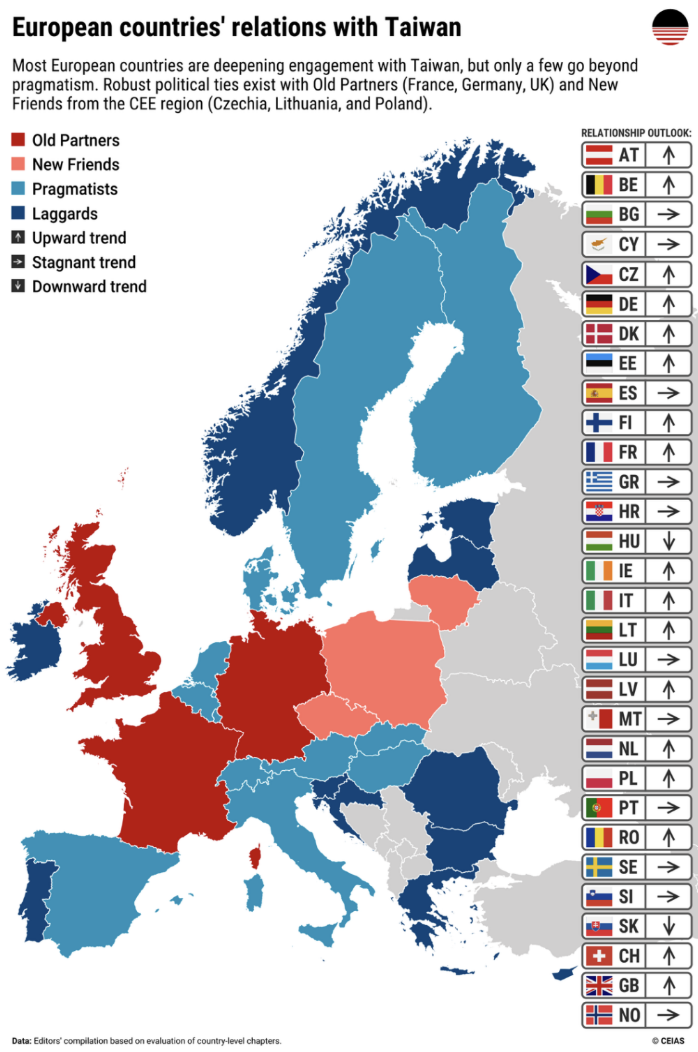
Image: Map showing the relationship types of European countries with Taiwan (Image Source: CEIAS)
The two former groups—Old Partners (France, Germany, the United Kingdom) and New Friends (Czechia, Lithuania, Poland)—alongside the EU institutions, are responsible for most of the growth in Europe-Taiwan relations, as well as the expansion of acceptable limits for engagement with Taipei.
For instance, while meetings at the deputy ministerial-level have become fairly normal, ministerial-level interactions are still unusual. Two instances have occurred of European ministers visiting Taiwan. In 2023, German Education Minister Bettina Stark-Watzinger visited Taiwan. In 2025, Taiwan welcomed Czech Minister of Science, Research, and Innovation Marek Ženíšek. In all instances of high-level interaction, visits were carried out by officials in charge of less-sensitive portfolios (i.e. ministers in charge of foreign affairs or national defense did not visit the island).
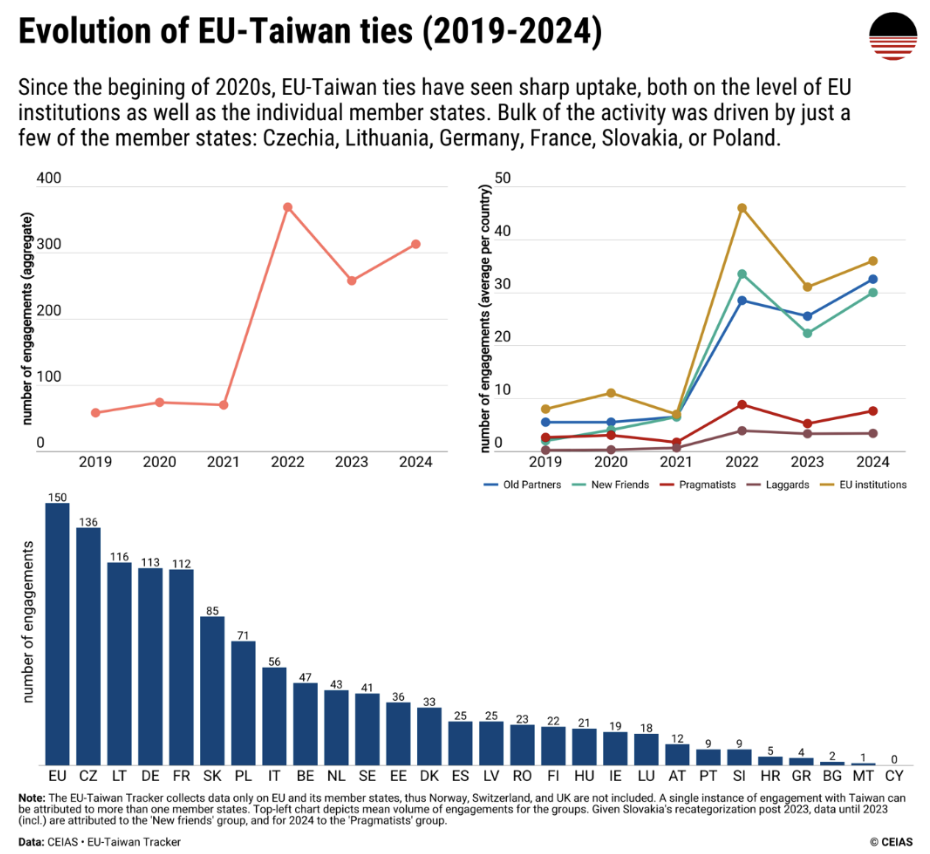
Image: Graphs showing engagement trends between EU countries and Taiwan (Image Source: CEIAS)
Nevertheless, even though individual European states differ in how they approach Taiwan, most European countries are allowing greater leeway for political, economic, and societal engagement with Taiwan. This gives Taiwan opportunities to engage European nations not just in the fields of trade, investment, technology, or culture—traditional cooperation areas—but to move also into areas usually considered more sensitive, such as political and security cooperation.
Three Dynamics Erode Taboos on Security Cooperation
For a long time, European governments have treated security and defense cooperation with Taiwan as a taboo issue, driven by fears of potential Chinese retribution. Indeed, after France supplied Taiwan with frigates and fighter jets in the early 1990s, it faced a diplomatic standoff with Beijing. It was settled only in 1994, after Paris pledged not to make future military sales to Taiwan, and agreed to a Beijing-aligned interpretation of a One-China Policy.
The recent evolutions in drone cooperation, however, indicate that perceptions regarding defense and security cooperation with Taiwan are rapidly changing across Europe. In fact, three recent developments have been essential to dismantling the traditional taboos. First, “security-adjacent” economic cooperation is exposing Europeans to the idea of security, and even military, cooperation with Taiwan. While partnerships on secure UAV supply chains are one example of security-adjacent economic cooperation, more is already happening. Last September, an unprecedented number of European companies made their way to Taipei to showcase their products at the Taipei Aerospace and Defense Technology Exhibition, Taiwan’s largest defense trade show. Among them was Airbus, the European aerospace giant, which is otherwise keen on selling its commercial aircraft to China, the company’s largest individual market. Czech and German defense companies also made appearances.
Europe’s long-standing interest in Taiwanese semiconductor investments is vital not just for the continent’s automotive industry or AI companies, but also for the continent’s remilitarization efforts. Modern defense platforms rely heavily on supplies of microchips, enhancing Taiwan’s industrial importance. In this light, widespread dependencies on imports of mature node (legacy) chips from China are particularly worrying. Initiatives like the ESMC fab in Dresden—a joint project between Taiwan’s TSMC and European chipmakers Bosch, Infineon, and NXP, which will produce legacy chips—directly contribute to Europe’s effort to wean itself off imports from China, and achieve its 2030 goal of producing 20 percent of the world’s semiconductors.
Security-adjacent business deals have also led to projects based in Taiwan. Given its near-total reliance on imported fossil fuels, Taiwan runs the risk of being cut off from imports of coal, oil, and LNG in the event of a China-initiated blockade or military invasion. Supply disruptions caused by the Hormuz Strait blockade have highlighted this strategic vulnerability. To improve Taiwan’s resilience, European companies have been investing in the construction of offshore wind farms, and prospecting Taiwan’s potential for geothermal energy generation. Danish companies have played a crucial role in this regard—the Ørsted-developed Greater Changhua 1 and 2a wind farms (大彰化離岸風力發電場), inaugurated in 2024, have essentially doubled Taiwan’s offshore wind capacity.
Secondly, Taiwan and Europe increasingly engage on matters of soft security, such as dialogues on how to respond to Chinese and Russian foreign information manipulation and interference (FIMI) operations. Overlapping interests also exist in the protection of critical infrastructure (such as undersea cables) or economic security. Much of the cooperation has been driven by the Global Cooperation and Training Framework (GCTF), a platform initiated in 2015 by Taiwan with the participation of the United States, Japan, Australia, and Canada. While it took until 2025 before a European country—the United Kingdom—joined the GCTF, many European nations have participated in individual activities on a more ad hoc basis. This includes Taiwan’s more active partners such as Czechia and Lithuania, but also more reluctant states such as the Netherlands, Finland, and even Greece. This renders the GCTF a valuable tool for fostering cooperation in areas that might otherwise be too sensitive for bilateral cooperation.
Thirdly, the global polycrisis, including disruptions caused by the COVID-19 pandemic, China’s weaponization of supply chains, and Chinese and North Korean support for Russia’s aggression against Ukraine, have driven home the understanding that European and Indo-Pacific security are deeply interconnected. This has contributed to advent of European nations’ freedom-of-navigation operations (FONOPs) in the region. European nations have even conducted FONOPs through the Taiwan Strait, asserting its status as an international waterway. In 2024, Dutch, German, and French ships transited the Taiwan Strait, much to Beijing’s dismay. A year later, in September 2025, the UK traversed the Strait jointly with the United States during Operation Highmast, which saw a British carrier strike group make several port calls and engage in various exercises across the Indo-Pacific.
Way Forward: Investing in Futureproofing the Relationship
Under the pressure of geopolitics and the global polycrisis, Europe’s traditional misgivings about security cooperation with Taiwan are steadily fading away. However, ensuring the momentum carries forward requires both sides to invest in future-proofing the relationship:
- Taiwan and the EU should continue to pursue diversification of economic relations beyond semiconductors and into other security-adjacent fields such as artificial intelligence, quantum computing, biotech, aerospace engineering, or energy. Focusing on building supply chain resilience in these fields will help Taiwan to position itself as Europe’s indispensable partner.
- Achieving lasting economic cooperation in these fields requires that Taiwan and Europe work together to remove remaining tariff and non-tariff trade and investment barriers. Imposition of local content requirements by Taiwan against European wind energy companies—which resulted in the EU initiating WTO proceedings against Taiwan in 2024—should serve as a warning scenario.
- In order to better withstand political fluctuations in Europe and Taiwan, both sides need to invest in relationship building. This should include interactions across the political spectrum, and the pursuit of broader party-to-party relations—a dimension of mutual relations that has so far been mostly underdeveloped.
- European countries and Taiwan should double down on ongoing and future track 1.5 diplomacy initiatives, which can serve as platforms for constructive evaluation and feedback on the relationship.
- European states should continue to engage Taiwan in dialogue on soft security issues where both sides have overlapping interests as well as a corpus of experiences and lessons learned that can be shared. For sustained soft security cooperation, European countries should move towards full membership in the GCTF platform. To help achieve this end, Taiwan should work with existing members, like the UK, Australia, or Japan, to motivate European stakeholders to pursue this goal.
The main point: Catalyzed by a global polycrisis and associated disruptions, Taiwan and European countries have rapidly moved towards deepening their relations—resulting in a five-fold increase in engagement volume in recent years. Engagement is now delving into the more sensitive areas of security and defense cooperation. To ensure continued momentum, both sides need to invest in future-proofing their mutually-beneficial ties.