
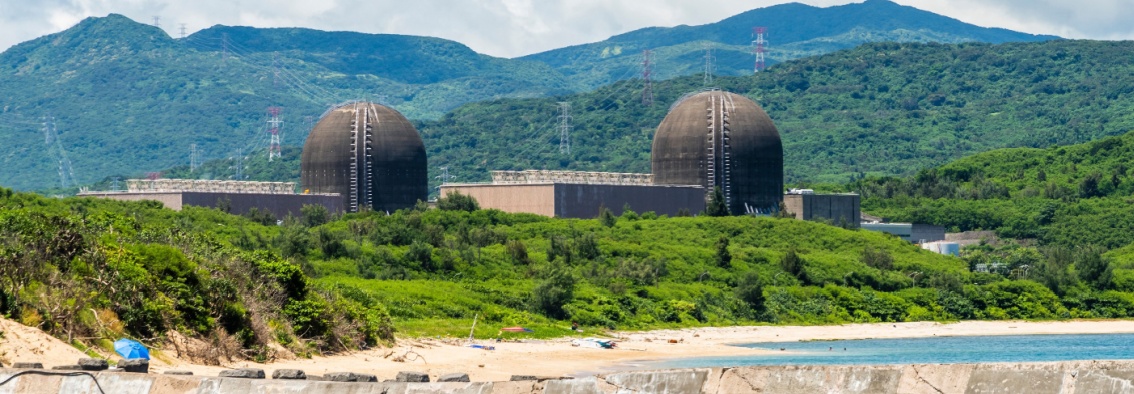

Since its inception in 1986, Taiwan’s Democratic Progressive Party (DPP, 民進黨) has adopted an anti-nuclear policy stance, aligning with Taiwan’s environmental and civil society groups in pursuing a “nuclear-free homeland” as a core party goal. By contrast, the Kuomintang (KMT, 國民黨) has traditionally been more supportive of nuclear power: all three of Taiwan’s nuclear power plants—Chinshan, Kuosheng, and Maanshan—comprising a total of six reactors, were constructed under KMT governments during the 1970s and 1980s.
Since President Lai Ching-te (賴清德) of the DPP assumed power in May 2024, his government has indicated a shift in the party’s long-held anti-nuclear policy by considering the restart of nuclear reactors and exploring advanced small modular reactor (SMR) technologies.
This brief has three objectives: first, it examines the DPP’s nuclear policy since the party first came into power in 2000; second, it analyzes the emerging changes in the DPP’s stance under the Lai Administration; and third, it explores the factors driving these changes.
DPP Nuclear Policy in Retrospect
The DPP emerged from the Tangwai (黨外, “outside the party”) pro-democracy movement of the 1980s. Its anti-nuclear stance was both an environmental commitment and a political strategy to challenge the authoritarian development model of the ruling KMT. When the party came into power for the first time in 2000, it put its nuclear-related policies into practice. The administration of President Chen Shui-bian (陳水扁, 2000-2008) halted the construction of the Fourth Nuclear Power Plant (Lungmen), which had already begun. It also codified the “nuclear-free homeland” principle into the Basic Environment Act of 2002 (環境基本法第23條), and established a Nuclear-Free Homeland Advisory Committee (非核家園推動委員會) that coordinated civil society, environmental groups, and government agencies to advance the phaseout agenda.
Japan’s Fukushima nuclear accident in 2011 gave the DPP, which was then in opposition, renewed momentum to advance its long-standing “nuclear-free homeland” agenda: phasing out Taiwan’s reactors and embedding anti-nuclear policies more firmly into national energy policy.
Upon the DPP’s return to power in 2016, the administration of President Tsai Ing-wen (蔡英文) (2016-2024) launched a comprehensive energy transition plan. It enacted the Electricity Act Amendment of 2017, which codified the principle of a “nuclear-free homeland” into law and directed Taipower (台灣電力公司)—Taiwan’s state-owned electric utility responsible for power generation and distribution—to restructure, promote, and liberalize the electricity market.
As the initial 40-year operation period of nuclear power plants approached, the DPP decided to retire them. The first of the six reactors, Chinshan Unit 1, was closed in December 2018; and the last, Maanshan Unit 2, was closed by May 2025. With this, Taiwan’s nuclear energy reached zero, and the DPP achieved its goal of a “nuclear-free homeland.”
To replace nuclear energy—which at times had constituted up to 20 percent of Taiwan’s energy supply—the Tsai Administration pursued a policy with energy targets of 20 percent renewables, 30 percent coal, and 50 percent liquefied natural gas (LNG) by 2025. It made massive investments in offshore wind and solar, positioning Taiwan among the top five globally in offshore wind capacity, while renewables grew from 4.1 percent in 2016 to 12 percent by 2024.
Crucially, the Tsai Administration pursued the “nuclear-free homeland” policy despite growing broad overall support for nuclear energy. For instance, in the 2018 referendum, approximately 59.5 percent of voters voted in favour of keeping nuclear power available, versus 40.5 percent who voted against it. The DPP continued its resolute policy of a “nuclear-free homeland” during Tsai’s two terms as president. However, this policy began to reverse under her successor, President Lai Ching-te.
Lai’s Reversal of Nuclear Policy
After taking office in May 2024, although President Lai did not halt the ongoing decommissioning of the last reactor, he adopted a more pragmatic approach to nuclear technology. He indicated the possibility of reviving existing reactors and deploying advanced nuclear energy technology such as “small modular reactors” (SMRs)—conditioned on ensuring nuclear safety, resolving nuclear waste issues, and achieving social consensus. He instructed both the Nuclear Safety Commission and Taipower to initiate the regulatory and safety inspection processes required before any restart could proceed.
Lai defended this policy reversal by arguing that reviewing a possible restart of nuclear power plants was fully compatible with Taiwan’s continued push for renewable energy, and necessary due to the strain that expanding AI applications are placing on the power grid. Under the Lai Administration, the DPP made a pragmatic reassessment of its long-standing opposition to nuclear energy, even though this put it at odds with environmentalist groups that had long been its partners.
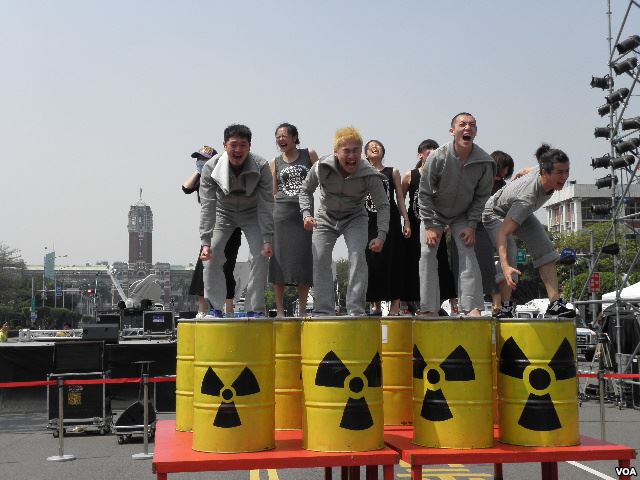
Image: Activists pose on top of simulated barrels of nuclear waste at an anti-nuclear power protest near the Presidential Office Building in Taipei (March 2013). (Image source: Wikimedia Commons / VOA).
Factors Behind the Reversal in Nuclear Policy
Several factors played a role in the gradual reversal of the DPP’s policy, as discussed below.
The Politics of Electricity
The Taiwanese public has demonstrated growing support for the continued use of nuclear energy, as evidenced by two recent referendums. As mentioned before, in the 2018 referendum, 59.5 percent of voters favored maintaining nuclear power generation. While the 2025 referendum failed due to low voter turnout, an overwhelming 74 percent of those who did cast ballots supported restarting the Maanshan Nuclear Power Plant. This growing support indicates a shift from the post-Fukushima period, when a majority of the public backed the DPP’s nuclear-free homeland policy, toward support for nuclear energy. This shift stems from concerns over energy security, rising electricity demand from AI and semiconductors, and heavy reliance on imported energy that is vulnerable to geopolitical tensions.
In the summer of 2025, the DPP faced political setbacks during its “Great Recall” campaign, which aimed to unseat 31 KMT legislators; ultimately, not a single opposition lawmaker lost their seat. These political defeats bolstered the KMT–TPP (民眾黨, Taiwan People’s Party) opposition coalition, which currently dominates the Legislative Yuan. With Taiwan slated to hold local elections in late 2026, it is in the DPP’s interest to pursue a publicly popular policy.
Setbacks in the Renewable Energy Transition
The DPP’s original energy platform dictated that nuclear power could be replaced by a combination of LNG, coal reduction, and—critically—renewables reaching 20 percent of the energy mix by 2025. However, that target was not met. Renewables accounted for only 13.1 percent of electricity generation in 2025, well below the policy target. Although solar and wind generation continued to expand, progress was hampered by corruption scandals and repeated project delays, pushing the official deadline for the 20 percent renewable target to November 2026.
The energy gap left by the phasing out of nuclear power was mainly filled by LNG, which accounted for approximately 47.8 percent of Taiwan’s electricity generation in 2025. This imposed geopolitical challenges at the regional and international levels. Regionally, as LNG tankers must pass through contested sea lanes, Taiwan’s energy supply is structurally vulnerable to maritime blockades or coercive military scenarios orchestrated by the People’s Republic of China (PRC). As LNG cannot be easily stockpiled for long periods, Taiwan would face rapid and potentially crippling energy shortages if cut off from sea-lane shipments. These concerns drove the controversial construction of Taiwan’s third LNG receiving terminal at Guantang, off the coast of Datan in Taoyuan. The terminal was completed in 2025, despite strong environmental opposition and political debate.
Internationally, the US-Israel strikes on Iran in early 2026 and the resulting regional tensions further exposed Taiwan’s energy vulnerabilities. For instance, Taiwan imported nearly 33 percent of its LNG in 2025 from Qatar, whose exports were severely disrupted by the closure of the Strait of Hormuz. Taiwan maintains only 11 days of gas reserves, the lowest in East Asia. The crisis exposed Taiwan’s energy fragility and contributed to President Lai’s decision to reconsider his party’s long-held nuclear policy.
AI and Semiconductor Demand
The structural demand-side shift has been equally decisive in considering nuclear energy options. Taiwan’s electricity consumption has increased significantly— and will continue to rise, driven by the AI boom and semiconductor expansion. Unlike industrial loads that can flex, high-performance AI clusters operate continuously, requiring uninterrupted electricity for both computation and cooling—making baseload supply, of the kind nuclear power uniquely provides, a strategic necessity rather than a preference. In the context of the AI boom, the Lai Administration stated it would explore nuclear options.
Addressing Concerns of Nuclear Proliferation
While the recent bipartisan alignment in support of reviving nuclear energy is driven by energy security, there is speculation that Taiwan might pursue the development of nuclear weapons. Prior to its expulsion from the United Nations in 1971, Taiwan signed and ratified the Nuclear Non-Proliferation Treaty (NPT). Taiwan maintains unique trilateral safeguards arrangements with the International Atomic Energy Agency (IAEA) and the United States, ensuring that its nuclear installations remain fully transparent and open to international inspections. Open-source analysis reveals no concrete evidence indicating that pursuit of nuclear weapons is a driving motive behind the current energy policy pivot. However, given the historical fact that Taiwan secretly pursued a nuclear weapons program in the 1970s and 1980s—which was dismantled only under intense pressure from the United States—lingering external analysis persists.
Furthermore, shifting regional debates (particularly in South Korea and Japan) on nuclear deterrence, coupled with intensifying cross-Strait tensions and Taiwan’s adoption of an asymmetric defense posture, may prompt some analysts to speculate about potential long-term strategic hedging. While civil nuclear know-how and infrastructure provide latent technical capabilities, any current speculation about a clandestine weapons program remains entirely speculative. The current policy shift toward restarting nuclear power plants seems to be driven solely by energy security and economic factors.
The main point: The DPP is gradually pivoting away from its well-established “nuclear-free homeland” ideology to embrace nuclear energy. This pragmatic shift is driven by domestic political pressures, AI-fueled electricity demand, the strategic risks of over-reliance on LNG, and the realities of a stalled renewable transition. The fact that both the government and the opposition now align in support of nuclear energy heralds a profound and consequential shift in Taiwan’s nuclear energy policy.
.jpg)