
“Taiwan’s Daughter is Back.” These were the words plastered across the headlines of numerous television news programs in Taiwan on November 21, 2025, on the arrival in Kaohsiung of the K-pop girl group TWICE. The pop music group held concerts on November 22-23 at Kaohsiung National Stadium, the group’s first-ever shows in Taiwan. The shows represented a homecoming for Tainan-born Chou Tzuyu (周子瑜)—usually known professionally simply by her first name “Tzuyu”—who was finally able to perform in Taiwan after a decade-long career.
Chou Tzuyu first debuted in 2015 as a member the multinational Korea-based girl group TWICE, which also includes members from Japan and South Korea. Since that time, her career has at times been overshadowed by the political complications of her identity as a Taiwanese person. One infamous incident occurred in 2016, when Tzuyu was only 16 years old: after appearing with a Republic of China (ROC, 中華民國) flag on a South Korean television program, she faced an intense backlash from Chinese netizens who accused her advocating for Taiwan independence. She was subsequently forced to issue a humiliating public apology video affirming the “One China Principle.”
The incident proved a clear example of the difficulties often faced by Taiwan artists and creative industries in the face of Chinese coercive pressure. For many young Taiwanese, the episode also crystalized the risks of cultural dependence on the mainland and reinforced the idea that identity could be policed beyond borders. This turn of events was also spotlighted back home, with Tsai Ing-Wen (蔡英文), the recent president-elect of Taiwan, referring to the incident in her victory speech, saying that it served as a “constant reminder” to herself and Taiwanese about “the importance of our country’s strength and unity to those outside our borders.”
I argue that Tzuyu’s career and public persona have symbolized the modern struggle of Taiwanese identity—especially in terms of how Taiwanese see themselves, and how others outside Taiwan see their identity. As a public figure, Tzuyu’s identity cannot be separated from her background, which increased the international appeal of the group (as with the case of TWICE members Sana and Momo, who were both born in Japan).
Celebrating Taiwan’s “Princess”
In Kaohsiung, fans gathered early on the first day of the concerts on November 22 to buy merch; and in the afternoon, more than 10,000 people waited outside the stadium to hear TWICE’s rehearsal. Foreign fans also crowded the area, filling the MRT station nearby and taking photos with a big Tzuyu poster there.
On the first day of the concert, Tzuyu greeted her fans in Hokkien, the native Taiwan dialect— and one of the key features distinguishing Taiwanese identity from the Mandarin-centric priorities of the PRC, which prioritizes Mandarin Chinese. “Hello, I’m Tzuyu. I really missed you guys. Did you guys miss me? Thank you!” She then continued in Mandarin: “This is the first time the other members and I have done a concert in Kaohsiung. I know you waited for me for a long time, and I know you have supported me a lot.” “You guys have really welcomed me home, and I felt all of your warm reception. I’m really happy. Today, let’s have some fun, okay?”
Later, the Kaohsiung city mayor explained that the two-day concert had attracted a total of 180,000 fans and garnered a boost in tourism income of almost NT$500 million (US$15 million). On the last day, TWICE teased an additional concert date in Taipei in March 2026, in part due to the massive enthusiasm they received from the Kaohsiung concerts.
The successor of President Tsai Ing-Wen, current President William Lai (賴清德)—who is also from the Democratic Progressive Party (DPP, 民進黨)—seized the public enthusiasm by stating that Tzuyu is “Taiwan’s princess,” and welcomed her back home. The DPP historically supports the Taiwanese identity as separate from a Chinese one—which makes Tzuyu’s experience of being punished for expressing connections to Taiwan all the more reason to celebrate this identity on the occasion of the TWICE concert tour.
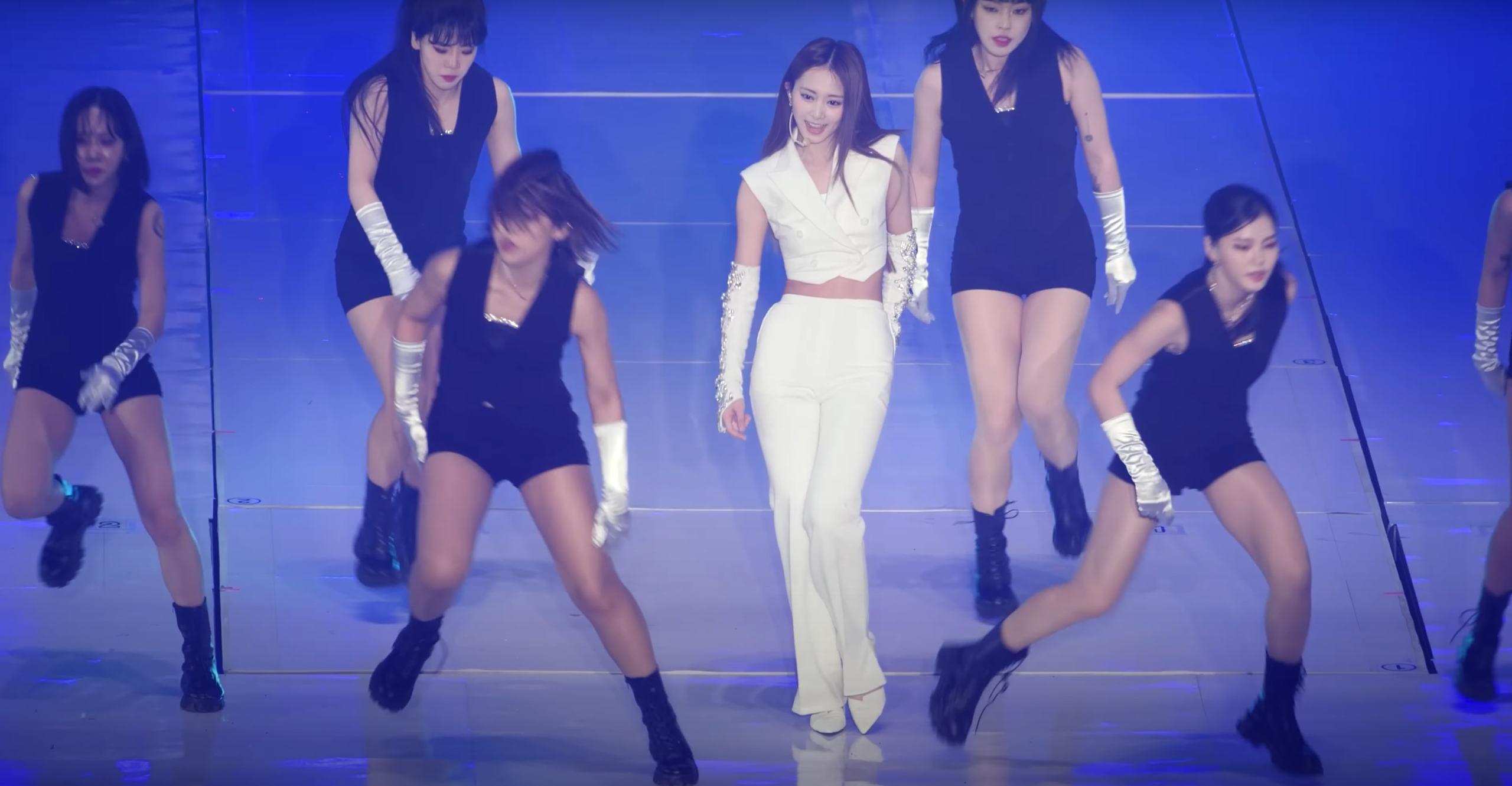 Image: Chou Tzuyu (center) performs during a concert by the pop music group TWICE in Seoul, South Korea (April 15, 2023). (Image source: Wikimedia Commons)
The Struggles Over Modern Taiwanese Identity
The 2016 incident started after Tzuyu waved a plastic ROC (Republic of China, Taiwan) flag in a Korean variety TV show, which elicited a strong response from ultra-nationalistic Chinese internet users. The incident quickly devolved, with Chinese netizens bullying her online before she was made to apologize on camera. The case serves as an apt example of the geopolitical controversies surrounding modern Taiwanese identity. Taiwan, which in the 21st century has increasingly been threatened by its authoritarian neighbor across the Taiwan Strait, must walk a tightrope in dealing with its own international identity because of its extremely sensitive relations with China.
Jonathan Manthorpe, author of Forbidden Nation: A History of Taiwan, has argued that Taiwanese identity has long been established, but has been constantly repressed by external forces. Per Manthorpe, this process has included occupation in the Qing Dynasty imperial Chinese era (including tales of the resistance folk hero Koxinga); colonialism by Western trading powers; and the more recent Japanese colonial era (1895-1945) that is still looked upon fondly by some native Taiwanese because of the period’s relative stability. Manthorpe has identified the pre-1949 bloody KMT occupation—which culminated in “the 2-28 Incident,” costing an estimated 28,000 Taiwanese lives—as an example of unfettered persecution and an unhealed wound lingering until today, while highlighting the contentious view of most Taiwanese of its modern ROC nation-state history after the “White Terror” authoritarian period extending from 1949 until 1987. [1]
Shelley Rigger, a prominent American scholar in Taiwan studies, has echoed Manthorpe’s thoughts by looking into Taiwan’s demographic composition. In the early days of Taiwan’s incorporation into the ROC, there was a social division in Taiwan: there were “Taiwanese” (known in Chinese as benshengren or 本省人, people of this province), those whose families had been living on the island anywhere between fifty and three hundred years before 1945; and “Mainlanders” (waishengren or 外省人, people from outside provinces), people who arrived after the Japanese surrender in 1945. This dynamic played into the complicated feelings of the benshengren towards the waishengren during the single-party authoritarian era. The minority waishengren (1.5 million people out of 7.5 million island residents in 1949) imposed their will on the island in the fight against Cold War communism: starting from the mandatory language conversion in everyday life from Hokkien to Mandarin, to the forced suppression of native Taiwanese culture in favor of the China-centric focus of the ROC. [2]
However, such analyses are not universally shared, and identity remains a complex issue in Taiwan. There exists an inherent tension in the matter of a native Taiwan identity, because the majority Han Chinese ethnic population residing in Taiwan shares ethnic, linguistic, and cultural roots with Han Chinese in the PRC. One such evidence of the project could be seen from the Taiwan-centric history education reform in 2019, with some teachers pushing back on what they called an attempt to “de-Sinicize” school curricula.
Kuang-hao Hou (侯廣豪), a Taiwan-born scholar researching on borderland and ocean studies in political science, has argued from a different viewpoint, seeing Taiwanese identity as a political project by the ruling DPP and the Taiwan independence movement to construct an enemy—specifically, by labeling the opposition Kuomintang (KMT, 國民黨) as an external entity in order to win the country’s democratic elections. Hou has even argued so far as to say that this project is manifested in the weaponization of the post-dictatorship restorative justice process, resulting in a democratic erosion in Taiwan. [3]
The majority of Taiwanese today prefer the status quo in Taiwan’s relationship with China—even as trends in opinion polling in recent years have demonstrated a steady rise in the sense of a “Taiwanese” (臺灣人) identity.
Pop Music and Politics in Cross-Strait Relations
Rigger also argues further that Taiwan has shaped modern China in terms of everyday life, as well. When Deng Xiaoping (鄧小平) opened Mainland China’s economy in the 1970s, there was a huge pent-up demand for cultural products, including pop music in Mandarin. Taiwanese musicians fulfilled that demand, with the most notable one being Teresa Teng (鄧麗君). Teresa Teng remains one of the most fondly remembered pop artists in both markets’ history, and her popularity pioneered the wave of Taiwanese music into Mainland China that was popularly called a “counter invasion.” Today, most singers of “Mandopop” draw their inspirations from previous Taiwanese artists—in part because its Hong Kong counterpart “Cantopop” doesn’t use Mandarin in its lyrics, thereby limiting its audience.
Before Chou Tzuyu, there was another case of a pop singer who endured the cost of her identity as a Taiwanese. Her name is A-Mei (阿妹). In 1998, she was one of Asia’s most popular singers. In May 2000, A-Mei performed the ROC national anthem at Chen Shui-bian’s presidential inauguration ceremony in Taipei. Overnight, A-Mei’s voice and image disappeared from China on instructions from Beijing. The backlash to the performance was so severe that it resulted in protests and clashes outside of her concerts in the PRC. [4]
Conclusions
Some have argued that the 2016 Tzuyu incident galvanized support for the DPP’s Tsai Ing-Wen in the presidential elections by boosting youth support for Taiwanese identity. Previously, the socialization of K-pop fans as activists was demonstrated in Taiwan against a deemed unconstitutional legislation, with many lightsticks representing K-pop fans’ identities in the demonstrations. The practice spread from South Korea, after massive protests erupted with some K-pop fan groups’ representation in reaction to martial law being enacted.
Taiwanese identity will always be a negotiated process, with a constant struggle involving both internal and external actors. In Taiwan, positive perceptions of this identity will likely stay high, with current conditions of solid economic growth and more freedom of expression as compared to China. For now, most youths in Taiwan are content to celebrate Tzuyu’s return as a way of celebrating their identity.
The main point: The November concert appearance of the K-pop girl group TWICE and the accompanying return of Taiwanese singer Tzuyu, and the massive homecoming reception displayed by fans, shows the resiliency of Taiwanese identity in the midst of increasing Chinese pressure. Tzuyu’s career and public persona have in many ways symbolized the modern struggle of Taiwanese identity, especially regarding the ways in which that identity is perceived, both internationally and by Taiwanese themselves.
[1] Manthorpe, Jonathan. Forbidden Nation: A History of Taiwan. Basingstoke: Palgrave Macmillan, 2009.
[2] Rigger, Shelley. Why Taiwan Matters: Small Island, Global Powerhouse. Bloomsbury Publishing, 2013.
[3] Hou, Kuang-hao. “Warning against Silverfish in Democracy: Decaying Constitutionalism in the Society of Taiwan.” Chinese (Taiwan) Yearbook of International Law and Affairs, Volume 41, 2023, December 20, 2024, 202–67. https://doi.org/10.1163/9789004719934_009.
[4] The story of A-Mei had a happy ending: she reinvented herself as “Amit” (阿密特), switching genres to rock and rebranding her persona with unapologetic feminist, pro-indigenous Taiwanese, and pro-LGBTQ messages in her albums—claiming massive success and a new fanbase in the process. See: Rigger, Shelley. The Tiger Leading the Dragon: How Taiwan Propelled China’s Economic Rise. Rowman & Littlefield, 2021.