
On September 28, 2025, former President Tsai Ing-Wen (蔡英文) named and launched Taiwan’s first domestically-built submarine, the Hai Kun SS-711 (海鯤號) at the construction completion ceremony for the critical new military platform. In late January and early February of this year, the Hai Kun successfully completed its first shallow water diving trials. The launch process will continue with more trials in the coming weeks, including tests of systems such as the periscope and antenna masts. The submarine not only shows Taiwan’s determination and will to defend itself, but also signals to the world that an advanced technology supply chain built upon like-minded allies—and free from People’s Republic of China (PRC) manufacturers—is indeed achievable.
The significance of the Hai Kun’s completion derives from the challenges facing Taiwan in building a domestic submarine without prerequisite experience, and sourcing materials despite international political pressure from Beijing. The submarine was built by the CSBC Corporation Taiwan (台灣國際造船股份有限公司), under the Indigenous Defense Submarine (IDS) program [titled “Hai Chang” (海昌計畫) in Mandarin]. The head of the company, Jeng-Horng Chen (陳政宏), has characterized the sourcing process as rife with difficulty. The submarine cost approximately USD 1.54 billion to build, with 40 percent of its parts sourced domestically in Taiwan.
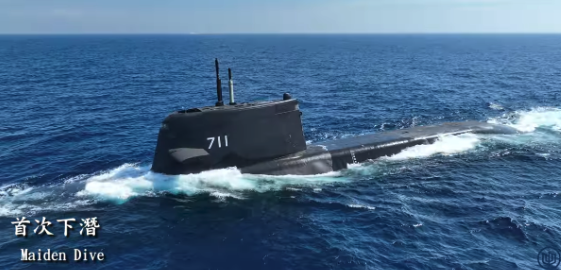
Image: The Hai Kun submarine in the process of submerging during shallow water diving trials in the vicinity of Kaohsiung (late January). (Image source: CSBC Corporation)
The Indigenous Submarine Program and Taiwan’s Effort to Create a “Non-Red Supply Chain”
From obtaining parts engineered by diplomatic partners, to preventing Chinese interference in supply chains, the Hai Kun’s development is a success story of a “non-red supply chain” (非紅供應鏈). Sourcing parts completely outside of China’s industrial supply chains has perhaps proved to be the most challenging step in the construction of the indigenous submarine. Indeed, Beijing has demonstrated a willingness to coerce third-party downstream suppliers to avoid involvement with the IDS program. CSBC Corporation Taiwan’s Chen has indicated that “the moment we left with a deal price with the foreign supplier, the CCP’s military attaché stationed abroad will go to the supplier and ask them not to sell parts to us.” Chen added that it is nonetheless easier to partner with third-party suppliers than it was 10 years ago.
Ultimately, Taiwan’s first domestically-built submarine was sourced through like-minded democracies. Countries such as Australia, Canada, India, Japan, Spain, the United Kingdom, and the United States all aided the program’s construction in various ways. The United Kingdom, a leading submarine construction country, could not openly support Taiwan’s stated intention of developing an indigenous submarine, but nonetheless approved multiple export licenses for UK companies to sell submarine parts to Taiwan. This support included submarine components, technical collaboration, and expert exchange. Taipei also recruited international talent—including engineers and retired naval officers from Australia, South Korea, India, Spain, and Canada—to work at submarine shipyards in Kaohsiung.
The United States’ continued support for Taiwan’s homegrown submarine program has also been key to Hai Kun’s success. In 2018, the US State Department approved licenses for technology sales to Taiwan’s IDS. The US Congress and various presidential administrations supported strengthening Taiwan’s defense capabilities through successive National Defense Authorization Acts (NDAAs). Presently, the Hai Kun is equipped with a sonar suite built by America’s Northrop Grumman, and a combat management system from Lockheed Martin—technologies that allow the submarine to better operate in possible naval combat.
The Importance of “Non-Red Supply Chains” to Taiwan and Other Partners
Taiwan’s success in building the Hai Kun is one example of a broader effort to decouple from China’s industrial base. The island first embarked on a mission of achieving so-called non-red supply chains during the Tsai Ing-Wen Administration (2016-2024). The goal of this economic initiative is to decouple critical industries—such as semiconductors, AI, energy and military equipment—from China’s industry and geopolitical uncertainties. Taiwan has sought to re-direct its supply chains to like-minded countries in North America, Europe, ASEAN, Northeast Asia, and Oceania. Since President Tsai initiated this effort, the policy has been taken up by the incumbent Lai Ching-te (賴清德) Administration. In 2025, President Lai unveiled government support to re-orient Taiwan’s high-tech commercial and military industries towards non-red supply chains. The Hai Kun is an early success of this long-term vision.
China’s rhetoric and actions have amplified the importance of this manufacturing transition. The readout of the PRC’s 15th Five Year Plan (released in October 2025) calls for a fusion of economic development and national security, “ensuring security in development, and pursuing development through security” (在发展中固安全, 在安全中谋发展). The 15th Five Year Plan hints at Beijing’s intention to establish clearer standards for the use of economic tools to preserve national security.
In this vein, Beijing’s recent use of economic coercion has elevated the urgency of Taiwan’s transition to non-red supply chains. In addition to China’s economic coercion directed at Taiwan, Taipei has observed Beijing use of sanctions, boycotts, and trade barriers to punish other countries: Japan during a land dispute; Australia in response to a COVID-19 origin investigation; and South Korea for fielding missile defense technology. Meanwhile, Taiwan has experienced increasing Chinese industrial and military espionage, as well as targeted attacks on its critical infrastructure. These operations heighten concerns regarding economic dependence on China. Indeed, between 2020 to 2024, the number of espionage cases in Taiwan increased from the single digits in 2020 to 64 people in 2024. According to Taiwan’s National Security Bureau (國家安全局), China has attempted to recruit spies among current and retired Republic of China Armed Forces members, Ministry of Foreign Affairs officials, and staff of Taiwan’s political parties.
Decoupling Taiwan’s high-tech industry from PRC supply chains is far from straightforward. Like most countries in the world, Taiwan has historically enjoyed cheap imports from China. Indeed, China has been Taiwan’s largest import partner for years—including deliveries of integrated circuits, refined copper, and office machine parts (see figure below). However, as Beijing has increasingly sought to weaponize supply chains, and accelerate overseas espionage operations, the risks of dependence on China are increasing. With its non-red supply chains initiative, Taiwan has concluded that national security cannot be traded away for discount goods.
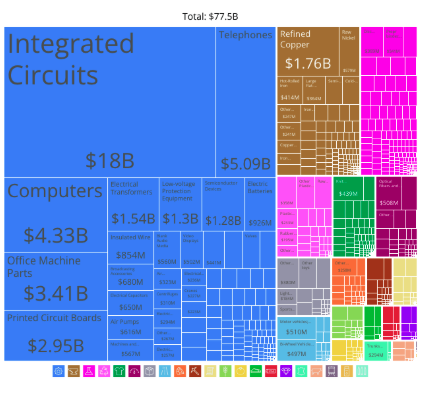
Image: Goods imported by Taiwan from China in 2024 (Image Source: Observatory of Economic Complexity)
Taiwan’s Resilience and Future Implications
Despite meeting its indigenous submarine goal, difficulties lie ahead for the Taiwanese government. While the Hai Kun test stimulates hope for a non-red defense supply chain in Taiwan, the continuation of the IDS program and other ambitious defense programs will require stable domestic funding as well as sustained cooperation from like-minded partners.
Domestically, the Taiwanese government should secure a continuation of funding that goes to the IDS program and other domestic defense programs, such as drones and cybersecurity systems. Strong domestic defense industries will allow Taiwan to gain access to important military capabilities that it might otherwise be denied through PRC pressure.
Internationally, Taipei should establish bilateral and multilateral free trade agreements with countries able to deliver parts for its defense programs. Taiwan should first target countries that share an interest in decoupling from China on critical industries. Possible partners include Japan, Australia, India, the United States, Canada, the UK, and other European countries. By establishing a more complex network of non-red supply chains throughout like-minded democracies, Taiwan can play a role as a leader in an emerging, alternative military industrial base free from PRC influence.
The main point: In recent years, Taiwan’s government has sought to promote “non-red supply chains” that would allow Taiwan to reduce its economic dependence on China, and remove Chinese-manufactured components from military equipment and other critical technologies. The development of Taiwan’s first indigenous submarine, the Hai Kun, illustrates both some of the successes and continuing challenges with building such “non-red supply chains.”