
In April, China stunned Taiwan by allegedly pressuring three African states—Seychelles, Mauritius, and Madagascar—to revoke overflight permission for President Lai Ching-te’s (賴清德) planned flight to Eswatini, just hours before take-off. Bloomberg reported that Taipei attempted to reroute Lai’s flight via Europe, but both Germany and the Czech Republic also denied last-minute access. A week later, however, Lai surprised observers by suddenly announcing his arrival in Eswatini for a four-day visit. Consequently, Beijing issued an unusual condemnation of Eswatini.
Lai’s original visit was highly publicized, offering China the opportunity to obstruct it. This time, Taipei and Mbabane kept the rescheduled plan discreet, preserving an “arrive then announce” strategy. Indeed, the world only learned about it when Lai declared on X that he had arrived in Eswatini.
For both legs of the journey, Lai used the official aircraft of Eswatini’s King Mswati III: an Airbus A340 formerly operated by Taiwan’s China Airlines, which had been retired in 2015 and sold to the kingdom the following year. He traveled 25,000 kilometers in total and returned to Taiwan after an 84-hour visit. To avoid the airspace of the three countries that had earlier denied him overflight access, Lai undertook a riskier maneuver by flying over a remote part of the Indian Ocean.
Major Activities in Eswatini
In Eswatini’s capital Mbabane, Lai received a state-level welcome with military honors. Both Eswatini’s prime minister and foreign minister met him at the airport. Lai then joined King Mswati III on the dais at Mandvulo Grand Hall for a ceremony marked by national anthems, a gun salute, a guard of honor, and traditional dances. The ceremony projected an image of a head of state undeterred in his diplomacy with Taiwan’s last African partner.
The Taiwanese president presented symbolic gifts to King Mswati III, including cattle—in line with local custom—a model of an Indigenous fishing boat used by the Tao people of Orchid Island, and a tea set in the shape of Taipei 101, Taiwan’s tallest skyscraper.
Lai also visited sites of Taiwan-funded major projects, including the Taiwan Industrial Innovation Park, the newly opened International Convention Center, and the Strategic Oil Reserve project. Both sides signed a Mutual Administrative Assistance in Customs Matters agreement, providing the respective customs authorities with a legal framework to share information and streamline trade procedures, along with a joint communiqué reaffirming the Taiwan-Eswatini diplomatic friendship and pledging to deepen cooperation across economic and political fields.
Lai made no major new announcements regarding aid projects during the visit. Instead, he urged Taiwanese private companies to expand investment in Eswatini.
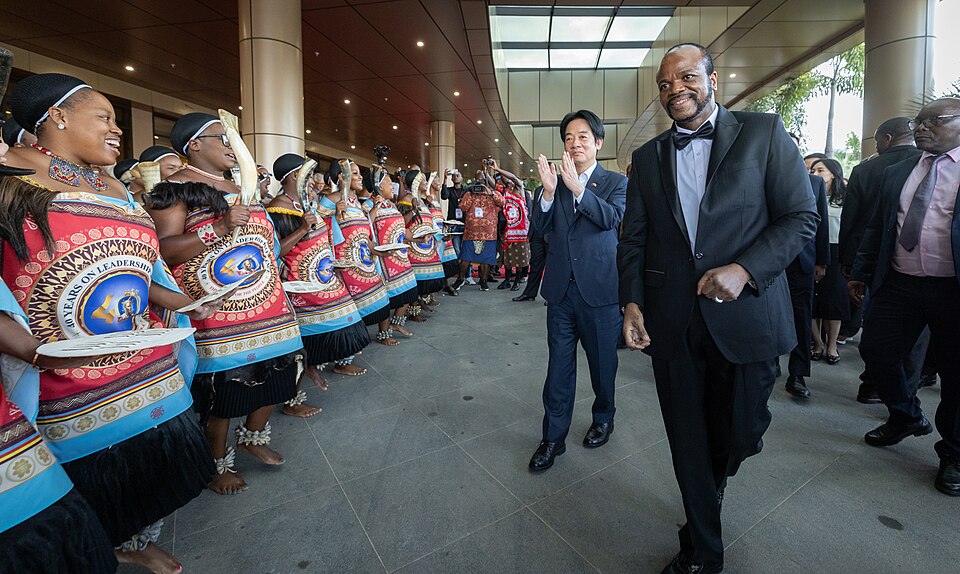
Image: Taiwan President Lai Ching-te and Eswatini’s King Mswati III walk past well-wishers at Eswatini’s International Convention Centre (ICC) on May 3, 2026. (Image source: Wikimedia Commons / ROC Presidential Office)
Responses to the Visit
Lai’s visit, first aborted and then completed, prompted strong responses from various quarters. When the original visit was canceled, the Taiwanese president condemned China’s “coercive actions,” using the incident to reinforce that authoritarian regimes pose a threat to international order. Upon completing the visit, he declared that “the world belongs to everyone,” and emphasized that Taiwanese people “have the right to engage with the world.” He added that Taiwan completed the trip in accordance with international law and argued that China’s obstruction only illustrated the “Taiwanese people’s firm determination and will to engage with the world.”
Taiwanese media celebrated the visit, portraying it as evidence that Taipei would continue to engage with the world and deepen ties with Mbabane despite external pressure.
China denied any role in the three African countries’ decisions to revoke Taiwan’s overflight permission, but expressed appreciation for their decision to uphold Beijing’s “One-China Principle.” However, as Lai overcame China’s obstruction and ultimately arrived in Eswatini, the episode embarrassed Beijing. China accused Lai of being a “troublemaker” and a “separatist,” who sneaked into Eswatini in an illegitimate “stowaway-style escape farce,” and characterized him as a “rat crossing a street.” It insisted that the visit “would always be a losing cause” and that Taiwan remained a part of China with no right to state-to-state relations.
After an initial mild admonishment, Chinese officials adopted unusually strong language against Mbabane: “Some politicians in Eswatini, kept and fed by Taiwan, have provided space for Taiwan independence forces—this runs counter to the tide of history, and China strongly condemns it.” In response, Eswatini described these remarks as an infringement on its sovereignty and “deeply unfortunate.” Officials in Mbabane stated that Beijing’s remarks fell short of international standards for a country claiming to be a “responsible global actor.”
The United States, a critical external player in cross-Strait relations, expressed concerns over China’s alleged obstruction of the original visit, terming it an “intimidation campaign.” When Lai successfully completed his visit, a spokesperson for the US State Department described it as a routine matter that should not be politicized. The spokesperson noted that Lai’s predecessor Tsai Ing-wen (蔡英文) had traveled to Eswatini in 2018 and 2023. “Taiwan is a trusted and capable partner of the United States and many others, and its relationships around the world provide significant benefits to the citizens of those countries, including Eswatini,” the spokesperson said. Several US national and state-level lawmakers made similar statements in support of Taiwan.
Meanwhile, responses from Taiwan’s two main opposition parties, the Kuomintang (KMT, 國民黨) and the Taiwan People’s Party (TPP,民眾黨), were varied. When the original April trip was canceled, the KMT expressed “regret” over China’s actions. At the same time, it seized the opportunity to criticize the government for failed diplomacy, referring to the loss of ten Taiwanese allies since the DPP came to power.
The TPP took a more assertive stance. It “strongly protested and condemned” China’s actions, declaring that they “seriously trample on our sovereignty and interfere in our internal affairs.” The TPP further warned that the Chinese Communist Party’s attempts to “aggressively constrict Taiwan’s diplomatic space and intimidate the Taiwanese people” would only exacerbate tensions in the Taiwan Strait.
Following Lai’s successful visit, the KMT criticized the president for traveling to Eswatini on a chartered plane provided by Taiwan’s African diplomatic ally, expressing acute national security concerns. A KMT legislator, Hsu Yu-chen (許宇甄), stated that “while consolidating diplomatic ties is important and Lai deserves recognition for his efforts, the king’s jet lacks the secure communications equipment of Taiwan’s presidential aircraft, which is equipped with a military-standard encrypted command-and-control system to ensure real-time communication with the Hengshan Military Command Center.”
Beyond partisan criticism, the communications concern raised a substantive operational question: a president traveling 25,000 kilometers without military-grade encrypted links to the Hengshan Military Command Center (Taiwan’s central military command) constituted a genuine command-and-control gap, not merely a political talking point. The opposition also raised broader concerns about the clandestine nature of the travel, the absence of a long-term strategy to address Taiwan’s diplomatic isolation, and Lai’s focus on his own personal image.
Implications
An Operational Win for Taiwan
The rescheduled visit turned an embarrassing diplomatic incident into an operational win for the Lai government. The optics—from the military ceremony, the guard of honor bestowed upon a head of state, national anthems, the joint communiqué, to the signing of a Mutual Administrative Assistance in Customs Matters—illustrated that Taiwan has at least one African diplomatic ally willing to resist Beijing’s pressure and forge closer ties.
The visit also allowed Lai to inspect Taiwan-funded projects in Eswatini, highlighting Taiwan’s contributions while inviting private investors to invest in the country. It reinforced a narrative of Taiwan as a tangible development force, rather than simply a partner for the sake of achieving diplomatic recognition.
The Trump-Xi Summit
The Eswatini visit was consequential in that it took place less than two weeks before US President Trump’s state visit to China. Such an episode meant that observers in America could not ignore the intensity of cross-Strait relations. For Beijing, Taiwan is a core issue. In his call with US Secretary of State Marco Rubio on April 30, the People’s Republic of China Foreign Minister Wang Yi (王毅) reiterated that “the Taiwan question bears on China’s core interests and is the biggest risk in China-U.S. relations.” The Trump Administration has adopted a heightened form of strategic ambiguity. The US Congress has been introducing an unprecedented number of Taiwan-related bills, while the administration has approved major arms sales packages to Taiwan (some of which are delayed). Nonetheless, Trump has still stated that Taiwan’s security is “up to him [Xi] what he’s going to be doing.”
Secretary of State Rubio has already stated that Taiwan will be a point of discussion during the Trump-Xi summit. This heightened concerns among some circles in the Taiwanese government that the island might be used as a bargaining chip between the two major powers.
Eswatini’s Diplomatic Strategy
It is also important to monitor Eswatini’s future policies. While Eswatini publicly reaffirmed its commitment to friendship with Taiwan, analysts have long emphasized that China has applied direct pressure on the country, even as its business and investment footprint in the kingdom steadily expands. Reports suggest that local businesses and industries are under increasing pressure to engage with Chinese capital and markets.
In May 2023, Eswatini awarded the approximately USD 146 million Mpakeni Dam construction project to China’s state-owned PowerChina (中国电力建设集团有限公司), despite the lack of diplomatic ties between Mbabane and Beijing. Over 40 percent of the work on the dam has now been completed. In 2024, Eswatini also sent a delegation to China seeking investment in the mining sector. Analysts describe this as Beijing’s “long game.”
Analysts have highlighted landlocked Eswatini’s practical challenges in maintaining diplomatic ties with Taiwan—a position that contrasts with the rest of Africa. China is deepening its engagement in Africa through development projects, loans, and economic incentives. A Boston University Global Development Policy Center report on the Chinese Loans to Africa Database (2000–2024) found that Chinese lenders signed 1,319 loan commitments with 49 African governments and seven regional institutions, totaling about USD 180.87 billion. Starting on May 1, China granted tariff-free access for two years to its market to 53 African countries with diplomatic ties, excluding Eswatini. This is a significant economic incentive. It was in this context that Beijing urged Eswatini “to see clearly the general trend of history” and not to “pull chestnuts out of the fire for a handful of ‘Taiwan independence’ separatists.” The extent to which Eswatini can continue to resist mounting economic and political pressure from Beijing, and pursue diplomacy that runs contrary to the rest of the continent, is hard to predict.
The main point: Taiwan President Lai Ching-te successfully completed a state visit to Eswatini in May 2026, circumventing China’s earlier attempt to obstruct his trip. In doing so, Lai turned a diplomatic setback into a win and reaffirmed ties with Taiwan’s only diplomatic ally in Africa. The episode drew sharp reactions on both sides of the Taiwan Strait, and raised questions about Eswatini’s long-term alignment amid growing Chinese economic influence in Africa.