
Over the past two decades, virtually every annual global indicator of democracy, human rights, corruption, and press freedom has pointed downwards—a protracted trend that the democracy monitoring V-Dem Institute has referred to as “25 years of autocratization.” As this crisis has deepened in recent years, democracy promotion funding has also seen a rapid diminishment, with traditional donors making deep cuts to their international assistance budgets. Vehicles such as the United Nations Democracy Fund continue to face a sharp decline in funding, and coalitions of authoritarian states led by Russia and China work to block human rights funding at the multilateral level. This situation presents significant security concerns for Taiwan, as Beijing-led narratives about Taiwan face much less scrutiny and challenge amid a weakened global information environment.
However, as demonstrated by the electoral defeat of Viktor Orbán in Hungary this year, an energized and motivated opposition can upheave even deeply entrenched authoritarian systems. Policymakers in Taipei should take inspiration from this. To help counter the ongoing wave of autocratization, Taiwan should explore the prospect of launching a new democracy defense fund to support pro-democracy movements and initiatives to promote transparency and accountability in government and politics around the world. Taiwan is at the forefront of many of the most pressing challenges to democracy: foreign information manipulation and interference, gray zone warfare, and efforts to portray democracies as weak and ineffective. It has lessons to teach, and lessons to learn, by supporting global responses against threats to democracy.
Given that the existing multilateral system is increasingly dysfunctional and deadlocked in combatting these issues, it would be strategically valuable for Taiwan to promote an innovative new funding model that both serves the vital function of protecting democracy and human rights, and of helping Taiwan to build out its global footprint and partnerships in an area in which China clearly cannot—and will not—outcompete it.
The Strategic Value of a Taiwan-Led Fund
Taiwan’s status as a democracy is central to its identity, and serves as a connecting line between it and powerful democratic allies and partners. In an essay for Foreign Affairs, “The Free World Needs Taiwan,” Taiwan Minister of Foreign Affairs Lin Chia-Lung (林佳龍) has written that Taiwan’s “experience in countering authoritarian expansion is a public good for the international community.” As one example, Lin points to recent efforts, such as a 2025 counter-disinformation training workshop held in Taipei through Taiwan’s Global Cooperation and Training Framework (GCTF, 全球合作暨訓練架構). While Taipei recognizes that it has much to contribute to global democracy promotion and cooperation, there is space to expand such initiatives to a wider, global remit.
Major donors have drastically reduced their international development budgets, with total official development assistance spending falling by almost a quarter among major donors in 2025. By contrast, Taiwan is one of the few democracies planning to increase its international development spending, rather than cut it. Allocating a portion of this funding toward democracy promotion and protection initiatives—focused on issues of media plurality, counter-disinformation, anti-corruption, investigative journalism, and civil society training—will help Taiwan fulfill its role as a democratic leader while also working to hold accountable the authoritarian actors working against it.
However, Taiwan’s international development spending has traditionally focused on issues like capacity building and technical support, health, and humanitarian development. Such efforts are often complicated by Taiwan’s lack of diplomatic recognition by target countries, its lack of a properly institutionalized and state-supported humanitarian sector, and efforts by China to outspend Taiwan in humanitarian support in cases such as natural disasters. Increased funding to democracy promotion work, on the other hand, would bypass many of the complications arising from non-recognition by state entities, providing resources directly to individuals and civil society organizations.
As authoritarian governments become increasingly coordinated, they pose a greater threat to Taiwan’s survival. Actors like Russia, Cambodia, and the Myanmar junta vocally support Beijing’s narratives about Taiwan and would likely provide diplomatic, economic, and even military support to Beijing in the event of a crisis. Authoritarian actors have keenly taken advantage of funding reductions and uncertainty for key institutions such as the BBC World Service and the closure of critical institutions such as the United States Counter Foreign Information Manipulation and Interference Hub. Taiwan therefore has a direct strategic need to fund and resource the individuals and organizations working to refute authoritarian actors’ narratives—thereby reducing their impunity and, ultimately, their power.
Authoritarian regimes learn from and abet one another. The tools they use are well-known and often take the same shape across different geographies. Disinformation-propagating bot farms and AI are used extensively by China, Russia, Iran, the Taliban, and others. While the specifics and language of their messaging may differ, their overall objectives are the same: sowing dissent and dissatisfaction with democratic leaders, promoting pro-regime messages and narratives, and obscuring crimes and human rights violations. Taiwan-led funding could work towards helping partner countries and organizations in responding to these shared challenges, developing common strategies for recognizing, preventing, and responding to major threats to democracy such as violence-inciting disinformation.
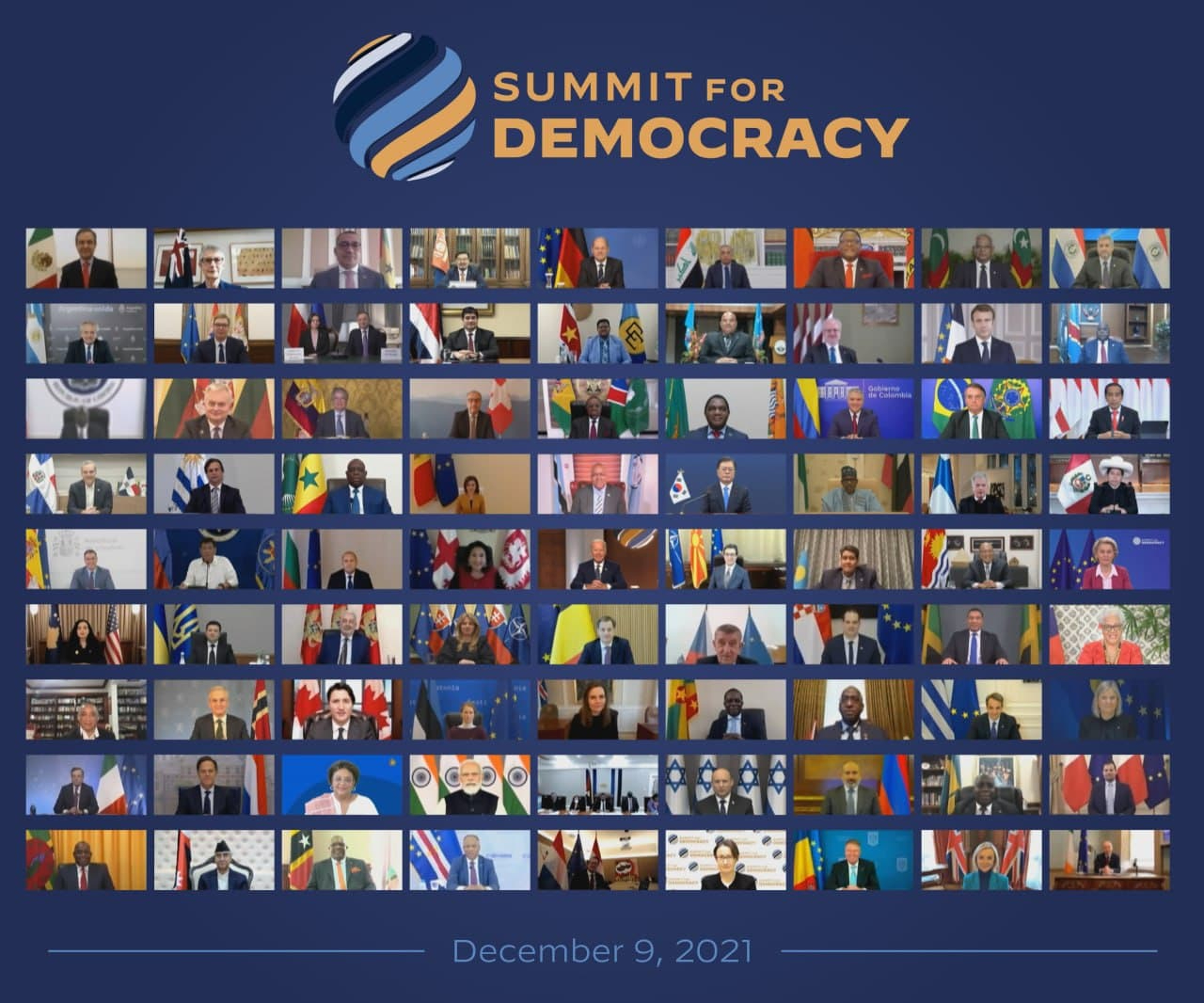
Image: Taiwan was one of the states invited to participate in the Biden Administration’s “Summit of Democracies” in December 2021. Hsiao Bi-khim, then the Taiwan representative to the United States (currently vice president), is visible in the bottom row (fourth from right). (Image source: ROC Ministry of Foreign Affairs)
Effectiveness of a Democracy Defense Fund
While organizations like the Taiwan Foundation for Democracy (TFD, 臺灣民主基金會) exist within Taiwan, a gap remains for more comprehensive democracy promotion organizations. TFD currently focuses on specific project-based funding and visiting fellowships. Furthermore, its grants are mostly geographically limited in remit to the East Asia region, with its research exchange programs often focused on hosting visiting academics rather than practitioners and activists. Additionally, TFD does little by way of international public promotion, and its absence from major social media platforms leaves it without meaningful communications impact—meaning that it does not work as an effective vehicle to promote democracy and Taiwanese values internationally.
A global fund would instead focus on supporting counter-authoritarian movements across a range of geographies, facilitating learning between such movements and organizations, and providing lifeline funding for organizations that are facing financial difficulty or closure. There should be no expectation for Taiwan and partners to fill the enormous funding gap left by cuts from major donors like the United States, Germany, and the UK. Nonetheless, comparatively modest funding could provide a significant lifeline for civil society organizations (CSOs), news agencies, and other organizations battling authoritarianism.
Even modest funding can go far to support independent media outlets with simple running costs, activists with legal action and other accountability efforts, and help to facilitate NGOs’ work to publicize threats against democracy and promote effective responses. Streamlined funding could provide rapid relief grants for organizations facing existential funding hardships, and allow individuals and organizations the latitude to work according to their own expertise, ensuring long-term support for critical democracy promotion efforts.
Introducing a new democracy-focused fund is comfortably within the scope of Taiwan’s current international development legislation, meaning that Legislative Yuan politics would pose less of an obstacle to establishing such a fund. Article 5 of Taiwan’s 2010 International Cooperation and Development Act (國際合作發展法) states that “[t]he goals of international cooperation and development affairs are … [t]o ensure human security and safeguard such universal values as peace, democracy, human rights, humanitarian care and sustainable development,” as well as having scope for providing support to governments, intergovernmental organizations, NGOs, and individuals alike. (The written Chinese version of the legislation can be read here.)
The limitations posed by Taiwan’s lack of official international recognition are not insurmountable. One important step is to ensure the fund is not exclusively state-based, by drawing on private foundations, philanthropists, individual donors, and subnational actors as key sources of potential fund mobilization. This would make it easier for other democracies to contribute (even if only modestly) as they would be able to do so without running afoul of Beijing.
Taking inspiration from the model of other global funds (like Gavi, the Vaccine Alliance) could also offer a way forward. Gavi is not a traditional international organization (in other words, it was not established via a treaty between states) but is instead a public-private partnership consisting of governmental, multilateral, private sector, and philanthropic stakeholders. Gavi attributes much of its success to this partnership model, stating that it allows the organization to “capitalise on the sum of our partners’ comparative advantages,” with partners varyingly contributing resources, expertise, and funds.
Taiwan’s extensive, long-term contributions to international organizations (such as the European Bank for Reconstruction and Development (EBRD), under the name “Taipei China”) demonstrate that it is possible for Taiwan to contribute to international funds despite the usual barriers posed by its lack of recognition. However, Taiwan also participates in EBRD projects under the “brand name” of TaiwanBusiness, which could point to a solution around the sensitivities of naming – supporting a global fund through an entity named, for example, ‘Taiwan Democracy,’ could present a viable solution to sensitivities around naming.
However, a Taiwan-led democracy fund should necessarily depend on large-scale participation. Taipei should stand ready to devote meaningful funds to such a project even if it means doing so alone. A comprehensive democracy defense fund would help to deepen Taiwan’s role as a democratic leader and continue to build its reputation for supporting democracy and human rights globally, while countering efforts by authoritarian actors to erase and undermine its interests.
The main point: As global support for democracy continues to diminish and authoritarian coordination deepens, Taiwan has both the opportunity and responsibility to take the lead in global democracy promotion. To do this, Taiwan should drive the launch a new, global “democracy defense fund” to mobilize funding from governments, foundations, private donors, and others.