
In May 2026, Taiwan’s Legislative Yuan (LY, 立法院) passed a special budget bill whose very name contained the words “strengthening asymmetric capabilities” (強化不對稱戰力). Despite the legislation’s title, the bill failed to fund some of the most asymmetric weapons in Taiwan’s domestic industrial base. Lawmakers pared the Executive Yuan’s (行政院) original NTD 1.25 trillion (USD 40 billion) request by about 38 percent—to a ceiling of NTD 780 billion (USD 24.8 billion). The LY excluded every domestic procurement contract and retained funding only for American systems purchased through US Foreign Military Sales (FMS).
Among the cuts were the Republic of China (ROC) (Taiwan) Army’s 208, 200-unit littoral attack-drone program (濱海攻擊型無人機), and 635 sets of man-portable counter-drone systems (人攜式無人機反制系統). These are exactly the sort of cheap, dispersed, hard-to-target systems for which the bill was titled. The LY called the decision budget housekeeping: the purchases were deferred to the annual budget process for tighter review rather than canceled. Events since have borne that out. On August 27, the legislature passed its own act routing up to NTD 240 billion (USD 7.6 billion) for unmanned systems over six annual budgets, and on September 3, the Executive Yuan’s supplementary budget re-entered NTD 55.9 billion for the same three littoral drone and boat programs. The money is coming back, and it is coming back for the same small systems. Since the EY first proposed the supplemental budget, the fight in the chamber turned on a number: how large the budget should be, and how many drones the government should buy. The more urgent question—one with which lawmakers have scarcely engaged—is what drones Taiwan actually needs for its most effective defense posture.
The drones Taiwan’s own industry builds do not have the range the mission requires. Combat drones fall into two kinds, distinguished less by the distance they travel than by the work they are built to do. A first-person-view (FPV) drone is a cheap, expendable munition that an operator flies by live video feed into a target in view—a vehicle, a gun position, a soldier in the open—and it is the weapon of the close fight, the point at which two forces have already met. Meanwhile, long-range maritime strike drones offer completely different capabilities, ranging far out over open water to find and sink hostile ships before they reach the coast.
The drones Taiwan builds and exports in volume are overwhelmingly of the first kind: Group 1 drones—small, short-range platforms employed on the front lines. Used defensively along Taiwan’s own beaches, that tier is a legitimate innermost layer, though it is also the layer of last resort. What Taiwan does not build are the long-range strike drones (Group 3 and above) that it will need to break an invasion fleet across the Strait. The EY’s original special act carried the first production order for one such design, the National Chung-Shan Institute of Science and Technology’s (NCSIST, 國家中山科學研究院) Albatross II. When it pared down the special budget, the LY struck the Albatross II off the domestic procurement list, instead relying on FMS from the United States to obtain larger drones. Yet, these FMS lines do not close the gap. The US-made MQ-9Bs arriving this year are surveillance aircraft, and the American ALTIUS loitering munitions now under contract can cross the Strait but carry warheads of 15kg or less— sized for vehicles and landing craft rather than amphibious transports. The long-range anti-fleet tier is the one Taipei is not acquiring, at home or abroad. At the same time, the LY also excluded funding for low-cost air defense systems that will be needed against the People’s Liberation Army’s (PLA, 中國人民解放軍) saturation attacks.
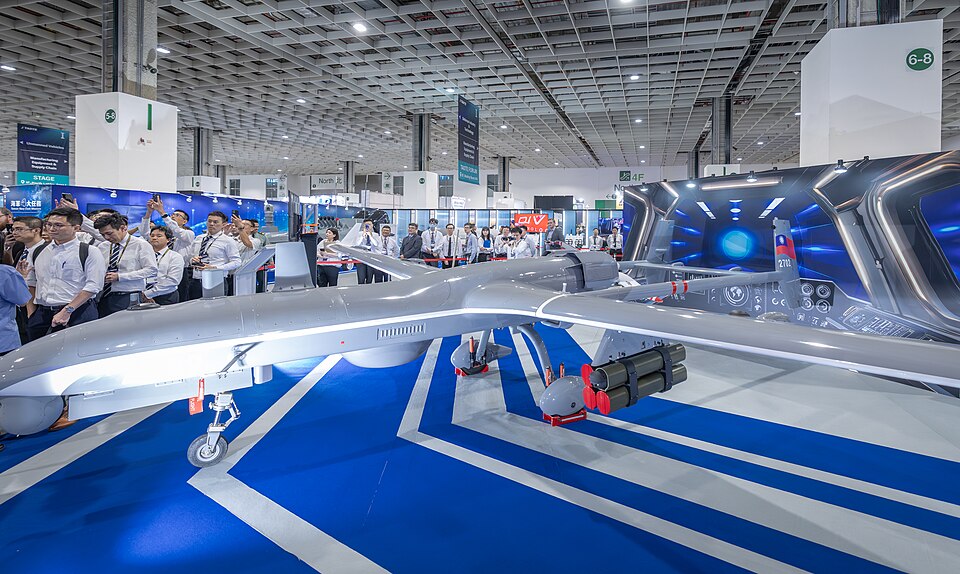
A Teng Yun II (騰雲二型) drone prototype sits on display at a defense exhibition in Taipei (Kenchen945/Wikimedia Commons, CC BY-SA 4.0).
The PLA Will Set the Range
As the attacking force, the PLA will hold the initiative in a cross-Strait conflict, and has greater influence over where fighting will occur. The PLA’s own short-range drones can be deployed close to Taiwan’s shores. Taiwan does not enjoy the same luxury: if it wishes to strike the PLA’s invasion fleet far out to sea, it needs drones with sufficient range.
The Pentagon sorts drones into five groups—determined by takeoff weight, altitude, and speed. These correspond with range closely enough that a drone’s group serves as a reliable proxy for how far it can travel. A Group 1 system—the FPV class weighing under 9 kg—has only a few kilometers of range. Group 3 drones and above can travel hundreds or thousands of kilometers. The drone platforms that Taiwan currently manufactures operate at ranges below 50km. This is insufficient for combat in the Taiwan Strait, which sits at about 180km wide.
The invading force, China, can also carry its drones forward. The Type 076 Sichuan (四川艦), an amphibious ship built to carry and launch drones, is expected to commission this year. The Type 076 vessel will allow the PLA to employ even shorter-range drones across the Strait. Taiwan has no such capabilities at hand. The Center for a New American Security’s (CNAS) “hellscape“ concept of asymmetric defense—considered a leading interpretation of Taiwan’s ideal deterrence strategy—positions long-range systems in an outer layer 40 to 80km from shore, where the concept expects attrition of an invasion fleet to begin, while PLA transports are still concentrated and far from the beaches. According to the “hellscape,” short-range drones should only be used at the final 5km before the beaches. Taiwan’s own doctrine reads the same way: “deny the enemy at the far shore, engage them at sea, destroy them in the littoral, and annihilate them on the landing beaches” (拒敵於彼岸、擊敵於海上、毀敵於水際、殲敵於灘岸). The beach layer is planned for; but if the fight reaches it, Taiwan has already failed at the denial phase. Thinning the PLA fleet at sea demands Group 3 drones and above.
Drones dominate the land war in Ukraine; by one 2025 estimate, they were inflicting 70 to 80 percent of casualties on both sides, chiefly through small attack drones. The Black Sea is a different story, and the more instructive one for Taiwan. The weapons that drove the Russian fleet out of Sevastopol were Neptune and Storm Shadow cruise missiles and purpose-built unmanned surface vessels: the Magura V5, carrying a 320kg warhead over several hundred kilometers, and the larger Sea Baby, carrying up to about 850kg. By March 2024, the Ukrainian navy counted a third of Russia’s Black Sea warships sunk or disabled. Taking the land war’s lesson at face value, one may conclude that Taiwan should out-produce China in Group 1 drones. The maritime record points the other way: sinking ships took platforms with hundreds of kilograms of payload and the range to reach a fleet in port. The FPV is decisive in the Donbas because the front is a contiguous band of land a few kilometers deep. Yet, Taiwan’s fight will be in maritime interdiction, over open water, in a jammed spectrum, and with no static line to hold. As Dr. Su Tzu-yun (蘇紫雲), a research fellow at Taiwan’s Institute for National Defense and Security Research (INDSR, 國防安全研究院), puts it, “In Ukraine, the fighting is on flat, open ground; for Taiwan, the drones come in first at sea” (烏克蘭是平原作戰,我國則是先用於海上作戰).
Figure 1: Same Drone, Different Reach
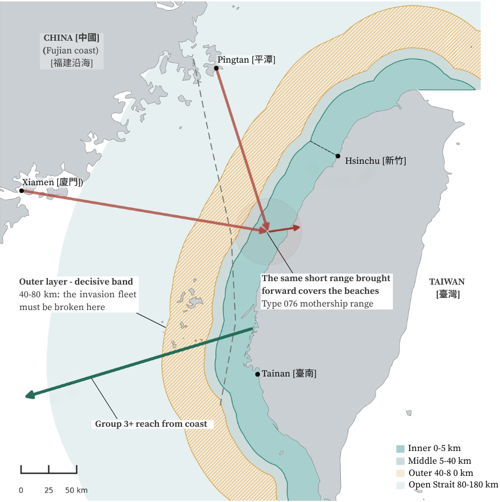
Image: A schematic of the various zones reachable by both PLA and Taiwanese drones (Image Note: the Type 076 Sichuan is expected to be commissioned in 2026 and is not yet in service; drone mothership figures are PLA-reported and illustrative; distances are approximate.) Source: Author’s creation, based on Hellscape for Taiwan: Rethinking Asymmetric Defense (Center for a New American Security, February 2026); Defense Primer: Categories of Uncrewed Aircraft Systems (Congressional Research Service, October 25, 2024); and Natural Earth, “Land” and “Minor Islands,” 1:10m Physical Vectors.
Building the Bottom, Importing the Top
Taiwan has yet to produce indigenous long-range anti-ship drones. The LY cut funding to manufacture designs for the Albatross II (銳鳶二型), a 2,000km maritime reconnaissance-strike drone (Group 4). Funding to produce the Teng Yun II (騰雲二型) (Group 5) prototype was also stripped. Both designs passed combat evaluation. Indeed, the fielding constraint is political, not technical.
Taiwan does build one long-range strike drone—the anti-radiation Chien Hsiang (劍翔), with a 1,000km range—but it is designed to home in on enemy radar emitters rather than ships. Taiwan has filled the gap with foreign imports. The first two MQ-9Bs were handed over in March 2026 and arrived on the island in June. They are weapons-ready airframes, but the 2020 sale included maritime radar and sensors rather than munitions, and the air force has budgeted for them as long-endurance surveillance aircraft. Anduril delivered 291 ALTIUS-600M loitering munitions between August 2025 and March 2026, and in late August Taipei signed a NTD 26.9 billion (USD 847 million) agreement for 1,554 ALTIUS-700M and 478 ALTIUS-600 ISR aircraft, with first deliveries due late this year. All of them are built in the United States. Anduril has opened a Taipei office and signed a memorandum with NCSIST on command-and-control software. Taipei and Washington have agreed in principle to co-produce NCSIST’s Mighty Hornet I attack drone, but no US-designed drone has yet been assembled on the island. The Research Institute for Democracy, Society, and Emerging Technology (DSET, 科技、民主與社會研究中心), a government-backed Taiwanese think tank, has warned that the LY’s decision to cut out funding for domestic drones may have set back the industry close to two years—even if the LY ultimately funds these projects through the annual budget process.
Taiwan exports large numbers of Group 1 systems to Czechia and Poland—which, by DSET’s account, are then shipped onwards to Ukraine. Attempting to out-produce China in the Group 1 category is a contest of mass that the smaller side, Taiwan, will lose. Over-investment in the export business of FPVs may result in lost capital and attention in long-range maritime drone production. Leaving the heaviest drones to American exporters may seem like a sensible division of labor, but routing the larger tiers through a single supplier is a vulnerability that domestic production was meant to hedge against.
Buying the Top, Skipping the Bottom
The same lopsidedness runs through Taiwan’s air defenses, in mirror image. In drones, the island builds the bottom tier and imports the top. In air defense, it is buying the top tier first. T-Dome (台灣之盾), the layered air defense system that President Lai Ching-te (賴清德) announced in October 2025, links Patriot batteries, NASAMS, and Sky Bow (天弓) into a single sensor-to-shooter network built for the missile tier (ballistic and cruise missiles, as well as larger one-way attack drones). Defending against the PLA’s low-end air capabilities is another matter. Swarms of low-cost FPV drones, possibly delivered by the Type 076 vessel, would undercut the T-Dome’s capabilities. In such a scenario, the exchange turns ruinous: a USD 1 million AMRAAM-class interceptor fired at a USD 1,000 FPV would equate to a cost-exchange ratio of 1,000 to 1. That ratio has not been sustainable for the United States’ missile defense operations in the Middle East, and it will not be sustainable for Taiwan.
Taiwan has fielded defenses against mass FPV attacks and close-in swarms: such as the Land Sword II (陸劍二) surface-to-air missile system, the Skyguard (天兵) anti-aircraft gun, and jammers. Yet these platforms are too few and too loosely tied together to be relevant. The EY’s special defense budget had also carried 635 man-portable counter-drone sets (人攜式無人機反制系統)—kits that one or two soldiers can set up in fifteen minutes to detect small drones at about 4 km and jam or take over their control links at about 2 km. They were meant for the targets T-Dome does not cover, command posts, radar sites, ships in port, and infantry in the field, and were to be spread across all four services. The LY excluded them with the rest of the domestic list.
As of May, DSET could confirm only two military counter-drone programs, worth NTD 5.3 billion (USD 170 million) between them, and the domestic supply base has not yet shown it can deliver even at that scale. The ROC Army’s one large domestic buy—26 fixed-site counter-drone systems contracted to Tron Future (創未來科技) for NTD 988 million in early 2025—failed acceptance testing three times against the specified 6km detection and 4km jamming ranges. The Ministry of National Defense (MND, 國防部) canceled the contract in July without payment and plans to re-tender it at a higher unit price through a 2027 supplementary budget. The hard-kill layer is thinner still: Taipei has yet to place any order for drone defenses in that kinetic tier.
The misplaced priorities in drone defense echo a long-standing problem in Taiwanese military acquisitions. T-Dome is a presidential flagship project and draws the oxygen, while the counter-drone layer has no champion. This story has played out before. Admiral Lee Hsi-min’s (李喜明) “Overall Defense Concept“ (整體防衛構想), built around a mass of small, dispersed, and lethal systems, was sidelined when he retired. Dr. Michael Hunzeker, director of George Mason University’s Taiwan Security Monitor, has written that the Overall Defense Concept was abandoned because “true asymmetry undercuts the rationale for pursuing high-profile, high-prestige, and high-cost weapons.” The order of funding—T-Dome first and the counter-swarm layer when money allows—is the preference Hunzeker describes, applied to a new program.
Buy for the Mission
Some contend that Taiwan’s success in FPV exports will seed a strong wartime production base that will, in time, turn out larger systems. DSET’s Samara Duerr frames the exports as laying the foundation for “a surge ability later on.” Indeed, the numbers are impressive. Taiwan exported 181,159 drones in the first four months of 2026, nearly 20 times the figure for the same period a year earlier. It is true that European countries see the value of a drone supply base relatively free from China’s supply chains. But it is not a given that success in the FPV sector will bring about long-range indigenous drones.
A Group 1 FPV production line does not automatically refine the turboprop, radar-equipped, satellite-networked maritime strike technologies that the Albatross II and Teng Yun II employ. Even the small end is harder to industrialize than export figures suggest: the US Army Materiel Command budgeted USD 75 million for machinery to produce brushless motors and wiring for its own small-drone push, with an eight-month lead time before a line could open. Taiwan’s sector has a second problem that volume does not fix. Its many makers run on control software and data links that do not interoperate, so one firm’s drones cannot be tasked or fed into a common picture alongside another’s. DSET’s Samara Duerr describes the ecosystem as highly fragmented. The Taiwanese government has handed NCSIST the job of building a common command layer. Ukraine solved this with Delta, a cloud-based battle-management system that its Ministry of Defense took over from the volunteer group Aerorozvidka and adopted across the armed forces in 2024. Delta pulls drone video, satellite imagery, radar tracks, and unit reports onto one map, lets operators assign targets and control aircraft from it, and has demonstrated data exchange with 15 allied command systems. Taiwan has nothing comparable. What the special act would have provided, and the LY excluded, was the production order for the Albatross II line: the one item on the domestic list that would have put a radar-carrying, military-grade maritime aircraft into serial production and pulled Taiwanese subcontractors up the tiers with it. Whether the Executive Yuan’s September 3 supplementary budget restores that order, and whether the legislature passes it, will decide whether the gap closes.
Taiwan is building drones only for close fights at its beaches—already identified as the battlefield of last resort. Meanwhile, in missile defense, it overinvests in exquisite systems, raising a prestige shield against the missile tier while the defense against drone swarms is starved of support. Admiral Lee Hsi-min put it plainly: the Overall Defense Concept is “not about abandoning conventional combat power, but about how resources are allocated” (並非摒棄傳統戰力,而是資源分配問題).
Taiwan can make the cheapest correction without waiting on anyone: scaling its counter-swarm defenses and buying the hard-kill interceptors that its own firms already make. Programs excluded from the special act are returning through supplementary and annual budgets, the slower road DSET warned about. The FMS side is moving faster—the ALTIUS contract was signed in late August. Beyond that, procurement ought to start from the mission each layer has to perform and buy for it. The anti-fleet layer at 40 to 80km needs a radar-carrying aircraft with a warhead that can stop a transport, which no FPV and no ALTIUS provides. Meanwhile, the beach layer needs mass, and the counter-swarm layer needs cheap interceptors and jammers at the units that will be hit. Unit counts follow from those requirements rather than the other way round. All of it should run on a single command network—Taiwan needs a sibling to Ukraine’s Delta network—because anchor orders and integration are what make mass lethal. Finally, Taiwan should make use of Section 1266 of the United States’ 2026 National Defense Authorization Act (NDAA). This provision directs the Pentagon to pursue co-production with Taipei of the advanced US platforms at home, rather than exclusively importing them.
The PLA’s Type 076 vessel Sichuan is on trials in the South China Sea and is due in service this year. At the same time, China has reportedly converted more than 500 retired J-6 fighters into expendable drones, with over 200 already staged near the Strait. As Taiwan wrangles over the appropriate drone warfare platforms, China is busily amassing saturation capabilities designed to overwhelm Taiwan’s exquisite air defenses in the opening wave.
The main point: Taiwan has overinvested in low-cost FPV drone production while neglecting long-range maritime strike platforms. In missile defense, the problem is reversed: Taiwan spends too much on exquisite missile defense systems and is not preparing for low-cost saturation attacks. Taiwan’s task is not to produce more drones but the right drones.