

Introduction
As strategic competition in the Indo-Pacific region intensifies, Washington increasingly views Taiwan as both a reliable partner for democracy and regional stability, and as a critical contributor to supply-chain resilience and technology security. However, one important area has room for improvement: health security and pharmaceutical resilience.
The COVID-19 pandemic exposed the strategic consequences of fragile medical supply chains, shortages of critical medicines, and overreliance on concentrated sources of pharmaceutical ingredients and manufacturing capacity. As Taiwan sits on the democratic frontline against authoritarian expansionism, its ability to maintain access to essential medicines, vaccines, diagnostics, and innovative therapies during a crisis should not be framed as a mere healthcare issue. It is a matter of national resilience and survival.
Recent developments in the US trade platform showcase this evolving perspective. In June 2026, Senator Todd Young (R-IN) and a group of Senate colleagues wrote a joint letter urging the US Trade Representative (USTR) to investigate foreign pharmaceutical pricing practices that, in their view, suppress the value of innovation and shift a disproportionate share of global research and development costs onto the United States. Later, USTR initiated a Section 301 investigation into Germany’s pharmaceutical pricing policies. These actions arguably underscore a broader trend in Washington: pharmaceutical policy is increasingly viewed through the lens of economic security, innovation competitiveness, and national resilience.
As the United States and Taiwan deepen their cooperation on economic security, policymakers inside the Beltway should recognize that pharmaceutical resilience should be considered a natural extension of existing efforts to strengthen democratic supply chains.
From Public Health Participation to Health Security Partnership
Congressional interest in US-Taiwan health cooperation has developed gradually through bipartisan efforts—during and after the COVID-19 pandemic—to elevate health security within the broader framework of Taiwan’s overall resilience. These efforts reflect a broader awareness that health security is an increasingly important component of resilience, economic security, and strategic competition in the Indo-Pacific region.
As Taiwan has long been excluded from international arenas, US-Taiwan health cooperation has historically focused on supporting Taiwan’s meaningful participation in multilateral health organizations, particularly the World Health Organization (WHO). Recent years have also shown growing opportunities for new and emerging areas of cooperation, reflecting a broader effort to link public health, security, and regional resilience.
Notably, then-US Health and Human Services (HHS) Secretary Alex Azar II visited Taiwan in August 2020 and witnessed the signing of the US-Taiwan health cooperation MOU. Azar’s visit—the first by a US HHS Secretary, and the highest-level visit by a US Cabinet official since 1979—demonstrated the unique position of public health in the US-Taiwan relationship.
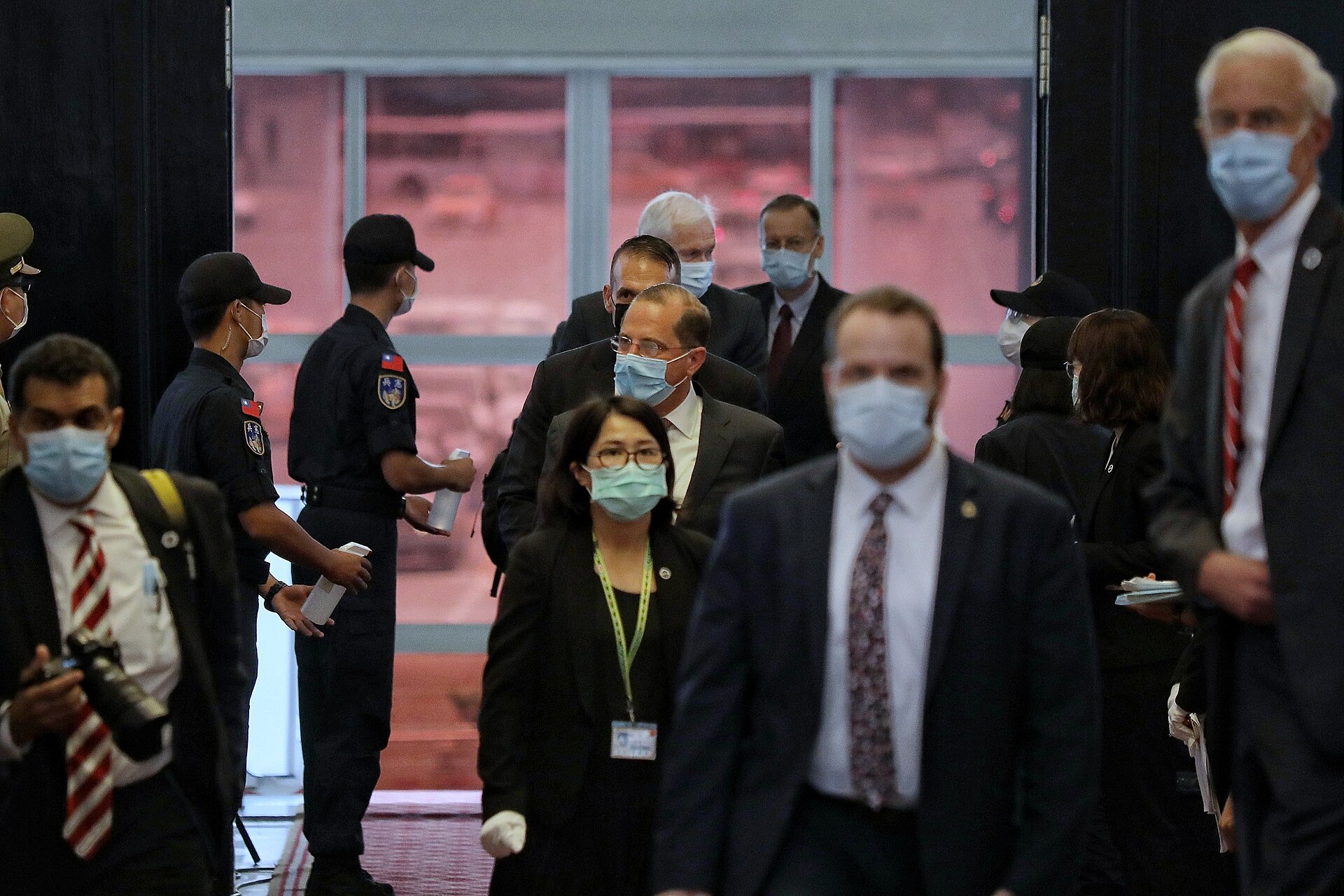
Image: Then-Secretary of Health and Human Services Alex Azar II (center of line) arriving at the Presidential Office Building in Taipei during his August 2020 visit to Taiwan. (Image source: Wikimedia Commons / ROC Presidential Office)
Another milestone came in 2021, with Section 1260B of the FY2021 US National Defense Authorization Act (NDAA). This legislation required the Secretary of Defense, in consultation with the Secretary of Health and Human Services, to assess the feasibility of establishing a US-Taiwan medical security partnership. The provision specifically identified potential areas of cooperation: including pandemic preparedness, vaccines and medicines, medical supplies, and scientific exchanges. Furthermore, by placing health-related cooperation within a defense authorization bill, Congress effectively recognized that medical readiness and health security are both indispensable components of broader resilience and security planning. Notably, this congressional effort was subsequently reinforced by a 2022 Department of Defense assessment, which concluded that expanded health-related cooperation with Taiwan was “not only feasible, but also desirable.”
Congressional interest in US-Taiwan health security did not end with the FY2021 NDAA. In 2021, Senator Tom Cotton (R-AR) and Representative Ro Khanna (D-CA) introduced the bipartisan and bicameral United States-Taiwan Public Health Protection Act, which proposed establishing a US-Taiwan Infectious Disease Monitoring Center within the American Institute in Taipei (AIT) to strengthen regional disease surveillance and public health preparedness. While the legislation was not enacted as a standalone bill, its underlying concept—that Taiwan should not be viewed merely as a participant in global health institutions, but as a responsible stakeholder in Indo-Pacific health security—continued to gain traction in Congress.
This broader vision was later reflected in the FY2023 NDAA through the incorporation of key elements of the Taiwan Enhanced Resilience Act (TERA), which expanded US-Taiwan cooperation on defense, economic resilience, countering coercion, and support for Taiwan’s meaningful international participation. Taken together, these legislative initiatives might imply an important US policy transition: Taiwan is increasingly viewed not simply as a partner seeking greater international space, but as a capable contributor to regional resilience—including in areas where health security intersects with broader economic and strategic preparedness.
The next phase of this agenda should recognize that health security is not limited to disease surveillance or pandemic response. A truly resilient Taiwan must also be able to sustain access to essential medicines, vaccines, diagnostics, active pharmaceutical ingredients, and advanced therapies during a public health emergency, natural disaster, or Taiwan Strait contingency. In this regard, US-Taiwan health security cooperation should include pharmaceutical resilience and biomedical supply-chain security in its agenda.
Taiwan’s Healthcare Strengths and Strategic Vulnerabilities
Taiwan’s healthcare system is widely admired for its universal coverage, cost-effectiveness, and clinical infrastructure. Combined with strong regulatory institutions, advanced digital health capabilities, and growing experience in real-world evidence generation, Taiwan enjoys many of the assets needed to become a reliable partner in regional health security. Meanwhile, it is also necessary for policymakers to recognize that Taiwan’s long-term resilience depends on the ability to maintain an uninterrupted pharmaceutical supply during a contingency.
Like many healthcare systems around the world, Taiwan has been challenged by balancing affordability, timely patient access, innovation incentives, and the integrity of supply chains. Budgetary pressures and reimbursement uncertainties may inadvertently contribute to medicine shortages, delayed availability of innovative therapies, and reduced incentives for manufacturers to prioritize the market during global disruption. These challenges are not merely healthcare management issues—they should be placed in a broader resilience framework.
In a future public health emergency, natural disaster, or Taiwan Strait contingency, disruptions in the supply of essential medicines, active pharmaceutical ingredients (APIs), biologics, or advanced therapies could place significant strain on Taiwan’s ability to maintain healthcare operations and public morale. Taiwan’s vulnerability is also not limited to physical supply chains. Recent assessments by Taiwan’s National Security Bureau have identified healthcare institutions among the key targets of PRC cyber activities, highlighting the broader challenge of maintaining healthcare continuity during periods of intensified tension and disruption. For this reason, resilience planning should extend beyond military readiness and technological security to include healthcare systems and pharmaceutical preparedness.
The Trade Policy Opportunity
Recent trade developments provide a unique opportunity to advance this agenda. The 2026 US-Taiwan Agreement on Reciprocal Trade (ART) included commitments related to pharmaceutical and medical device regulation, enhanced transparency, and efforts to address non-tariff barriers affecting healthcare products. The agreement also emphasized supply-chain resilience and broader economic cooperation. These provisions represent an important step forward. However, regulatory streamlining alone is insufficient to achieve long-term resilience.
On the other hand, inclusion of pharmaceutical market access into bilateral trade talks could be a solution for addressing the growing US-Taiwan trade imbalance. As Taiwan’s tech-driven trade surplus with the United States continues to grow rapidly, actively incorporating cutting-edge biomedical technologies into Taiwan’s healthcare system might offer an opportunity to rebalance bilateral trade flows. Furthermore, Taipei can demonstrate its readiness to move beyond its role as a manufacturing partner in the tech supply chain into a strategic partner that actively co-invests in the resilience of Western medical innovation.
Future discussions should focus not only on how quickly medical products can access the Taiwanese market, but also on whether healthcare systems are structured in ways that support sustainable access, supply continuity, and biomedical innovation in the long term. The broader lesson is that healthcare governance should no longer be viewed solely as a domestic social policy issue. It has gradually intersected with trade policy, economic security, and strategic resilience.
Policy Recommendations for US Policymakers
- Advance a THRIVE Taiwan Act to Assess US-Taiwan Health Security Gaps
Congress should build upon the legislative foundation established by the FY2021 NDAA’s medical security partnership and subsequent congressional proposals spearheading US-Taiwan public health cooperation. A practical next step would be to introduce a THRIVE Taiwan Act—the Taiwan Health Resilience, Innovation, and Vitality Enhancement Act—directing the Secretary of Health and Human Services, in coordination with the Secretary of State and other relevant agencies, to assess current gaps in the US-Taiwan health security partnership, identify existing mechanisms, and develop a strategy for strengthening cooperation on pharmaceutical resilience and biomedical supply-chain security.
The bill could require the administration to evaluate Taiwan’s vulnerabilities related to essential medicines, active pharmaceutical ingredients, diagnostics, vaccines, and advanced therapies; assess how existing US-Taiwan health, economic, and security mechanisms could be better aligned; and report to Congress on policy recommendations for strengthening Taiwan’s whole-of-society resilience, including considerations for public health.
- Integrate Pharmaceutical Resilience into US-Taiwan Economic Security Frameworks
Recent US trade concerns involving pharmaceutical pricing policies in Germany and the United Kingdom illustrate that healthcare and pharmaceutical access issues should be treated as part of US-Taiwan trade and economic security engagement. These issues could be addressed through existing or future discussions related to the Agreement on Reciprocal Trade and other economic cooperation frameworks.
Instead of focusing narrowly on market access challenges, economic security frameworks should address broader topics such as pharmaceutical supply-chain resilience, innovation policy, reimbursement transparency, emergency preparedness, and trusted biomedical partnerships. Recent US debates regarding global pharmaceutical pricing have underscored that innovation itself is increasingly viewed as a strategic asset, making healthcare governance relevant not only to public health, but also to economic competitiveness and national resilience.
Integrating these issues into existing economic engagement frameworks would reinforce the growing recognition that healthcare and economic security are increasingly intertwined. Taiwan’s strengths in clinical research, digital health, regulatory science, and real-world data capabilities could further support a more integrated innovation partnership, allowing Taiwan to be viewed as a trusted contributor to regional biomedical resilience.
- Use the 2020 Health Cooperation MOU Renewal as a Near-Term Implementation Vehicle
The impending renewal of the 2020 US-Taiwan Health Cooperation Memorandum of Understanding (MOU) presents a unique opportunity to broaden the scope of bilateral cooperation. While the existing MOU has facilitated valuable collaboration in areas such as public health, disease prevention, and pandemic preparedness, ever-changing geopolitical and supply-chain realities call for a more comprehensive approach.
As part of the renewal process, both sides should use the MOU as a near-term implementation vehicle for the broader agenda outlined above, including working-level consultations on pharmaceutical supply-chain resilience, access to innovative therapies, the value of health investment, regulatory cooperation, clinical research collaboration, real-world evidence generation, and preparedness for future health emergencies.
This approach would allow both sides to make quick progress before new legislation is enacted. Rather than creating a separate institutional structure, the renewed MOU could help transform shared priorities into practical cooperation, identify early deliverables, and lay the groundwork for deeper collaboration over time. The renewal of the MOU therefore offers an opportunity to elevate health security from a largely technical issue to a strategic pillar of US-Taiwan cooperation.
Conclusion
Over the past decade, US-Taiwan cooperation has expanded from traditional defense ties to include economic security, supply-chain resilience, and whole-of-society preparedness. In the next decade, pharmaceutical resilience should become its next strategic pillar. Proposed Congressional initiatives, such as the medical security partnership and Senator Tom Cotton’s infectious disease monitoring center, demonstrate an emerging recognition that healthcare is an essential component of resilience. At the same time, recent debates over pharmaceutical innovation, pricing, and industrial competitiveness suggest that healthcare issues are increasingly becoming matters of economic security as well.
As Washington and Taipei continue to upgrade their strategic partnership, pharmaceutical resilience should be integrated into existing trade, economic, and health security frameworks. This would help protect the integrity of supply chains, support biomedical innovation, and ensure Taiwan’s resilience in case of future contingencies.
The main point: As both the United States and Taiwan are committed to deepening their economic security partnership, health security should be prioritized in high-level policy discussions. Building on bipartisan congressional support, recent trade-policy developments, and the 2020 Health Cooperation MOU, policymakers should identify pharmaceutical resilience as a key pillar of the US-Taiwan partnership alongside defense, semiconductors, and supply-chain security.
.jpg)