
As part of the Global Taiwan Institute’s commitment to promoting a diversity of voices, the Global Taiwan Brief occasionally publishes articles written by Taiwanese youth. We are pleased to present this perspective from a high school student about the challenges young people face in navigating a complex internet information environment, and continuing debates over civic education in Taiwan’s schools.
Taiwan faces several serious threats, not only from direct military forces, but also from a self-defeating attitude that I see frequently in people of my age. While foreign observers warn of the possibility of a cross-Strait conflict, social media platforms popular among young people are filled with claims that “War won’t break out,” “Taiwan could never win anyway,” or “It doesn’t matter who governs us.” Nonetheless, these statements do not represent the voice of the majority of youth groups in Taiwan, and they should not be seen as proof that the entire generation has given up. However, as indifference toward democracy becomes a part of everyday conversation, it creates a sort of vulnerability that deserves attention.
The problem arises not simply because some students know too little about politics. In fact, many of us encounter politics in an information environment very different from the one for which our schools were designed. Civic education still largely proceeds through textbooks, exams, and classroom lectures. Political narratives, however, now reach us through short videos, influencers, memes, and recommendation algorithms. If schools avoid discussing controversial issues in the name of neutrality, students will not become politically neutral: instead, they will go somewhere else to learn about politics.
When Politics Spreads Through the Feed
Chinese social media platforms have become a major part of Taiwan’s information environment. Platforms such as TikTok, Douyin, and Rednote blur the line between entertainment and political influence. Indeed, content that may impact Taiwanese does not always have to employ obvious propaganda. Videos of modern skylines, high-speed rail, traditional culture, food, rural life, or ordinary families can render China a familiar and attractive country. Political messages can then spread through entertainment videos, and Taiwanese youth may not perceive these as political messages at all.
This is not a marginal issue. In fact, a 2025 Doublethink Lab study—using data from the Taiwan Communication Survey—found that 50.73 percent of high-school students used TikTok. Researchers also interviewed sixteen Taiwanese users aged fifteen to eighteen and discovered that political videos had sometimes appeared unexpectedly in social media groups, especially around the 2024 presidential election. Nonetheless, the researchers found that most of these teenagers still had negative views of the PRC government and opposed unification. It is thus an oversimplification to claim that using Chinese platforms makes Taiwanese teenagers “pro-China.” The more important question may be what kind of political information Taiwanese youth encounter on those platforms, and how they understand it.
That concern becomes clearer when we look beyond what appears on the screen. A 2025 peer-reviewed study of 700 members of Taiwan’s Generation Z found that more frequent use of Chinese social media platforms—including TikTok, Rednote, and Weibo—was associated with lower political knowledge about cross-Strait affairs, and a weaker ability to tell the different usages of language between China and Taiwan. Greater use of Chinese social media was also linked to a decreased ability to identify People’s Republic of China (PRC) disinformation. This does not necessarily mean that young people are being “brainwashed.” The problem may be more subtle. If people have less knowledge about an issue, it becomes harder for them to judge whether the information they see is reliable in the first place.
The numbers from another Doublethink Lab nationwide survey make this picture even more complicated. Among 2,612 Taiwanese respondents aged fifteen and above, the majority of both frequent and non-frequent TikTok users rejected the idea of giving up democracy for cross-Strait peace. Yet there was still a difference between the frequent and non-frequent users. The study found that 30.3 percent of frequent users were willing to accept giving up democracy for peace, compared with 23.4 percent of non-frequent users. Frequent users were also more likely to believe that unification with China might not significantly change everyday life in Taiwan. These numbers do not prove that TikTok caused these attitudes. But they do suggest that cognitive influence does not have to make young Taiwanese actively admire Beijing. Sometimes, it may simply make the differences between democratic and authoritarian systems feel less important, or make resistance seem less worthwhile.
What “Politics Out of Schools” Originally Meant
If political influence increasingly reaches students through their phones, then Taiwan must also ask what role schools should play. Here, our democratic history creates an ironic situation. During the authoritarian period of Taiwan, politics was not absent from Taiwanese campuses. Rather, politics was deeply intertwined with education. Historical records show that Kuomintang (國民黨) organizations, the China Youth Corps (中國青年救國團), military instructors, and state security agencies were involved in monitoring and managing university campuses. In 1986 and 1987, as Taiwan moved toward democratization, students involved in the “Freedom of Love” movement (自由之愛運動) at National Taiwan University demanded freedom of speech, university autonomy, and reform of the University Act (大學法), as well as the removal of party organizations, the Youth Corps, and military instructors from campuses.
This history matters because the original democratic demand was not that students should stop discussing politics. Instead, it was that the party-state should stop controlling political life in schools. Indeed, demands for political institutions to leave campuses appeared alongside demands for greater freedom of expression. Removing political control is not the same as removing political discussion.
Taiwan’s legal framework still reflects this distinction. Article 6 of the Educational Fundamental Act (教育基本法) requires education to follow a principle of neutrality and prohibits schools from either campaigning for particular political organizations, or forcing teachers and students to participate in political activities. The restriction is directed at the institution, not at the student. Taiwan democratized its schools by making institutions politically neutral, not by requiring students to be politically silent.
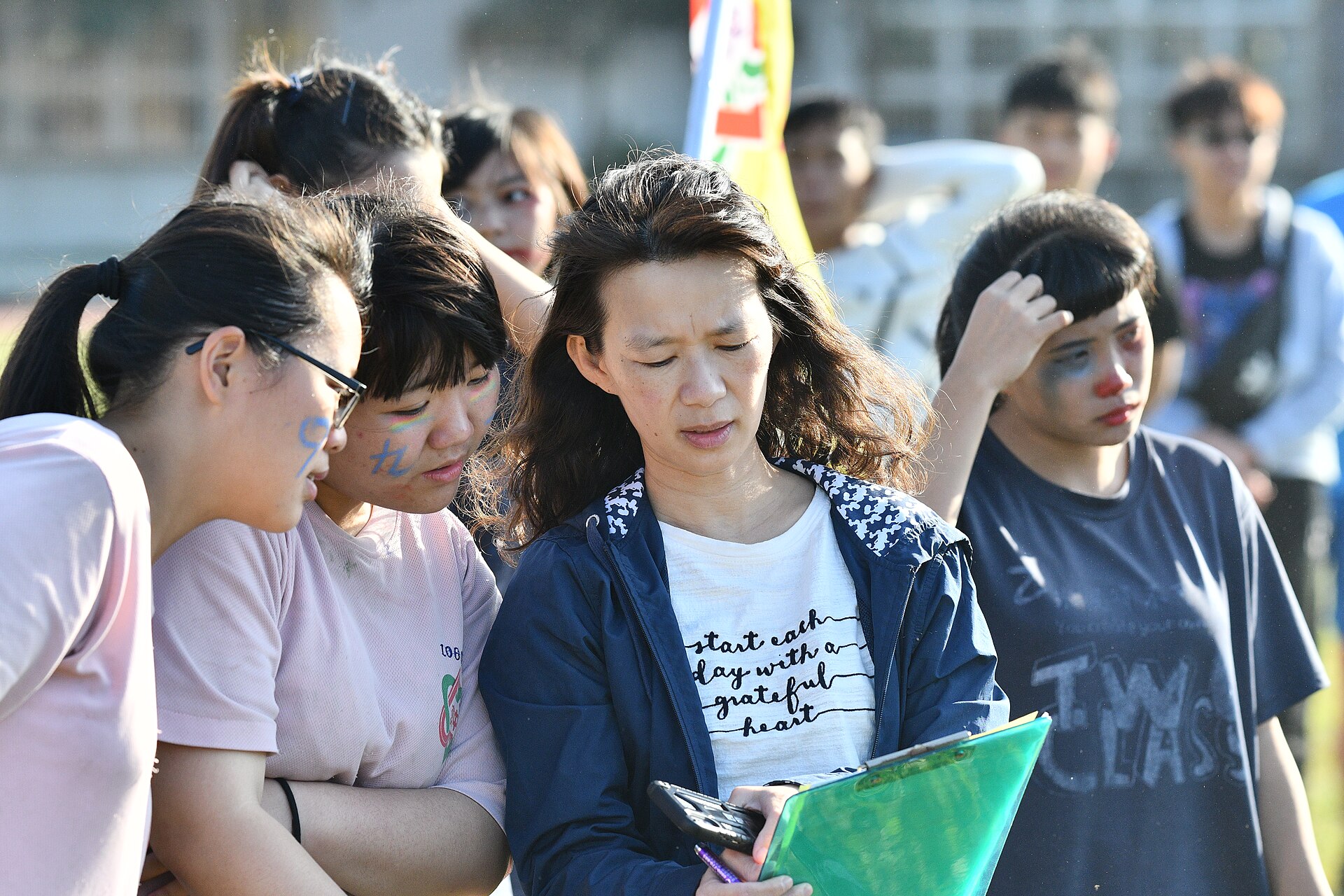
Image: A teacher and students at Baozhong Junior High School in Yunlin County, Taiwan (December 2019). Image source: Wikimedia Commons)
From Political Neutrality to Political Silence
Yet in practice, the memory of authoritarian political indoctrination may have encouraged a broader habit of avoiding controversial politics in school. The idea that “politics should not enter schools” (政治不入校園) can be interpreted not only as a warning against party control, but also as a reason for teachers to avoid politically sensitive issues. This is different from the original purpose of educational neutrality, which was to protect students from forced ideology, rather than to stop them from discussing political life.
The same tension can also be seen inside schools. A National Academy for Educational Research (國家教育研究院) survey of high-school history teachers found broad support for teaching transitional justice, but more than 60 percent of teachers worried that such teaching could be influenced by partisan viewpoints. Among teachers who did not design additional lessons on transitional justice, fear of being accused of partisan indoctrination was the second most common reason— after lack of class time. This does not mean that teachers do not want to discuss politics. Rather, it shows how easily civic education can be confused with political indoctrination, even in a democratic society.
The tension is especially clear because Taiwan’s curriculum has moved in the opposite direction. The 108 Curriculum (108課綱) included transitional justice in high-school history, and education researchers have also recommended using multiple historical perspectives to encourage discussion and reflection. Formally, schools are therefore expected to help students think critically about history, understand different perspectives, and reflect on democratic values. At the same time, teachers may still worry about being accused of taking sides.
As many of my classmates have noticed, political issues can therefore become exam facts that we memorize for answer sheets, but quickly escape our memory. Civics exists as an academic subject, but politics does not always become part of students’ real lives. History can feel distant from our own identities, while democratic rights become background conditions that we assume will always exist. When students then hear “If there’s war, just surrender” or “It doesn’t matter who is in charge,” they may understand the danger of war without having seriously thought about what political change could mean for freedom of speech, elections, personal rights, or the rule of law.
This is where the role of the classroom becomes important. Schools should not tell students which party to support or what position to take on cross-Strait relations. Instead, they should give students a place to ask questions, test claims, compare evidence, and discuss difficult issues. Research using data from 3,953 Taiwanese students in the International Civic and Citizenship Education Study found that an open classroom climate for discussion was associated with stronger civic knowledge and expected electoral participation. In other words, students do not become better citizens simply because disagreement is kept out of the classroom. They need opportunities to learn how to disagree while still respecting evidence, rights, and one another.
Rebuilding Civic Resilience
Taiwan can learn from the experiences of other democracies. Austria has included political education in its formal education system and emphasizes that controversial issues should also be presented as controversial in the classroom, while avoiding political indoctrination. Finland, meanwhile, treats media literacy as an important part of education and integrates it across subjects, helping students understand information, media, and misleading content. These two examples show that political education and media literacy do not have to mean telling students what to believe. Instead, they can help students understand political issues, recognize different viewpoints, and evaluate the information they receive.
Taiwan has also begun to recognize this need. In 2025, the Ministry of Education (教育部) announced plans to develop teaching materials on understanding China, including cross-Strait relations, national identity, and possible risks. By July 2025, thirteen teaching materials had undergone initial review, and were still being revised and supplemented. However, as a student on the front line of Taiwan’s education system, I was barely aware of this plan. Most of the teachers and classmates I asked had not heard about it either.
Even if the material is still under review, students should be able to understand what is being prepared, why it is needed, and when they may actually have the chance to use it. A policy cannot have much effect on students if the students themselves barely possess awareness of it.
For this reason, the Taiwanese government should expedite the development of these materials and simultaneously seek to raise awareness among students and teachers regarding what changes are underway. However, teaching materials alone may not be enough. Taiwan should also consider adding more opportunities for civic education and discussion in schools, especially on topics such as cross-Strait relations, democracy, media literacy, and how political information affects our daily lives.
Taiwan does not need to copy either Austria or Finland’s models exactly. Its own history provides the more important lesson. Taiwan’s democratization movement fought to remove one-party control from schools so that thought could become freer. The purpose of that effort was never to create classrooms in which politics could not be discussed.
Modern cognitive warfare makes this distinction urgent. Algorithms do not respect the principle of “politics out of schools.” They enter teenagers’ lives every day, deciding what we see. If schools in democracies respond by remaining silent, they leave the most politically consequential part of students’ education to systems designed not to educate citizens, but to maximize attention.
The challenge, then, is not to bring partisan politics back into schools. It is to bring democratic politics back into civic education. Students should understand how Taiwan’s freedoms were won, how authoritarian systems differ from democratic ones, how algorithms can shape political perception, and how to examine claims without automatically accepting or rejecting them because of party labels. Taiwan’s psychological defense will not be built by teaching young people what to think. It will be built by giving them the knowledge and habits necessary to decide what is worth defending for themselves.
The main point: As political information increasingly reaches Taiwanese youth through social media, schools’ reluctance to discuss controversial issues may leave students more vulnerable to misleading narratives and cognitive influence. Political neutrality should not mean political silence. Instead, Taiwan’s civic education should encourage open discussion, critical thinking, and media literacy, allowing students to develop their own informed judgments about democracy and the challenges it faces.