
On February 12, officials from the United States and Taiwan signed an Agreement on Reciprocal Trade (ART) (台美對等貿易協定) in Washington, DC. The ART is the most significant trade agreement between the United States and Taiwan in decades, and perhaps the closest thing the two countries will ever have to a bilateral trade agreement. The ART will eliminate or reduce trade barriers, and up to 99 percent of tariff barriers. It reflects a desire by both sides to promote the US-Taiwan economic partnership through increased investment and commercial opportunities. But getting the ART approved by Taiwan’s legislature will be the greatest challenge before seeing this deal go into force.
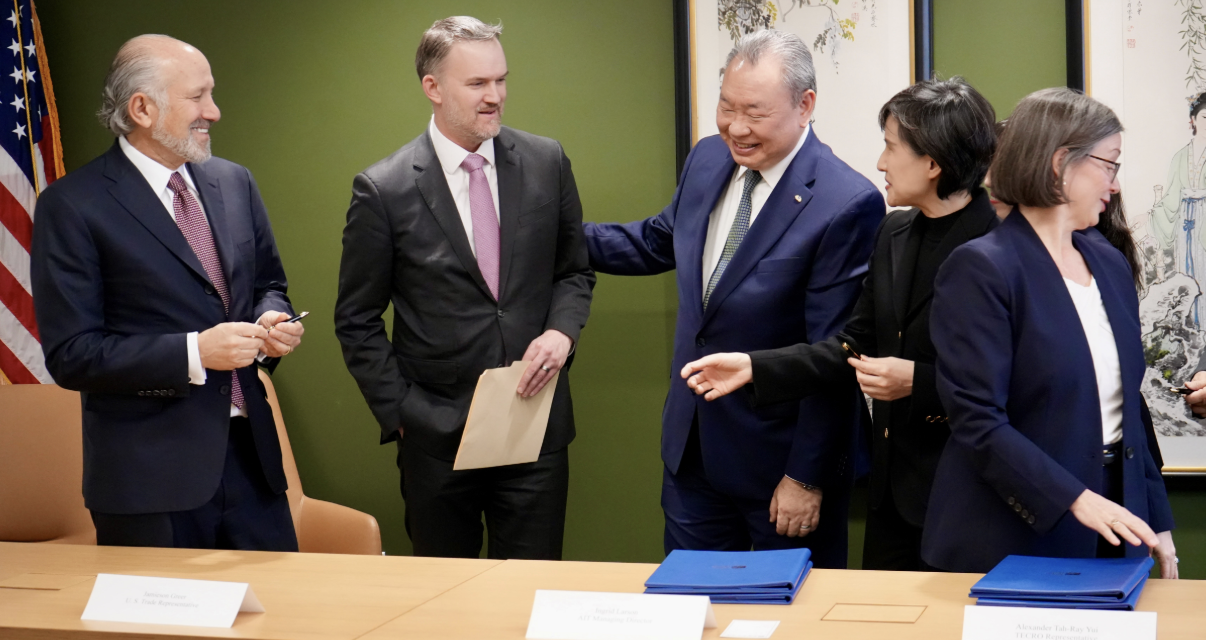
Image: US and Taiwan officials—including US Commerce Secretary Howard Luttnick (left), US Trade Representative Jamieson Greer (second from left), Taiwan Representative to the United States Yui Tah-ray (center), and Taiwan Vice-Premier Cheng Li-chiun (second from right)—at the signing ceremony for the US-Taiwan Agreement on Reciprocal Trade (Feb. 12, 2026). (Image source: Office of the US Trade Representative)
What Are the Major Provisions of the ART?
The ART is a comprehensive agreement that covers tariff and non-tariff barriers, and regulatory and enforcement issues. It further outlines economic and national security measures, investments goals, and future purchase commitments of American goods. The deal only goes into force once it has been through the internal procedures of each country—which in Taiwan’s case means approval by its legislature, the Legislative Yuan (LY) (立法院).
Here are some highlights of the agreement:
Tariff Reductions
Taiwan is expected to reduce 99 percent of its tariff barriers on products from the United States.
The process will be a phased implementation over a three-year period, with the majority of tariffs expected to be eliminated once the deal goes into effect. Imports of products such as passenger vehicles, which currently have a 17.5 percent tariff, will be expected to drop to zero immediately. The tariff rate on more politically sensitive agricultural products [1]—such as ducks, guinea fowl, and fresh oranges—will drop by at least 50 percent immediately. A 12.5 percent tariff on swine products is expected to drop by 50 percent over three years. Meanwhile, Taiwan’s existing tariffs on rice, clams, oysters, and chickens will remain unchanged.
Figure 1: Tariff Rates on Major Products Per the Agreement on Reciprocal Trade
ART: Taiwan’s Tariff Changes | |||
Staging Categories | Staging Categories’ Tariff Change | Number of Commodities Affected | Example of Commodity (with current tariff rate) |
EIF | Reduce current tariff rate to zero | 6,300+ products | Passenger vehicles (17.5 percent), Virginia tobacco (13 percent), tomatoes (10 percent), guitars (10 percent), knives (10 percent), glassware (8 percent), fishing rods (5 percent) |
A | Current tariff rate is already zero | 2,800+ products | Smartphones, personal computers, semiconductor manufacturing equipment, elevators, construction vehicles |
Z | Current tariff rate remains unchanged | 27 | Rice (NT$45/KGM), rice flour (NT$49/KGM), chicken meat (20 percent), oysters (20 percent), garlic (NT$27/KGM), dried red beans (NT$22/KGM) |
R2-R10 | Current tariff rate reduces to between 2 percent and 10 percent | 39 | Pork belly (40 percent), duck meat (30 percent), guinea fowl meat (25 percent), refrigerated trucks (17.5 percent), electrical apparatus for switching or protecting electrical circuits (10 percent), numerically controlled horizontal lathes (6 percent) |
RH & RH3 | Current tariff rate reduces by 50 percent (either immediately or over three years) | 27 | Swine carcasses and parts (12.5 percent), swine feet and stomach (15 percent), fresh oranges (20 percent), fresh grapes (20 percent), turkey meats (15 percent), gaskets and similar joints of metal sheeting (5 percent), co-axial cable (5 percent) |
Source: Compiled by the author, per information in: AIT-TECRO ART Tariff Schedules sanitized.pdf
Non-Tariff Reductions
Safety standards have often been seen as a non-tariff barrier for American exports to Taiwan. However, many such standards issues have been eased or eliminated in the ART. For example, Taiwan has agreed to accept vehicles that are compliant with U.S. Federal Motor Vehicle Safety Standards. It will accept medical devices that are approved by the US Food and Drug Administration.
Further, Taiwan will ensure that its safety standards for food and agricultural imports conform with internationally recognized standards: to include historically sensitive products in US-Taiwan trade negotiations including beef, pork, and animal byproducts. There are also provisions relating to removing barriers to trade for bison, poultry, dairy, aquatic products (excluding catfish), potatoes, and agricultural biotechnology, including more reasonable limitations on future import restrictions on poultry products potentially affected by avian influenza.
Economic and National Security Cooperation
While Taiwan already has export controls and investment screening, the ART goes further to ensure that the United States and Taiwan coordinate more closely on these issues. Taiwan will align its export controls with respect to the US Foreign Direct Product Rule (FDPR) on semiconductors and equipment. It will ensure Taiwan maintains “robust research security measures,” including entering into no agreements with the PRC regarding technologies such as artificial intelligence, biotechnology, and quantum computing. Taiwan will also maintain and apply a comprehensive mechanism to review inbound and outbound investment.
Regulatory Alignment
On more technical trade matters, Taiwan will ensure transparency and fairness with respect to the protection or recognition of geographical indications—which link products to specific geographical places of origin. Taiwan will ensure there are no digital service taxes on American companies, while also ensuring the free transfer of data across trusted borders. The two countries will expand rare earth recycling opportunities. And Taiwan will crack down on illegal logging, unregulated fishing, and illegal wildlife trade.
Enforcement Enhancement
Taiwan will provide a robust standard of protection for intellectual property, including providing effective systems for civil, criminal, and border enforcement of intellectual property rights. It will ensure that these systems combat and deter the infringement or misappropriation of intellectual property, including online. Taiwan will also work towards enforcing internationally recognized labor rights, including the protection of unions. It will also eliminate any form of forced or compulsory labor, particularly in distant water fishing.
$85 Billion in Purchase Commitments
Between now and 2030, Taiwan agrees to purchase from the United States $44.4 billion worth of liquid natural gas (LNG) and crude oil; $25.2 billion worth of power equipment, power grids, materials, generators, storage facilities, marine equipment, steel-making equipment, and other relevant equipment; and, $15.2 billion worth of civil aircraft and engines.
$500 Billion Investment Companion
On January 15, 2026, officials from the US and Taiwan signed an investment agreement that will see $250 billion in new direct investment in the United States by Taiwanese semiconductor and technology enterprises, and $250 billion in credit guarantees by the government in Taiwan for additional investments. These investments will focus on building and expanding advanced semiconductor, energy, and artificial intelligence production, as well as the supply chain and ecosystems that support these industries. Taiwan is also expected to facilitate investment in America’s LNG export capacity, and to invest in Taiwan’s own LNG storage capacity—which is then expected to be filled with American LNG.
Unfortunately, neither the ART nor investment agreement mentioned any progress towards establishing a US-Taiwan bilateral tax agreement – despite all the planned investments to be made.
As a part of these trade and investment deals, the US has agreed to reduce tariffs applied on imports from Taiwan. The tariff rate applied under the International Emergency Economic Powers Act (IEEPA) will be reduced from 20 percent to 15 percent. A 25 percent tariff rate on Taiwanese auto parts, timber, lumber, and wood derivative products applied under the Trade Expansion Act of 1962 will be reduced to 15 percent. Tariff rates on generic pharmaceuticals, generic ingredients, aircraft components, and unavailable natural resources will become zero. And future tariffs on semiconductors will be based on a quota system that depends on Taiwanese investment in the United States.
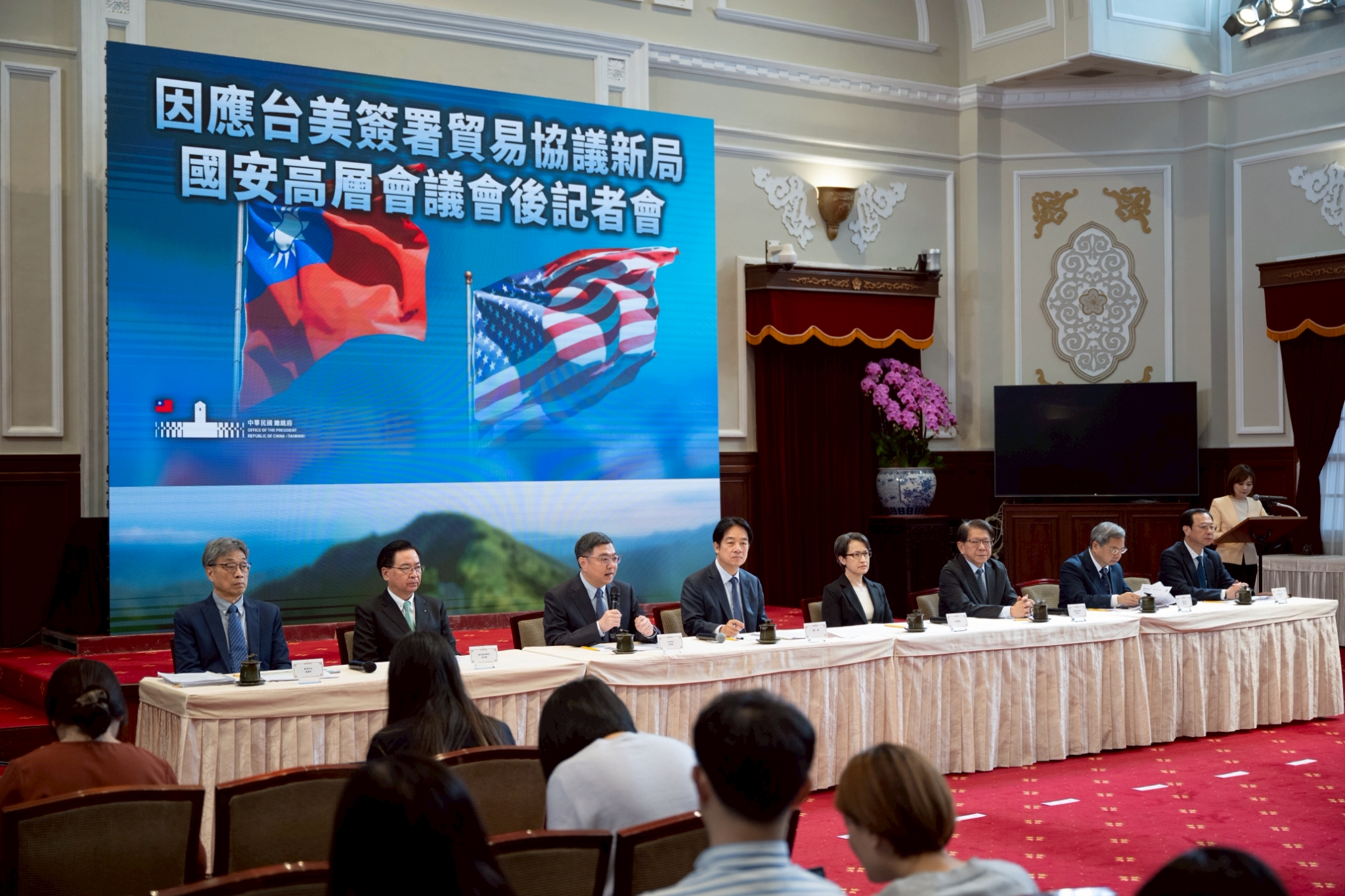
Image: Taiwan President Lai Ching-te (center left), Vice President Hsiao Bi-khim (center right), and other officials at a press conference to discuss the new US-Taiwan trade deal (Feb. 13, 2026). (Image source: ROC Presidential Office)
Implications for Taiwan-PRC Relations
While much of the ART is focused on expanding the US-Taiwan economic partnership, several important efforts are made in the agreement to ensure that neither country expands their partnerships with China, at least without approval of the other party.
Article 5.4.6 of the ART states that if Taiwan enters into a new bilateral free trade agreement or preferential economic agreement with China, the United States may terminate this agreement and reimpose tariffs. Since the emphasis is on new agreements, it’s safe to assume the 2010 Economic Cooperation Framework Agreement (ECFA) doesn’t affect this deal. However, both Taiwan’s and China’s desire to get into the Comprehensive and Progressive Agreement for Trans-Pacific Partnership (CPTPP) would.
Additionally, Article 4.3 of the deal states that if Taiwan enters into a digital trade agreement with China, the United States may terminate the agreement and reimpose tariffs. Article 5.2.7 states Taiwan will phase out the use of existing technology from countries of concern, and not allow technologies from those countries into Taiwan’s digital infrastructure: including the country’s 5G and 6G wireless networks, subsea cables, cloud systems, internet data centers, imaging technology used at airports and seaports, and cranes used at seaports.
Reactions from the PRC to the trade deal have been predictably negative.
Challenges Ahead
The ART will require the approval of Taiwan’s unicameral legislature before it can move forward—and if recent challenges involving passage of the defense budget are any indicator, President Lai will have to spend a lot of political capital to get the ART through.
The tariff reductions specifically will require legislative approval, but the LY will want to review the entire agreement—including the companion investment deal, which has yet to be made publicly available. This will represent a significant challenge for the Lai Administration: Lai’s Democratic Progressive Party (DPP, 民進黨) is in the minority in the legislature, with a coalition of the opposition Kuomintang (KMT, 國民黨) and the Taiwan People’s Party (TPP, 民眾黨) holding a majority of the seats.
In light of how politically sensitive the ART may be domestically, there will be real difficulties in securing passage. The KMT has criticized the agreement, claiming that it could jeopardize food safety and harm Taiwanese industries (automotive, agricultural, etc.) that are now open to competition with American companies. Local elections in November may also add to the challenge to getting the ART through the LY, especially if the approval process stalls for very long. As of now, the LY may start its review of the ART in March.
Recent events between the US and South Korea show that Mr. Trump is not interested in other country’s domestic politics where his trade deals are concerned. While trade deals don’t typically include a date of implementation, if President Lai can’t get the ART through the LY in a timely manner, tariffs on imports from Taiwan will go back up before too long.
Conclusion
The future of US-Taiwan trade relations rests on not just Taiwan’s ability to get the deal approved through its legislature, but to also implement the deal in a timely manner. Whether the growing US-Taiwan trade deficit matters anymore is anyone’s guess. But the ART contains language indicating that future exemptions from tariffs will depend not just on the trade deal—but also on Taiwan’s ability to fund its defense at 3 percent of GDP, streamline defense trade, and develop shipbuilding, among other things.
While the US and Taiwan were on an established path towards a bilateral trade agreement under the 21st Century Trade Initiative, those efforts slowed and the US presidential administration changed. The Trump Administration has chosen a different path for US trade policy—one which has led to higher tariffs, but greater U.S-Taiwan investment and commercial opportunities.
The main point: The United States and Taiwan have signed a new trade deal called the Agreement on Reciprocal Trade (ART). The ART will reduce or eliminate most tariff and non-tariff barriers on American imports in Taiwan – even for politically sensitive agricultural products. The ART is a companion deal to an investment agreement that was signed in January, which will see $500 billion in new investment in the United States—much of which will be focused on the semiconductor industry, and artificial intelligence-adjacent industries.
[1] In Taiwan, politically sensitive industries tend to be those with greater political influence—such as farmers and those that work in agriculture. Politicians may also be politically sensitive to certain manufacturing industries, such as the automobile or steel industries.