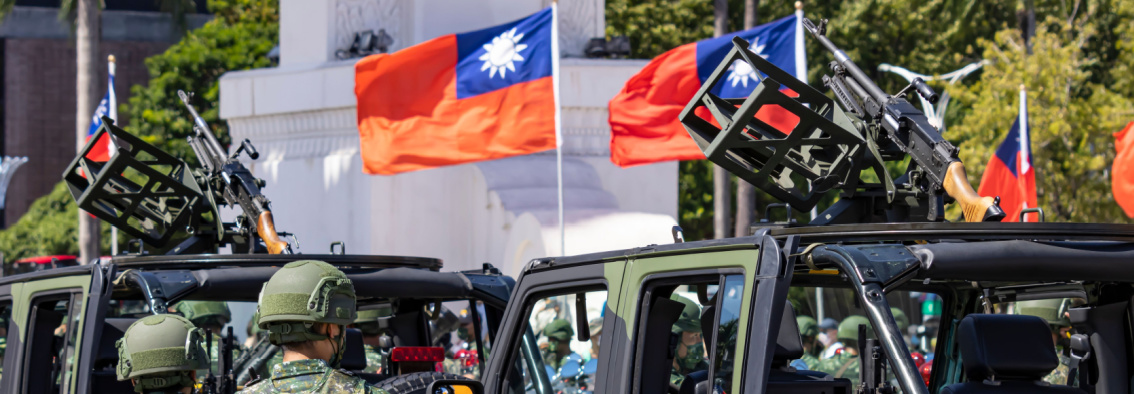

The end of 2025 came with yet another demonstration of Beijing’s desire to operationalize the encirclement of Taiwan: the “Justice Mission 2025” (正義使命 2025) exercise. There were several notable aspects of Justice Mission, including more and larger designated exercise zones, the deployment of the PLA Navy and China Coast Guard closer to Taiwan, and the publicized deployment of the Type 075 landing helicopter dock (LHD) vessel with Z-8/Z-20 helicopters on Taiwan’s east coast (implying a capability to conduct special forces raids). PLA Air Force sorties were also notably high in number, displaying unprofessional maneuvering and disrupting civil aviation.
These operations were in service of a propaganda campaign showcasing the PLA’s claimed ability to conduct a “blockade and disruption” of Taiwan’s ports (see image below). The exercises were billed by People’s Republic of China (PRC) state media as a response to the December 2025 US announcement of a USD 11 billion arms package to Taiwan. The arms package contains platforms and capabilities that will significantly empower Taiwan to execute a“strategy of erosion”(削弱戰略), such as High Mobility Artillery Rocket Systems (HIMARS), M109A7 self-propelled howitzers, Altius unmanned aerial vehicles (UAVs), Tactical Mission Network Software for command and control, and Javelin and TOW 2B anti-armor missiles. This new strategy is designed to utilize Taiwan’s terrain to maximize defender advantages and systematically erode the PLA’s combat power as it gets closer to the island and lands. No longer will Taiwan’s military be expected to gamble on high-risk, decisive action to win sea and air control against a quantitatively superior adversary. In light of these acquisitions, the exercise was meant to demonstrate to casual observers that the PLA could choke off Taiwan without needing to land on the island.
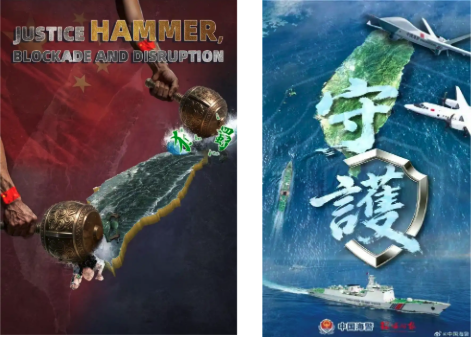
Image: PRC graphics from Justice Mission 2025. Note the use of “China Coast Guard” (中国海警) assets on the propaganda, to emphasize that a blockade would be an “internal matter” as opposed to a legal act of war against a foreign state. (Image Source: PRC Ministry of Defense)
Nonetheless, PRC propaganda regarding the People’s Liberation Army’s capabilities is overblown. Meanwhile, the encirclement exercise itself is unrealistic. In a wartime situation, the closer the PLA Navy and China Coast Guard get to Taiwan, the easier it is for Taiwan’s armed forces to target PLA units with anti-ship missiles and UAVs. Similarly, if the Type 075 landing helicopter dock were actually to be used, it would only be well after the PLA achieved air dominance (which itself would be difficult to achieve even with heavy suppression of enemy air defenses). To employ the Type 075, the PLA would also need to achieve destruction of Taiwanese anti-ship missile capability, and be confident that US/coalition forces would not intervene.
Still, the exercise serves as a good reminder that Taiwan must be prepared for a holistic, flexible PLA military campaign. Ensuring that the Republic of China (ROC) (Taiwan) military can rapidly mobilize and execute the strategy of erosion against an invasion is still the most urgent priority—but alone, it is insufficient. Taiwan must also prepare to extend this strategy across a protracted campaign. What happens once the enemy stops obligingly running into pre-designated kill zones? What happens if the enemy doesn’t land at all? How will Taiwan credibly deter the PLA and Chinese Communist Party (CCP) under those conditions? Ultimately, these are the difficult strategic and operational questions regarding how Taiwan can successfully terminate a war with the PRC. This difficulty is compounded by an adversary that attempts to leverage Taiwanese defense incoherence into paralysis. In this two-part series, I will define this defense incoherency and what it means for Taiwan. I propose several steps that Taiwan can take to guard against the paralysis caused by domestic political infighting. In the second article, I will outline the principles by which Taiwan can regain defense coherency: a strategy to make time work for Taiwan.
Defense Incoherency and Paralysis
Defense incoherency is the lack of a clear, consistent approach to defense planning. In Taiwan’s case, defense incoherency is driven by the disconnect between vastly-increased PLA capabilities (both real and perceived), declining Taiwanese defense capability relative to the threat, and the electoral imperative from Taiwan’s political-military leadership to project confidence in spite of deficiencies.
Of course, the PRC is aware of these dynamics in Taiwan. Accordingly, the PLA puts far more emphasis on the rapid, public roll-out of new platforms as opposed to the considerably more difficult task of integration and combat readiness—an assessment made by none other than the recently-purged Vice Chairman of the Central Military Commission, Zhang Youxia (张又俠). Coercion exercises like Justice Mission, which have increased in pace and scale, are designed around showcasing PLA capabilities, as opposed to war-training. Fast platform roll-outs, gray zone activity, coercion exercises, and dangerous maneuvers are all part of a cognitive warfare campaign to introduce uncertainty and increase Taiwanese defense incoherency.
This uncertainty of capability and intent leads to a floundering response. The initial growth of the PLA Rocket Force (previously known as the 2nd Artillery) in the early 2000s drove numerous academic debates over the usefulness of “asymmetric” versus “symmetric” weaponry. More recent iterations, stemming from the growth of the PLA Navy and PLA Air Force, include debates over prioritizing gray zone responses versus invasion preparedness, or the PLA’s potential use of a quarantine versus a blockade. What underpins these debates are several rarely-challenged assumptions. The first of these is the assumption that Taiwan’s defense budgeting is a zero-sum game, where defending against one aspect of attack will mean forgoing defenses against another. The second is the assumption that the PLA’s quantitative and qualitative advantages over Taiwan are so great that entire classes of weaponry, locations, or methods of fighting must be pre-emptively ceded.
These assumptions feed off each other: for instance, why bother investing in an air force or a navy if the PLA Rocket Force can supposedly destroy all of Taiwan’s fighters and ships in the first few days of a “joint firepower strike campaign”? Similarly, why bother investing in an army if the PLA Navy can just blockade Taiwan into surrender?
On a smaller scale, such binary thinking leads to poor defense planning. For instance, some argue that Taiwan should prioritize constant gray-zone intercepts instead of combat training, under the assumption that PLA missile strikes will take out the Taiwanese air force in the opening salvos of a war. Others suggest that Taiwan should deprioritize joint training under the belief that during a war, the PLA will jam all communication or destroy the other military branches. It is no accident that these assumptions, taken to extremes, echo standard CCP propaganda themes regarding the omnipotence of the PLA, the irreparable weakness of Taiwan’s military, the futility of resistance, and the inevitability of unification.
PRC actions drive Taiwanese defense incoherency. Defense incoherency leads to disorganized action based on political, bureaucratic, budgetary, or personal incentives— incentives that usually do not underpin optimal defense considerations. This leads to a risk-averse military culture wherein the overwhelming motivations are to keep up appearances and avoid rocking the boat: in short, paralysis.
Guarding Against Paralysis
Only a few years ago, Taiwan’s military was knee-deep in a decades-long era of defense incoherence. It took the shock of the Russian full-scale invasion of Ukraine to break the paralysis. It then required years of clear political direction, dedicated budget increases, actionable military planning, and reformist leaders such as Chief of General Staff Admiral Mei Chia-shu (梅家樹) to reverse the incoherence and re-orient Taiwan’s military towards the strategy of erosion.
Despite significant effort, this transition is not complete. Decades of neglect and paralysis cannot be reversed in a handful of years. Moreover, for the Taiwan military to achieve the next step—the capacity of all-around deterrence and warfighting in a protracted campaign—still greater effort must be exerted. Taiwan cannot afford paralysis now, as exemplified by the current impasse over the special defense budget.
Taiwan can take three steps to guard against paralysis. The first is to increase and sustain defense resources on a scale adequate to the problem. Taiwan’s defense spending has indeed increased considerably over the last decade, to roughly 2.5 percent of GDP in 2025. However, this increase from the catastrophically-low levels of less than 2 percent of GDP is not enough to offset the damage done to the force.
Even if the currently proposed defense special budget passes in its entirety, defense spending would only stand at 3.3 percent of GDP, roughly what Taiwan was spending in the vastly different security environment of 1997. Insufficient increases serve only to heighten strategic incoherence by presenting the appearance of action, without the necessary resources to credibly address the problem.
Moreover, the flood of new capabilities coinciding with this defense spending would necessitate urgent initiatives to adequately man, integrate, and exercise the armed forces in order to incorporate these new capabilities. Whether symmetric or asymmetric, weapons platforms do not plan operations. Instead, significant manpower is required to fuel, arm, maneuver, and target enemies. This requires personnel investments to resolve the military’s chronic qualitative and quantitative manpower issues—an effort that involves expanding existing bipartisan efforts to increase military pay/living standards as well as the operational exercise budget. Both the issue of new capabilities and personnel spending are linked, and should not be set against the other. Last, but certainly not least, sustained and predictable budget increases will help break a risk-averse military culture, where commanders fear that the next accident incurred during training or a failed platform experiment will result in the withdrawal of scarce funds.
The second is to conduct systematic, task-based planning based on realistic assessments of enemy threats. For instance, previous defense planning tended to be overly focused on US defense acquisitions as a “strategy of insurance” in and of themselves—or as a service-centric means of boosting morale by acquiring flashy new capabilities. Part of the success of the re-orientation to a strategy of erosion against a landing has come from the Taiwan military focus on defense requirements regarding one clearly-defined (albeit complex) task, with structured sub-tasks for each service underneath.
Such a structuring not only focuses priorities, but also forces each service to work with each other to maximize task success. Just as importantly, it implicitly forces planners to consider not just the strengths of the PLA, but also its weaknesses. The continued growth of Taiwanese military capabilities and manpower will allow for this type of planning to scale to the greater problem of fighting an entire campaign.
In this regard, Ukraine’s experiences from the all-out invasion of 2022 continue to provide valuable references for Taiwan. Prior to the war, Ukraine dealt with its own version of defense incoherence that paralyzed military reform. However, immediately following the invasion, Ukraine (along with the US intelligence community) discovered how the earlier limited use of elite Russian units masked enormous issues with the bulk of the Russian military. Finally, after the failure of the much-hyped, politically-influenced 2023 Ukrainian counter-offensive, Kiev began systemic reforms to sustain a protracted war against the Russians while preserving Ukrainian manpower.
The final element to avert paralysis is the organization a long-term strategy based on first principles—to be covered in part 2 of this article series.
The main point: Recent PLA exercises drive home the point that Taiwan must be prepared not just for an island landing, but also the possibility of a blockade and protracted war. While the ROC military’s re-orientation to a strategy of erosion against an invasion has broken earlier defense incoherence, Taipei must be on guard to ensure that paralysis does not set in once more as it seeks the more difficult target all-around deterrence.