
“Taiwan knows how to build,” and has built “a reputation for execution – not simply announcing plans, but delivering results.” These comments, from US Under Secretary of Commerce for International Trade William Kimmit, were made in reference to an investment agreement signed in January between the United States and Taiwan. The deal promises $250 billion in Taiwanese private-sector investment and up to $250 billion in government-backed credit guarantees in the United States.
Perhaps even more notable is the context in which Under Secretary Kimmit gave his praise.
Kimmitt attended a welcome reception in Washington DC hosted by the Taipei Economic and Cultural Representative Office in the United States (TECRO) for the May 2026 SelectUSA Summit—a forum for companies hoping to invest in the United States. The summit, organized by the US Department of Commerce, is “the highest profile event in the United States to facilitate business investment,” hosting thousands of foreign companies every year, and has generated over USD 256 billion in new investment projects across the United States. For the past seven out of eight years, Taiwan has sent the largest delegation in the world to attend. This year, with 113 companies and 207 Taiwanese delegates attending, Taiwan delivered the largest delegation in history.
Growing US-Taiwan Trade and Investments
This may come as no surprise given the thriving nature of US-Taiwan commercial relations in recent years. For example, according to recent US Census Bureau data, Taiwan was the United States fourth-largest trading partner in 2025, with bilateral trade totaling approximately USD 256 billion. Four years prior, Taiwan was America’s eleventh-largest trading partner, with bilateral trade barely exceeding USD 100 billion. Now, Taiwan is the United States fourth-largest source of imports (USD 201 billion), and the tenth-largest export market (USD 55 billion). This large volume of trade has led the United States to become Taiwan’s second-largest trading partner for over a decade.
In addition to the impressive trade volumes, Taiwanese investment in the United States is also on the rise, and arguably becoming just as important as US-Taiwan trade. According to the Bureau of Economic Analysis, Taiwan is one of the top 15 sources of foreign direct investment (FDI) in America: with USD 14.8 billion in investment stock in 2024, and announced investment projects at almost USD 200 billion in total. [1] Additionally, Taiwan is responsible for the largest FDI project in American history: Taiwan Semiconductor Manufacturing Company (TSMC, 台灣積體電路製造公司)’s USD 165 USD billion project for a semiconductor manufacturing complex in Phoenix, Arizona.
While discussion of Taiwanese investment understandably focuses on TSMC, there are also a growing number of companies across a wide range of industries trying to expand into the American market. This was obvious at the 2026 SelectUSA Summit, where Taiwanese participation included company delegates from sectors including artificial intelligence (AI), robotics, drones, health technology, and food manufacturing. Taiwanese investment in the United States has more potential than just semiconductor projects and will include networks of small and medium-sized enterprises (SMEs) that bring a variety of expertise in the technology sector to the United States. Overall, with the US-Taiwan investment cooperation memorandum signed earlier this year, Taiwanese investment into the United States is set to grow significantly.
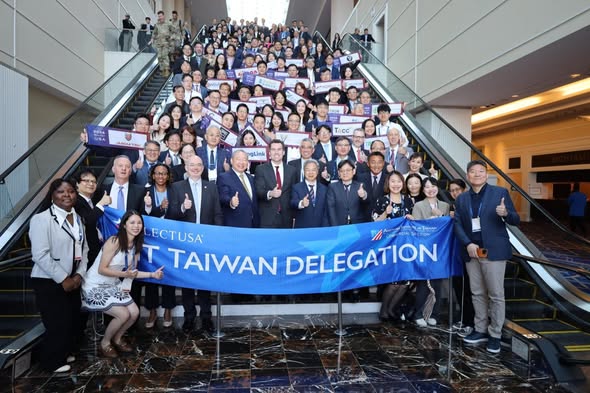
Image: Members of Taiwan’s delegation to the 2026 SelectUSA Summit, held in May in Washington, DC. Taiwan’s was the largest delegation at the 2026 event. (Image source: ROC Ministry of Foreign Affairs)
Implications of Taiwanese Investment
This growing investment matters for several reasons. First, investment has the potential to facilitate significant job creation in key states and industries. America’s International Trade Administration pointed out that approximately 10 percent of US employment was directly or indirectly attributable to foreign direct investment in 2019, and that FDI makes the US manufacturing industry more productive. According to TECRO’s 2024 estimates, trade and investment with Taiwan supports over 380,000 American jobs.
Moreover, Taiwanese investment also supports higher-end jobs—specifically in the high-tech sector, including high-tech manufacturing, engineering, and artificial intelligence. During the 2026 SelectUSA summit, twenty Taiwanese firms in the semiconductor and related supply chain sectors announced plans to invest USD 35 billion in the United States. According to Taiwanese Minister of Economic Affairs Kung Ming-hsin (龔明鑫), this will “not only help strengthen the global competitiveness of Taiwanese companies, but also assist the US in accelerating the establishment of a more complete and resilient high-tech supply chain.”
This directly aligns with recent American economic strategy policy goals. In the context of competition with China, the Biden Administration emphasized “friendshoring” and allied coordination, seeking a stronger and well-organized division of labor between the US and like-minded democratic allies like Taiwan. On the other hand, the Trump Administration has advocated for broader reshoring or decoupling, economic separation from China, and moving supply chains to the United States. Taiwan’s investment in high tech industries in the United States supports both of these strategies by building manufacturing capabilities in the United States with a trusted democratic partner.
This trend also supports supply-chain resilience in general, aligning with Taiwan’s goal to build resilient “non-red” supply chains (非紅供應鏈) (i.e., supply chains not based in or reliant on China). Scholars point out that, in the modern age, countries and firms may leverage strategic chokepoints to coerce and harm adversaries, particularly in certain industries such as semiconductors or rare earths. By working with democracies worldwide to maintain technological strengths, Taiwan and the United States can deter the PRC from weaponizing economic interdependence and asymmetrical positions within global supply chains, preventing trade from becoming a potential strategic vulnerability. Therefore, there are numerous benefits to attracting Taiwanese investment into the United States.
Policy Recommendations
As Taiwan and America continue to pursue deepening this investment relationship, there are a few key things to consider. First, America and Taiwan need to promote subnational engagement and state-level investment partnerships. The US is not a singular market, given that states have different regulatory environments and investment considerations. Even though the US has a lot to offer with each states’ advantages in various industries, Taiwanese firms have limited access to acquire more information before making investment decisions. To narrow this gap and assist Taiwanese firms in their investment goals, more states should consider opening up trade and investment offices in Taiwan. Currently, just 23 American states have trade and investment representative offices in Taiwan. These offices are typically set up under the American State Offices Association (ASOA), which was formed to facilitate and strengthen bilateral ties between individual states and Taiwan, supporting efforts to increase US exports and attract Taiwanese investment. There is clearly potential for future growth, given that not even half of all American states have offices in Taiwan. These offices serve as an important pipeline for Taiwanese companies interested in investing in the United States, as they are able to articulate their respective state’s investment ecosystem, regulations and policies, and incentives or challenges for Taiwanese companies seeking to take root in America. These offices can also connect Taiwanese firms to local talent networks and service providers to facilitate easier and deeper investment.
At the same time, state governors and other subnational representatives should continue to bring delegations to Taiwan. By visiting Taiwan, states show that they attach importance to Taiwan, opening up opportunities for further collaboration. For instance, Wyoming representatives have visited Taiwan several times over the past few years and developed opportunities for further collaboration with Taiwan. During a visit to Taiwan in April 2025, Wyoming representatives signed a Memorandum of Understanding (MOU) promoting the development of quantum technology cooperation, and President Lai met with Wyoming Governor Mark Gordon this May to discuss avenues for economic and trade collaboration. Individual states should follow suit and actively engage in attracting Taiwanese investment, considering the hundreds of billions of dollars Taiwan has promised to allocate for private-sector investment.
This was solidified by a joint letter issued this June by the US Departments of State, Agriculture, and Commerce, which encouraged US state governors to expand engagement with Taiwan in trade and investment. The letter noted the commercial opportunities of subnational engagement with Taiwan, and that such engagement is consistent with the Taiwan Relations Act. Given the restrictions that Taiwan has for interacting with the United States on the national level, subnational engagement is an effective way to promote US-Taiwan relations and economic cooperation, while also expanding Taiwan’s international space. This is especially important, given that firms must eventually pick a specific location in which to invest first.
Additionally, despite the deepening of US-Taiwan investment ties, the United States is the only G7 country without a double taxation agreement with Taiwan. A US-Taiwan double taxation agreement would unlock billions in FDI for the US economy. Taiwan companies that currently invest in the United States face an overall 15 percent tax rate, which deters small and medium-sized Taiwan enterprises, including TSMC’s specialized suppliers, from investing in the US. The US House of Representatives passed a bill in January 2025 addressing double taxation (H.R.33) on cross-border investments between the US and Taiwan, but the bill has not progressed further. To bolster economic ties and alleviate instances of double taxation, commercial diplomacy efforts should focus on negotiating and finalizing a tax agreement with Taiwan.
In conclusion, Taiwan is becoming a major strategic investor for the United States, not just an export partner. To continue strengthening ties with Taiwan and expanding its international space, policymakers both on the national and subnational levels should make efforts to capitalize on this new development. As competition over technology and supply chains grows, attracting Taiwanese investment is more than just an economic opportunity—it is also aligned with American security interests.
The main point: Taiwan is becoming one of the United States’ most important investors, helping to support supply chain resilience and technological competitiveness. American policymakers at the national and state levels should reduce barriers to Taiwanese investment and make room for commercial engagement.
[1] For further information on these trade figures, see these sources: https://www.nist.gov/news-events/news/2025/06/president-trump-secures-200b-investment-micron-technology-memory-chip; and https://money.usnews.com/investing/news/articles/2026-07-10/nvidia-supplier-king-yuan-electronics-to-invest-up-to-1-4-billion-in-us-facility; and https://www.pbs.org/newshour/politics/watch-live-trump-makes-investment-announcement-as-he-prepares-speech-to-congress; and https://www.digitimes.com/news/a20260508PD212/taiwan-usa-investment-financing-government-tsmc.html