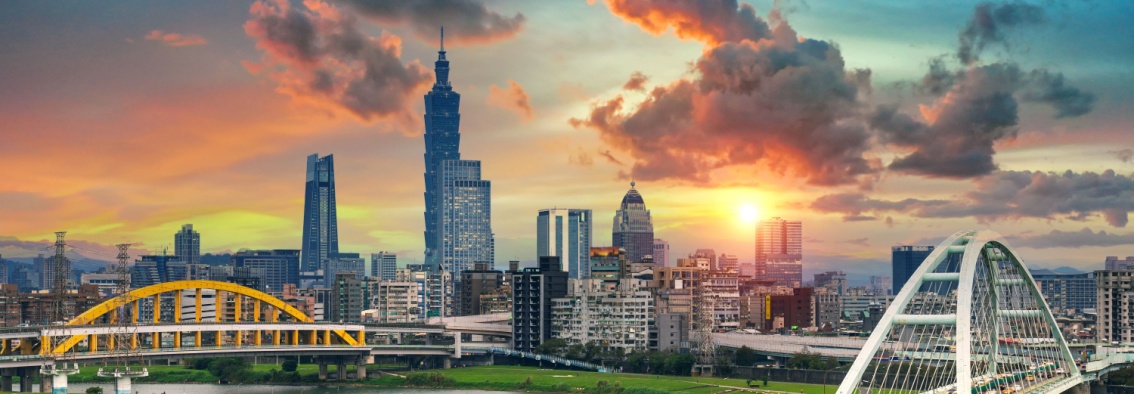

Introduction: The Problem of Homelessness in Taiwan Today
Taipei Main Station is a destination that wears many hats. Aside from being the largest land and rail transport hub for Northern Taiwan, it is also a critical space for the city’s unhoused population – where many gather, keep their belongings, and settle down.
Official statistics show there are about 3,000 homeless people, also known as “street friends” (街友), across Taiwan: 620 of them are said to be living in Taipei, a similar number may be found in neighboring New Taipei City, and the rest can be found dispersed in urban centers across the country. Social workers say most of the unhoused are male, with an average age of 60. Many, but certainly not all, are single and unmarried.
Despite this, Taipei’s aid workers believe the actual figure is much higher, since the official statistics only cover those who fit the government’s definition of a homeless person: someone who “sleep(s) on the streets or in any public area.” Additionally, non-government groups like Homeless Taiwan state that the number does not consider “rough sleepers,” or persons who have a permanent address but sleep in shelters, institutions, internet cafes, or couch-surf in the homes of friends or relatives.
Non-government groups like Salt Collectiv, which runs feeding programs around Taipei Main Station, say the homeless are mostly concentrated in three areas: in and around Taipei Main Station, at Bangka Park (艋舺公園) near Taipei’s Longshan Temple (龍山寺), and in the neighboring Wanhua district (萬華區). The areas are so well known they attract recruiters who often go to designated spots to find people willing to undertake low-paid, casual work.
Allowing homeless people to settle in high-traffic, high-visibility areas confounds both tourists and commuters: It challenges their view of Taipei as a safe, welcoming city. The homeless population in and around Taipei Main Station has grown since Bangka Park closed for refurbishment to attract more visitors. Several homeless people have rejected the city’s offer to be sent to halfway homes and shelters, while others indicated that the closure cut them off from potential employment offers.
Luke Pigott, who works with Salt Collectiv, believes the location makes sense because it provides the homeless with a sense of security. “[The homeless] are allowed to set up beds, whether that be made out of cardboard, camping mats, or whatever people can arrange, because this [Taipei Main Station] is a ‘public/private space’ after 6 p.m. They are required to pack up their sleeping means by 6 a.m. A private entity is not likely to demonstrate the same level of flexibility,” he said. [1]
As in other parts of the world, the problem of homelessness in Taiwan is complex. “There are family disputes and their social networks break down. That brings comorbidities such as alcohol misuse. There are also other factors, like mental health issues, that can contribute and make it worse,” Pigott said. Moving out from the family can also be a challenge, because “rents [in Taipei] are high. [If] you look for places under TWD 5000, what you get is car park spaces, small rooms, no bathrooms, no kitchen, and they are usually far away from public transportation.”
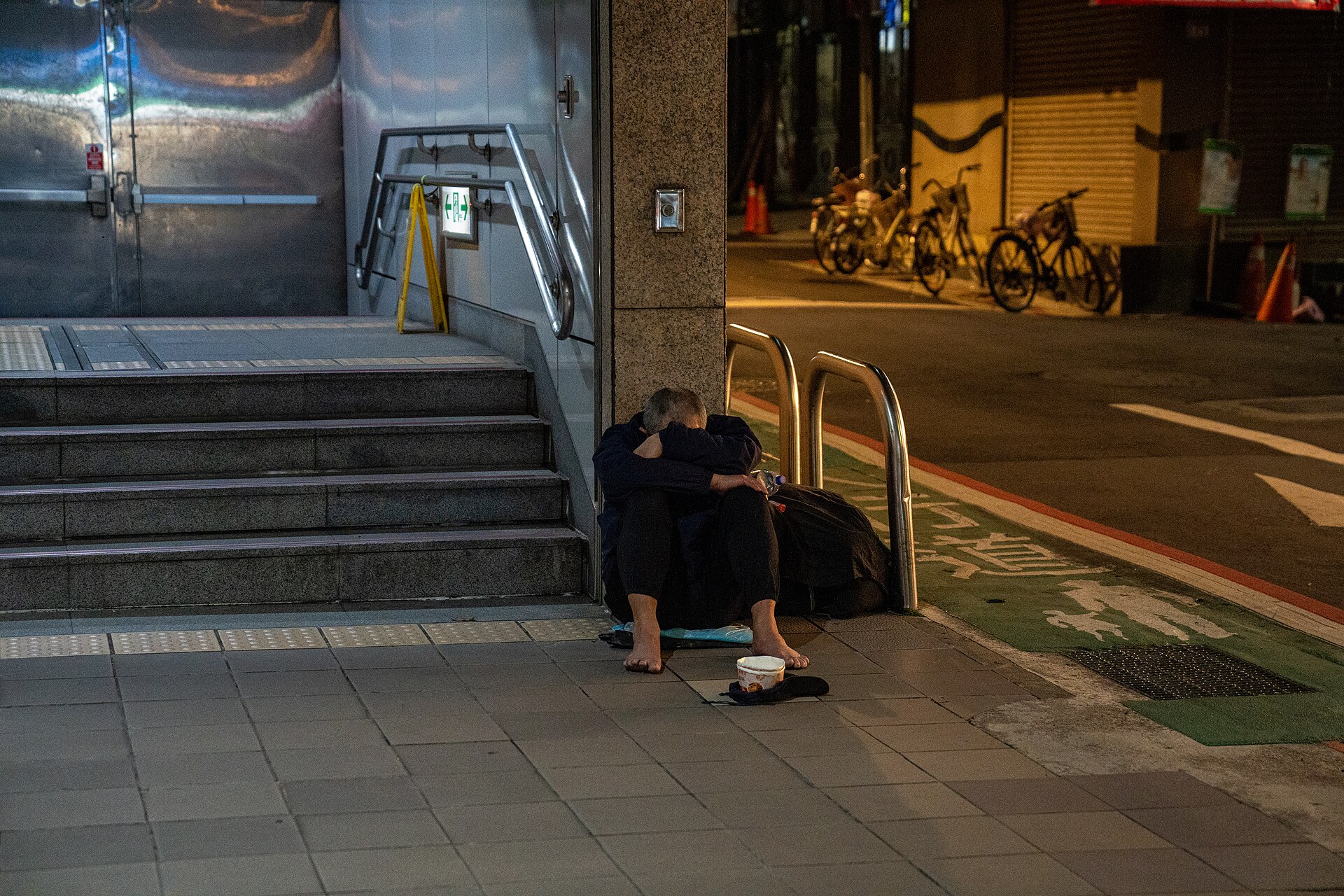
Image: A homeless man sleeping outside an unidentified subway station in Taipei (April 2025). (Image source: Wikimedia Commons)
Measures for Homelessness in Taiwan’s Past
To see the homeless free to settle outdoors undisturbed would have been unthinkable decades ago. Historically, the homeless were considered lawless elements: gangsters and ne’er-do-wells who had been cast away from their families. During the Qing dynasty and the subsequent Japanese occupation, Taiwan’s homeless were seen as an overall threat to the social order. That did not change post-1949, when the influx of refugees and soldiers from China strained Taiwan’s resources.
During the late 1960s and the height of Taiwan’s Martial Law era (1949-1987), the city passed the Taipei City Regulations for the Suppression of Homeless Persons (臺北市取締遊民辦法), which defined the homeless, or “youmin” (遊民), as people in one or more of these categories (I) those who lived without proper household registration; (II) beggars and “vagrant children”; (III) those who were jobless; and/or (IV) were seen wandering the streets or sleeping in public places. Furthermore, the police, assisted by the Military Police Corps, would have the “work of suppressing homeless persons.” Under these rules, the homeless were to be arrested and taken forcibly to designated homeless shelters “for handling.”
It was not until the 1980s that the measures were softened, when legislation emphasised the need for social welfare. The regulation was renamed Taiwan Province Regulations Governing the Sheltering and Counseling of Homeless Persons (臺灣省遊民收容輔導辦法). While the homeless were still referred to as “youmin” (which is a derogatory term), the new law redefined them as “those who wander, drift on the streets in loneliness and without support, or beg for alms in public places and must be sheltered and counseled.”
Further amendments were made during the 2010s. The Placement and Counseling of Homeless Persons Ordinance (臺北市遊民安置輔導自治條例) defined the homeless as “those who habitually stay overnight in public places or places accessible to the public.” It gave the homeless agency to decide their own fates. It also entrusted Taipei’s Social Welfare Department with the care, housing and maintenance of the homeless; and the Labor Department with the responsibility of assisting the homeless in finding suitable employment. This ordinance remains in effect in Taipei today.
Policy Measures for Homelessness in Taiwan Today
But government policy is not foolproof, and aid workers say the homeless continue to be left behind. For instance, to be eligible for social welfare assistance in Taipei, applicants need a permanent address and to demonstrate that the total value of their personal property is below TWD 150,000 (about USD 5,000). That requirement is impossible to meet for those who have cut ties with their families.
Moreover, the homeless face difficulties receiving medical attention because they cannot cope with the required paperwork. Global health scholar Elisabeth Gilmore, who did a survey among the unhoused in Taipei, pointed out that homeless people are often too preoccupied with the basics, like food and shelter, to think about filling out bureaucratic paperwork. As Gilmore has pointed out, “They have so many daily struggles that registration is not their priority: Where am I going to sleep? What am I going to eat?” [2]
Gilmore further indicates that the struggle to get social welfare and healthcare is also an obstacle for rough sleepers who fall through the cracks. “Those we surveyed were people sleeping outside, usually in public places, and that is where social workers will go and talk to them. [However] … for a group of people who are couch-surfing, or sleeping in more hidden places, they will not even know that they need to get registered or get in contact with social workers.”
Even though the homeless are now referred to by the less derogatory term “street friends,” they still face discrimination. “Uncle Liang,” a tour guide for Homeless Taiwan, said the homeless have difficulty renting places despite having the funds to cover rent, because landlords are unwilling to lease to those who have a record of being unhoused. [3] Piggott has further commented: “There are obviously interpersonal struggles, and a feeling of stigma from society, that does not see the homeless as humans. They are seen as fixtures, as invisible.”
Nevertheless, the homeless in Taipei still enjoy a small advantage over other parts of the developed world. Along with the ability to rest in a place where they feel secure, Piggott points to the absence of “hostile architecture,” which prevents the homeless from lingering in public spaces. As progressive legislation has decriminalised homelessness, Taipei has treated the problem as a social issue requiring a humane and tangible approach—instead of criminalizing homelessness, which would require stern police action to resolve.
The main point: Taiwan experiences many of the same problems with homelessness that affect other developed democratic societies, frequently impacting individuals who have lost ties to their families and/or suffer from mental illness or substance abuse. In past decades homelessness was generally treated as anti-social in nature, and subject to repressive government measures. Current government policy in Taiwan tends to treat homelessness more as a public welfare issue, but many problems remain.
[1] Author’s interview, September 2025.
[2] Author’s interview, March 2025
[3] Author’s interview, April 2025.