

Over the past few decades, “Boys’ Love” (BL) literature, television, and film have taken the world by storm. From the first emergence of the BL genre in 1970s Japan, many Asian countries have since begun to produce their own BL content: including South Korea, Thailand, China, and Taiwan. Now, with the introduction of global streaming platforms, BLs have been able to enter many foreign markets, allowing cultural exchange and the potential for improved outlooks of Asian cultures, thereby increasing their soft power
Yet, due to China and Taiwan’s use of similar language and cultural nuances for their productions, authors and publishers from the two countries have been competing for the same audience. This has allowed China’s BL boom, also known as danmei (耽美, specifically used to refer to BL content from China), to overshadow Taiwanese BL content—especially as recent dramas have garnered millions or even billions of views in online platforms. However, as the Chinese Communist Party (CCP) has begun to suppress danmei material—not just by censoring content, but also by arresting creators—this has opened the market for Taiwanese BLs to take the stage as the major producer of LGBTQ+ entertainment for using the Chinese language market. Alongside Taiwan’s strides to create one of the most LGBTQ+ friendly spaces within Asia, it provides an opportunity to amplify Taiwan’s soft power through television and film, introducing Taiwanese culture and values to audiences far beyond Taiwan itself.
A History of Danmei in China: From Acceptance to Suppression
It was the late 2010s. Danmei had entered the realm of Chinese dramas: the famous danmei web novel Are You Addicted (你丫上瘾了) found both praise and scrutiny nationwide from its homoerotic depiction of two male lovers in high school. The novel received so much attention that it was adapted into a web series called Addicted (上瘾), garnering 10 million views on its first day streaming. BLs had found a new place in East Asia to thrive.
That was, until it could no longer hold up under the scrutiny of the CCP.
Not soon after Addicted’s rise to fame, the Chinese government banned any and all depictions of gay relationships and people on TV. Claiming the drama had “vulgar, immoral, and unhealthy content,” the CCP’s State Administration of Press, Publication, Radio, Film and Television (SAPPRFT, 国家新闻出版广电总局) pulled the drama from all Chinese streaming websites with only 3 episodes left until the season finale. With new regulations on content that “exaggerated the dark side of society,” Addicted found itself facing censorship in real time.
With such censorship laws, the Chinese danmei scene had to pivot to more “morally correct” themes. This required many dramas to instead “bromance-ify” their stories, focusing more on the friendship between male protagonists while also highlighting dramatic elements of the storyline. For example, Mo Dao Zu Shi (魔道祖师), a famous web novel by Mo Xiang Tong Xiu (墨香铜臭), follows the story of a demonic cultivator able to control ghosts—who comes back to life 13 years after his death to reunite with a former male classmate in order to solve a murder, while also coming to realize his feelings for said classmate. Its television adaptation, The Untamed (陈情令), however, completely rid itself of any explicit homoerotic scenes, while also conforming to other Chinese censorship laws on ghosts and the undead. With such enticing themes, Chinese television producers were able to skirt past censorship laws and find critical acclaim worldwide: The Untamed passed over 9.5 billion views on Tencent Video just two years after it first aired.
Yet, somehow, that still was not enough for the CCP, as more censorship laws came into effect in 2021 after the critical success of The Untamed. Starting that year, the CCP began an “internet cleanup campaign,” with the Central Propaganda Department (CPD, 中国共产党中央委员会宣传部) issuing an “Notification on Carrying Out Comprehensive Management of the Field of Culture and Entertainment.” This article determined that danmei adaptations were destroying social environments, and were particularly harmful to teenagers. Since this crackdown, Chinese authorities have officially declared a boycott on danmei adaptations, including both live-action and manhua (漫畫, cartoon) forms, in order to address concerns of “morality” in media. Furthermore, the CCP even banned online Chinese literature platforms such as Jinjiang Literature City (晋江文学城), Fanqie Novel (番茄小说), Bilibili Manga (哔哩哔哩漫画), and Miss Evan (猫耳FM) from having danmei content on their websites. State crackdowns have led to arrests of authors nationwide, with over 30 writers facing imprisonment for writing danmei in 2025 alone.
Such stringent restrictions and censorship have thus resulted in a decline in the production of many danmei series in China. Even authors who were able to overcome the “Great Firewall” and publish on the Taiwan-based Haitang Literature City (海棠文學城) have faced imprisonment from the Chinese government. Consequently, many Chinese creators have had to completely stop producing BL content as crackdowns have worsened, leaving many to wonder how or if Chinese danmei culture will continue to prosper.
In the Face of Censorship, Taiwan Brings Hope to LGBTQ+ Communities
As limitations on LGBTQ+ expression continue to expand throughout China, Taiwan has become a beacon of hope not just for the BL genre, but also for LGBTQ+ communities throughout Asia and beyond. As the first Asian country to legalize gay marriage (with the law coming into effect on May 24, 2019), Taiwan has already displayed a significant acceptance of LGBTQ+ minorities, thereby paving the way to improve its image globally. For example, Taiwan hosts one of the largest pride parades throughout Asia every October, with nearly 150,000 participants in 2025 alone, showcasing wide public support. Furthermore, Taiwan has incorporated LGBTQ+ rights into legal protection more broadly. Its Gender Equality in Employment Act prohibits employers from discriminating against employees for their gender or sexual orientations. Additionally, in 2023, Taiwan passed a law that allows same-sex couples in Taiwan to have full adoption rights. With considerable support from the public and policy, censorship laws have not been pushed like in China. Taiwan’s BLs therefore already have the foundation to be accepted and even praised throughout Asia and worldwide.
Moreover, Taiwan’s attitudes toward LGBTQ+ content create a distinct opening for the BL genre to find an even larger audience to amplify Taiwan’s global image. First, unlike China, the Taiwanese government has not explicitly censored any LGBTQ+ content, with content laws for television applying to both opposite and same sex relationships on screen. Additionally, Taiwan hosts the largest streaming service for LGBTQ+ content, GagaOOLaLa—which surpassed over five million registered users globally in 2025, with over 35 percent of those users being from the US. With multiple genres available, the streaming service becomes a prime medium that introduces the diversity of Taiwan’s LGBTQ+ contents and the island’s inclusiveness to foreign audiences.
Taiwanese LGBTQ+ friendly television has already received massive amounts of popular support, especially in East Asia, as BL content has become increasingly popular worldwide. For example, since 2020, BL novels like My Influencer Boyfriend (我的網紅男友), Day Off, and The Shimmering Summoner (微光的召喚師) have been translated into Japanese due to their high popularity. GagaOOLala also promotes Taiwan’s BL series globally by offering subtitles in English, Japanese, Korean, Thai, and Spanish. With enough popularity and support to translate BL literature along with the infrastructure necessary to export more Taiwanese BL television and film, Taiwan has the momentum to create products that can promote tourism to Taiwan. Displaying Taiwanese culture and way of life in the programs can also boost its image as an open and inclusive Asian country.
With Taiwan’s clear openness to the LGBTQ+ community, the country has been able to create a popular product that China is no longer able to provide. Its production of BL literature, television, and film can definitely allow it to further enhance its already well-developed soft power influence. However, even with such a prime global market opportunity, Taiwan still faces several obstacles to create a branded product that international viewers will be attracted to and recognize as distinctly Taiwanese.
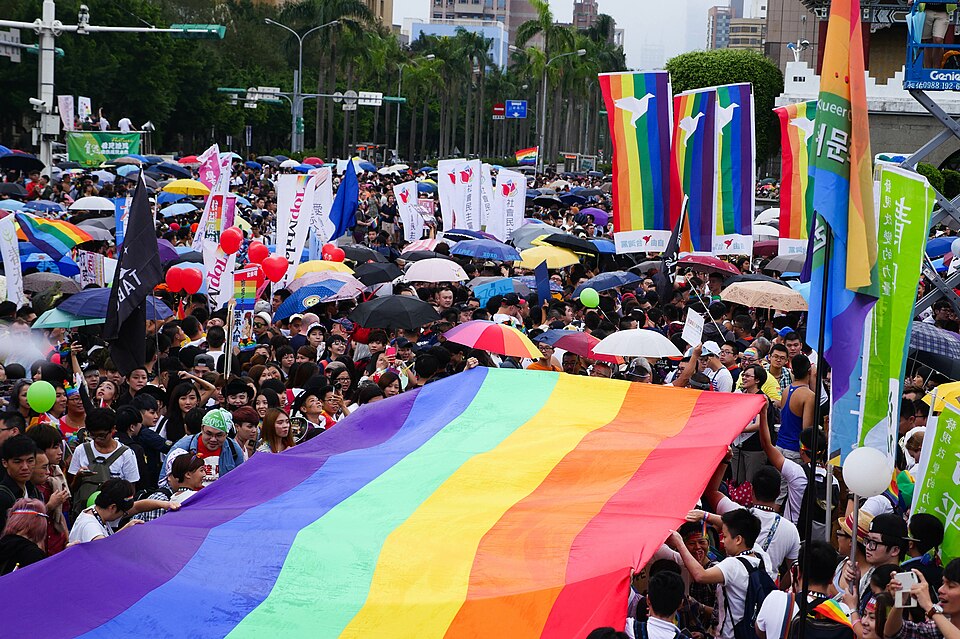
Image: A scene from Taiwan’s 2016 Pride Day events (October 29, 2016). (Images source: Kokuyo / Wikimedia Commons)
Current Challenges for Taiwanese BL Material, and How to Overcome Them
While Taiwan has the ability to utilize its open-minded society and prime infrastructure to promote its domestic BL content, global audiences may not be attracted to these products or understand their Taiwanese origin. One of the current issues is that many fans of BLs have been largely attracted to danmei focusing on traditional Chinese culture with fantasy elements—such as The Untamed, which is set in ancient China and incorporates many fantastical xianxia (仙侠) elements. Other popular Chinese dramas amongst international fans often integrate both contemporary and ancient elements while preserving Chinese cultural characteristics. In addition, due to its similar cultural and linguistic elements to China, Taiwan has struggled to produce a distinct BL product that global viewers recognize as coming from Taiwan. Some Taiwanese BL series, such as the popular HIStory 3: Trapped, have mainly focused on utilizing contemporary settings—thereby making it difficult for international audiences to distinguish them from their modern Chinese counterparts.
The Taiwanese BL industry therefore needs to establish a niche in the realm of BL. While Taiwanese BLs are already much more open about romantic and sexual relationships in comparison to Chinese BLs, not every viewer will recognize that immediately. In order to create BLs that global viewers will understand as Taiwanese, the use of local Taiwanese cultural elements and locations is essential in these productions. Furthermore, many of Taiwan’s BL dramas are set in modern times, which may tend to be less popular amongst international audiences. However, if Taiwan wants to focus on historical storytelling, the Taiwanese government should encourage local/domestic creators to incorporate aspects of Taiwan’s past (such as the Japanese colonial era), or of the cultures of indigenous and other minority populations, in order to tell more distinctive stories about Taiwan.
Distinct Taiwanese branding in BL products can be encouraged through state grants and subsidies for creators that focus on regional storytelling on Taiwan, similar to the current 2026 Innovative Content Grant for International Co-Funding and Co-Productions, as well as through the promotion of international film festivals that have themes on unique Taiwan experiences. Furthermore, the Ministry of Culture’s (文化部) Bureau of Audiovisual and Music Industry Development (BAMID, 文化部影視及流行音樂產業局) can partner with international platforms like GagaOOLala to create initiatives that promotes more domestic LGBTQ+ content. Since many international viewers will use subtitles to consume these products, the use of both Mandarin and other languages in Taiwan to tell the story should not be too big of a hindrance to their consumption. By creating content that reflects Taiwan’s openness to LGBTQ+ communities and its democratic values, Taiwan can further amplify its unique soft power while distinguishing itself as culturally and politically separate from China.
The main point: Taiwan is already one of the most LGBTQ+ friendly countries in Asia. Its streaming services have widely supported Taiwanese BL stories, and advanced global visibility of LGBTQ+ content by providing international language subtitles. These steps have created a valuable opening for the country to establish a larger audience. By utilizing the dichotomy between China and Taiwan’s censorship laws and regulations, as well as by establishing a creative niche distinct from China, Taiwan can use the popularity of BL literature to create further international soft power influence.

.jpg)