
Introduction
The current crisis in the Strait of Hormuz demonstrates how strategic geopolitical chokepoints can affect the global supply chain. The Luzon and Taiwan Straits are no different. Once imagined by academics and politicians to be isolated and separated, these Western Pacific chokepoints have the potential to harm the world’s economic arteries should a major conflict erupt in the Pacific Region.
In a separate Global Taiwan Brief article from last year, this author coined the term, “New Cross-Strait Security Complex” (NCSSC) to denote the Philippines’ consolidation of its archipelagic and maritime defense: interlocking the West Philippine Sea (WPS) and Luzon Strait as a common concern, and linking the Luzon Strait’s future security with that of the Taiwan Strait. Put simply, NCSSC refers to the material, institutional, and cognitive patterns occurring and intersecting between the polities of the two straits.
This author argues that the NCSSC is not an empty term. It represents an organic framework of action observed by multiple actors: including the People’s Republic of China (PRC), Taiwan, the Philippines, the United States, and Japan. One notable dimension of this framework comes with how the cognitive aspect affects the material and institutional patterns of interactions. Simply put, while some actors are recently recovering truths of the past—namely, the past connection between the Philippines’ Ivatan people, and Taiwan’s Tao people—to shape the future relations, still others are also using the past to spread lies. This includes the PRC’s downplay of that connection, and claims over the Batanes Islands. Ultimately, the NCSSC impels states and other actors to produce clearer policies with flexible mechanisms for the future security agenda in the broader Indo-Pacific region.
A Framework of Interaction?
The Philippines is known to muddle through in pursuing its foreign and security policies. The literature debates whether or not it has a deliberate grand strategy, yet one thing is certain: the future of Taiwan is now in Manila’s sights as it sees the PRC’s regional ambitions unrestrained. “To be dragged into a potential conflict”—as noted by Philippine leaders’ rhetoric and official documents—is one thing. However, to appreciate its geopolitical importance in the broader Indo-Pacific is another. The NCSSC serves as a sensible framework to see how regional actors might interact in the immediate and distant future.
Recent events show the regularity of such interaction. On a positive note, we can see how Taiwanese and Filipinos are historically and culturally linked by the seas. In June 2026, 20 Tao people from Orchid Island (Lanyu, 蘭嶼), Taiwan’s southernmost island, sailed into a port in Mahatao, Batanes, the Philippines’ northernmost island. This was a journey of about 111 miles using a traditional wooden boat known as Tatala (as known by the Tao people) or Tataya (as known by the Ivatans of Batanes). Such deep connections between the Taos and Ivatans—although dormant for 300 years due to colonialism—demonstrates how contemporary peoples of this region are making these unheard stories heard by replicating this 4000-year practice of migration and seafaring. Indeed, such rekindling serves as a reminder of their Austronesian linkage. Though lacking an explicit supportive statement of the Tao-Ivatan exchange by higher government officials, the Philippines’ Office for Transportation Security strategically framed its press release about Manila’s resolve to “ensure that the country’s northern maritime gateways remain protected and efficient” in the case of “welcoming communities.”
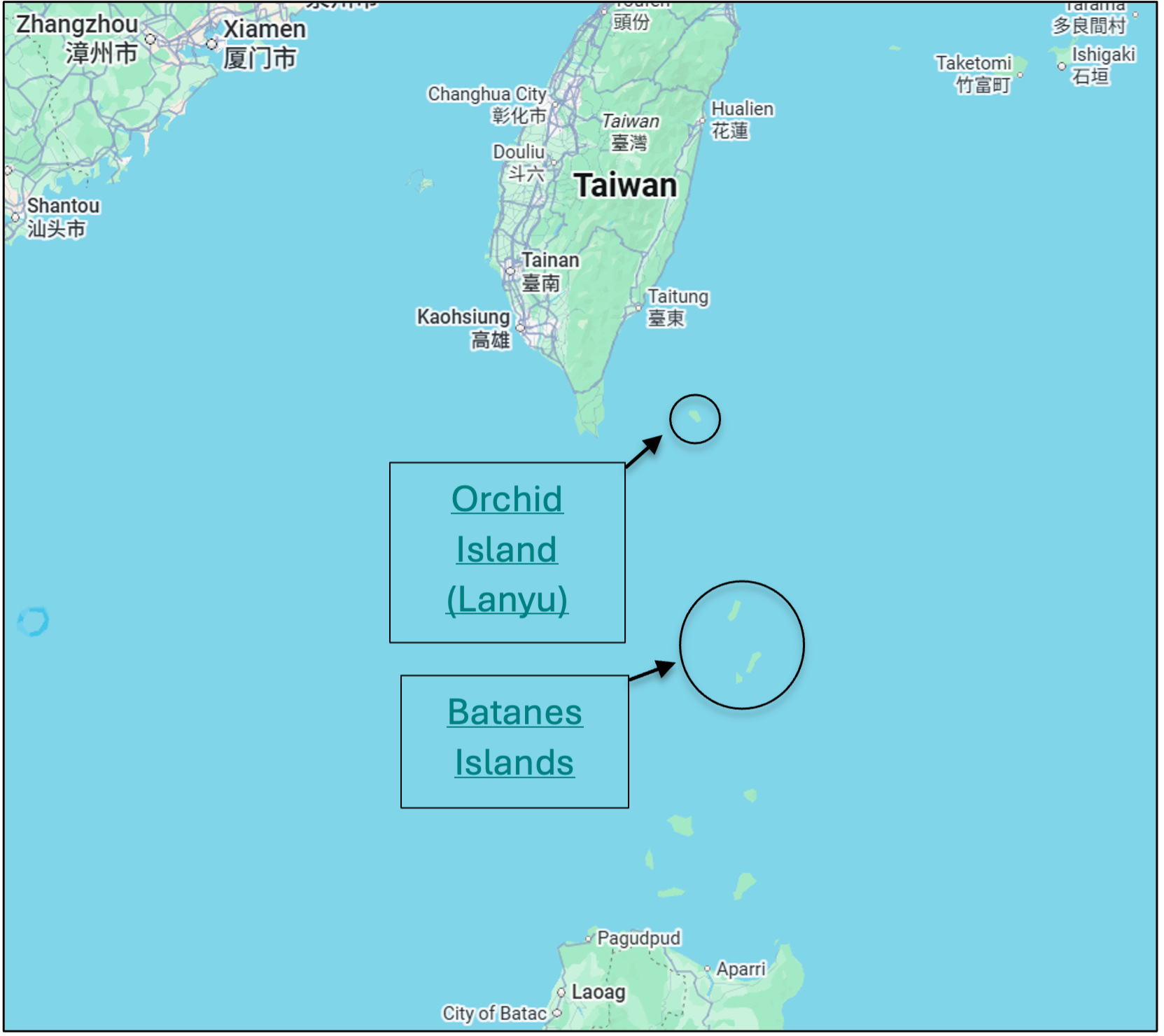
Image: The Batanes Strait, between Taiwan and the northern Philippines. In 2026, PRC government institutions began to advance the claim that the Batanes Islands (part of the Philippines) were Chinese territory, based on the extension of the continental shelf from Taiwan. (Image source: Google Maps)
Interestingly, two Chinese officials—Ambassador to the Philippines Jing Quan, and Consul and Head of Post Li Xiaoyan of the Chinese Consulate in Laoag, Ilocos Norte—arrived in Batanes on the same day as the Tao people’s arrival for an “official visit” to the province’s officials. On the one hand, this visit serves to remind Philippine officials of Manila’s “One-China Policy.” On the other hand, it also means that Beijing is now playing into the logic of the NCSSC, which serves as a prognosis for broader regional tensions.
Some academics from the PRC contest the “Out of Taiwan” theory of Austronesian linkage between the Tao and Ivatan peoples. Rather, they prefer to propagate Beijing’s narrative of historic rights over Taiwan, contending that these indigenous peoples came instead from mainland southern China. In July 2026, a Global Times article reported that several PRC-based academics at an academic symposium in Jinan University (暨南大學) asserted that the Batanes Islands “are legally China’s sovereign territory and form a natural geographic extension of China’s Taiwan island,” on the basis of the 1898 Treaty of Paris and the so-called “Japan-Philippines maritime delimitation talks.” In other words, by virtue of PRC’s historic claims on Taiwan and the Tao’s linkage to the Ivatans, Batanes is allegedly an integral part of the PRC.
Philippine government officials have rebuked such PRC academic’s claims on Batanes. For instance, Philippine Defense Secretary Gilberto Teodoro Jr. noted at the sidelines of the West Philippine Sea summit that such talking points by PRC academics validated his agency’s assessment that Beijing wants to control the Western Pacific. Moreover, given that there is no serious legal basis for such claims, Teodoro noted that “it’s a joke.” Separately, Philippine Foreign Affairs Secretary Ma. Theresa Lazaro noted that the government would not listen to unofficial channels, while her agency’s spokesperson Analyn Ratonel said that “flights of fancy should not be dignified with a response” since “the Philippines’ sovereignty over Batanes is settled and not up for debate.” Batanes’ lone District House Representative, Ciriaco Gato Jr., similarly rebuked such claims, noting that “any challenge to our status is not merely a geopolitical provocation; it is an affront to our identity that we will not tolerate.” The Philippine’s National Historical Commission (NHC) debunked the Chinese scholarly claims, noting that there is a continuous shelf extending from Northern Luzon through the Babuyan and Batanes Islands and into parts of the Taiwan archipelago based on “current satellite and oceanographic data.”
There were also reported circulations among Chinese social media apps last year suggesting that the Philippine province of Palawan—which puts the Municipality of Kalayaan in the WPS under its jurisdiction—is allegedly part of China, by virtue of Ming-era Admiral Zheng He’s explorations. At the macro-level, the Philippine government recognizes that such Chinese talking points are reinforced by foreign influence and malign interference (FIMI) operations—various kinetic activities that aim to alter Filipino solidarity in favor of PRC’s narratives.
All Set for the Future?
These latest events demonstrate that the framework of interaction demonstrated by the NCSSC does not only involve material and institutional aspects, but also the most basic of human cognitive elements—identity, historical memory, and people-to-people linkage—which are all essential to make the case for brokering the regional commons. They also point to a common denominator: the PRC’s irredentist and unrestrained expansion. However, the NCSSC also opens novel methods for various stakeholders to explore opportunities to assert their agency.
The first opportunity refers to cognitive patterns. Whether by constraints or deliberate choice, the Taiwanese government has yet to make any comments on the claim by PRC-based academics regarding Batanes. While ignoring Chinese talking points against the Philippines may sound risk-averse, there is an equal harm inherent in isolating these comments outside the PRC’s broader FIMI operations. Taiwan’s political and security apparatuses would be well advised to invest their attention in curating counter-responses. Moreover, both Manila and Taipei must also leverage linkages between Filipino and Taiwanese cultural communities, academics, think tanks, and civil society organizations, to counter the PRC’s FIMI operational logic.
The second opportunity refers to institutional patterns. Since Taiwan is de facto limited in its diplomatic options, the Philippines—with its rapidly expanding strategic partnerships—could serve as a node of a broader security network by framing the Luzon and Taiwan Straits as strategic nerves that cannot be unilaterally occupied by one regional hegemon. Rather, the Straits represent a politically plural area in which to enforce a rules-based international order. This would mean enhancing logistical points of entry and exchange through increased port security, diversifying areas of cooperation between their respective coast guards, fisheries agreements, and anti-piracy and anti-smuggling frameworks, among others. Moreover, while Filipino and American officials argue that Balikatan exercises are solely for Philippine defense, and not intended as a stage for a Taiwan contingency, Filipino and other regional scholars and analysts otherwise note that they are not mutually exclusive. Here, wargaming centers by academics and think tanks can intensify stress-testing assumptions into wider grand strategic considerations, which ripple into Track 1.5/2 dialogues and influence public opinion.
The third opportunity refers to material patterns. So far, it is microchip discourse which catches the main attention of the PRC, the US, and other global players on this NCSSC. Minilateral forums serve as cost-efficient avenues in addressing shortcomings of multilateral forums that have been hijacked by PRC’s “Global South Champion” narrative. Moreover, informal talks—like the “Smart Harbor” forum in December 2025 between Taipei and Philippine officials—demonstrate the balance between strategic autonomy and risk-aversion. The Luzon Economic Corridor, which feeds into the US’s Pax Silica initiative to counter the PRC’s World Artificial Intelligence Cooperation Organization (WAICO), are both welcome developments. Taiwan has stated on separate occasions that it is willing to expand economic corridors with the Philippines, either through its proposed “Silicon Prosperity Initiative” or as an external node with Pax Silica.
So far, Pax Silica has not been well received by most Filipinos, largely due to the lack of an accurate and transparent blueprint, which in turn caused fear among local communities. So far, the Philippines rejection of a diplomatic immunity bargain by the United States in the proposed Pax Silica compound in North Luzon are very well noted points to rebuke PRC narratives of the Philippines “as an American Puppet.” However, the broader goal must be the ability of the Philippines to become a formidable node of the global supply chain through state-led development—not “independent” for its own sake—while addressing local woes. In sum, there is a need for more assertive Philippine counterproposals to serve the country’s industrial interests if it is to become Taiwan’s capable partner.
Strategic uncertainty will continue to pervade the 21st century, and the new geopolitical reality of the NCSSC has now emerged around which all stakeholders must carefully design their approach. They must set clear policy interests while maintaining flexible mechanisms. As for the Philippines and Taiwan, they have an opportunity to set their shared path by modeling such interactions.
The main point: The Philippines is becoming more relevant to the future of Taiwan’s security, as the two island states find their security concerns ever-more connected. It is time for all stakeholders to integrate the New Cross-Strait Security Complex as part of the broader regional security architecture. They should and can achieve this through clearer policies, with flexible and responsive mechanisms for future interaction.