
As the topic of Taiwan’s organized crime and the Chinese Communist Party’s (CCP, 中國共產黨) united front influence on the island has garnered international attention, analysts have posed an alarming question: “What would Taiwan’s gangs do if China invades the island?”
Long-standing resentment in Taiwan towards the pervasiveness of gangs has fueled speculation that these groups might act as a “fifth column,” aiding the CCP’s invading forces by sabotaging critical infrastructure or sowing widespread panic. The concerns are backed by prominent revelations regarding some Taiwanese crime bosses’ collaboration with People’s Republic of China (PRC) espionage operations. In March 2025, Taiwan’s President Lai Ching-te (賴清德) publicly highlighted the role of Taiwan’s gangs in the CCP’s interference campaigns on the island. Months before Lai’s speech, Taiwan’s National Security Bureau (NSB, 國家安全局), its intelligence service, had released a report specifically describing how Taiwan’s organized crime groups (among other actors) facilitate CCP espionage operations and even fifth column recruitment. Fears were compounded in May of this year, when the news site Mirror Daily (鏡報) broke the story that the NSB had come into possession of a PRC intelligence document that allegedly mapped every major gang in Taiwan, covering the gangs’ sizes, leaders, criminal enterprises, and supposed willingness to cooperate with the CCP. The Mirror Daily report caused consternation in Taiwan, prompting the Democratic Progressive Party’s (DPP, 民進黨) former caucus chief executive Rosalia Wu (吳思瑤) to openly conclude that gangs would “cooperate with Chinese invading forces during wartime.”
Given gangs’ history of cooperation with the CCP, as well as the fact that some are heavily armed with assault rifles and fabled katanas, it is prudent to analyze whether they could form an internal paramilitary force disrupting Taiwan’s defense effort. However, analysis that fails to consider the underlying incentive systems guiding gang participation will ultimately overstate the likelihood of these groups engaging in fifth column sabotage. Speaking to the Mirror Daily, one commentator compared the overall number of suspected gang members in Taiwan to the nation’s police, prompting the news site to run the headline: “70,000 police officers fight against 300,000 gangsters.” Such a crude comparison overlooks the fact that the majority of Taiwan’s gang members are legal minors who have never committed gun crimes, murder, or other militant activity that could psychologically prepare them to assault critical infrastructure or police installations. Moreover, the expectation that gangs will participate en masse in fifth column paramilitary behavior underestimates the reservations that local gang bosses would experience towards sanctioning attacks on the territories they control.
Better candidates for fifth column saboteurs belong to the constellation of pro-unification sham political parties, such as the Chinese Unification Promotion Party (CUPP, 中華統一促進黨). The operations of these groups are often conflated with organized crime—and indeed many of these party members have backgrounds in Taiwan’s underworld—yet these fringe political parties differ from Taiwan’s local gangs in the crucial area of ideology. Simply put, the rank-and-file of Taiwan’s local gangs lack the pro-unification ideology that could allow them to fire upon their own friends, family, and community members in order to execute CCP sabotage objectives during a Taiwan invasion.
Spiralling Suspicion
In recent years, scrutiny towards collaboration between Taiwan’s gangs and the CCP has intensified. In many respects, this is justified. It is undeniable that some criminal bosses—including those that “double-hat” as Daoist temple leaders—have supported CCP united front political warfare and espionage. This author and others have documented how some temple leaders—allegedly linked to organized crime—participate in CCP efforts to use religious and cultural exchanges between Taiwan and the PRC to promote pro-China sentiment. On the espionage front, the chairwoman of the Rui Yao Temple (瑞磘宮) in New Taipei City, and a member of the Sun Alliance (太陽聯盟, a larger criminal network in Taiwan), was recently caught recruiting spies in Taiwan’s military. Her recruitment campaign had reached as far as military police in President Lai’s security detail, triggering an outcry in Taiwan’s security establishment.
Aware of some gang leaders’ involvement in CCP influence operations and espionage, some observers now ask: “Could these gangs use their muscle to disrupt a war effort in Taiwan?” Indeed, the Taiwanese military has been preparing for potential internal attacks on critical infrastructure in the event of a PRC invasion. The Ministry of National Defense (MND, 國防部) has identified 300 such possible targets in Taiwan, ranging from Taipei Main Station to oil refinement facilities. The alleged PRC intelligence map of Taiwan’s gangs, as reported on by the Mirror Daily, has fueled an additional concern: that gangs might take over local police stations in order to prevent authorities from maintaining order in wartime Taiwan.
The alleged PRC intelligence document, which reportedly runs at about 10,000 Chinese characters in length, maps the spheres of influence of local gangs as well as police installations dotted around Taiwan. According to the Mirror Daily, the document also lists the manpower, weaponry, contact information, and even the propensity to cooperate with the CCP of each local gang. Disturbingly, the document also suggests the speed at which each gang could mobilize, the sum the CCP would have to pay for their cooperation, and resettlement costs should gang members need to leave Taiwan.
If taken at face value, the map is damning and confirms the worst fears regarding a gang-led fifth column. However, it is worth questioning the provenance of this document. If the document is genuine, it could merely be an exploratory report aimed at mapping and relaying the relative strength and operations of each gang in Taiwan (useful for any would-be invading force). It is also possible that this is a genuine, highly-sensitive dossier that reflects actual commitments made by gang members to support the CCP. But if it were the latter, one should question why PRC intelligence services would blithely lay out their assets all in one briefing-style document. Indeed, an NSB official speaking with the Mirror Daily cautioned that the document could merely be an aspirational list of potential recruitment targets, rather than a concrete list of fifth column collaborators: “Although it’s premature to consider all the gangs listed in the report as CCP collaborators, the contents do suggest that the PRC seeks to use this intelligence, and clearly intends to exploit the weaknesses of the gangs one by one.”
Police and NSB investigations, which are reportedly underway as a result of this intelligence coup, may shed light on the veracity of the document’s claims. However, before taking a blanket characterization of violent gang collaboration with the CCP at face value, it is first necessary to assess whether the structures of gangs would really allow them to serve as an organized CCP fifth column.
Local Gangs and Loyalties
In an interview with this author, Chang Hung-chi (張弘佶) described how Taiwan’s local gangs “operate something like a company,” with “executives, middle-management, and entry-level staff.” At the age of 14, Chang was inducted into a gang in Taichung before he got out and continued his studies. When he took part in this interview, he was a PhD student studying Technology Management at National Yang Ming Chiao Tung University (國立陽明交通大學). The structure Chang described is specific to Taiwan’s local gangs—the kinds of organizations that focus on controlling specific territories in order to operate criminal enterprises such as brothels, casinos, and drug dealing. This is somewhat contrasted with the highest echelons of Taiwan’s nationwide organized crime associations—such as the Bamboo Union (竹聯幫) or the Celestial Alliance (天道盟)—which focus more on facilitating international enterprises such as drug- or gun-smuggling, or internet scams.
Local gangs may declare allegiance to these nationwide syndicates in return for access to resources and business opportunities (such as imported drugs or money-laundering systems), but they must always keep an eye towards community relations in order to perpetuate their local operations. It is hard to keep brothels and casinos secret from the local community—indeed, the local community supplies clients for these illicit businesses—so local gang bosses preoccupy themselves with their reputation. This dynamic has encouraged local bosses, known in Taiwanese as gatao (角頭), to jockey for control of Daoist temples in order to win the favor of the community through splendid temple events. It is also for this reason that gatao may be reluctant to order attacks on local sites such as police stations. Were it to be discovered that a gatao had ordered his gang to lay siege to a police station during a PRC invasion, and the PRC had later failed to occupy Taiwan, the gatao would lose all credibility with the local population. Indeed, he or she would likely be driven out of town or prosecuted. Participation in PRC fifth column operations therefore constitutes a wager where success and annihilation are the only two outcomes.
Such a wager would run contrary to the habits of local bosses, who prefer to maintain plausible deniability whereby a failure in their criminal operations cannot lead to accountability. Indeed, plausible deniability may be an important ingredient that has encouraged some crime bosses to support PRC espionage—the work is necessarily clandestine and is therefore less likely to result in discovery.
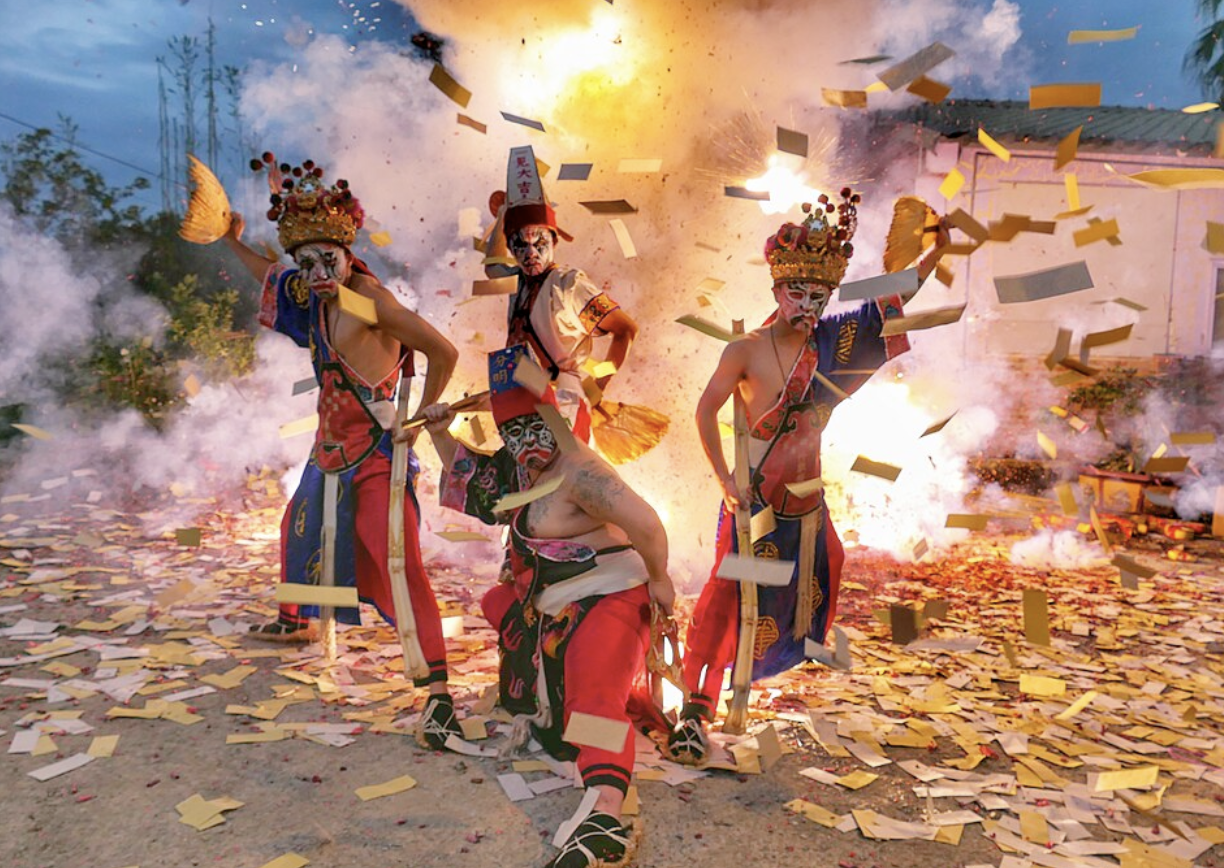
Image: Young Taiwanese perform a ritual to ward of COVID-19 in the garb of the “Eight Generals” (八家將). The gang affiliation of the individuals in this image is unknown. (Image Source: Wikimedia Commons)
The Rank-and-File of Taiwan’s Gangs
The altogether more serious impediment to gangs’ fifth column involvement lies in the quality of the would-be footsoldiers themselves—the so-called “entry-level” staff in Taiwan’s gangs. As Chang tells me, gang leaders intentionally recruit minors, including children as young as middle-school age, to carry out risky criminal acts such as violent debt collection or drug dealing. As both Chang and the Criminal Investigation Bureau describe, this is because Taiwan’s penalties for crimes committed by minors—such as assault and drug dealing—are far lighter than those for adults. Under the Juvenile Justice Act (少年事件處理法), a minor convicted for a serious crime may spend only a few years in juvenile prison. At age 18, minors are eligible to have their convictions sealed from future employers or schools.
Gangs can recruit minors on this basis, but more importantly on the promise of reliable income and a sense of belonging and purpose. Minors who join gangs often come from broken or impoverished families. Gang membership comes with a measure of financial independence and a “job” (however unsavory). In the case of gangs led by gatao “double-hatting” as temple chairs, membership also delivers a sense of purpose derived from participation in Daoist temple ceremonies performed for the local community. In these ceremonies, minors lay on facepaint and perform the ritual of the “Eight Generals” (八家將). According to Chang, this role gives minors otherwise shunned by society a sense of pride and belonging.
In this context, it is hard to imagine the everyday enforcers in Taiwan gangs readily participating in military-style assaults on local infrastructure and police stations. While Taiwan’s underage gang members may possess some animus towards local law enforcement, attacking police sites during a state of war would constitute a crime at a level of seriousness far exceeding anything these minors would previously have committed. Besides the fact that the perpetrators—regardless of their age—would face steep penalties for treason, sabotage of this kind would eviscerate the fragile sense of purpose that these minors gain from in-group membership and the performance of sacred Daoist rituals for the communities around them. As Chang stated, for these underage gang members, “the local town is not just a location; it is their entire world.” To turn against their own communities, including friends and family members, through sabotage on behalf of a foreign country is simply beyond the realm of possibility for most underage gang members.
The remaining class for consideration, then, is the “middle-management” of Taiwan’s gangs. According to Chang, these are individuals in their twenties and thirties who served prison time as minors and remained in the gangs. They act as go-betweens, allowing bosses to convey orders to the minors without having to meet them directly. Because they have committed to a career in organized crime—but lack the recognizability of gatao—this class of gangster may be the best recruitment target for the hardened crime of treason. However, recruiting gang “middle managers” for fifth column sabotage also presents its own obstacles. For one, Chang underscores that their criminal histories makes these gangsters well-known to local police. In tandem with this fact, gang “middle-managers” are often draft age, meaning that Taiwan’s military could easily call up these individuals to military service in advance of an invasion, neutralizing their capacity to assemble into a fifth column.
Nonetheless, there remains the possibility that the CCP could engender scattered incidents of civil disorder or sabotage through rogue gang members recruited ad hoc. Indeed, Taiwanese lawmaker Puma Shen (沈伯洋) has warned that scattered attacks are the most likely scenarios for internal sabotage. However, such actions are more likely to bring about psychological repercussions than real impairments to Taiwan’s war effort. Ultimately, predictions of island-wide rebellions by local gangs are far-fetched.
Were gangs to play a coordinated role in a PRC invasion, it would most likely take place after PRC victory was assured and the People’s Liberation Army (PLA) was in the course of occupying Taiwan. Under such a scenario, there would be no risk for a gatao to support occupying PLA forces—indeed, resistance would likely guarantee eradication. Gatao could justify their support for occupying forces under the premise that they are helping restore order in Taiwan’s localities. Just as when the Kuomintang (KMT, 國民黨) relied on Taiwan’s local gangs to support their authoritarian rule over the island in the 20th century, the PLA would likely be forced to turn to gangs to support their occupation at the beginning stages.
Fringe Pro-Unification Parties and the Fifth Column
In recent years, more egregious examples of fifth column preparation have come not from Taiwan’s gangs, but rather a fringe network of sham political parties openly calling for unification with the PRC. The political parties scarcely deserve the label, as they do not focus on winning elections, but rather use their freedom of association to build networks around the island facilitating bribery and other crimes. They are often conflated with organized crime because some of their members are former or current gangsters. But even some of Taiwan’s gangs resent this conflation, with one Bamboo Union gang member complaining that “Just because the CUPP has a gang-related background, does that mean every incident gets blamed on us?”
The most famous of these political parties is the CUPP, headed by Chang An-lo (張安樂), AKA the “White Wolf.” CUPP members have assaulted student protestors taking anti-PRC stances, and have attempted to recruit spies in Taiwan’s military on behalf of the CCP. Another fringe party is the now-defunct Taiwan Military Government (台灣軍政府), founded by an acquaintance of Chang and a former lieutenant general in the Republic of China (ROC) Army. The founder, Kao An Kuo (高安國), was sentenced to seven-and-a-half years in prison in October this year for recruiting collaborators to spy on Taiwanese military bases and agreeing to establish a fifth column force on behalf of the PRC. The group was only able to secure a handful of recruits before discovery.
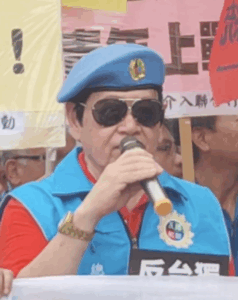
Image: Kao An Kuo (高安國), the former head of the “Taiwan Military Government” (台灣軍政府) political party. (Image Source: Wikimedia Commons)
In another unsettling case, a retired ROC Army major was sentenced to ten years in prison for recruiting six retired military personnel to surveil critical political and military sites in Taiwan, and to organize a sniper gang that could attack these positions during a PRC invasion.
These cases indicate a trend whereby disaffected retired military personnel could be the most conspicuous participants in PRC fifth column recruitment. Indeed, of the 64 individuals prosecuted in espionage and sabotage cases last year, 66 percent were current or former members of Taiwan’s armed forces. The military training that these individuals have undergone may prepare them for fifth column sabotage missions. But most importantly, ROC soldiers—especially older, retired ones—may be more likely to maintain a pro-unification ideology inculcated by the authoritarian-era KMT leadership. Kao An Kuo, the 80-year-old founder of the Taiwan Military Government, defended his actions by saying he sought to “uphold the One-China principle in the Republic of China Constitution.”
The pre-existing ideological inclinations of Taiwan’s retired military personnel render them more likely recruits for a PRC fifth column than the rank-and-file of Taiwan’s gangs. However, even retired military personnel may not prove powerful internal saboteurs. Because many of these retirees are beyond military age, with Kao and others exceeding 60, they may not constitute a potent fighting force capable of distracting Taiwanese internal security for a consequential length of time.
Policy Recommendations
While the character and incentives of Taiwan’s local gangs may frustrate PRC fifth column recruitment, the Taiwanese authorities should not neglect this risk. In order to curtail this threat, the Taiwanese government should pursue a two-pronged approach:
- Surveillance: Taiwan’s government should capitalize on intelligence, including local informants and the alleged PRC map of Taiwan’s gangs, to monitor grassroots activity and determine whether or not gatao are laying the ideological groundwork for underage members to engage in fifth column sabotage.
- Co-optation: The Taiwanese government should seek to co-opt the rank-and-file of Taiwan’s gangs capable of engaging in sabotage. Firstly, the government should seek to integrate temple-affiliated gangs into the burgeoning civil defense infrastructure of Taiwan, under the pretext that it is working with the legal organizations that govern temples. Indeed, the government has toyed with this policy before. This could be achieved by using local politicians and village chiefs—many of whom are closely-networked with temple leaders—as interlocutors. Temple-affiliated gang bosses may acquiesce as civil defense participation could burnish their legitimacy in local communities. Underage gang members may relish the chance to physically serve society through disaster relief activities. Secondly, if war is imminent, the ROC military should intentionally include the “middle-management” gang members in the first round of reservist call-ups, ensuring they are not present in local areas to execute possible sabotage activities.
The main point: While surging attention on Taiwan’s organized crime has prompted concerns that gangs could support PRC fifth column activities, the rank-and-file Taiwanese gangsters are neither trained nor ideologically-primed to take part in these operations. Instead, retired ROC military personnel and fringe pro-unification political parties may serve as better fifth column recruits. In order to minimize the risk of gang participation in a PRC fifth column, the Taiwanese government should escalate surveillance of organized crime and seek to co-opt temple-affiliated gangs into civil defense infrastructure and reserve forces.