
This year marks the 79th anniversary of the “2-28 Incident” (二二八事件), which began in Taiwan on February 28, 1947. According to the inscription on the monument erected in 1995 at the 2-28 Peace Memorial Park in Taipei, the 2-28 Incident refers to the large-scale public protests and demonstrations against the Kuomintang (KMT, 國民黨) government in late February 1947, as well as the subsequent suppression and massacre of the Taiwanese people—including the local elite—carried out by troops dispatched by the KMT government between March and May of that year. Both sides of the Taiwan Strait have held frequent ceremonies and conferences to commemorate the 2-28 Incident. Yet, the Chinese Communist Party (CCP) and the present Taiwanese government maintain completely different narratives regarding the incident.
The CCP has long proven itself adept at weaponizing history to serve its political interests: one recent example took place when CCP Chairman Xi Jinping brought up the United States’ Pacific War with Japan in a November 2025 call with President Donald Trump. In its propaganda regarding the 2-28 Incident, the CCP has constantly altered narrative themes in response to shifting political contexts. However, in stark contrast with its current policies, the CCP’s earliest messaging regarding the incident advocated for Taiwan’s autonomy, and even its independence. In the years since, the 2-28 Incident has served as a regular topic in the CCP’s cognitive warfare strategy directed at Taiwan, and has impacted the KMT’s own historical narratives.
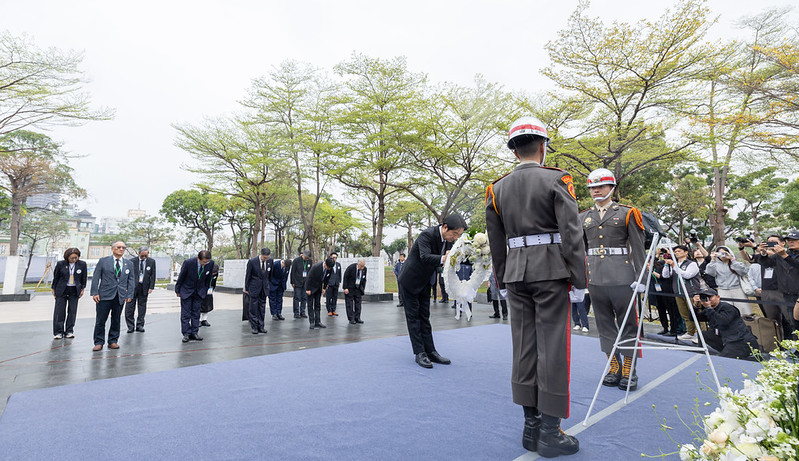
Image: Taiwan President Lai Ching-te laying a wreath in honor of victims at a memorial ceremony in Kaohsiung for the 2-28 Incident (Feb. 28, 2026). (Image source: ROC Presidential Office)
Competing Cross-Strait Narratives Regarding the 2-28 Incident
On the morning of February 28, 2026, Taiwan’s President Lai Ching-te attended the nation’s main memorial ceremony for the 2-28 Incident, held in Kaohsiung. In his speech, Lai stated that “the 2-28 Incident was a tragic historical event where innocent people were persecuted by an alien regime; in itself, it was certainly not a democratic movement, nor was it related to colonial rule. However, the 2-28 Incident in combination with the White Terror of the martial law period did indeed drive the Taiwanese people’s democratic will for self-determination.”
Meanwhile, this year’s CCP-led memorial ceremony of the 2-28 Incident revolved around a contrasting narrative. One of the so-called “democratic parties” permitted to exist within China by the CCP, the Taiwan Democratic Self-Government League (TDSL, 台灣民主自治同盟), held a symposium in Beijing to commemorate the 79th anniversary of the event. The TDSL operates within the CCP’s united front political warfare system and contributes to the CCP’s effort to portray the People’s Republic of China (PRC) as the legitimate ruler over Taiwan. During the 2-28 Incident symposium in Beijing, representatives from the TDSL stated:
The 2-28 Uprising was a patriotic democratic movement of the Taiwanese people against the authoritarian rule of the Kuomintang authorities. It echoed the “anti-hunger, anti-civil war, and anti-persecution” movements being carried out on the mainland at the time, converging into a massive torrent of patriotic democratic movements among compatriots nationwide […] TDSL has resolutely opposed “Taiwan independence” and the “Taiwan separatist movement,” and has carried forward the glorious tradition of patriotism and love for their homeland among Taiwanese compatriots.
While the current Taiwan government emphasizes democratic self-determination in its 2-28 Incident messaging, the CCP underscores the event’s connections to the “patriotic” and “democratic” movement in mainland China, and the party’s unification and anti-independence stances.
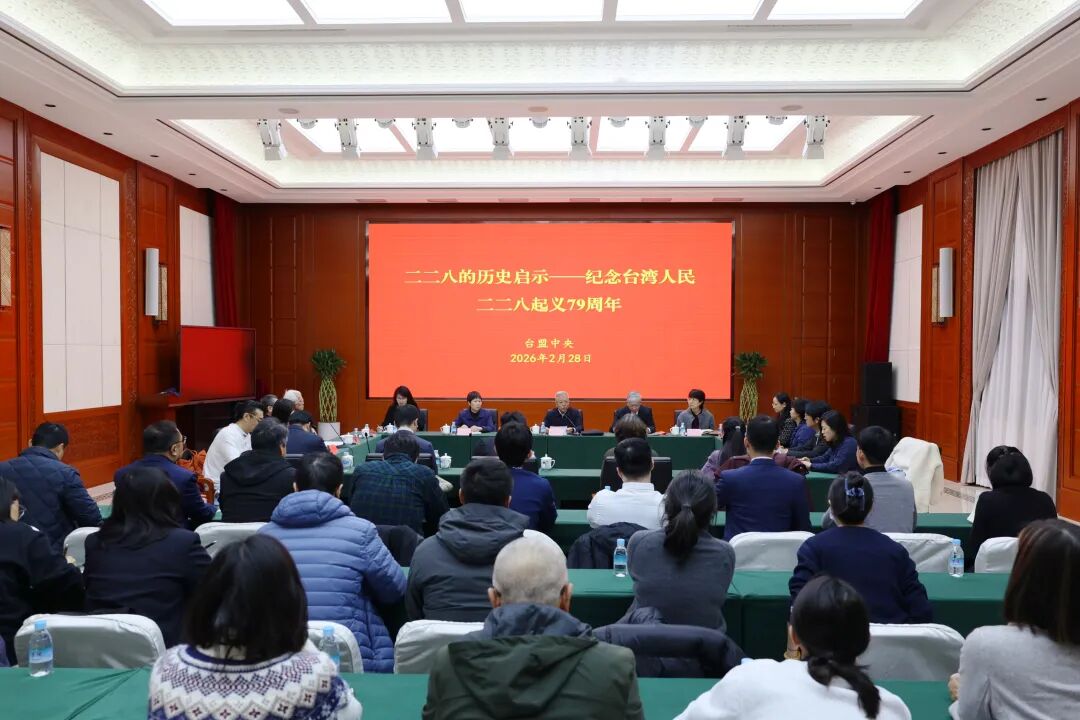
Image: A forum on the 2-28 Incident organized by the Taimeng (台盟), a CCP-controlled front organization (Feb. 28, 2026). The CCP seeks to leverage narratives surrounding 2-28 to promote its own program of unification with Taiwan. (Image Source: Taimeng)
The CCP’s Early Interpretation of the 2-28 Incident
The CCP’s initial messaging regarding the 2-28 Incident was entirely different from the narratives it presents today. Surprisingly, when the 2-28 Incident occurred in 1947, the CCP defined it as an autonomy movement and encouraged Taiwan to break away from KMT rule and become autonomous or independent.
On March 4, 1947, while the anti-government uprising was unfolding in Taiwan, the CCP’s People’s Daily wrote that “the people of Taipei rose to fight. Chiang Kai-shek’s police shot citizens, and the public became angrier.” On March 8, 1947, the Central Committee of the CCP (中國共產黨中央委員會) issued a significant statement defining the nature of the 2-28 Incident, titled “Taiwan Autonomy Movement.” The statement outlines that “The peaceful autonomy movement of the Taiwanese people was forced to defend itself… The autonomy movement of Taiwan compatriots will surely win, and will win soon. The CCP warmly praise the heroic struggle of Taiwan compatriots and wish them a glorious victory.” Indeed, the statement uses the word “autonomy” (自治) 33 times. This combined messaging indicates that, at the time of the event, the CCP defined the 2-28 incident as a Taiwanese autonomy and self-determination movement, and it openly supported Taiwanese self-determination, even independence.
After the CCP established the People’s Republic of China in 1949, it directed the People’s Liberation Army (PLA) to take over Taiwan. The CCP thus modified its narratives regarding the 2-28 Incident to complement this mission. In its post-1949 messaging the word “autonomy” was no longer used, and the incident was depicted simply as an armed uprising under the CCP’s leadership against the bloody rule of Chiang Kai-shek’s KMT and the imperialist United States. In February 1950, on the third anniversary of the 2-28 incident, the CCP held grand memorial meetings in Beijing. The Red Army’s Commander-in-Chief, Zhu De (朱德), participated in the meeting and issued a call to the Chinese people and government to liberate Taiwan. During the memorial, other CCP leaders expressed their firm determination to liberate Taiwan. In February 1973, during the Cultural Revolution (文化大革命), the CCP held a symposium to commemorate the 26th anniversary of the 2-28 Incident. The CCP continuously defined the 2-28 Incident as an uprising and argued that that Taiwan must be liberated.
The CCP’s Post-Cold War Interpretations of the 2-28 Incident
After the Cultural Revolution and the death of Mao Zedong, the CCP initiated its reform and opening-up policy. To attract investment from Taiwanese businessmen and improve cross-Strait relations, the PRC began to emphasize a peaceful narrative for unification with Taiwan, and downplayed its commemoration of the 2-28 Incident. On February 27, 1987, China organized a meeting in Beijing to commemorate the 40th anniversary of the 2-28 Incident, defining that it was a patriotic movement. On the 49th anniversary of the historical event in 1996, the TDSL and other CCP united front groups held a commemorative rally that in one breath opposed “acts of national separatism,” and in another called for the “the expansion of cross-strait people-to-people exchanges.”
In the 21st century, during the periods that Democratic Progressive Party (DPP) presidents have governed Taiwan, the CCP has emphasized that it would resort to force, if necessary, to achieve unification. Its messaging regarding the 2-28 Incident followed suit. On February 19, 2004, during the 57th anniversary of the 2-28 Incident, the CCP made the specific claim that no one shouted a slogan of “Taiwan independence” in the 2-28 Incident. In 2017, during the incident’s 70th anniversary, the PRC’s Taiwan Affairs Office (台灣事務辦公室) spokesperson An Fengshan (安峰山) pointed out that the 2-28 Incident was “an integral part of the Chinese people’s liberation struggle,” and castigated “’Taiwanese independence’ separatist forces” for “exploiting” the event.
This new narrative under Chairman Xi Jinping’s administration attracted the attention of Western media. Reuters reported that “China on Wednesday described landmark Taiwan protests against Nationalist troops in 1947 as part of China’s liberation struggle that Taiwan independence forces were trying to hijack, ahead of commemorations next week for the 70th anniversary.”
In the Xi Jinping era, the CCP no longer employs the rhetoric of “uprising” or “autonomy” in reference to the 2-28 Incident. Instead, it employs an interpretation of the historical event that underscores Chinese patriotism in Taiwan and the island’s sustained connection with mainland China. Meanwhile, the rhetoric regarding the 2-28 Incident under Xi is firm in its opposition to Taiwan independence.
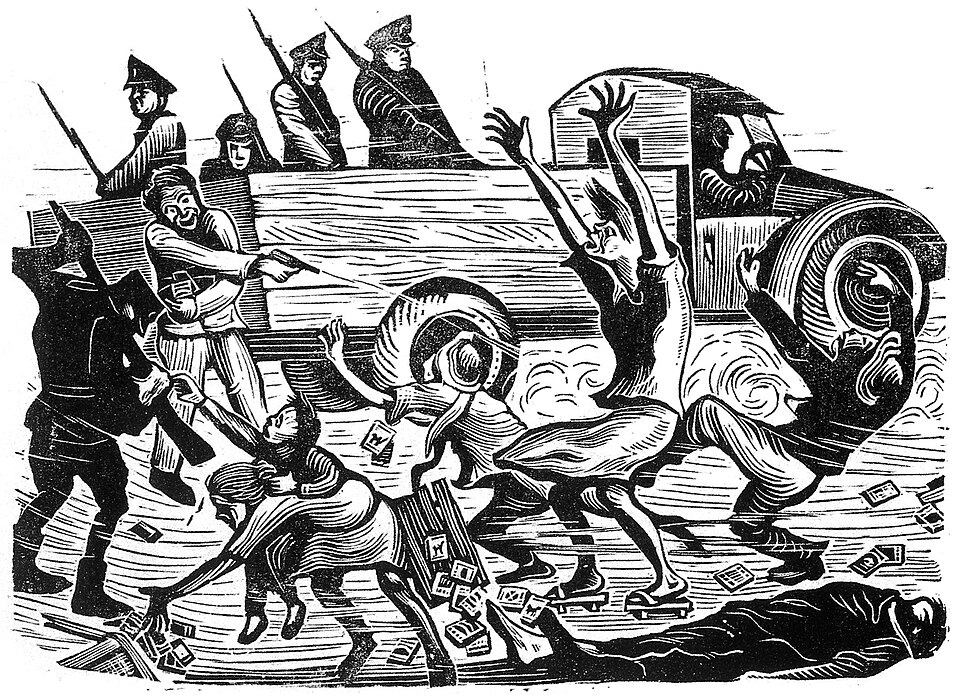
Image: The woodcut image “The Horrifying Inspection” by artist Huang Rong-can, depicting the violence of the 2-28 crackdown (circa 1947). (Image source: Wikimedia Commons)
The Usefulness of the 2-28 Incident to CCP Propaganda and Cognitive Warfare
The CCP has employed narratives regarding Taiwan’s history in its cognitive warfare operations aimed at influencing political decision-making on the island. Its operations have indeed affected some Taiwanese. For instance, on November 8, 2025, the new KMT Chair Cheng Li-wun (鄭麗文) attended a memorial in Taipei honoring victims of the White Terror era. Among those memorialized in the event was the highest-ranking communist spy in the 1950s KMT government, Wu Shi (吳石). Wu Shi, a high-ranking KMT military official-turned-spy for the CCP, has been hailed as a martyr by the CCP and was depicted in a 2025 Chinese television drama named Silent Glory (沈默的榮耀). The TDSL, the CCP-sanctioned united front political party in the PRC, also delivered a tribute at the event. Cheng Li-wun’s participation, whether intentional or unintentional, caters to the CCP’s narrative that its spies killed in Taiwan are victims and martyrs.
Additionally, on February 27 this year, Cheng attended a book launch event for Exiled 2-28 (流亡2-28) in Taichung. At the event, Cheng asserted that the 2-28 Incident was a democracy movement rather than a Taiwan independence movement. She further criticized the DPP for not learning from the 2-28 Incident, arguing that the historical event has become a “cheap” tool for political struggle. Given that it plays down connections between Taiwanese independence and the 2-28 Incident, Cheng’s narrative is similar to that of the CCP.
Given that the CCP has adjusted its historical interpretations of the 2-28 Incident to complement its shifting political goals over time, the CCP’s narrative regarding the incident at any given time cannot be taken at face value. When the 2-28 Incident was actually unfolding, the CCP had not yet taken power over mainland China, so it defined the 2-28 Incident as an autonomy movement and encouraged Taiwan to break free from KMT rule, or even pursue independence. After the CCP took power, its leaders sought to unify with Taiwan by force, so the party positioned the 2-28 Incident as an armed uprising under the leadership of the CCP, instead of emphasizing Taiwanese autonomy. When the CCP began its reform and opening-up policy, peaceful unification became the central theme of its Taiwan strategy, and the party downplayed the commemoration of the 2-28 Incident. Under the leadership of Xi Jinping, the CCP has focused on combating Taiwan independence forces and embraced the prospect of unification by force. The CCP thus labeled the 2-28 Incident as a patriotic and democratic movement, and removed the narrative of autonomy—while also denouncing the exploitation of the 2-28 Incident by so-called “independence forces” in Taiwan.
The CCP once advocated for Taiwan’s autonomy. It now strongly opposes Taiwan’s independence. The CCP’s contradictory policy regarding autonomy is not unique to Taiwan. The CCP once supported the independence of Xinjiang in 1944. In fact, both the Soviet Union and Mao Zedong signaled initial support for the independence movement in Xinjiang. The CCP later opposed Xinjiang autonomy and struck an agreement with the Soviet Union to assimilate the region. Similarly, the CCP’s initial narrative regarding the autonomy movement during the 2-28 Incident stands in stark contradiction to Xi Jinping’s present rhetoric of a “great rejuvenation of the Chinese nation” and Taiwan’s “reunification with the motherland.”
In terms of interpreting historical events, the CCP is pragmatic, and is willing to adjust its rhetoric to serve its political objectives. Observers should recognize that the CCP’s historical narratives are inherently contingent on the party’s political interests, and should first seek to understand their origins before taking them at face value.
The main point: The CCP’s narratives regarding the 2-28 Incident have been a feature of its cognitive warfare operations aimed at Taiwan. As the 2-28 Incident unfolded, the CCP initially published propaganda highlighting the “autonomy” of Taiwanese residents. Later propaganda has cast the 2-28 Incident as a movement led by the CCP, and a patriotic Chinese initiative coinciding with the founding of the PRC.