

At the Chinese Communist Party’s (CCP) annual Taiwan Work Conference (对台工作会议) in February this year, top Chinese officials reportedly discussed establishing a task force to interfere in Taiwan’s November 2026 local elections. The officials outlined a specific strategy: employing united front work in cyberspace to damage “Taiwan independence forces” (台獨勢力), a phrase the CCP frequently uses to identify officials of the Democratic Progressive Party (DPP, 民進黨). The effort was reportedly classified as a top priority within the CCP’s Taiwan policy for the year.
Meanwhile, academics in Taiwan anticipate that the People’s Republic of China (PRC, 中华人民共和国) will launch initiatives offering economic incentives to cities and counties in Taiwan, such as by purchasing agricultural products, loosening import restrictions, and increasing group tourism efforts. The use of economic tools to influence Taiwan’s voters in local elections is not new. Indeed, reports from the CCP’s Taiwan Work Conference suggest that economic incentives will likely be accompanied by subtler, PRC-orchestrated cognitive warfare operations, involving targeted information campaigns to shape Taiwanese perceptions on key issues.
Election periods in Taiwan historically bring about an uptick in influence operations facilitated by the PRC. This was seen on a large scale during the 2024 national elections—with the Legislative Yuan (LY, 立法院) and the presidency on the line, electoral outcomes would have a distinct impact on Taiwan’s cross-Strait policy. Although the upcoming elections in 2026 will place local—not national—officials on the ballot, they still have significant influence on Taiwan’s political landscape and will elevate certain candidates in advance of the 2028 presidential elections.
Two factors have accelerated PRC information operations targeting Taiwan in recent years: intensifying cross-Strait tensions, and developments in AI and data harvesting technology. Taiwan’s National Security Bureau (NSB, 國家安全局) recorded a 60 percent increase in inauthentic social media accounts between 2024 and 2025, and tracked over 2 million instances of disinformation within the same year (a 74 percent increase since 2023).
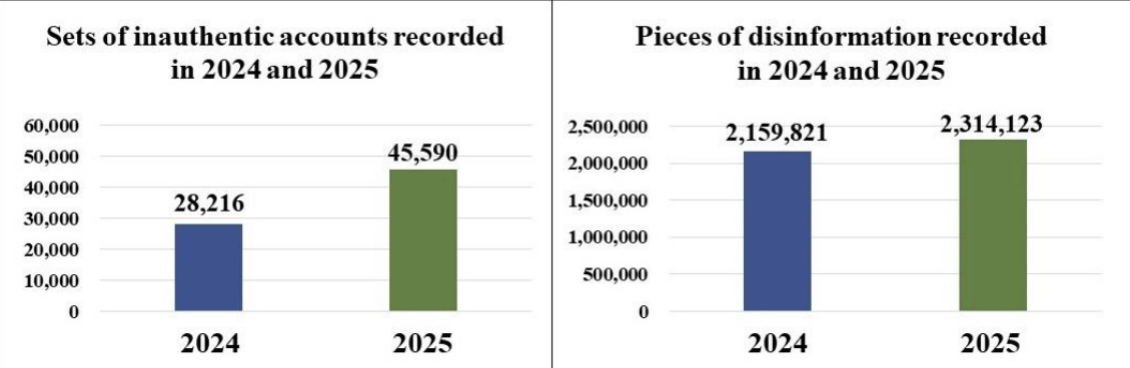
Image: Taiwan’s National Security Bureau statistics on inauthentic accounts and disinformation in 2025. (Image source: NSB)
With local elections set for November 2026, Taiwan can expect to face targeted information operations from the PRC in the coming months. This article will examine how Beijing’s cognitive warfare operations have evolved both strategically and operationally, and why they are increasingly relevant to this year’s local elections in Taiwan.
Growing Sophistication in PRC Information Operations
In January 2026, the NSB released a report titled Analysis of China’s Cognitive Warfare Tactics Against Taiwan in 2025 (2025年中共對臺認知作戰操作手法分析), which relayed data on cognitive warfare efforts by the PRC to manipulate public opinion in Taiwan. The report identified the PRC’s four strategic goals: to “exacerbate internal divisions within Taiwan,” “weaken Taiwanese people’s will to resist the enemy,” “influence allies’ willingness to support Taiwan,” and “win support for China’s stance.” The NSB outlined the primary social media manipulation tactics employed by the PRC, as well as the PRC-based firms that collaborate with the government on information operations. According to the report, the PRC directs Chinese IT and marketing companies to “analyse Taiwan’s social dynamics, establish diversified channels to disseminate disinformation, employ inauthentic accounts to manipulate public opinion, use AI to generate highly realistic videos, [and] conduct cyber intrusions to hijack Taiwanese users’ accounts.”
The strategic interests of Beijing’s cognitive warfare tactics have shifted focus in recent years from promoting pro-China sentiment to stoking social divisions and elevating distrust in Taiwan’s government, political leaders, and military capability. Alongside the shift in narrative priorities, PRC-based influence actors have increased the sophistication and subtlety of their information campaigns. Following the last local elections in 2022, the Taiwanese NGO Doublethink Lab reported that PRC interference and information efforts had grown increasingly decentralized and harder to track, with a decline in content farm production and a shift in focus towards identifying and leveraging existing divisive issues within Taiwan. This report identified that during the election period, PRC-led information campaigns amplified discourse on select contentious issues through CCP-directed media entities as well as Taiwanese media entities with aligning values but no relationship to the CCP. One such example was a rumor suggesting that the DPP was planning to sell Taiwan Semiconductor Manufacturing Company (TSMC, 台灣半導體股份有限公司) to the United States, which was later found to have been heavily circulated by inauthentic accounts from the PRC.
PRC Strategic Interests are Increasingly Relevant to Local Elections
PRC efforts to influence and spread disinformation during Taiwan’s national elections has been widely covered. Indeed, in national elections where cross-Strait relations are a perpetual talking point, the PRC’s interests in electoral outcomes are relatively clear. During the 2024 national elections, the PRC reportedly engaged in information campaigns to amplify criticisms of the DPP-led government’s handling of an egg-shortage crisis. PRC actors channeled critical information through state-owned media outlets, and conducted social media campaigns (primarily on Facebook). In a similar campaign, PRC actors reportedly disseminated forged documents alleging massive “dollar diplomacy” cash transfers from Taiwan to Paraguay, escalating criticisms of then-presidential candidate Lai’s foreign engagement. The forged documents were also linked to PRC-affiliated online actors.
Local elections in Taiwan were historically insulated from national policy debates or cross-Strait issues; with voting outcomes in these elections typically shaped by local issues such as housing, food security, and patronage. However, following a year of intense political polarization, Taiwanese society in 2026 is arguably more vulnerable to PRC attempts at division. As partisan polarization increases, local politics within Taiwan are increasingly influenced by national issues rather than local ones. Such a dynamic has decreased the political power of local factions and rendered electoral outcomes more reliant on partisan allegiance.
Coinciding with the nationalization of the local political landscape in Taiwan is the nation’s increasing susceptibility to PRC cognitive warfare. Local political outcomes often elevate and position political leaders to hold national office, in turn impacting cross-Strait politics. The outcomes of local races are also opportunities for the PRC to grow its influence on local issues, through candidates who promote closer economic ties with the PRC. Some analysts argue that local elections are more conducive to PRC influence operations than national ones, as the information space is fragmented, and PRC actors can conduct campaigns with less chance of detection.
Expanding PRC Efforts: Reported Interference in the 2025 KMT Chair Elections
In October 2025, allegations surfaced regarding PRC interference in the KMT chairmanship election. During the race to decide the party’s next chair, KMT political commentator Jaw Shaw-kong (趙少康) alleged that AI-generated content and newly created social media accounts with foreign IP addresses had targeted the moderate candidate Hau Lung-bin (郝龍斌) and promoted the conservative, Beijing-friendly candidate Cheng Li-wun (鄭麗文), who ultimately won the election. The NSB later announced that they had identified over 1,200 TikTok and YouTube videos discussing the election that had been created by overseas accounts. Speculation regarding PRC interference elicited shock and concern among some KMT officials and members, who trend towards friendlier views on relations with the PRC. Interference in intra-party elections, specifically KMT ones, suggests a more subtle and intricate PRC influence strategy.
Expanding PRC Efforts: Growing AI Capabilities
The expansion of global AI use has widened the capacity of disinformation and influence campaigns, and created new challenges for countering them. Fake accounts are harder to identify and track. Deep-fakes are more convincing. Content is more acutely targeted to audiences.
In 2025, Vanderbilt University’s Institute of National Security released leaked documents exposing the operations of a PRC-based “influence-for-hire” company, GoLaxy (中科天玑). The investigation uncovered GoLaxy’s use of AI-powered Foreign Information Manipulation and Interference (FIMI) systems to conduct large-scale influence operations to impact foreign elections, including in Taiwan, encompassing extensive data on national and local Taiwanese political figures, parties, and institutions. Analysis by Doublethink Lab outlines how GoLaxy engaged in one project that collected 50,000 Taiwan‑related news items, and categorized actors mentioned into “Hardliners (顽固派), Moderates (友好派), Swing Voters (摇摆派), Objectivists (客观派), and their opposites.” Each category included at least 1,000 key individuals, enabling development of targeted and politically impactful influence campaigns. This discovery has provided significant insight into PRC efforts to develop fully autonomous FIMI systems and incorporate AI models into comprehensive information campaigns.
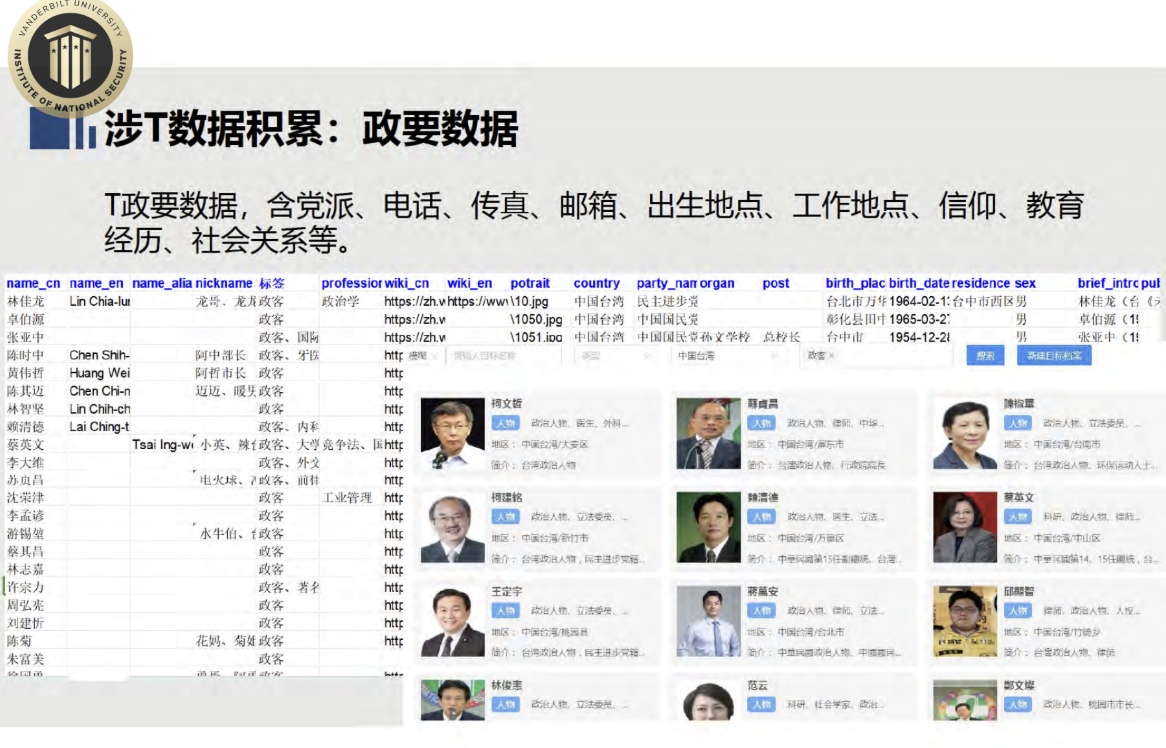
Image: Documents leaked from Golaxy depicting data collection on key political figures in Taiwan, including Ko Wen-je (柯文哲), Lai Ching-te (賴清德), and Su Tseng-chang (蘇貞昌) (Image source: Vanderbilt University)
Conclusion
Evidence suggests that Taiwan will likely remain a target of PRC influence operations in the November local elections. Though cognitive warfare operations seem all but certain, their full scope and impact is yet to be determined. Civil society efforts in Taiwan to investigate them, such as Doublethink Lab’s election monitoring hub, have broadened in recent years. With dogged investigative efforts at all levels of society, there remains hope that PRC influence operations during the local election cycle will not escape reporting. By attuning voters to these interference threats, monitoring efforts have developed into a robust and effective defense force in their own right.
The main point: As the quantity and quality of Beijing’s cognitive warfare operations against Taiwan increase, observers are focused on the 2026 local elections in Taiwan as a target of PRC influence. The growing divide both within and between political parties in Taiwan exposes vulnerabilities for PRC information operations to exploit. Meanwhile, developments in AI have allowed PRC-based influence actors to conduct more tailored information operations against the island.