
More than two decades have elapsed since Taiwan’s Gender Equity Education Act (GEEA, 性別平等教育法) went into effect on June 23, 2004. Since that time, continual efforts to renegotiate the act’s scope and content have encapsulated broader trends in national gender politics. The history of the GEEA has been characterized by notable advances in education reform, alongside structural challenges hindering full implementation of its provisions. Currently, the GEEA establishes a framework for equal educational rights, anti-discrimination protections in schools, and curricular instruction on gender diversity, sex education, and LGBTQ+ identity. These latter topics have become a particular source of contention for the act’s opponents, stymieing progress toward substantive equality. As educational initiatives related to gender diversity and inclusion come under growing scrutiny worldwide, the limitations and successes of the GEEA can serve as a reference for future policy interventions within and beyond Taiwan.
Policy Development Background
Educational equity became an early advocacy priority for Taiwan’s burgeoning feminist movement at the close of the twentieth century, as the democratizing state responded to an emboldened civil society and enacted post–martial law reforms to the academic system. In 1988, the Awakening Foundation (婦女新知基金會), one of Taiwan’s first feminist organizations, published a handbook that drew wider attention to the pervasive gender stereotypes common to textbooks of the time and called for school curricula to incorporate values of equity and inclusion. By the mid-1990s, the government had begun to explicitly include gender-related concerns in educational policy agendas. At this stage, many activists used the phrase “equality between both sexes” (兩性平等) in their calls for change, emphasizing the representation of women relative to men in educational materials and the consequences of existing imbalances.
In 2000, the focus of educational advocacy broadened following the death of middle school student Yeh Yung-chih (葉永鋕), who had been bullied by classmates for his perceived feminine characteristics. The incident increased the urgency to push for legislative change and prompted wider embrace of the term “gender equality” (性別平等) in recognition of more complex manifestations of gender discrimination in the classroom. This linguistic shift—also reflected in the name change of the “Educational Act for Equality Between Both Sexes” legislative draft (兩性平等教育法) to the GEEA—highlights how addressing diverse gendered experiences and expressions beyond a binary framework has been embedded in the act’s core from the beginning. This shift in the legislation’s framing was driven by the feminists themselves, who offered a framework for the inclusion of LGBTQ+ education within its parameters, even as the provisions for course content on gender diversity and sexuality quickly became its most controversial and neglected components.
The increasing support for educational reform during the early 2000s generated momentum for new and existing civil society groups. In 2002, activists and teachers founded the Taiwan Gender Equity Education Association (TGEEA, 台灣性別平等教育協會) to provide follow-up assistance for the Yeh Yung-chih case and push for greater protection and understanding of gender diversity on school campuses. Subsequently, TGEEA formed a legislative advocacy coalition with other feminist groups, including the Awakening Foundation and Taiwan Tongzhi (LGBTQ+) Hotline Association (Hotline, 台灣同志諮詢熱線協會), the nation’s oldest and largest LGBTQ+-serving nonprofit. After two more years of discussion, the legislature passed the GEEA on June 4, 2004. The new law went into effect later that month, establishing initial articles against sexual harassment and assault, anti-discrimination protections for teachers and students regarding sexual orientation and gender identity/presentation, and curriculum requirements related to gender equity instruction.
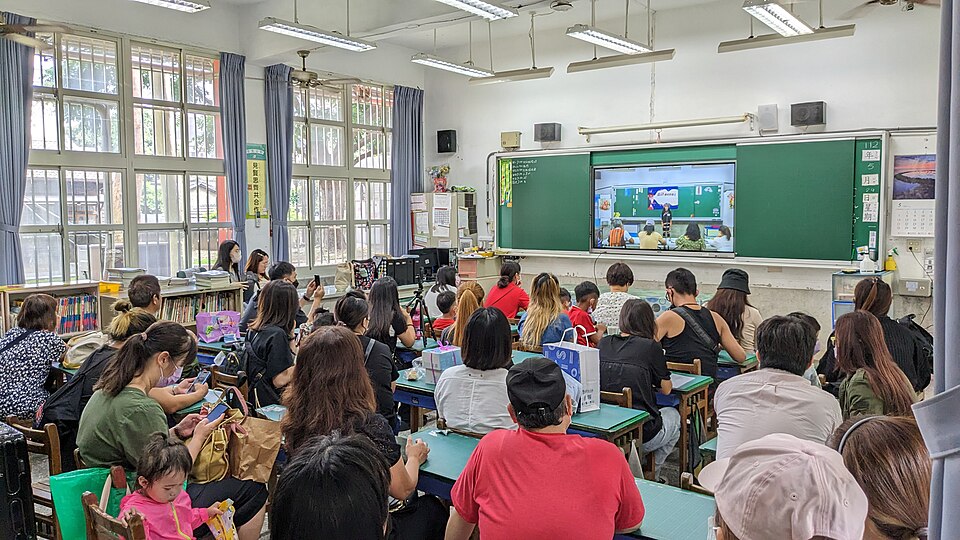
Image: Parents listening to student performances at Tanzi Public Elementary School in Taichung (臺中市潭子區潭子國民小學) (May 2023). (Image source: Wikimedia Commons / Taichung City Government)
Early Implementation and Politicization
Although the passage of the GEEA marked a crucial first step towards educational equity in Taiwan, its often protracted and uneven implementation—like other social policy initiatives—presented an immediate challenge to further progress. Across Taiwan, academically high-performing schools and those in urban centers generally enjoy greater access to educational resources than lower-ranking and rural schools. This uneven distribution limits both the availability of relevant pedagogical expertise to all students, and the amount of time teachers at under-resourced schools are willing to devote to subjects that are not exam-oriented. Furthermore, since the GEEA went into effect, policymaking agendas have seldom prioritized gender education, exacerbating the challenges to GEEA implementation.
In addition to these structural barriers, backlash against GEEA provisions on comprehensive sex education and curricular inclusion of LGBTQ+ identity spread in the early 2010s. The GEEA legitimized and provided an official framework for pre-existing efforts to promote gender education in schools and teacher trainings, and organizations like TGEEA continued to create supplementary learning materials to embody this purpose. Despite being within the scope of the GEEA, some of these materials became the target of parent groups and budding campaigns to restrict GEEA enforcement. Perhaps most prominently, the sex education short film “Shall We Swim” (青春水漾), first released by TGEEA in 2011, became subject to numerous bans and protests—due largely to its portrayal of same-sex relationships.
This timeline corresponds to the parallel expansion of movements for and against same-sex marriage legalization throughout the 2010s. Opposition to the GEEA surged leading up to the passage of marriage equality legislation in 2019, during which both supporters and detractors increasingly framed gender diversity education and same-sex marriage as ideologically linked policy goals. The 2018 national referendum included five items associated with marriage equality and GEEA implementation, such as a motion to block the enforcement of LGBTQ+ education requirements in elementary and middle schools (which passed with approximately 67 percent of the vote) and a counter-motion to protect the requirements at all levels (supported by only 34 percent of voters).
The divisive referendum campaign period profoundly affected schools’ willingness to foster discussion on topics related to gender diversity and LGBTQ+ identity, regardless of GEEA provisions. This trend is illustrated by a dramatic decrease in the number of gender diversity education lectures delivered by Hotline volunteers at schools: from 415 in 2016 to 139 in 2017, and further still to 123 in 2018. Although institutional support for gender equity education has since begun to recover, the tensions that emerged during Taiwan’s marriage equality movement have had lasting consequences for the political climate in which social policy is developed, revised, and enacted.
Persistent Challenges and Future Possibilities
As its history illustrates, the GEEA has generally received the most attention during periods characterized by broader social transformations in gender relations and positioning, a trend that has remained evident in recent years. In addition to minor revisions made largely in the early 2010s, the GEEA was most recently and extensively amended during the summer of 2023 in response to Taiwan’s #MeToo movement. These amendments expanded the definition and regulatory scope of campus gender incidents (校園性別事件), increased reporting requirements, strengthened investigation and oversight mechanisms, and reaffirmed the mandatory nature of gender equity awareness activities.
With each revision cycle, the GEEA brings Taiwan’s educational landscape closer to the ideal of equality that activists have long envisioned. Nevertheless, advocates have consistently highlighted several key challenges that continue to impede this goal. Sociologist and founding member of TGEEA Yang Chia-ling (楊佳羚) has researched the continued discrepancy between GEEA provisions on paper and their practical implementation in schools—which is often frustrated by the lack of adequate teacher training on gender issues, incentives to devote greater focus to exam-oriented subjects, and administrators’ fear of generating controversy over course content. For initiatives like Hotline’s educational outreach program to effectively reach students, any visits must be invited (and thus sanctioned) by school personnel, who may face pressure from parents and other third parties to limit or avoid gender diverse and LGBTQ+-inclusive course content.
As is commonly the case with mounting book bans and teaching material challenges in the United States, individuals lodging complaints against gender-related course content in Taiwanese classrooms often exert influence through broader networks of parent associations and anti-LGBTQ+ groups. In one notable 2017 example, a teacher in Kaohsiung received complaints from members of such groups nationwide after his sex education lesson for elementary schoolers was televised, even though his students’ parents had approved the lesson in advance. Beyond the school level, politicians’ reluctance to invest in gender education continues to pose barriers: in early 2025, gender movement organizations (including TGEEA, Hotline, and the Awakening Foundation) released statements criticizing proposed budget cuts that would suspend nearly all funding for the Executive Yuan’s Department of Gender Equality. Although the cuts were ultimately rescinded, such proposals can block efforts to further improve and implement policies like the GEEA.
Advocates have also expressed concerns regarding the full integration of comprehensive sex and gender education into everyday curricula. The GEEA stipulates that schools must provide students with at least four hours of instruction in gender equity education per semester, but teachers may lack incentives to devote any additional class time to gender issues. When such instruction primarily involves one-off lectures or volunteer-driven classroom visits, this status quo may reinforce a sense of distance between the topic of gender equality and other required subjects, allowing educators to outsource responsibility for initiating these discussions. Efforts to promote gender equity education are often siloed rather than systemic, focusing on a handful of common themes (e.g., discrimination and sexual health) rather than a more nuanced, holistic approach to inclusion that is embedded within daily classroom activities.
Despite these challenges, the GEEA has undeniably advanced the status of gender education in Taiwan since 2004, increasing social awareness and acceptance of gender diversity. LGBTQ+ and gender-diverse students in Taiwan—particularly those who are transgender—face lingering harassment and bias as the increasing backlash against gender education initiatives worldwide complicates their implementation. Acts like the GEEA provide a crucial framework to ensure students are granted equal opportunities to learn in a safe and open environment. In 2025, the U.S. Supreme Court affirmed that parents should be able to remove their children from LGBTQ+-inclusive lessons, reflecting similar retrenchments to educational equity nationwide. Measures to shield students from any exposure to positive portrayals of gender diversity contrast with the ultimate goal of gender education policies to normalize and integrate such content across all facets of the educational environment. As Taiwan’s case demonstrates, the success of these policies is contingent upon sustained commitment at both the institutional and individual levels. Further stakeholder consultation, dedicated resource provision, and continued policy and strategy adjustment in response to current needs will be essential to fully embed the GEEA within Taiwan’s educational system.
The main point: Throughout its more than 20-year history, Taiwan’s Gender Equity Education Act has been at the center of calls for inclusive education reform and broader shifts in societal gender discourses. This policy has provided crucial protections for students and educators while increasing attention to gender-related topics in the classroom, but persistent policy and implementation gaps must be addressed to truly fulfill the act’s purpose.