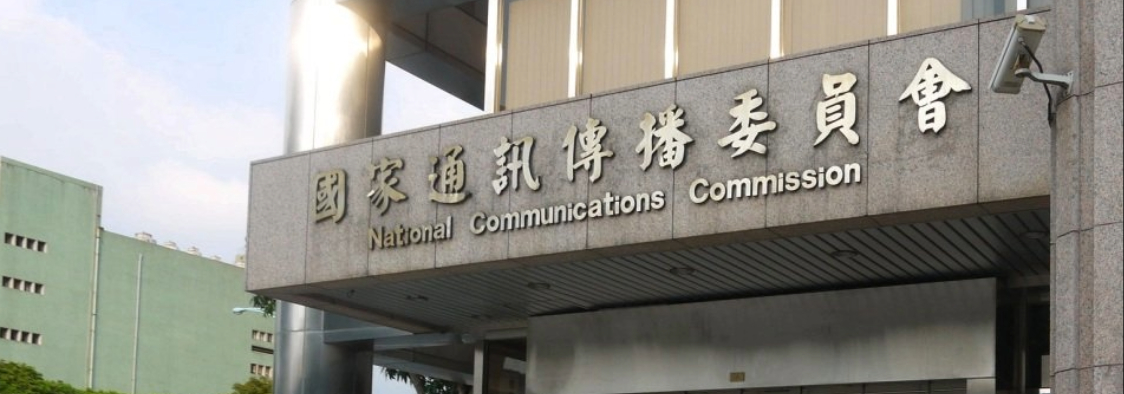


For the past 20 years, the National Communications Commission (國家通訊傳播委員會) has served as a significant regulatory force in Taiwan’s telecommunications and media environment. Yet in recent years, its operations have been considerably compromised, as the Legislative Yuan’s (LY, 立法院) voting majority has vetoed every new commissioner proposed by Taiwan’s Executive Yuan (EY, 行政院) since 2024. As of the beginning of August, all commissioner seats in the NCC are now vacant as a result of this impasse between the EY and the majority caucus in the LY. As long as the NCC lacks a quorum of commissioners, it cannot function, and Taiwan’s national security is at risk: in these circumstances, both critical communications infrastructure and drone initiatives cannot receive the regulatory certainty needed for stable development.
What is the NCC?
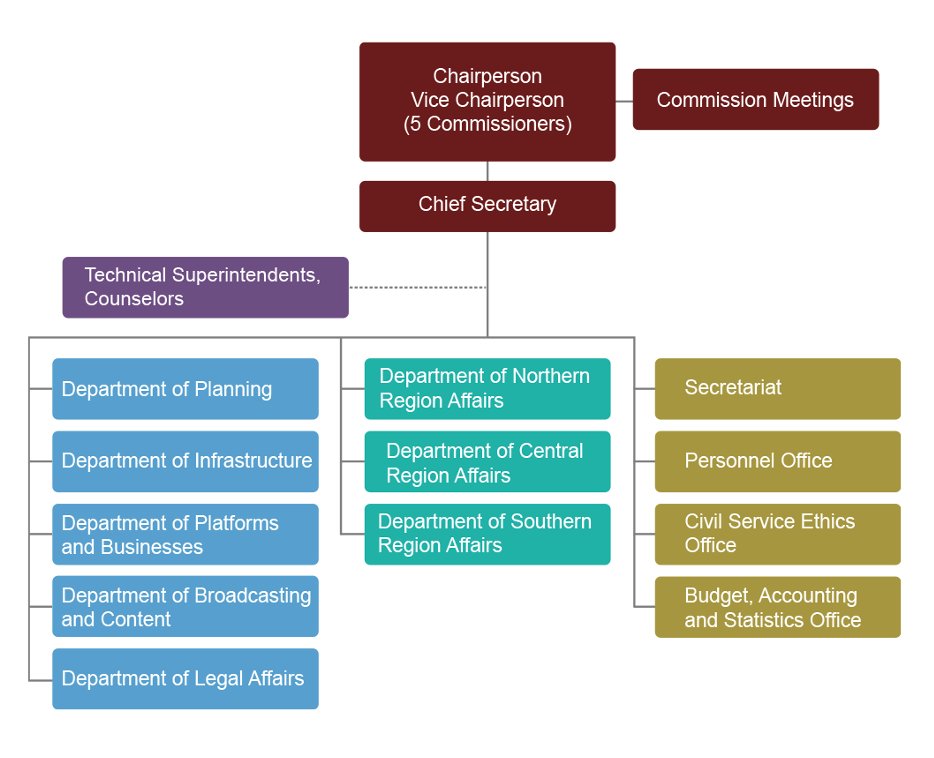
Image: The Organization Structure of National Communications Commissions (NCC). (Image source: NCC Website)
The National Communications Commission is an independent statutory agency of the EY, responsible for regulating telecommunications and broadcasting services. Established in 2006, its mandate includes issuing licenses, inspecting and certifying communication systems, managing radio frequencies, and strengthening the development of Taiwan’s telecommunications industries. The NCC is also responsible for ensuring media professionalism.
The NCC comprises seven full-time commissioners, each serving a four-year term (and eligible for one consecutive reappointment). They are nominated by Taiwan’s premier (the head of the EY) and require approval by the LY. To ensure bipartisanship, no more than half of the commissioners can belong to the same political party. The NCC’s decision-making process is based on majority voting. Major matters under the NCC’s legal authority must be decided through a commission meeting, and a resolution requires the support of more than half of the commissioners. If a commissioner supports a final decision but holds different reasoning, they can submit a concurring opinion. Meanwhile, if a commissioner disagrees with the decision, they can share a dissenting opinion. These opinions are published alongside the commission’s decisions for transparency and accountability.
However, when there are too few commissioners to reach the required decision-making threshold, the NCC is only empowered to conduct routine administrative work through its professional staff. However, professional staff cannot substitute for commissioners in formal NCC decisions. Therefore, the deadlock of commissioner appointments has created an important vulnerability. When there are not enough commissioners, the NCC loses the legal authority to safeguard the public interest, ensure fair market competition, and preserve Taiwan’s media integrity.
A full bench of commissioners is necessary for important decisions. For instance, the NCC commissioners approved separate mergers by two of Taiwan’s large telecom operators with smaller carriers in January 2023. To ensure the fair distribution of resources and market competition, the NCC conditioned the mergers on the two companies improving their service quality, with the mergers subject to an annual review. In the beginning of 2024, the NCC commissioners blocked a pro-Democratic Progressive Party (DPP, 民進黨) media channel from purchasing a stake in an internet and cable channel company. Concerned about the possibility of media monopolization and the lack of transparency in the shareholder structure, the NCC fined the digital communication company more than USD 450,000 and demanded corrective measures.
Nevertheless, some of the NCC’s rulings have provoked partisan controversy. A prominent example is NCC’s decision in 2020 not to renew the broadcasting license for CTi News (中天新聞台). The NCC’s decision followed a series of regulatory violations by CTi News. In 2019, there were accounting for 31.5 percent of all complaints regarding TV stations. These complaints accused CTi News of including unverified information in the news and disproportionally reporting certain politicians. The NCC judged that CTi News’ major shareholders [including its biggest shareholder Tsai Eng-meng (蔡衍明), who runs the food manufacturing conglomerate Want Want China (旺旺集團) in China] were significantly involved in news production, thus violating news production ethics and Radio and Television Act (廣播電視法) .
Therefore, the NCC’s commissioners unanimously voted 7–0 to deny CTi News’ license renewal on November 18, 2020. The decision generated controversy in Taiwan as CTi News is often understood as a pro-Kuomintang (KMT, 國民黨) media outlet.Some critics argued that the decision was influenced by partisan politics and infringed on press freedom. Yet, CTi News lost 17 out of the 26 ensuing lawsuits it filed against NCC, undermining the argument that the NCC’s decision lacked merit.
The Impasse in the Legislative Yuan
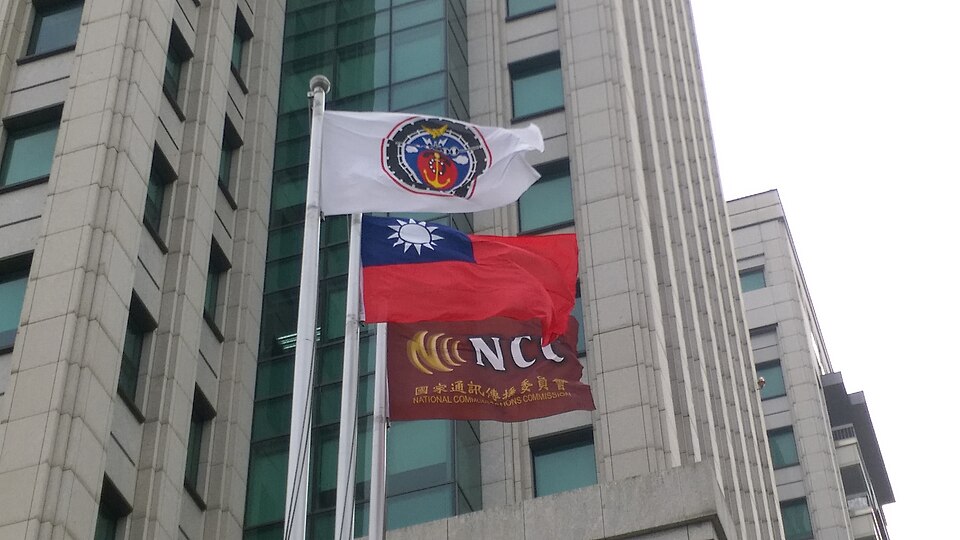
Image: The flags of the Transportation Ministry (top), the ROC (middle), and the NCC flag (bottom) fly outside of the NCC’s office building in Taipei (2014). (Image source: Wikimedia Commons)
The NCC has not been able to function at its full capacity since July of 2024, following the victory of the KMT and the Taiwan People’s Party (TPP, 民眾黨) in the January 2024 legislative elections. Since then, the KMT and TPP legislative majority has continuously vetoed the EY’s commissioner appointments. On July 31, 2024, four out of the seven commissioners finished their terms, leaving only three seats filled. In response, the EY extended the term of one commissioner to sustain at least half of total seats—which is the minimum required by the NCC Organization Act (國家通訊傳播委員會組織法) for commission meetings to issue decisions. However, in November 2024, KMT and TPP legislators passed an amendment to the NCC Organization Act that removed EY’s power to extend commissioner terms. This law thus crippled the NCC, as it could no longer achieve a functioning quorum.
In July, 2025, the EY announced a new list of commissioner nominations, comprising one KMT member and three candidates with no party affiliation. Nevertheless, KMT and TPP jointly rejected the appointments in a November LY session, leaving the NCC without commissioner authority.
On July 31 of this year, the three remaining NCC commissioners all finished their four-year terms. This is the first time since the creation of the NCC in 2006 that there have been no active commissioners. In the past two years, the three NCC commissioners have only been able to hold advisory meetings to advance the administrative functions of the organization. Starting from August 1, the lack of commissioners prevents the NCC from holding even advisory meetings. In their absence, the chief secretary of the NCC has assumed some commissioner functions.
Of particular concerning, the LY’s 2026 budget (passed on August 14) removes 56 percent of the funding for NCC’s basic administrative operations budget. This budget cut will impact the NCC’s water and electricity, rent, security, and building maintenance. On top of the commissioners’ absence, the NCC is poised to lose access to funding for day-to-day operations.
In an effort to restore full function to the NCC, the EY proposed another set of commissioner appointments this July, but with seven candidates this time. A DPP legislator on the LY’s Transportation Committee (交通委員會) held a public hearing on August 19, urging the acceleration of the LY’s appointment review process.
The Consequences of an NCC Without a Quorum
As the NCC’s mandate spans telecommunications regulation and the protection of Taiwan’s information environment, a malfunctioning NCC has consequences far beyond administrative inefficiency. As of August 1 this year, there are 700 outstanding cases that the NCC has lacked the commissioner authority to process. These cases cover six major areas: including public safety, transportation, remote and offshore communications, research and development, and foreign telecom companies operating in Taiwan.
1) Public Safety and Critical Infrastructure
A malfunctioning NCC poses an immediate risk to the reliability of Taiwan’s public safety and transportation systems. Of the 700 cases yet unresolved by the NCC, 84 concern radio-frequency equipment used by the police, firefighters, medical emergency services, and the coast guard. Without the necessary approval, these Taiwanese first responders cannot replace or install new radio equipment if radio frequency permit licenses cannot be verified by Customs. The consequences also extend to transportation. As most air and sea vessels rely on radar to operate, delayed approval of new communication equipment could halt the activity of aircraft and ships. If vessels are forced to extend the lifetime of existing radar equipment, there may be risks to transportation safety and operational continuity. Moreover, if mobile broadband base stations in remote areas and offshore islands cannot receive upgrades or replacements, these regions will suffer from impaired connectivity with Taiwan’s main island. Impaired connectivity is especially concerning during Taiwan’s typhoon season, when reliable communication is essential for receiving emergency alerts, reporting disasters and coordinating responses. These examples demonstrate that the NCC’s inability to approve critical equipment can directly affect Taiwan’s emergency response and transportation safety.
2) Economic Development and Taiwan’s Digital Resilience
The NCC’s regulatory capacity is also closely connected to Taiwan’s economic competitiveness and ability to develop resilient communications infrastructure. Because licensing and equipment certification requires NCC approval, some Taiwanese businesses now face delays in installing communications equipment for their products or research and development. Such regulatory paralysis also creates barriers for companies seeking to introduce new communications technologies to Taiwan, such as satellite connectivity. Taiwan’s government has placed emphasis on launching low-earth orbit (LEO) communications satellites in order to reduce its reliance on undersea cable for outbound communications. The Ministry of Digital Affairs (數位發展部) has announced a USD 18 million plan to build more than 700 satellite receiver stations in two years. Last month, the government further amended the Telecommunications Management Act (電信管理法) to allow foreign LEO satellite providers—such as SpaceX’s Starlink—to potentially enter the market. However, the inability to process applications for emerging technologies could delay the diversification of Taiwan’s communications infrastructure.
3) Information Environment and Social Trust
The NCC’s responsibilities also extend to broadcasting and media consumption within Taiwan’s broader information environment. Its functions include reviewing cable television and broadcast license renewals and applications, and enforcing accountability for the dissemination of false information. When NCC does not have a quorum of commissioners, it can only institute temporary or workaround measures. Although these measures prevent immediate disruption, prolonged reliance on temporary arrangements creates regulatory uncertainty and weakens institutional accountability. Over time, this undermines public confidence in the communications regulatory system. In 2025, the Taiwanese government discovered 45,000 sets of inauthentic social-media accounts and 2.3 million pieces of disinformation.
Since mis/disinformation has become ubiquitous in Taiwan’s information environment, Taiwan faces the additional challenge of preventing false narratives from being promoted through television and other mass media. Information operations linked to the People’s Republic of China (PRC) have capitalized on vulnerabilities within Taiwan’s own media ecosystem. Strategies include the utilization of PRC-linked capital to acquire or invest in major media outlets, allowing Beijing-aligned interests to influence editorial priorities and amplify narratives favorable to the PRC. Under Taiwan’s Satellite Broadcasting Act (衛星廣播電視法), television news programs are required to adhere to practices such as fact-checking and fairness, and the NCC has the authority to address violations. Without a functioning NCC, misleading information circulated through news media outlets will increase public confusion and deepen political polarization. This regulatory void creates opportunities for foreign influence operations to exploit Taiwan’s open information environment.
4) Technological Development and the Drone Industry
NCC is also a key player in market regulation to protect and support Taiwan’s drone industry. According to Article 65 of the Telecommunications Management Act, certain controlled radio frequency devices must receive approval from the NCC before they can be manufactured or imported. In addition, anyone who manufactures or imports these controlled devices must regularly report information about the devices. Since most drones available on the market are controlled remotely via radio frequency modules, such as 4G or Wi-Fi, they fall within the NCC’s regulatory boundaries. Even with three commissioners, the NCC struggled to maintain operations. Now, with none, its functions are impaired to the point that drones cannot clear manufacturing or import review.
As of July 2026, the NCC has halted the import of 48 drone models in order to prevent unqualified items (such as devices that overlap restricted radio frequencies or contain components that are prohibited) from entering the Taiwanese market. Should national frequency bands be disrupted or occupied by unlawful devices that circumvent a non-functional NCC, Taiwan’s military and public safety communications could be compromised—thereby affecting the government’s ability to effectively respond to emergencies or security threats.
Moreover, based on the 1998 APEC-TEL Mutual Recognition Arrangement (亞太經濟合作會議電信設備符合性評鑑相互承認協定), Taiwan-certified drones can gain easier access to international markets because NCC approval is recognized by participating economies. This reduces the need for Taiwan’s drones to earn certification in every new market. In the first quarter of 2026, Taiwan’s drone export value surged to USD 115 million, surpassing the export value for the whole of 2025 (USD 93 million). If the NCC cannot reliably certify new Taiwanese drone models, drone exporters face greater uncertainty and costs when entering international markets.
Conclusion
In sum, the NCC’s current dysfunction should be understood as a broader national security and economic resilience problem. The impact of prolonged regulatory paralysis weakens Taiwan’s ability to maintain a trusted information environment and creates uncertainty for businesses developing and deploying critical communications technologies. Taiwan’s opposition parties should enter negotiations with the government to produce an acceptable list of commissioner nominees who can restore the NCC’s full decision-making capacity. Meanwhile, the 2027 budget must not retain a provision removing funds for the NCC’s daily operating expenses.
The main point: Taiwan’s National Communications Commission (NCC) plays a critical role in safeguarding public safety, digital development, information security, and emerging technological advancement. Stalled by domestic political deadlocks since 2024, the paralysis of the NCC has significant implications for Taiwan’s national security and societal resilience.