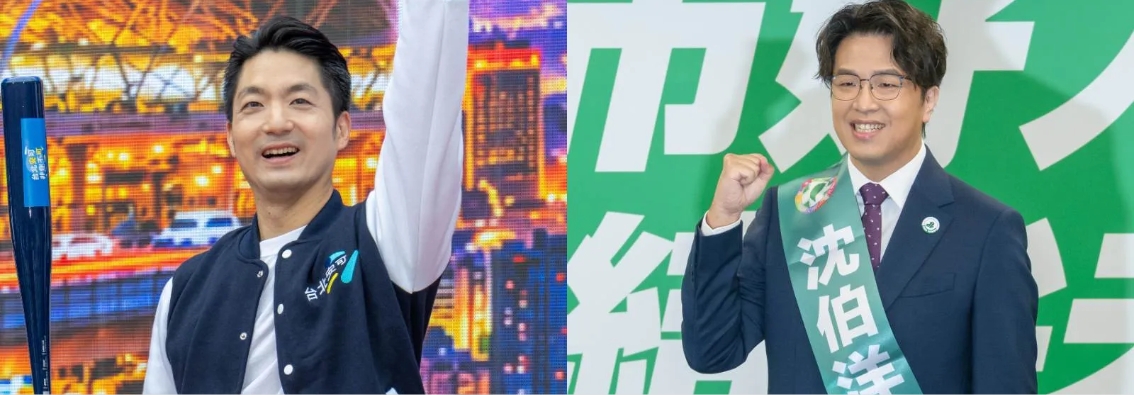


Cover image: Chiang Wan-an (蔣萬安) of KMT (left) and Puma Shen (沈伯洋) of DPP (right). (Source: Commonwealth Magazine)
Taiwan is fast approaching its “Nine-in-One” local elections, which will be held on Saturday, November 28, 2026. While President Lai Ching-te (賴清德) is not on the ballot, the election will serve as the first significant electoral test of Taiwanese voters’ assessments of the Kuomintang Party (KMT, 中國國民黨) and Democratic Progressive Party (DPP, 民主進步黨) since the “Great Recall Movement” (大罷免) in 2025. With elections taking place across different municipalities, the race for the Taipei mayor’s office is arguably the most prominent and critical battleground between the two major political parties. This analysis aims to provide background context regarding the two major campaigns competing in the 2026 Taipei mayoral race, prior to the official policy debate between the two candidates on October 31.
Historical Significance of the Taipei Mayoral Election
The Taipei mayoral election has always drawn a great amount of attention—not only by virtue of Taipei’s status as the capital city of Taiwan, but also because of the political implications of the race at the national level. Historically, candidates from Taipei mayoral races have often proceeded to become candidates in Taiwan’s presidential elections. Therefore, the race for Taipei mayor this year has been expected to be the “opening skirmish of the 2028 presidential election” (2028總統大選的前哨戰).
Table: Selected Taipei Mayoral Candidates and Subsequent Political Roles.
Politicians | Party | Year of Running for Taipei Mayor | Year of Running for President | Other Notable Positions |
Chen Shui-bian (陳水扁) | DPP | 1994 (Elected) 1998 (Lost) | 2000 (Elected) 2004 (Elected) | DPP Chairperson (2002-2004; 2007-2008) |
Ma Ying-jeou (馬英九) | KMT | 1998 (Elected) 2002 (Elected) | 2008 (Elected) 2012 (Elected) | KMT Chairperson (2005-2007; 2009-2014) |
Hau Lung-pin (郝龍斌) | KMT | 2006 (Elected) 2010 (Elected) | N/A | KMT Deputy Chairperson (2014-2020) |
Hsieh Chang-ting (謝長廷) | DPP | 2006 (Lost) | 2008 (Lost) | DPP Chairperson (2000-2002) Ambassador to Japan (2016-2024) |
Su Tseng-chang (蘇貞昌) | DPP | 2010 (Lost) | 2008 (Lost) | DPP Chairperson (2005-2008; 2012-2014) Premier of Executive Yuan (2006-2007; 2019-2023) |
Ko Wen-je (柯文哲) | Taiwan People’s Party (TPP, 台灣民眾黨) | 2014 (Elected) 2018 (Elected) | 2024 (Lost) | TPP Chairperson (2019-2025) |
Sean Lien (連勝文) | KMT | 2014 (Lost) | N/A | KMT Deputy Chairperson (2021-2025) |
(Source: Compiled by the authors).
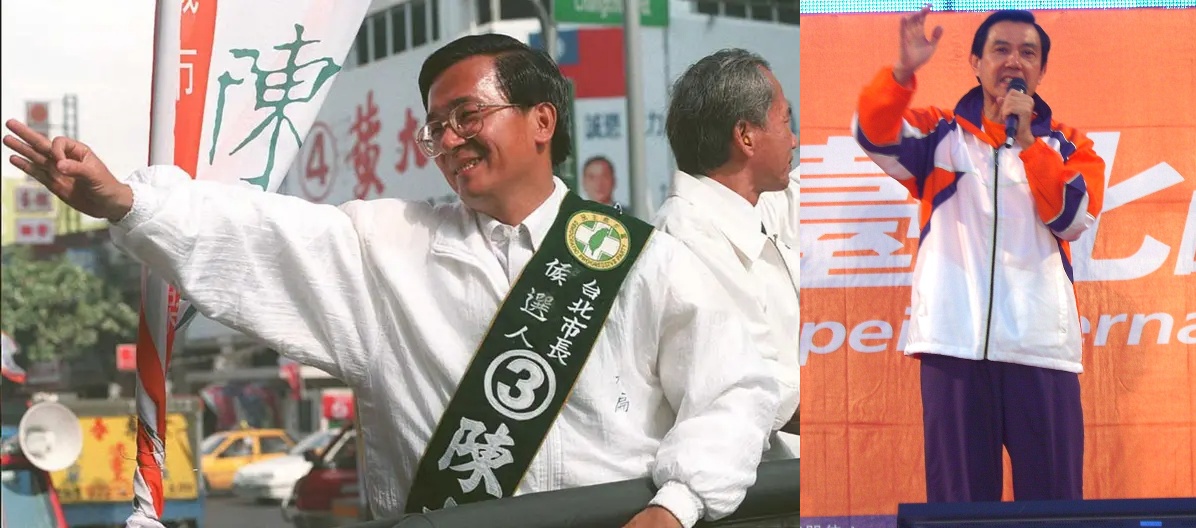
Image left: Chen Shui-bian (陳水扁) of the DPP campaigning for Taipei mayor in 1994 (Source: BBC Zhongwen). / Image right: Then-Taipei mayor Ma Ying-jeou (馬英九) of the KMT speaking at the Taipei Marathon in 2006 (Source: Wikimedia Commons). Both men were subsequently able to leverage their tenure as Taipei mayors in successful bids for the presidency.
“Blue North and Green South”
Taipei has been widely considered a KMT stronghold for many decades, with few exceptions. Since Taiwan’s first direct local election took place in 1994, Taipei has only elected two non-KMT mayors: Chen Shui-bian (陳水扁) of the DPP in 1994; and then-independent Ko Wen-je (柯文哲) in 2014 and 2018. In Chen’s case, the momentum of pro-democracy movements likely contributed to his victory. (The other two candidates in the 1994 race also split the Pan-Blue vote.) Yet, despite a 70 percent satisfaction rate for Chen’s mayorship, he lost to Ma Ying-jeou (馬英九) in his 1998 bid for re-election.
This demonstrates that the KMT still enjoys a solid support base in Taipei—due in part to the legacy of KMT military veterans and supporters settling in the capital city after the KMT retreat from mainland China in 1949. Entering the 2000s, both economic developments and turbulent cross-Strait relations led to the phenomenon of the “blue north and green south” (藍北綠南) in Taiwan politics. The KMT, because of its endorsement of closer cross-Strait ties, received greater support from the northern part of Taiwan, where technological and export-oriented industry thrived. The DPP, on the other hand, attracted a larger share of voters from southern Taiwan, partially as a result of its policies of benefiting farmers and closing up developmental gaps.
In the past 10 years, Taiwan’s local elections have been significantly shaped by a range of factors, to include party influence, the charisma of individual candidates, and the prevailing political landscape. In addition, Taipei has witnessed a surge in independent voters who are indifferent to either major party. Ko successfully appealed to these independent voters, and won the Taipei mayoral elections twice as a political outsider in the 2010s. Undoubtedly, independent voters will still continue to play a critical role in deciding whether or not Taipei will elect another non-KMT mayor.
The KMT and DPP Candidates in the 2026 Taipei Mayoral Election
Five candidates are currently in the running in the Taipei mayoral race this year, with Chiang Wan-an (蔣萬安) of the KMT and Puma Shen (沈伯洋) of the DPP at the center of the spotlight. The parallels and contrasts between the two candidates have dominated most election-related headlines and social media discussions. Both Chiang and Shen grew up in Taipei and went on to pursue higher education in the United States. (Chiang received his JD from the University of Pennsylvania in 2006; Shen earned his PhD in criminology and sociology from the University of California, Irvine in 2017.) They also share similar public images of being both family men and rising stars within their respective parties’ younger generation.
Still, differences between Chiang and Shen are salient. Chiang enjoys the advantages of being the incumbent seeking re-election, as well as the “Chiang-family” prestige from being a rumored descendant of Chiang Kai-shek (although this claim has its own set of controversies). Shen, with his professional experience primarily focused on national defense and information warfare in academia, is often criticized for lacking formal political experience and lineage. While he joined the DPP only three years ago, he has gained significant status and visibility within the party during that time. Regardless of the election outcome, Shen’s status could further rise due to his willingness to take on a risk that no one else in the DPP was willing to bear: potentially losing another election in the capital city to the opposing party.

Images: Chiang Wan-an (蔣萬安) of the KMT (left) and Puma Shen (沈伯洋) of the DPP (right). (Source: CNA)
Where the Candidates Stand in Current Polls
When Shen made the decision to run as the DPP candidate for Taipei mayor in May, the public widely viewed it as a “battle without any chance of winning.” In an opinion poll conducted by TVBS Poll Center in May 2026, 58 percent of respondents supported Chiang for re-election, while only 30 percent of respondents preferred Shen to be their mayor. However, five months of campaigning have significantly altered the popularity of the two candidates. The newest poll in October 2026 also carried out by TVBS shows that the support rate for Chiang has dropped to 49 percent, as that of Shen has risen to 41 percent. An opinion poll by another survey center has demonstrated a more dramatic shift: 50 percent of respondents believed that Shen is more suitable for the mayorship, leaving only 33 percent supporting Chiang.
Nevertheless, whether or not opinion polls accurately reflect public opinion is still up for debate. Considering the unexpected failure of the Great Recall Movement, DPP supporters remain cautiously optimistic about Shen’s chance of victory. During the recall movement, the narrative of “countering China to protect Taiwan” (抗中保台) promoted by pro-DPP voters failed to attract independent voters, who were more concerned about economic and social issues. The results of the Great Recall Movement severely damaged morale within the DPP, and subsequently boosted the KMT’s status. Despite a promising support rate in recent polls, it still remains a challenge for the DPP to “break” the “spiral of silence” effect (沉默螺旋) among Taipei constituents – which in this context means the assumption that most KMT voters restrain from expressing their support for the KMT publicly due to fear of judgement from peers or society, although they would still ultimately cast ballots in favor of the KMT. It is also worth observing whether or not Taipei voters will approve of the DPP’s attempts to strike a balance between its core values of national security, and local issues that may appear less abstract to independent voters.
National Security Concerns and Foreign Interference in Local Elections
Taiwan’s presidential elections have been targeted by foreign influence campaigns, and this fact has been widely discussed. However, local elections in recent years have also been subject to foreign interference, and China has explicitly attempted to interfere in the 2026 Taipei mayoral race. The Global Times (环球时报), a Chinese Communist Party (CCP)-affiliated media outlet, published an article on October 27 criticizing the DPP for allegedly “shaping the election with underground gambling.” Furthermore, Taiwan’s National Security Bureau (NSB, 國家安全局) recently revealed that the Government Service Network (GSN, 政府網路服務網)—which is a dedicated and secure high-speed backbone network for Taiwanese government agencies to use for internet usage and cybersecurity defense – had been attacked on average 2.58 million times per day, and that the number of attacks have risen as this year’s election approaches. The NSB stated that the increase of interference could reflect preparation for intelligence collection and influence campaigns directed against the upcoming local elections.
Social media has become a double-edged sword in Taiwan’s elections, and the upcoming Taipei mayoral election is not an exception. Both candidates and their supporters have been actively engaging with each other on social media outlets such as Threads and Facebook. The interactive nature of social media has increased the public discussion on policy and politics. However, it has also been exploited to advance foreign influence campaigns against Taiwan’s elections, including races for local mayors and legislators. Around the 2022 local elections, Taiwan’s Doublethink Lab observed a surge of suspicious posts with misinformation and extreme narratives attacking DPP-affiliated politicians.
With the growing popularity of Threads among the Taiwanese audience, especially among the younger generation, inauthentic social media posts have only become more rampant this year. For example, a series of opinion polls on the special municipalities conducted by the “Chiaohu Island Poll” (巧虎島民調) have circulated on Facebook and Threads; however, it appears that no such company actually exists, as there is no entity by that name registered with the Ministry of Economic Affairs (MOEA, 經濟部). The “Chiaohu Island” graphics also show no information on the methodology of how these “polls” were conducted (such as the sampling size, actual questionnaires used, etc.). In addition, a series of posts have circulated on the internet attacking Shen for allegedly making up false stories of his grandfather and other issues. These posts have aimed to frame Shen as dishonest, thereby impacting voters’ opinions to be unfavorable towards Shen. As Shen has been listed as a “die-hard Taiwan independent separatist” (台獨頑固分子) by China’s Taiwan Affairs Office (TAO, 國務院台灣事務辦公室), it may be expected that foreign interference will only further intensify as the elections approach.
The “Kevin Tsai Incident” and Financial Coercion
A recent case of foreign coercion targeting Taiwan’s local elections that has recently emerged in news headlines is China’s reaction to Kevin Tsai (蔡康永)’s participation in Shen’s campaign. Tsai, the popular and well-known host of the popular Taiwanese variety show Kangsi Coming (康熙來了), was photographed in October while attending a Shen campaign event. Unsurprisingly, Tsai’s presence stirred up considerable negative reactions from China. Tsai’s social media accounts were flooded with raging Chinese netizens. Companies that previously cooperated with Tsai, such as Leapmotor and Harper’s Bazaar China, announced that they would take down any related advertisement contents. Moreover, Chinese officials and CCP-affiliated organizations have also weighed in on the incident. The TAO criticized Tsai of being a “two-faced” person who “earns Chinese money while entangling with Taiwan independence forces.” A social media account affiliated with the PLA News Media Center threatened that public figures will pay the price for siding with pro-“Taiwan independence” figures.
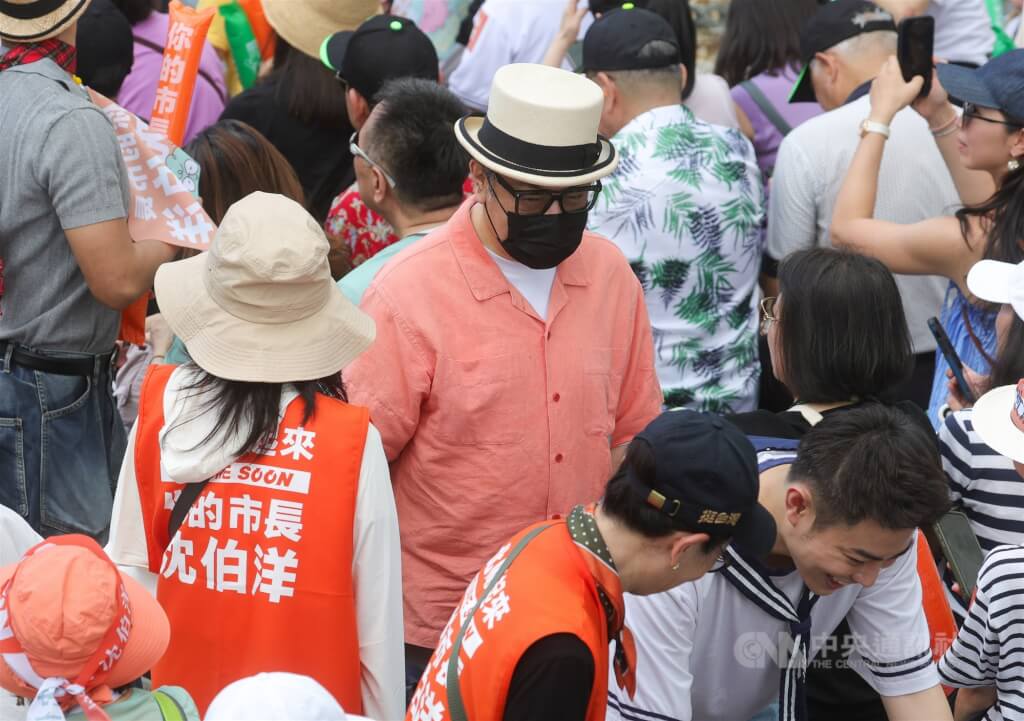
Image: Famous television host Kevin Tsai (蔡康永) was seen participating in Shen’s campaigning event on October 4. (Source: CNA)
The immense pressure from China forced Tsai to put out a formal statement that he does not support independence. The TAO then responded to Tsai’s social media post by calling on Taiwanese celebrities to nurture Chinese “compatriotship” and promote friendly cross-Strait interactions. Taiwan’s Mainland Affairs Office (大陸委員會) warned that this has become a strategy of the CCP: coercing public figures to take a stand, then demanding pledges that they behave in accordance with CCP positions. This type of behavior reminded many voters of a similar incident involving the K-pop star, Chou Tzu-Yu (周子瑜), close to the 2016 presidential elections—an event that many believed shifted some voters’ behaviors to vote for Tsai Ing-Wen. Whether the Kevin Tsai incident and similar actions from the CCP will convert Taiwanese peoples’ actual voting behavior still remains to be seen, but it is clear from all the online discussions and media frenzy around such incidents that many people are watching this election closely.
The main point: Both the KMT and the DPP have a large stake in the upcoming Taipei mayoral election, as it could impact the future political trajectory for both parties on a national level. The KMT incumbent, Chiang Wan-an, was initially viewed as a strong favorite to win re-election; however, the DPP challenger, Puma Shen, has proven to be an effective campaigner and has outperformed initial expectations. Intensive campaigning from both sides may be expected in the lead-up to the election on November 28.