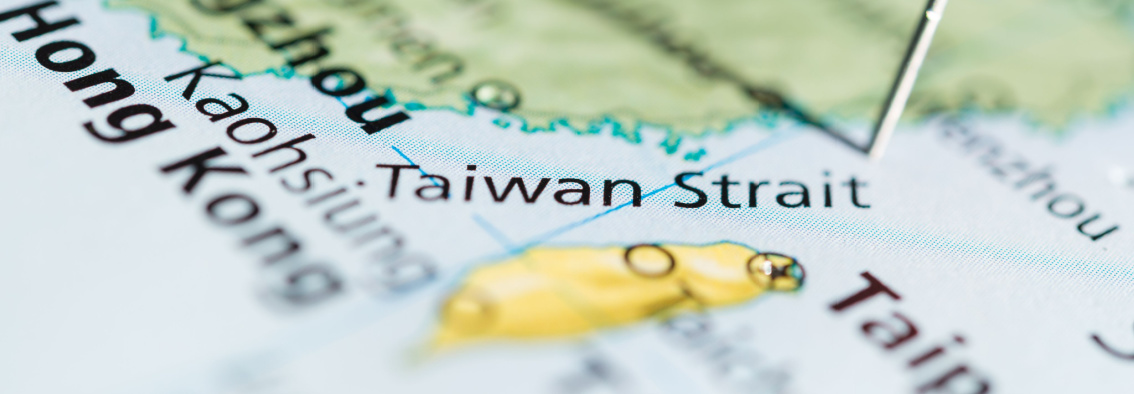


The 100 mile-wide Taiwan Strait has long served as the ultimate guarantor of Taiwan’s security. For decades, the sheer geographic challenge of crossing that barrier has reinforced a sense of strategic insulation. However, the convergence of evolving hybrid warfare tactics and advances in unmanned aerial vehicle (UAV) technology is rapidly changing the security environment. Taiwan’s experience with small civilian drone incursions over the island of Kinmen is no longer a localized issue. Instead, it is a preview of an all-island security challenge, as Beijing learns lessons from Moscow’s war against Ukraine.
Moscow and Beijing are effectively shrinking the operational geography around their targets by combining hybrid warfare with advanced UAV capabilities. These tactics allow aggressors to project influence deep into interior territory, disrupt critical infrastructure, and force a reallocation of defense resources far from the frontlines. For Taiwan, this means the risk of Chinese drone incursions is no longer confined to the offshore islands but extends directly over military and civilian critical infrastructure on the main island of Taiwan. The implications are clear: Taiwan must recognize that the strategic depth once provided by the Strait is being eroded, and it must urgently enact all-of-Taiwan policies to counter Beijing’s encircling strategy before low-cost, high-impact drone incursions become the new normal.
The Technical Asymmetry of UAVs
The effectiveness of UAVs in the gray zone is rooted in technical and economic asymmetry. There are several elements to this. First, commercially-available quadcopters or fixed-wing drones are difficult to detect and track continuously. Their small radar cross-sections and low-altitude flight paths make them challenging targets for military radar systems designed to track larger, faster threats. AI-enabled UAVs are now capable of adapting to environments and making unpredictable movements to confuse defenders. It is difficult to distinguish between civilian UAVs, armed UAVs, and decoy UAVs. This operational ambiguity is a core gray zone advantage.
A second significant factor is the economic disparity between utilizing UAVs and employing counter-measures. UAVs such as the Russian “Geran” (adapted and improved from the Iranian “Shahed”) cost somewhere between USD 50,000-100,000, with decoys costing one-fifth of this price. Meanwhile, counter-measures are either capital-intensive (such as the air-to-air AIM-9 missile, costing several hundred thousand dollars) or manpower-intensive (including the use of helicopters, aircraft, and roving teams of mobile air-defense units). This cost-exchange ratio drains a defender’s resources and stresses air defense supply chains.
Third, even cheap UAVs are now capable of relatively long-range operations. In the Russia-Ukraine War, the kill zone of low-cost UAVs now extends to roughly 10-20 kilometers from the line of contact. This also has implications for gray zone harassment.
UAVs and the End of Geographical Sanctuary
Europe is now encountering these realities first hand. NATO’s “frontline states”—like Finland, Poland, and the Baltics—have historically borne the brunt of Russian aggression. Now, even countries far from the frontline are experiencing drone incursions that have challenged their ability to respond. Germany, France, Denmark, Belgium, and Italy have all experienced UAV harassment targeting critical infrastructure and military bases (in addition to the continued harassment of the traditional target states of Poland, Estonia, Romania, and Lithuania).
These incursions are likely being carried out through UAV launches in international waters, courtesy of Russia’s “ghost fleet” comprised of old tankers with non-transparent ownership. These tankers were originally used to evade sanctions on Russian oil; over the last year, their duties have expanded to cutting undersea cables and serving as UAV “motherships,” with cheap UAVs now having the capability to cruise through the 12 nautical miles of territorial waters and onto European territory.
Russia appears confident that European nations are hesitant to risk a military confrontation over ambiguous ‘civilian’ vessels. However, as these tankers shift from simple sanctions-evasion to active sabotage, they become legitimate targets for seizure under maritime law. To preempt this, Russia now routinely deploys aircraft and naval vessels to shadow tankers deemed at-risk of being boarded. These military assets act as a “tactical shield,” using aggressive close-proximity maneuvers to signal that any law-enforcement action against the tanker will be treated as an attack on the Russian military itself.
While these incidents have yet to turn lethal, they have caused significant disruptions such as lengthy airport closures. Shooting down individual UAVs over heavily-populated areas is a risky and costly task, so the initial focus of the Europeans has been to track the UAV motherships. In one notable incident, French naval commandos boarded the Boracay tanker off the coast of Saint-Nazaire. This vessel had been sailing near Denmark during a series of drone incursions. The commandos detained the captain and a crew member, both Chinese nationals, for questioning. The captain was later placed under formal investigation for refusing to comply with naval orders, while the other crew member was released.
By combining its pre-existing ghost fleet with UAVs, Russia has been able to impose costs on interior NATO countries. The challenge is not solely a military one. These incidents reveal multiple interconnected gaps in Europe’s ability to credibly challenge these incursions. These gaps are fourfold. There is the question of the technical ability to track and shoot down the UAVs (or seize the mothership). There are organizational questions regarding who approves and undertakes kinetic action. There is the legal question of responsibility when UAVs are shot down over sensitive infrastructure and heavily-populated areas. Finally, there are the political costs of engaging in kinetic action against UAVs or motherships that are loitering in international waters.
These gaps point to the plausible deniability problem inherent in the defense against UAVs, which paralyzes action by the defender. There is clear cross-pollination in tactics between the PRC and Russia. Just as Beijing is learning technical lessons from the war in Ukraine, Russia has adapted Chinese gray zone harassment methods in the South China Sea and Taiwan’s outlying islands. Moreover, Russia’s UAV harassment continually tests NATO’s willingness and capability to respond, which gives Beijing valuable data on designing a ladder of escalation in the Pacific.
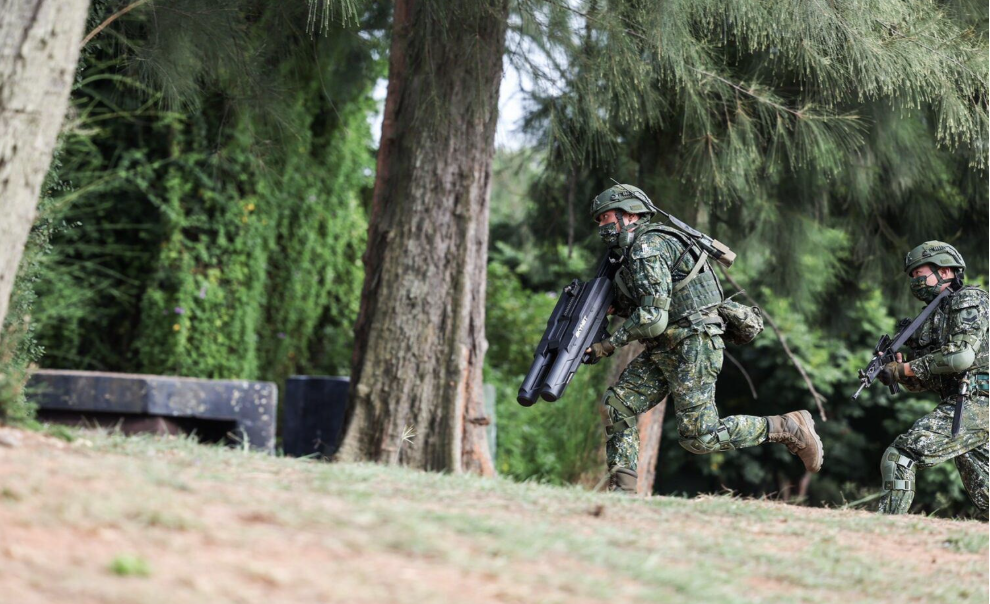
Image: ROC military personnel training with weapons including an anti-UAV jamming gun (undated). (Image source: RFA / ROC Ministry of Defense)
The PRC’s Adaption of Russian Harassment Methods against Taiwan
Unlike the Russian strategy of bolder and more rapid risk escalation, the PRC utilizes a more long-term “choking” strategy in its gray zone warfare. Over the last decade, both the People’s Liberation Army Navy (PLAN) and People’s Liberation Army Air Force (PLAAF) escalated their incursions across the Taiwan Strait median line, and now regularly test Taiwan’s Air Defense Identification Zone—all using a similar strategy of persistent presence in disputed waters and exhaustion aimed at the Japan Self-Defense Forces. However, using manned aircraft to conduct these incursions imposes its own costs on the PLAAF and PLAN, ranging from aircraft engine life to training hours.
Thus, the PLAN is also developing specialized UAV launch platforms, also known as drone carriers. The most notable of this type is the Type 076 Sichuan. This vessel redefines what an amphibious assault vessel can do by blending its traditional troop transport role with a new focus on power projection through unmanned systems. The Type 076, with the lead ship named Sichuan, is not an incremental upgrade from the previous Type 075 Landing Helicopter Dock class. Instead, it is a new class entirely and can be described as a hybrid drone carrier-amphibious assault ship.
This platform is designed to host a diverse air wing that could significantly ease the PRC’s capability to harass Taiwan, particularly on Taiwan’s east coast. The Type 076’s electromagnetic catapults allow for the launch of heavy, high-performance combat drones such as the Hongdu GJ-11 “Sharp Sword,” an unmanned combat aerial vehicle designed for deep penetration and precision strikes. Beyond high-end combat assets, the vessel’s capacity supports medium-altitude, long-endurance drones such as the Tengden TB-001 “Twin-Tailed Scorpion,” which has already been utilized in encirclement flights around Taiwan and in the East China Sea to demonstrate a persistent surveillance capability. Perhaps most critical for gray zone coercion is the potential for these ships to serve as command nodes for drone swarms. By launching high volumes of smaller, expendable rotary or fixed-wing UAVs, the PLA can saturate Taiwan’s air defense radars. This capability provides additional flexibility to Beijing’s arsenal in case of a full-scale attack.
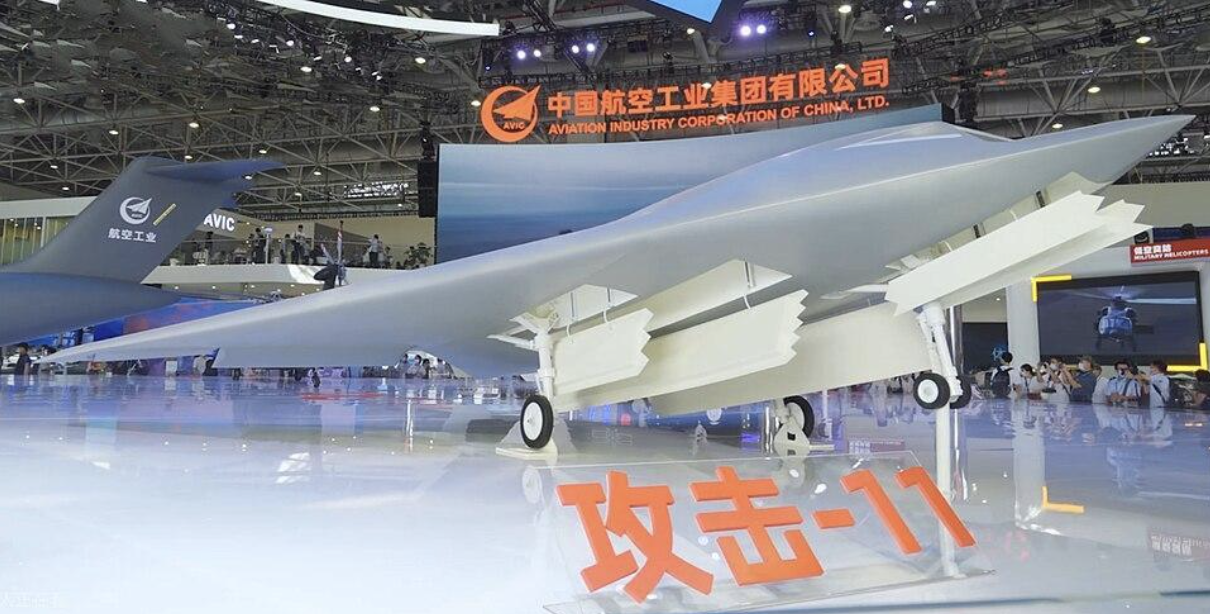
Image: A model display of a GJ-11 at the 2021 Zhuhai airshow. (Image source: Wikimedia Commons)
Such capabilities can also be utilized to some extent by the PRC’s paramilitary forces. In recent years, the PRC has ramped up attempts to turn the China Coast Guard (CCG, 中國海警軍) and the People’s Armed Forces Maritime Militia (PAFMM, 中國海上民兵) into what resembles a second and third navy. The CCG has adapted PLAN Type 054A frigates into its Type 818 “patrol cutters,” shifted naval officers to coast guard service, and is planning much of its future development along further adaptations of PLAN ships.
In the future, there is therefore the potential that the CCG will secure an adapted version of the Type 076. There have already been rumors as early as August 2024 that the CCG was interested in this type of capability. The utilization of drone swarms into Taiwan’s territorial waters and airspace under the guise of “law enforcement” operations or “civilian fishing use” would allow Beijing to conduct high-volume harassment and reconnaissance operations at a relatively low cost. Moreover, such operations would likely be deliberately conducted in conjunction with existing military UAV harassment, with a goal to confuse and paralyze Taiwanese responses.
Implications for Taiwan
To pre-empt this threat, Taiwan must shift from reactive measures to a proactive all-of-society defense strategy with clear response protocols for the public, as well as its political leadership. The primary hurdle is the legal and political paralysis that aggressors weaponize, observed in both the August 2022 Kinmen UAV incident as well as the European experience in confronting Russian hybrid warfare.
To overcome this, legislative and regulatory actions are required to establish clear rules of engagement. Areas of responsibility, legal authorizations for UAV neutralization, and a clear chain of communication/command must not only be established, but also practiced. This is true not only of the military, but also of civil defense organizations.
One major success in countering the PRC’s previous drone incursions against Kinmen was Taiwan’s willingness to implement a policy change allowing for kinetic action against these platforms, regardless of whether they could be attributed with certainty to the People’s Liberation Army. These “civilian” drone incursions into the airspace over the outlying islands were effectively discontinued following the downing of one drone. The success here lies in establishing a credible, active deterrence.
Gray zone activities exploit ambiguity of intent. By treating drone incursions as a relevant, hostile event, Taiwan successfully raised the perceived risk of escalation for Beijing while simultaneously demonstrating that it had the political will to impose consequences.
This will not be a foolproof strategy. Gray zone aggression, particularly at the low-end, is designed to be cheap and thus difficult to deter through cost imposition. The PRC will continue to experiment with new ways of pressuring Taiwan. However, a pre-emptively executed plan of defense will mean that the people of Taiwan will be ready and prepared when the PRC begins using Russian-style harassment tactics in the Pacific.
The main point: Advancing UAV technology and hybrid ‘mothership’ tactics are eroding the Taiwan Strait’s role as a geographic buffer, bringing gray-zone threats directly to the main island. Taiwan must urgently adopt a comprehensive defense framework with clear rules of engagement to neutralize these low-cost incursions and deter an encirclement strategy by Beijing.