
Major naval acquisition programs can set a state’s grand strategy for decades, and this renders submarine construction an extremely high-stakes industry. For countries neighboring China, such as Taiwan and India, submarines are essential to domestic national security strategies. India and Taiwan both require a higher number of submarines than they currently possess to deter and fight China. Taiwan also needs more modern ones. Although India and Taiwan have expressed a desire to develop domestic production, both are equally reliant on other countries to provide submarine hulls and major subsystems. If Taiwan and India want to increase their defense industrial development, they must invest in initial phases of defense production capacity, rather than simply importing or reverse-engineering capabilities.
To analyze the challenges that Taiwan and India face in submarine production, we must evaluate the industrial base underneath recent domestically produced submarines. Taiwan recently launched its first Hai Kun class submarine and completed initial underwater trials in January 2026. Similarly, India’s third Arihant class nuclear-powered ballistic missile submarine is expected to enter service later this year. These manufacturing milestones, however, should not obscure the extent to which both states remain dependent on foreign assistance for critical components, hull fabrication, and long-term sustainment across their submarine fleets. As a result, efforts to expand domestic submarine capacity will continue to rely on external partnerships, even as both governments pursue greater defense-industrial autonomy. This article investigates how Taiwan and India may leverage collaborative arrangements to mitigate these constraints and advance their submarine production capabilities.
While India and Taiwan are unlikely to sign formal defense cooperation agreements because New Delhi does not formally recognize Taiwan’s sovereignty, informal collaboration mechanisms are possible. This article evaluates the two countries’ submarine production ecosystems to present paths of informal collaboration—such as through existing capabilities in Taiwan’s civilian manufacturing of lithium-ion batteries.
Global Submarine Acquisition Delays
India and Taiwan’s pursuit of domestic submarine production is, in part, a response to global production. Multiple constraints have delayed international deliveries. High global submarine demand has not been met by the market’s largest suppliers: France, Germany, Russia, and China. In response to delivery delays, countries have opted either to launch new domestic production (e.g., India and Turkey) or enhance their existing programs (e.g, Taiwan, South Korea, and Spain). While the United States—the world’s largest arms exporter by value—does not export its nuclear submarines, Washington has formed a collaborative development agreement with Australia and the United Kingdom (AUKUS). These agreements convey an understanding that Australia will operate Virginia-class attack subs by the early 2030s, and receive British built AUKUS nuclear-powered subs before Australian domestic manufacturing commences in the 2040s.
Across manufacturers globally, common contributing factors to submarine production delays include design problems, skilled labor shortages, supply chain entanglement, as well as shifting national priorities. With regards to Taiwan’s biggest supplier of arms, US domestic production is consistently running behind the desired rate of output. The added pressure to deliver additional Virginia submarines to Australia for AUKUS will likely exacerbate production difficulties, potentially leaving Australia scrambling for submarines if the program falters. One of the reasons for Australia’s decision to scrap its initial Naval Group Contract with France was due to delays in the French attack sub design phase. If America delays on its promises for the Virginia-class attack sub, Australia could be left with a capability gap that it was hoping to avoid. With regards to one of India’s top suppliers, Russia has its own state-level concerns in its construction of the new Yasen-M class missile boat, which will strain an already overtaxed industrial base. Ongoing production delays with the latest generation diesel-electric Lada-class submarines has also forced Russia to upgrade its 1970s era Kilo class diesel-electric submarine. The three Lada class submarines that have been produced lack air independent propulsion (AIP) systems (whose characteristics are provided below), which renders them technologically obsolete. Thus, despite high demand, the global supply of submarines is low and supply chain challenges riddle the industry.
Since major naval acquisition programs can set a state’s grand strategy for decades, this renders submarine construction an extremely high-stakes industry. For countries neighboring China, such as Taiwan and India, submarines are essential to domestic national security strategies. India and Taiwan both require a higher number of submarines than they currently possess in order to deter and fight China. Although India and Taiwan have expressed a desire to develop domestic production, both are equally reliant on other countries to provide submarine hulls and major subsystems. If Taiwan and India want to increase their defense industrial development, they must invest in initial phases of defense production capacity rather than simply importing or reverse-engineering capabilities.
Cooperative Gains in Submarine Engineering and Design Work
Enhanced collaboration in submarine construction would be a natural evolution of Taiwan and India’s growing cooperation in commercial high-tech manufacturing. Just as cell phones and semiconductors are crucial to Taiwan and India’s economic and technological strategies, submarines are vital for their national security. Despite the risk of provoking China, India and Taiwan have shown resilience in deepening their ties in areas where mutual strategic interests align. Thus, given the two countries’ shared need to expand domestic submarine production and their existing experience in cooperative engineering and design, the foundation for further collaboration in the defense sector is already in place. In particular, India stands to gain from Taiwan’s expertise in lithium-battery technology in its goal of achieving AIP systems in its submarines.
Diesel-electric submarines operate using batteries and must surface or snorkel every few days to recharge, unlike nuclear submarines. For decades, lead-acid batteries were the standard, but advancements in lithium-ion technology are enhancing the range, speed, and recharge time of conventional fleets. Japan’s Ōryū (SS-511), launched in 2020, was the first submarine to fully adopt lithium-ion batteries. Lithium-ion batteries also enhance the capabilities of air independent propulsion systems, allowing submarines to operate for extended periods without surfacing. AIP systems provide an alternative power source while submerged, avoiding the need for atmospheric oxygen through snorkeling or surfacing. Various countries have tested different configurations of this technology. Germany’s ThyssenKrupp Marine System’s (TKMS) Type 214 submarine currently holds the record for 14 days of submerged operation without surfacing, powered by a lithium-ion battery system. Similarly, South Korea’s KSS-III Batch-II submarine (including its export variant, the DSME-3000), integrates lithium-ion batteries to power its AIP, showcasing the growing adoption of this technology.
While initially costly, this technology has the potential to revolutionize submarine capabilities. As export variants adopt these innovations, countries looking to extend submarine battery life must either develop lithium-ion technology or collaborate with manufacturers. For India, Taiwan’s advanced lithium-ion manufacturing sector presents an opportunity to form technical partnerships that support both nations’ submarine development goals.
Taiwan’s Technological Offering
Taiwan is well positioned to serve as a technological partner for India. Taiwan is a leader in lithium-ion battery technology and closed-loop recycling systems. Its focus on lithium-ion batteries began in the 1990s, coinciding with its advancements in manufacturing microchips, computer components, and other electronics that have driven Taiwan’s economic model. Taiwanese companies have developed advanced battery designs known for their fast recharge and discharge properties.
Furthermore, Taiwanese companies have established the first closed-loop recycling ecosystem for lithium-ion batteries. This system enables the recycling and recovery of rare earth metals, lithium, and other essential materials for creating new cathode materials. Closed-loop systems hold significant potential for both Taiwan and India, as they offer a way to reduce reliance on Chinese-controlled lithium production and refinement by creating alternative supply chains.
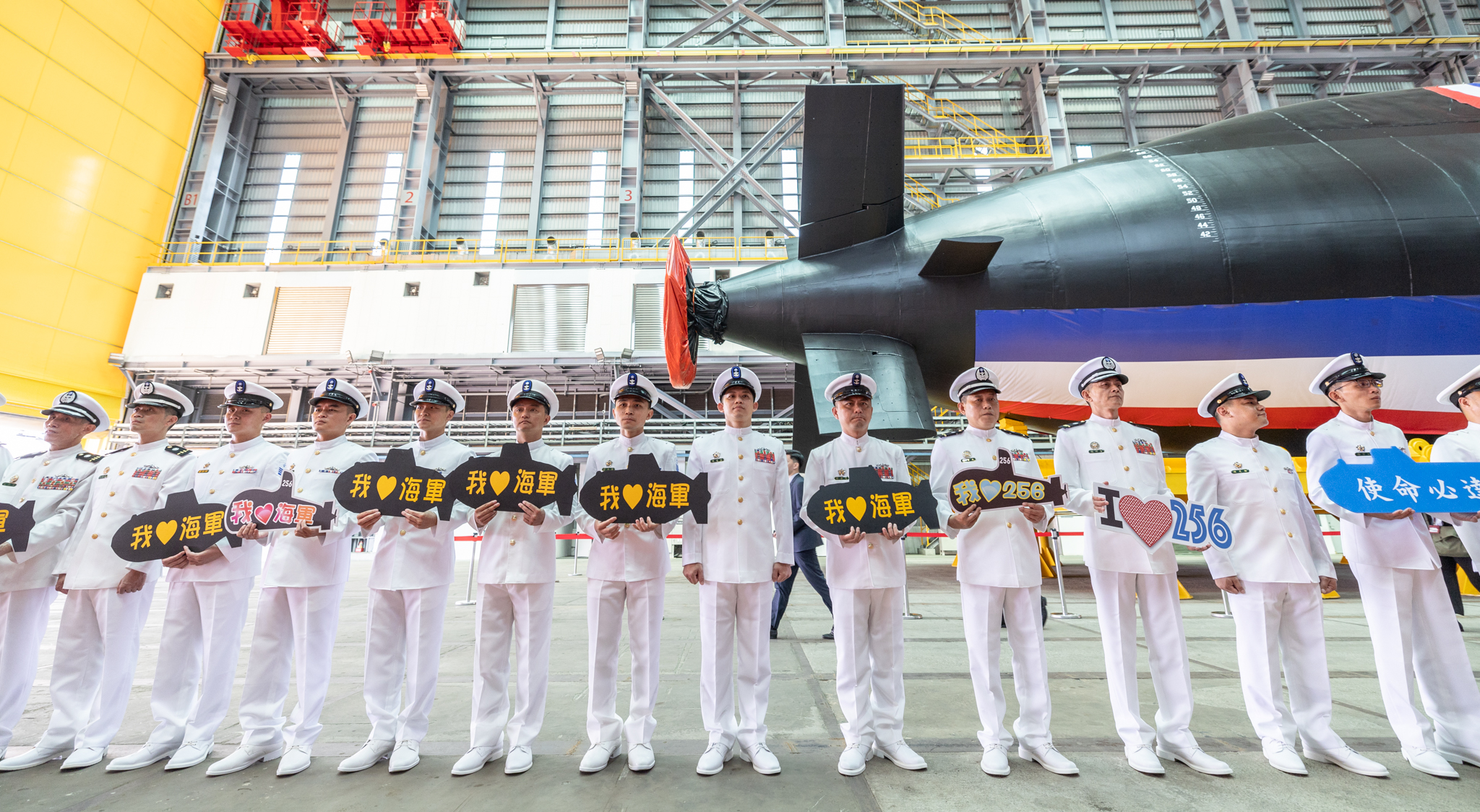 Image: ROC Navy personnel at the commissioning ceremony for Taiwan’s indigenous Hai Kun submarine (Sep. 28, 2023). The Hai Kun class is believed to rely extensively on technologies acquired from other states. (Image source: Wikimedia Commons)
What’s In It for Taiwan?
The benefit of collaboration is not a one-way street. Taiwan’s submarine program will also benefit from collaboration with India, particularly in the area of refurbishing aging submarine platforms. Other than Taiwan’s first indigenous submarine—the Hai Kun-class—the nation’s submarine fleet consists of four diesel-electric submarines: two US-supplied second-hand Guppy-class (Guppy III) submarines from the 1950s, and two Dutch-supplied Zwaardvis-class submarines (the newest of which was commissioned in 1988). India faces a similar challenge with its diesel-electric fleet of submarines: of which seven are l980s Soviet-origin Kilo-class submarines, and four German Type-209 submarines of the same vintage.
Since the 2010s, Taiwan has taken considerable steps to improve its submarine refurbishment capabilities and to build out its design capacity for domestic submarines. These endeavors have culminated in Taiwan’s first indigenous submarine, the Hai Kun-class. Despite this progress, Taiwan has remained dependent on the United States for advanced sub-systems and armaments, such as advanced torpedoes authorized by the Trump Administration in 2017. At the same time, India has insisted on technology transfer through investment agreements, specifically through localized production of two of the four Type-214 German submarines and six of the French-made Scorpène-class submarines. The key reason for acquiring the Scorpène-class platform was its ability to employ the submarine-launched version of the French Exocet (SM-39) anti-ship missiles, which the Type-209 submarines can also use. Such use of foreign components demonstrates the continued importance of international cooperation if India is to advance its domestic submarine production.
Overcoming Barriers to International Cooperation
The domestic and international legal barriers hindering such cooperation are not insurmountable. India’s legal regime governing the export of weapons and related technology centers on the Special Chemicals, Organisms, Materials, Equipment and Technologies (SCOMET) list under the Foreign Trade Act. Diesel, electric, and AIP engines fall under entry 6A009 of this list. However, the export of data and designs—such as intellectual property related to submarine propulsion or hulls—are not explicitly mentioned in this list. Although the list of states for which India relaxed SCOMET rules for dual-use technologies in 2024 did not include Taiwan, collaboration with Taiwan on dual-use technology is being discussed in India.
For example, India’s Arms Act of 1959, “Arms Rules of 2016,” and “Defence Acquisition Procedure of 2020” require that any foreign collaboration in defense manufacturing be approved by both the Department of Defence and the Ministry of External Affairs. This requirement presents a problem when partnering with a non-recognized state. Nonetheless, India has signed a series of commercial agreements with Taiwan. Modifications of existing agreements using the same frameworks may create a path for collaboration even without diplomatic recognition. India and Taiwan therefore have the technological means, security interests, and the legal frameworks for collaborating on submarine development and production.
Conclusion and Policy Options for Taiwan and India
Submarines are essential to Taiwan’s and India’s national defense strategies. For Taiwan, submarines offer undersea capabilities not provided by other military means: stealth sea denial and anti-access delivery of anti-ship capabilities against Chinese ship movements. For India, submarines are likewise central to sea denial strategies, and hold the potential to establish a credible second-strike nuclear deterrent.
We are not suggesting that India and Taiwan should sign formal defense cooperation agreements to facilitate collaboration on submarine construction. Instead, we suggest that India and Taiwan conduct such cooperation through the frameworks of current economic engagement. This can be done through existing agreements, such the “Double Taxation Avoidance Agreement,” the “Customs Mutual Assistance Agreement of 2011,” and the “Bilateral Investment Agreement of 2018.” These agreements demonstrate the feasibility of sustained, politically-durable cooperation that is critical for any prospective defense-related collaboration. The success of informal economic mechanisms, therefore, provides a conceptual and empirical foundation for developing flexible cooperative defense initiatives that preserve strategic ambiguity while advancing mutual security objectives.
The main point: Challenges to submarine manufacturing affect the global marketplace and place a premium on domestic production. India’s pursuit of untested technology elevates its risk, while Taiwan’s domestically produced system continues to rely on foreign components. Both states can benefit from cooperation on engineering and designs in submarine production. While collaboration on submarine technology would represent a step change from pre-existing economic cooperation, improving domestic production capacity necessitates pursuing mutual gains wherever possible.