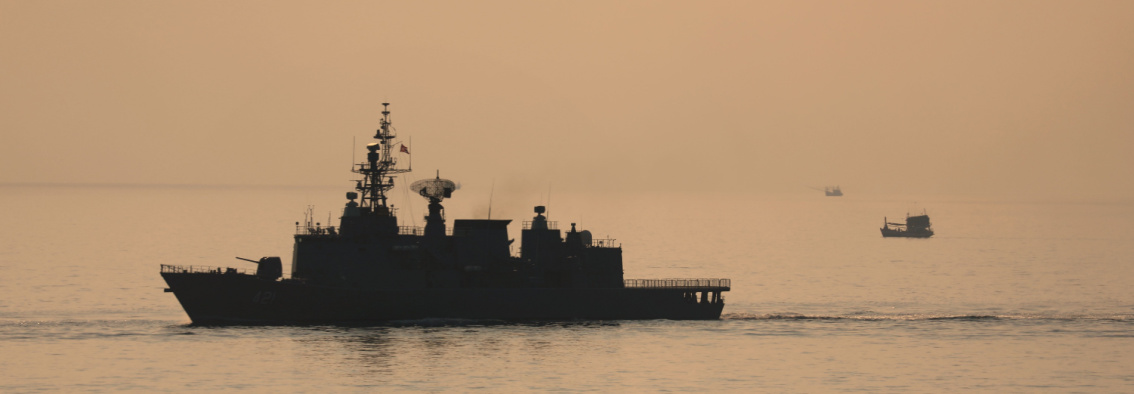

On March 9, 2021, the then-head of the US Indo-Pacific Command, Admiral Phil Davidson, testified before the US Senate Armed Services Committee. Despite not mentioning a concrete timeline for a PLA operation directed at Taiwan, Davidson emphasized the PRC’s goal “to accelerate military modernization initiatives in time for the PLA’s 100th anniversary in 2027″—as well as the military threats, diplomatic isolation, and economic constraints the PRC imposed on Taiwan. Meanwhile, the PRC Ministry of National Defense (国防部) announced in March 2025 that it was on track to achieve PLA centenary goals “on schedule.”
Meanwhile, PLA has been actively pursuing military readiness for a “strategic decisive victory” over Taiwan (取得对台决定性胜利). A strategic, decisive victory—defined as the PRC’s full control over Taiwan through military means executed by the PLA—is deemed necessary if peaceful unification fails. As a result, an amphibious landing remains one of the viable options among all hypothetical PLA operations to seize control of Taiwan. Even as PRC leaders have described “peaceful unification” as their preferred pathway, the PLA has been de facto enhancing its amphibious capabilities since 1995 in its “southeast coastal region” (东南沿海). Dongshan Island (东山岛), an island county in Fujian province, has served as a training base for the People’s Liberation Army Navy (PLAN)—as well as the People’s Armed Forces Maritime Militia (PAFMM), another critical force that supports the PRC’s cross-Strait operations.
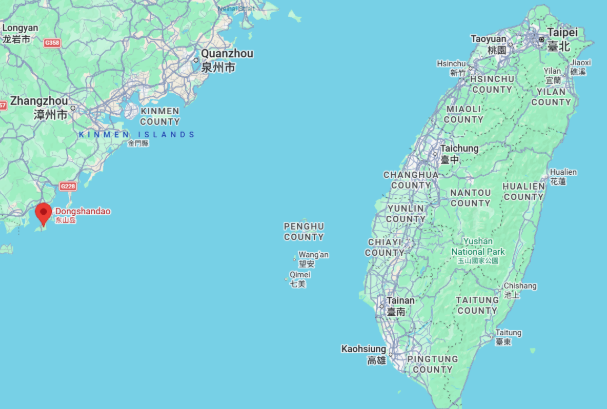
Image: Dongshan Island, located on the southern coast of Fujian Province and near the southern mouth of the Taiwan Strait, in relation to Taiwan. (Image source: Google Maps)
Dongshan’s Strategic Proximity to Taiwan’s Energy Supply
Dongshan’s critical relevance to cross-Strait security is evident in its geographic proximity to the Taiwan Strait and the historical battles fought on the island between PRC and ROC (Taiwan) forces. Dongshan is the second-largest island in Fujian Province, and marks the southern boundary of the Taiwan Strait. Dongshan is under the administrative control of Fujian’s Zhangzhou City (漳州市), a heavily armed port city and home to the PLA Air Force’s Zhangpu Base (漳浦基地).
As the location of the PLA 73rd Group Army’s Air Brigade, Zhangzhou is also one of the three coastal Fujian cities (along with Xiamen and Quanzhou) most likely to host the HQ-16 (红旗-16) missile system— particularly its newest variant, the HQ-16FE medium-to-long-range surface-to-air missile. These developments further bolster the PLA’s anti-access and area-denial capacity over southwestern Taiwan and boost the island’s role as a hub for logistical support and personnel training. The S-300 system has also reportedly covered dual-use airfields in coastal Fujian, including Longtian Airfield and Huian Airfield. This geographic proximity thus transforms Dongshan from an exercise ground into a forward-positioned node within the PLA’s force structure.
Dongshan is located 110 nautical miles west of Kaohsiung City, the city that harbors the largest deep-water port of Taiwan. The Kaohsiung port imports 30 percent of the island’s crude oil. Specifically, in 2025, the Yung-An terminal, which is located in Kaohsiung City, imported approximately 54 percent of Taiwan’s liquefied natural gas (LNG). LNG powers 43 percent of Taiwan’s electricity, making Kaohsiung a critical energy hub. More significantly, the maritime trade route has supplied over 98 percent of Taiwan’s energy via Qatar (25 percent), Australia (38 percent), and the United States (10 percent). Presently, Taiwan’s LNG stores can reportedly sustain 10–11 days at the current daily consumption rate. Taiwan consumed 30,346 million cubic meters of LNG in 2025, with power generation accounting for approximately 80 percent of total demand. According to Wu Wen-chung (吳文忠), the Director of the State-Owned Enterprise Commission under Taiwan’s Ministry of Economic Affairs (經濟部), LNG storage capacity is expected to reach 14 days of supply.
As a result, Dongshan’s geographical proximity to Kaohsiung Port, coupled with Taiwan’s structural dependence on energy imports, renders the island a highly strategic location in a possible cross-Strait conflict. A PRC quarantine, blockade, or amphibious operation directed at Taiwan would likely involve interdictions of vessels entering Taiwan and trigger an energy shortage. Meanwhile, the PLA has used Dongshan to simulate beach assaults against Taiwan to prepare for amphibious landing operations since 1996.
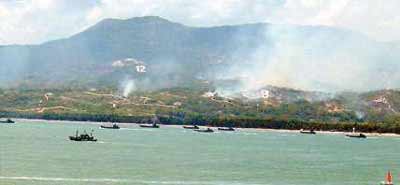
Image: PLA amphibious forces conducting an exercise near Dongshan Island (undated, 2001). (Image source: China Daily)
Dongshan as a Historical Cross-Strait Battlefield
Besides the recent activities of the PLAN and PAFMM, Dongshan’s geostrategic importance is reflected in the historical battles fought on its shores in the years following the main phase of the Chinese Civil War (1946-1949). A decisive conflict between the Chinese Communist Party and the Nationalist Party (國民黨, KMT) occurred in July 1953. Known as the Battle of Dongshan Island (東山戰役), the conflict involved an assault by the KMT’s air, sea, and land forces (三棲作戰), backed by the US Central Intelligence Agency. Occurring in the last year of the Korean War, the operation was an attempt to divert the PLA’s resources from the Korean Peninsula to the Taiwan Strait.
A second failed operation in 1965 to recapture Dongshan led the KMT to refocus on defending its offshore islands rather than “reconquering the mainland” (反攻大陸). Consequently, both the PRC and Taiwan have integrated lessons from the Dongshan conflicts into their education programs for soldiers and national security personnel. Fujian Province has appropriated funds for a national-level memorial to commemorate the 1965 battle. Multiple military contests for control of Dongshan have reinforced the island’s enduring role in both the symbolic and operational dimensions of cross-Strait security.
The Third Taiwan Crisis and Critical Developments in Dongshan
The PLA’s amphibious drills on Dongshan date back to 1995. That year, incumbent Taiwanese President Lee Teng-hui’s (李登輝) Congressionally-authorized visit to Cornell University in New York resulted in a PRC military response. The PRC interpreted Lee’s remarks at Cornell as a call for Taiwanese independence and a breach of the PRC’s asserted “One-China Principle.” In October 1995, the PLA conducted a major naval exercise. One month later, before Taiwan’s legislative elections, the PLA staged an amphibious landing exercise on Dongshan Island.
Since the Third Taiwan Strait Crisis of 1995-1996, Dongshan Island has served as a training hub for PLA contingency planning involving Taiwan. The island also facilitates the PRC’s routine gray-zone activities against Taiwan, and has been involved in the PLA’s joint exercises and drills aimed at deterring perceived moves towards “Taiwan independence”—particularly the live-fire drill in August 2022, codenamed “Justice Mission (正义使命),” which occurred following Nancy Pelosi’s visit to Taiwan. Additionally, the island also played a key role in the PLA’s Joint Sword series exercises (联合利剑系列演习), which have simulated port blockades and island encirclements targeting Taiwan.
Soon after the conclusion of the Joint Sword-2024B drills in October 2024, CCP Chairman Xi Jinping visited Dongshan Island on October 15 for an inspection tour (考察). During his inspection in Dongshan County, Xi visited the Guandi Cultural Industry Park (关帝文化产业园), where he received briefings on local efforts to “strengthen cultural heritage protection and promote cross-Strait cultural exchanges” (听取当地加强文化遗产保护、推进两岸文化交流等情况介绍). Xi also paid tribute to the memorial of Gu Wenchang (谷文昌纪念馆)— ), a Party Secretary of Dongshan County, renowned among locals for his 14-year campaign to combat desertification and transform Dongshan’s economy—to understand “local situations on the inheritance of the red gene” (了解当地传承红色基因等情况). PRC state media did not, however, indicate or report a specific correlation between Xi’s Dongshan visit and the Joint-Sword-2024B exercise that occurred a week earlier.
Specifically, Dacheng Bay (大埕湾) represents a key body of water for the PLA’s joint training. The area hosts PLA Eastern Theater Command (ETC, 东部战区) amphibious training bases designated for operational purposes. Official sources from the PLA and MND, PRC state media, and Taiwan-based user-generated content all suggest that Dongshan is a key PLA amphibious assault training location, designated for joint operations from the air, sea, and land domains. The island also supports China Coast Guard (中国海警, CCG) patrols and vessel inspections, activities that often exploit the ambiguity between coercion and domestic law enforcement.
The Dacheng Bay base has been used to train PLAN Marine Corps units, and other air, sea, and land forces (陆海空三军) for joint-operation simulations. Given the similarities in terrain and climate between Dongshan and Taiwan, the bases serve as useful locations for readiness training. These exercises involve both combat operations and logistical support: for example, on September 2, 2021, civilian vessels (including roll-on/roll-off ships) were spotted at Dongshan Island. The vessels were engaged in logistical operations, including transporting PLAN Marine Corps ZTD-05 amphibious fighting vehicles for beach assault simulations. In September 2022, seven ferries of the BoHai Ferry Group (渤海运输集团)—under the PAFMM’s Eighth Transport Group (海运八大队)—transported operational materiel to Dongshan. These exercises have signaled Dongshan Island’s emerging importance as a hub for civil-military integration. One year later, on September 24, 2023, the Taiwan Ministry of National Defense announced that “we detected PLA aircraft and ground troops conducting military drills at Dacheng Bay located in Dongshan Island.” Such developments, along with the recurring patterns of the PLA activities in the “ETC and areas contingent to the Taiwan Island” (东部战区台岛周边), have further demonstrated the rising importance of Dongshan’s strategic value in the PLA’s capacity-building aimed at greater operational readiness.
According to official sources and historical accounts from Fujian Province, bases on Dongshan Island have also been training “tens of thousands of militiamen” each year. Known as the PRC’s “Third Sea Force” (中国的第三海军), PAFMM units in Fujian often simultaneously serve essential or supplementary roles in the PRC’s gray zone operations and military drills, from which escalation towards a full-scale assault may begin. As a dual-use force situated for “diversified military tasks” (多样化军事任务), the PAFMM significantly bolsters the PLA’s overall capacity and resilience in Taiwan-related operations.
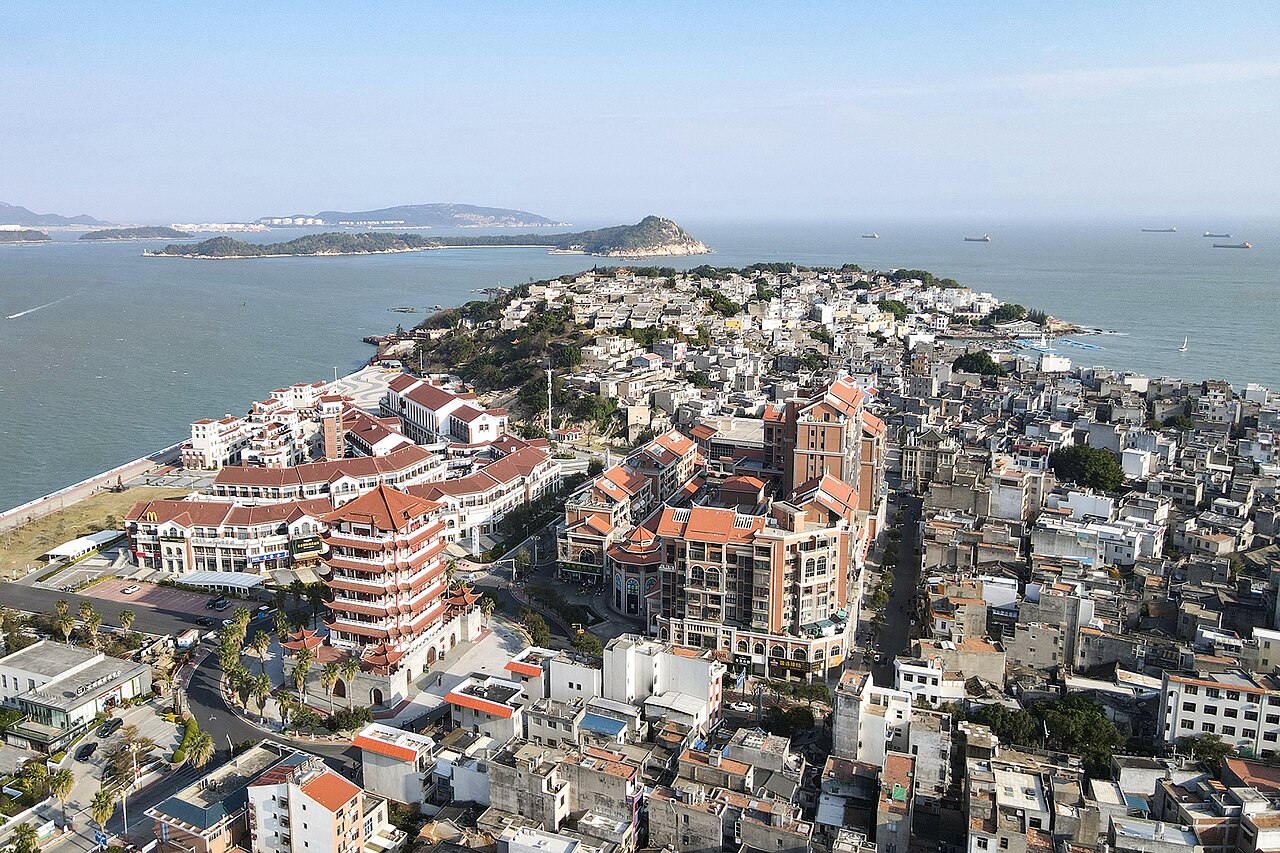
Image: Tongling Township on Dongshan Island (undated). (Image source: Wikipedia)
Double-Support in Practice: Dongshan’s Civil-Military Integration
Dongshan is a prime example of the PRC’s civil-military integration efforts. For six years, the island has consistently been awarded the “Model County for Double-Support” (双拥县) title. Indeed, in the Double Support of China (中国双拥) journal issued by the PRC Ministry of Veterans Affairs (退伍军人事务部), Dongshan has been praised as “The Island of the Hero” (英雄岛).
In practice, the Dongshan County government and the local CCP County Committee (县委) have implemented programs that provide preferential treatment to PLA personnel and militia members. These policies have been carried out under the CCP county committee and the county government’s directive of “wide participation among all industries, and shared responsibilities among local-military departments” (县委、县政府主抓,军 地部门各司其职,各行业广泛参与). (An official source from Fujian’s Ministry of Veteran Affairs verified the implementation structure to this author in December 2025, and forwarded the article from the Double-Support of China.)
Dongshan’s “double-support” (双拥) implementation strategy strictly adheres to the Fujian Provincial Government’s “Measures for Guaranteeing Militia Rights and Interests” (福建省民兵权益保障办法), which was issued in January 2025. According to the official Xinhua News Agency, “double-support” means “the government and the people support the military, and the military supports the government and the people.” The 2025 Measures for Guaranteeing Militia Rights and Interests establishes a province-wide framework of financial incentives, employment protections, priority public services, and institutional benefits for both militia members and participating enterprises, aiming to strengthen recruitment, retention, and operational readiness. However, Dongshan’s implementation strategy is also tailored to local conditions. Preferential measures in Dongshan include complementary meals for senior veterans and military families, as well as free resettlement employment training provided by local businesses. The local source at Fujian’s Ministry of Veterans Affairs indicated to this author that Dongshan’s preferential programs lean heavily toward employment, aiming to guarantee “100 percent reemployment of the veteran” (退役军人100%就业).
From an infrastructure perspective, Dongshan is home to Zhangzhou City’s first “Service Center for Military Personnel” (军人服务科). The center was established as part of Zhangzhou City’s joint military–local hospital initiative (军地医院) in 2023. According to an official Baijiahao (百家号) account affiliated with the PLA Eastern Theater Command, the center provides priority medical services for military personnel and integrates civilian hospitals with PLA medical resources, while also serving as a designated wartime medical support node for frontline operations (战时全力拥军支前). Such an initiative reflects the ongoing integration of civilian infrastructure into military support systems in Dongshan. Thus, localized preferential measures have reinforced Dongshan’s suitability as a forward-operating node within the PRC’s broader cross-Strait civil–military framework.
The main point: Dongshan Island’s proximity to Taiwan’s energy supply lines, as well as its historical role in cross-Strait conflicts, renders the island a critical node for coordination between the PLA and PAFMM. Since 1995, Dongshan has served as a training ground for amphibious training operations simulating assaults on Taiwan. As Dongshan’s strategic importance has grown, local authorities have stepped up measures to support military personnel and veterans on the island.