
In early August 2022, then-US. House Speaker Nancy Pelosi visited Taipei to meet with then-Taiwan President Tsai Ing-wen. The visit, originally scheduled for the spring but delayed due to Pelosi contracting COVID-19, marked the culmination of Pelosi’s foreign policy career as a leader in the Democratic Party. Before losing the gavel after the November 2022 midterm elections in the United States, Pelosi wanted to cement her legacy as the first (and to date, only) female speaker of the House of Representatives by meeting with Asia’s first democratically elected female leader who did not come from a political dynasty.
While Pelosi’s visit to Taiwan fortified her legacy and served as a strong symbol of US congressional support for Taiwan, it had a stronger impact in another space: it changed the nature of People’s Republic of China (PRC) military coercion against Taiwan and forever altered the cross-Strait status quo.
PRC Military Coercion before August 2022
Even before Pelosi visited Taiwan, the Chinese Communist Party (CCP) routinely connected high-level political events to increasing military pressure on Taiwan through military aircraft incursions into Taiwan’s declared air defense identification zone (ADIZ). After all, the ADIZ incursions started in direct response to visits to Taiwan in August and September 2020 by, respectively, then-Secretary of Health and Human Services Alex Azar and then-Under Secretary of State for Economic Growth, Energy, and the Environment Keith Krach.
It was in response to the Krach delegation that CCP Foreign Ministry Spokesperson Wang Wenbin denied the existence of the median line of the Taiwan Strait. The median line of the Taiwan Strait, dubbed the Davis Line, was established by General Benjamin O. Davis Jr. in 1955 in response to the First Taiwan Strait Crisis. The line was meant to deconflict military operations by the PRC and Taiwan to keep some semblance of stability between the two rivals. The line essentially divided the strait for decades as both sides tacitly accepted the division without formally accepting it. In 2019, Taiwan’s Ministry of National Defense clarified its location of the line: 27°N, 122°E (north) and 23°N, 118°E (south). The line never held international legal status, but it kept the peace throughout and beyond the Cold War.
During a September 2020 People’s Liberation Army (PLA) military exercise, 22 military aircraft crossed the median line of the Taiwan Strait over the two-day operation. However, despite the PRC’s rejection of the existence of the median line, no PRC military aircraft crossed the line for the following two years, until a WZ-10 attack helicopter did so in May 2022.
There was relative stability and predictability in PLA movements and operations around Taiwan between September 2020 and July 2022. During this two-year period, the PLA routinely sent planes to breach Taiwan’s southwestern ADIZ in the South China Sea. The PLA would use a pro-Taiwan political event, such as the signing of security- or economic-related memorandum of understanding, a visit by a foreign political figure, or a high-profile speech by Taiwan’s president, to alter the cross-Strait status quo by flying aircraft closer to Taiwan. However, during this time period, they refrained from crossing the median line of the Taiwan Strait.
Despite rejecting its existence, the CCP generally abided by the line’s demarcation even as it was increasing its pressure around Taiwan. Then, prior to the postponed Pelosi visit in July 2022, Taiwan Affairs Office Spokesperson Zhu Fenglian reiterated the CCP’s refusal to accept the line’s existence. Zhu said, “The Taiwan region is an inalienable part of China’s territory, and the so-called median line is non-existent.” This statement was released in conjunction with the PLA patrol vessel Haixun 06’s assignment to the Taiwan Strait area.
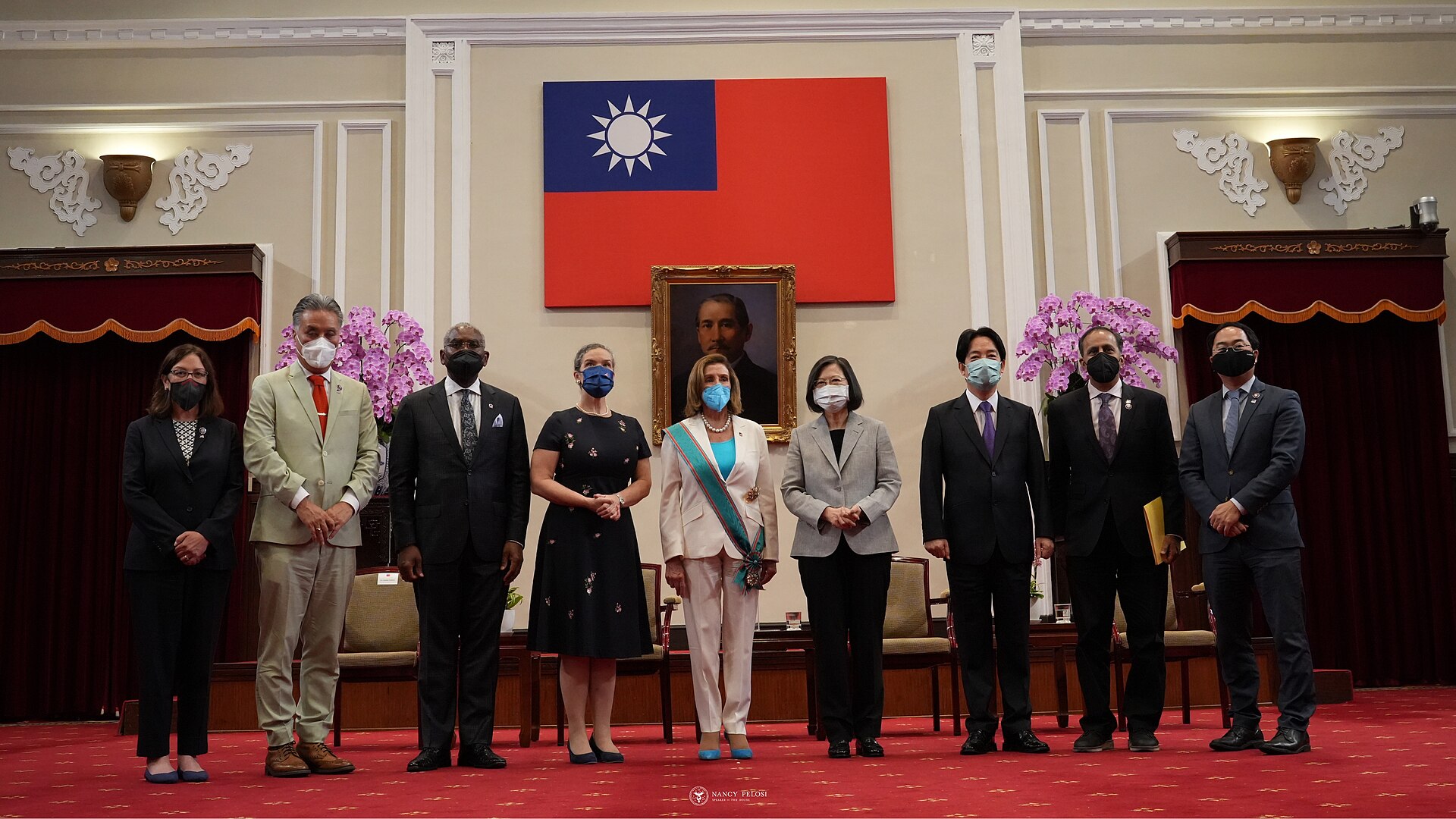
Image: Then-US Speaker of the House Nancy Pelosi (center) meeting with then-President Tsai Ing-wen (center-right) and other dignitaries at the Presidential Office Building in Taipei (August 3, 2022). (Image source: US Speaker’s Office / Wikimedia Commons)
PRC Military Coercion after August 2022
Pelosi’s delayed visit to Taiwan provided Beijing with an opportune pretext to escalate its rejection of the declared median line. In August 2022, the PLA conducted a large-scale military exercise surrounding Taiwan, including six declared exclusion zones around the island. This was also the first military exercise in which the PLA would formally conduct operations off Taiwan’s east coast. During the Third Taiwan Strait crisis in 1996, the PLA did operate on Taiwan’s northeast coast, but in August 2022, the east coast itself became a new theater of operation. (Editor’s note: For more detailed analysis of the August 2022 PLA exercise, see previous GTI articles here and here.)
On August 3, the PLA sent 22 aircraft across the median line of the Taiwan Strait—the same number of aircraft that crossed the line over two days in September 2020. After August 3, the PLA did not relent. In August 2022 alone, 302 military aircraft crossed the median line of the Taiwan Strait. During the rest of 2022 (excluding August), a total of 263 aircraft crossed the median line, meaning that one month’s activity surpassed the rest of that year’s crossings. Notably, a significant majority of these crossings were conducted by fighter aircraft, such as the J-10, J-11, J-16, and Su-30—aircraft that would take only approximately 10 minutes to reach Taiwan proper from the median line. August 2022 remains the month with the highest number of PLA median crossings ever.
The exercise following Pelosi’s visit sent a clear message marking the end of decades of observance of the median line of the Taiwan strait. In 2022, 565 aircraft crossed the median line; in 2023, the number increased to 703. In 2024, the number doubled to 1,472 aircraft; in 2025, the number increased to 1,500.
At the time of the Pelosi visit, crossings of the median line made front-page headlines across international media because it marked a new phase of PRC military coercion of Taiwan. Questions arose around how much time decision makers in Taipei would have to act in the event of an attack; how far across the median line would Taiwan tolerate before responding to or intercepting encroachments; and the effect such regular movement might have on civil air traffic under this new normal.
Now, four years later, median line crossings are an afterthought. They’re a part of the daily PRC coercion of Taiwan, and thus no longer newsworthy. Taiwan has seemingly adapted to this new phase of the cross-Strait status quo.
Continuing the Pretext to Escalate Trap
Why did the decades-shattering decision by Beijing become background noise? The world moved on because the PLA did, too. Since the Pelosi visit and the erasure of the median line of the Taiwan Strait, Beijing has expanded its coercion of Taiwan in new ways.
In response to the April 2023 meeting in California between then-US House Speaker Kevin McCarthy and Taiwan’s then-President Tsai Ing-wen, Beijing announced a “special joint patrol and inspection operation” in the Taiwan Strait along with the first Joint Sword military exercise.
In early 2024, Beijing turned its focus to the outlying island of Kinmen, in response to an accident between the Taiwan Coast Guard and illegal Chinese fishermen operating inside Kinmen’s restricted waters. Like the Pelosi visit and the median line, Beijing used this incident to reject Kinmen’s “restricted waters.” Since then, the Chinese Coast Guard has operated inside Kinmen’s restricted waters—and become a regular feature in major PLA exercises.
That is another legacy of the Pelosi visit: named military exercises. The Pelosi visit created a permissible situation for Beijing to formalize its military drills and incursions into exercises meant to improve interoperability of the PRC’s military services and to practice feasible military contingencies around Taiwan: such as blockade, missile strike, and invasion scenarios.
There are many other examples of the PRC using a pro-Taiwan event as an excuse to increase its coercion against Taiwan. Waiting for opportune pretexts to escalate has worked well for the PRC: it can blame Taiwan or the United States for forcing it to act in self-defense. That excuse and projection of blame play well to China’s international partners.
Beijing waited for a sufficiently high profile event to justify enacting its long-term plans to change the cross-Strait status quo and display the stark military imbalance between itself and Taiwan. This opportunity happened to be Pelosi’s visit. If Pelosi had backed down due to pressure from the Biden administration to cancel the visit, then Beijing would have selected some other event—such as Tsai’s meeting with McCarthy, the inauguration of Lai, a visit by former Secretary of State Mike Pompeo, or a long list of other supposed offenses.
Conclusion
Beijing wants to dictate the level and types of engagements and exchanges that foreign countries can have with Taiwan. And if they violate those terms, then Beijing will use that event as a pretext to escalate an already-planned course of action, such as increased coercive military pressure.
However, the United States and Taiwan’s allies and partners have for the most part rejected this modus vivendi. Foreign partners continue to visit Taiwan—even as Beijing continues to pressure them not to go, or sanction them for visiting, as was the case with New Zealand lawmakers in June 2026.
Despite the military imbalance between Taiwan and China, Beijing’s pressure campaign does not always result in total victory. Beijing used a variety of economic tools to coerce Lithuania after Taipei and Vilnius announced in 2021 that they would open unofficial representative offices in each other’s capitals. However, Lithuania did not back down—despite some teetering and doubts—and Beijing finally backed down in June 2026 with the establishment of diplomatic relations at the charges d’affaires level. Lithuania has made no apparent concessions related to Taiwan in response, though there is still time for Vilnius to appease Beijing. There is a clear lesson in this: standing up to Beijing can expose its weaknesses and defeat the narrative that it is all powerful.
Four years after Beijing used Pelosi’s visit as a pretext to escalate in the Taiwan Strait, countries have started to be more supportive of Taiwan, and to reject PRC narratives. There is still much progress to be made, but the Pelosi visit exposed the PRC’s machinations about Taiwan for the world to see.
The main point: The People’s Republic of China used the August 2022 visit to Taipei by then-US House Speaker as a pretext to escalate in the Taiwan Strait. As cross-Strait relations have continued to deteriorate since, Beijing’s actions have exposed a simple truth: it will use any excuse to increase its military coercion of Taiwan.