
On April 21 this year, the cabinet of Prime Minister Sanae Takaichi approved a significant revision to Japan’s Three Principles on Transfer of Defense Equipment and Technology, a set of self-imposed guidelines for the government’s arms sales to other countries. The revision cleared the way for Japan to export lethal weapons to 18 partner countries.
Japan’s arms exports restrictions were first articulated in 1967 under Prime Minister Eisaku Sato. Then, Japan prohibited arms exports to three kinds of buyers: communist states, countries subject to United Nations Security Council arms embargoes, and parties involved in or at risk of international conflict. These constraints were further tightened in 1976 into a near-total ban of weapons transfers.
Yet, limitations on arms exports have gradually eased since the Japanese government outlined its initial Three Principles on Transfer of Defense Equipment and Technology document in 2014. In subsequent revisions to its arms exports policy, the government has relaxed sales for five non-lethal categories: mine-countermeasures, surveillance, warning, transport, and rescue equipment. By extending this trend to the transfer of lethal weapons to foreign countries, the 2026 revision under Prime Minister Takaichi represents the most consequential relaxation yet of the restrictions introduced in 1967.
Japan’s decision to lift its long-standing ban on lethal weapons exports is the latest step in the steady erosion of its self-imposed constraints on the Japan Self-Defense Forces (JSDF) and Japan’s defense manufacturing sector. This evolution has followed shifts in regional tensions. Indeed, since the 1990s, Japan has gradually reshaped the role of the JSDF through a series of significant steps. Notably, the 1992 International Peace Cooperation Act enabled the participation of the JSDF in United Nations peacekeeping missions. In 2007, the Japan Defense Agency was upgraded to a full Ministry of Defense. And in 2015, the Legislation for Peace and Security reinterpreted Article Nine of the Constitution of Japan to allow for collective self-defense, thereby enabling Japan to defend allied nations under attack.
Amid rising threats from China, as well as the United States’ unpredictability under the second administration of President Donald Trump, the 2026 decision to allow for lethal arms exports echoes with Japan’s current goal to enhance both the JSDF and its deterrence power. Under the revised framework, Japan can now export lethal defense equipment to states with which it has signed an Agreement Concerning the Transfer of Defense Equipment and Technology. The Japanese government argues that by expanding sales channels and securing production capacity, such transfers will help maintain a resilient and sustainable domestic defense-industrial base on which the JSDF depends.
This revision has already been characterized by Beijing as a further departure away from Japan’s traditional pacifist posture. China’s criticism is the latest measure in a period of deteriorating bilateral relations, beginning with Beijing’s reaction to Prime Minister Takaichi’s November 2025 declaration that a Chinese military attack on Taiwan could constitute a “survival-threatening situation” for Japan, echoing the terminology for situations in Japan’s legislative acts regarding national security that allow for military intervention. Tensions grew further after the transit of the Japanese Maritime Self-Defense Force (JMSDF) destroyer JS Ikazuchi through the Taiwan Strait on April 17, the first such passage under Takaichi’s term.
This new arms exports framework is a further building block in Japan’s deterrence architecture in East Asia, with immediate implications for partners such as the Philippines and Australia, who have signed Agreements Concerning the Transfer of Defense Equipment and Technology with Japan. Takaichi’s move has signaled to Beijing that it faces an increasingly capable and connected regional security network.
But it also opens a question regarding one of Tokyo’s most immediate neighbors: Taiwan. In its 2021 Defense White Paper, Tokyo explicitly framed stability in the Taiwan Strait as essential for Japan’s own security, a stance reiterated several times since then. Notably, during a visit to Taipei before she became prime minister in April 2025, Takaichi proposed the idea that Japan, Taiwan, Australia, India, and European countries should form a quasi-security alliance to jointly maintain their security.
Under current conditions, arms exports from Japan to Taiwan are inconceivable and would trigger an immediate response from Beijing. Nonetheless, as Japan seeks to strengthen its regional deterrence, it is important to consider under what conditions—if any—Japan’s new export framework could extend to Taipei.
Could Weapons Be Exported to Taiwan?
Taiwan has no Agreement Concerning the Transfer of Defense Equipment and Technology with Japan, and Japan does not recognize Taiwan as a country. Moreover, the changes regarding arms exports explicitly exclude transfers to parties engaged in ongoing armed conflict. Therefore, Japan’s current restrictions would rule out exports to Taiwan in a war scenario.
However, the revised framework contains an important exception: if the National Security Council determines that Japan’s national security is directly at stake, lethal transfers remain permissible even in circumstances where a recipient is in active combat. This grants Tokyo the flexibility to decide—based on its own national security assessment—whether to transfer weapons to a party in active conflict. Given Japan’s own framing of a Taiwan contingency as potentially survival-threatening scenario, this flexibility functions as a deliberate deterrence tool.
Japan’s role in a potential Taiwan Strait conflict has long remained unclear. Certain experts envision Japan’s role primarily as a supportive one: notably through logistical backing for potential US operations, and through rear-area functions that stop short of direct military engagement.
The revision of arms exports does not fundamentally change these expectations, but it introduces the possibility of weapons transfers in a conflict scenario, provided that the political and security conditions are met. In this regard, Prime Minister Takaichi’s November 2025 statement regarding the potentially “survival-threatening” nature of Taiwan contingency is significant, as it indicates that the political threshold for invoking such conditions has already been publicly framed.
The growing People’s Republic of China (PRC) military pressure on both Taiwan and Japan has contributed to increasingly close ties between Taipei and Tokyo. This dynamic is also reflected in Japan’s support for Taiwan’s international integration and in growing cooperation between the two nations on resilient supply chains. As Taiwan serves as a buffer for Okinawa and the Senkaku Islands, Japan has a direct strategic interest in ensuring that Taiwan’s defensive capacity remains operational and that the status quo does not change in a unfavorable manner.
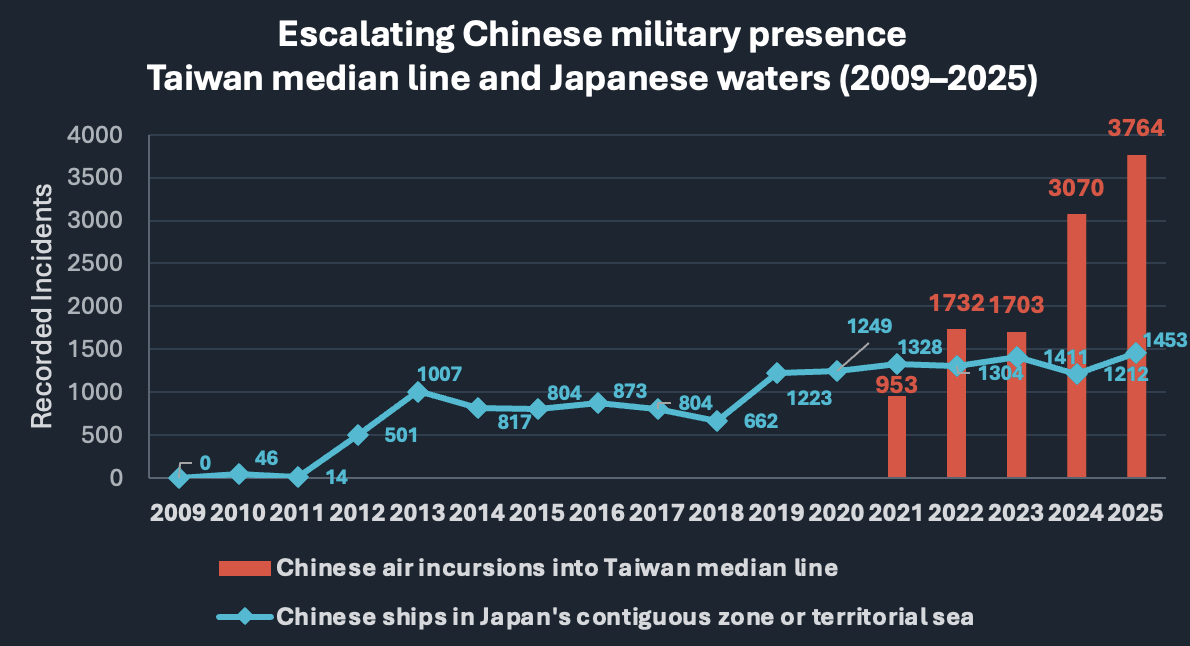
Image: Chinese incursions beyond the Taiwan Strait median line and into Japan’s contiguous zone or territorial sea (2009-2025). (Image Source: The author with data from the Ministry of Foreign Affairs of Japan, Ministry of National Defense of Taiwan, and PLATracker)
In this context, Japan’s new arms export framework already reshapes Beijing’s strategic calculus by strengthening the democratic security network in the region. Arms transfers that may impact Beijing’s strategy include sales of the Mogami-class frigate to Australia and the transfer of Abukuma-class destroyer escorts to the Philippines. These acquisitions may force Chinese planners to account for a more capable set of regional partners in any military contingency. Regarding Taiwan specifically, Beijing must now incorporate into its military calculus the possibility that an armed attack on Taiwan could push Japan towards formally declaring a “survival-threatening situation,” potentially triggering arms transfers as part of its response.
However, this deterrence logic is conditioned by a variable that Tokyo does not fully control: the position of the United States. Japan’s posture toward Taiwan cannot be separated from the United States-Japan alliance framework, and any decision by Tokyo to transfer weapons to Taiwan in a crisis scenario would require, at minimum, a tacit American endorsement. Given the current US administration’s transactional approach to Taiwan policy—in which arms sales to Taipei have themselves been subject to discussion with Beijing—such an endorsement cannot be taken for granted. Therefore, Japan cannot act unilaterally on this question as the risk to not be backed by Washington exists—as demonstrated by the November 2025 dispute when Prime Minister Takaichi’s statement drew little public support from Washington, reportedly frustrating Tokyo.
However, Japan’s new arms export framework aims to directly address this dependency by expanding its capacity to act in coordination with other like-minded partners beyond the United States. This flexibility remains nonetheless constrained by Japan’s current industrial capacity, which is unlikely to meet simultaneously the JSDF’s growing needs for equipment and the demands of supporting Taiwan in the event of a full-scale military conflict.
Complexities in Wartime Arms Exports from Japan to Taiwan
In addition to political considerations, another factor that may challenge wartime arms exports to Taiwan is the physical environment in which they would have to be executed. The scale and length of a conflict in the Strait would directly influence Japan’s ability to respond. China’s recent military drills around Taiwan have consistently demonstrated an intent to strike the key military assets and critical infrastructure related to supply lines, including ports and airports. Such strikes would strongly complicate any attempts for external support.
While the complexity of amphibious operations, Taiwan’s geographic advantages, and its asymmetric defensive capacity could complicate a PRC invasion and theoretically create a window for external support, the encirclement patterns demonstrated by China’s April 2025 Strait Thunder 2025A exercise and December 2025 Justice Mission 2025 exercise suggest that such transfers would face severe obstacles.
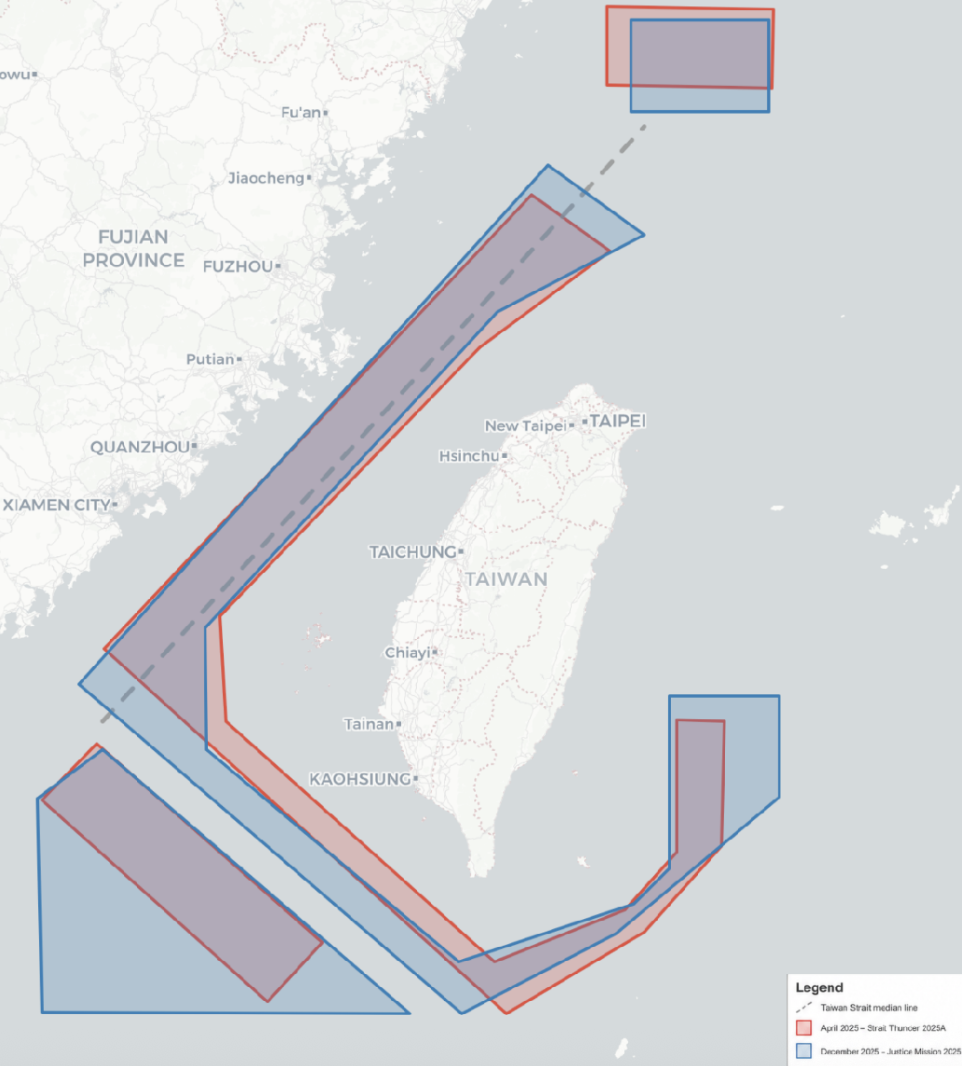
Image: The locations of People’s Liberation Army drills around Taiwan in April and December 2025. (Image Source: The author with data from Ministry of National Defense of Taiwan)
Beyond the logistical obstacles, providing arms to Taiwan during an active conflict would likely require breaking the PRC’s maritime encirclement of the island, rendering Japan a direct military target and significantly raising the cost of intervention. Pre-war transfers would avoid these logistical constraints and could strengthen Taiwan’s defensive capacity more effectively, but would conflict with Japan’s self-imposed restrictions on exports to countries at risk of conflict. Meanwhile, such a move would almost certainly provoke a strong response from Beijing, and could accelerate rather than deter Chinese military action by narrowing the window in which Beijing believes it can act.
Article Eight of China’s 2005 Anti-Secession Law explicitly authorizes the use of “non-peaceful means” when Beijing determines that peaceful unification has become impossible, and a Japanese decision to arm Taiwan could push the PRC to such a conclusion—whether out of fear of losing strategic control, concern over a broader international coalition forming around Taiwan’s defense, or a determination that the conditions for peaceful reunification are being permanently foreclosed.
The status quo is already in a worryingly unstable shape, and arms sales from Japan to Taiwan prior to a conflict in the Strait could increase the risk of war. The last two PRC military drills around Taiwan were ostensibly responses to Taiwan’s defense policies––President Lai Ching-te’s (賴清德) “17 National Security Measures” in March 2025 were followed by the PRC’s Strait Thunder 2025A in early April; whereas Justice Mission 2025 was seemingly intended to respond to the United States’ announcement of a NTD 350 billion (UD $11 billion) arms sale to Taiwan, as well as the comments from Japanese Prime Minister Takaichi. It is probable that the advent of Japanese arms transfers to Taiwan would produce an even fiercer response from Beijing.
Conclusion
Even hypothetical arms exports to Taiwan would remain highly constrained and conditional on various factors. In current peacetime conditions, they are impracticable. Yet the combination of Japan’s new arms exports framework, and Prime Minister Takaichi’s comments about a potential threshold for Taiwan Strait intervention, makes wartime transfers conceivable in a way that was not the case before April 2026. As Japan reassesses its role within the East Asia security architecture, broadened support for Taiwan is not to be discounted. Drone cooperation at the civilian level suggests that this expansion is already taking place. Beyond arms exports to Taiwan, Japan’s new policy expands its set of deterrence tools in the region, creating ambiguity that will raise the cost of any Chinese military action. This newly acquired arms exports flexibility must nonetheless be carefully employed: it expands both Japan’s power projection and its set of available measures in a crisis, but could also make Japan a more direct target in an increasingly volatile region.
The main point: Japan’s armes sales to Taiwan are legally constrained and politically impractical in a pre-war environment. However, in a scenario in which the PRC attacks Taiwan, Japan’s National Security Council could determine that arms transfers to Taiwan are permissible under recent revisions to its defense posture. Nonetheless, such exports would be highly constrained by the physical environment in the Strait, and could risk putting Japan into a direct military confrontation with the PRC.