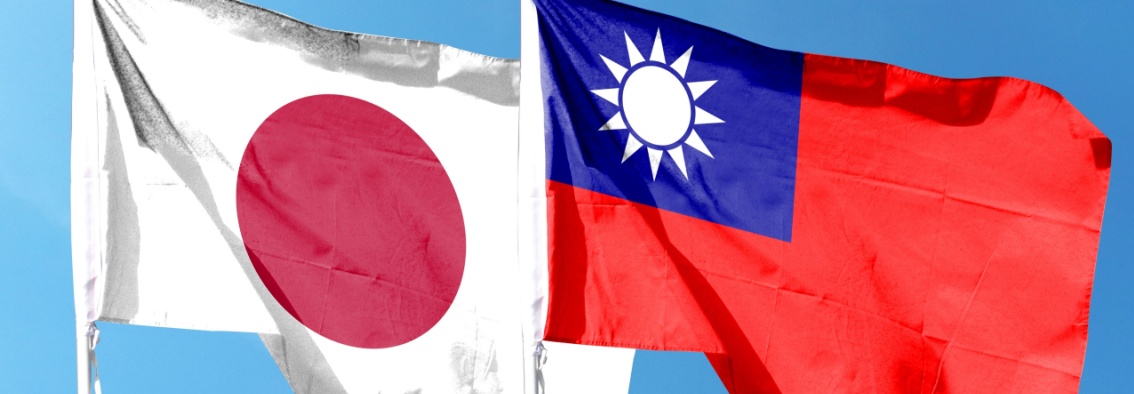

Japan’s Prime Minister Sanae Takaichi has articulated a clear strategy for Taiwan’s security, as opposed to the ambiguous statements offered by President Trump after the Trump-Xi Summit in May of this year. In November 2025, Takaichi stated that a Chinese attack on Taiwan could constitute a “survival-threatening situation” for Japan. She also lifted the ban on full lethal weapons sales to more than 17 countries; visited South Korea, Australia, Vietnam, and met with the Philippines president; and strengthened strategic partnerships with major middle powers such as Canada, India, and European states. In the Shangri-La Dialogue this year, Japan’s Defense Minister Shinjiro Koizumi sharply rebuffed claims of “new militarism” leveled by the People’s Republic of China (PRC), and opposed “unilateral changes to the status quo by force or coercion.”
Why does Japan show strong support and strategic clarity for the defense of Taiwan? The PRC’s increasingly aggressive posture, and the Trump Administration’s ambiguous cross-Strait policies, have compelled Japan to assume both a policy of strategic clarity and a leading role in regional security.
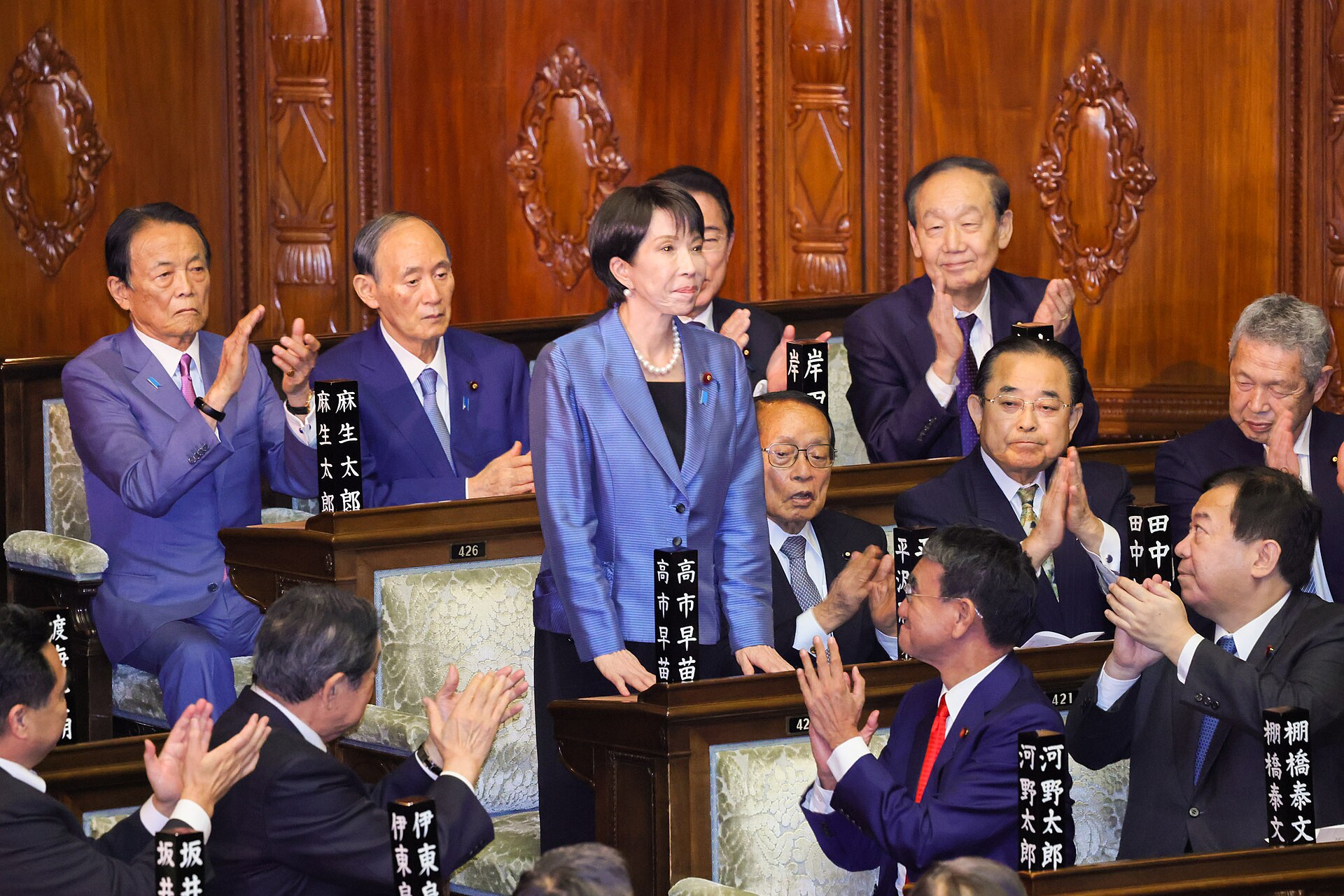
Image: Japanese Prime Minister Sanae Takaichi in Japan’s legislature on October 21, 2025, when she was designated as Japan’s prime minister. (Image source: Wikimedia Commons)
Three Periods of Japan-Taiwan Relations Post World War II
The history of Japan-Taiwan relations provides the foundation for Japan’s current security policies. In broad terms, the bilateral relationship has undergone three periods after World War II (WWII): the first from 1952 to 1972, when there were formal diplomatic ties and an unofficial Cold War alliance between Japan and the Republic of China; the second from 1972 to 2000, wherein bilateral relations were practical and “unofficial in name only;” and the third from 2000 to the present, with informal but close and active bilateral relations.
In 1952, Japan signed the “Treaty of Peace” with the Republic of China (ROC) government in Taipei, formally ending the war between the two countries and establishing diplomatic relations. Following the treaty, the two countries established mutual embassies in Taipei and Tokyo, operating with full ambassadorial-level representation. In June 1957, Japanese PM Nobusuke made an official visit to Taiwan. Moreover, between 1945 and 1972, Japan provided Taiwan with economic aid and technical assistance and promoted private investment, facilitating Taiwan’s early industrialization.
In this period, Japan’s commitment to defend Taiwan was reflected in the US-Japan Security Treaty, which included a “Far East” clause: “[I]n the Far East, the US is granted the use by its land, air and naval forces of facilities and areas in Japan.” The Japanese government clarified that “Far East” included territories under the control of the ROC. Therefore, in the event of a Chinese attack, the US and Japan could defend Taiwan. On this basis, the US military was stationed in Taiwan for approximately 28 years until 1979. Thus, Taiwan and Japan were Cold War allies against communist regimes in the region, and this became the foundation for bilateral relations between them.
In 1972, following the US-China rapprochement, Japan established relations with the PRC through a Joint Communiqué. Japan followed a “One-China Policy” and cut ties with Taiwan. However, Japan and Taiwan developed practical, deep, and “unofficial in name only” relations, especially in the economic, social, and cultural domains. People-to-people ties were also strengthened through tourism and the return of media outlets to Taiwan. Lee Teng-hui, Taiwan’s president in office between 1988 and 2000, enjoyed a warm relationship with the people and culture of Japan, and significantly promoted bilateral relations.
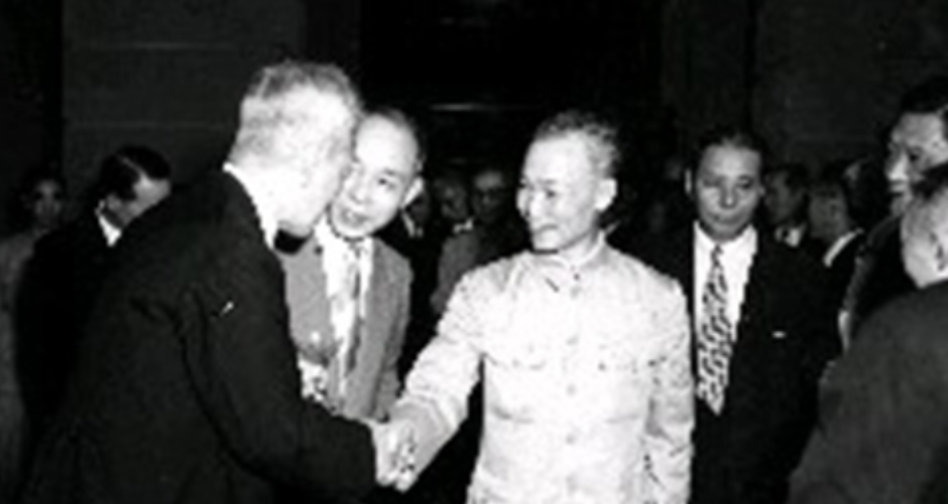
Image: Then-ROC Premier Chen Cheng shaking hands with Japan’s representative Isao Kawada on the occasion of the signing of the ROC-Japan peace treaty in Taipei (April 28, 1952). (Image source: ROC Executive Yuan)
Despite the lack of official ties, the 1997 US-Japan Defense Guidelines emphasized that the two states should address the “situations in areas surrounding Japan”—which was widely understood to include the Taiwan Strait, although Japan officials avoided specifically defining this concept. Furthermore, Japan’s Diet adopted the 1999 Act Concerning Measures for Peace and Safety in Areas Surrounding Japan, and advanced legislative and regulatory authorizations to implement the revised Guidelines.
From the year 2000, the geopolitical situation changed: China rose, became a powerful hegemon in Asia, and intensified its expansionism in the Taiwan Strait and the South and East China Seas. In Japan, the Koizumi Administration (2001-2006) viewed Taiwan as a vital democratic partner and security buffer. Koizumi publicly stated that Japan had an “important role” in fostering a cross-Strait dialogue without the use of force. In 2005, the US-Japan Security Consultative Committee issued a joint statement that listed for the first time a “peaceful resolution of issues across the Taiwan Strait” among its objectives.
Under PMs Shinzo Abe (2006-2007, 2012-2020) and Sanae Takaichi (2025-present), Japan aimed to play a greater role in regional stability and to strengthen the relationship with Taiwan. Both administrations focused on China’s aggressive behavior and security cooperation with Taiwan. Abe advocated the Quadrilateral Security Dialogue (QUAD) in 2007, the “Free and Open Indo-Pacific” concept in 2016, and held many events to enhance multilateral defense cooperation. Additionally, defense mechanisms in the Taiwan Strait expanded through the 2014 Cabinet reinterpretation of Article 9, the 2015 revision of the US-Japan Guidelines for Defense Cooperation, and the 2015 Legislation for Peace and Security—thereby strengthening the legitimacy of defense cooperation with Taiwan. On November 7, 2025, PM Takaichi explicitly defined the Taiwan crisis as a “survival-threatening situation,” and that she would apply the 2015 Peace and Security Legislation to require Japan’s Self-Defense Forces (SDF) to respond. Takaishi has therefore explicitly articulated a stance of “strategic clarity,” marking the highest level of defense cooperation between Taiwan and Japan since 1972.
The Implications of Trump Administration Policy in Japan-Taiwan Relations
Takaichi’s “strategic clarity” has marked a shift in Japan’s national security posture towards Taiwan, and stands in contrast to Trump’s second-term Taiwan policy. When Trump took office in 2025, he did not clarify whether or not he would send troops to protect Taiwan. As Trump sought to improve relations with the PRC, support for Taiwan faced limitations: for instance, the denial of a US transit for Taiwanese President Lai Ching-te. After the 2026 Trump-Xi summit, Trump almost accepted Xi’s narrative regarding Taiwan’s independence, and asserted that arms sales to Taiwan constituted an obstacle in negotiations with the PRC.
In this regard, Takaichi bore the heavy pressure of economic coercion, diplomatic isolation, and intense criticism from China—even as Trump remained silent after her statements, urging Japan not to aggravate the dispute. In response, Japan expressed frustrations over the lack of explicit US support. Reliability in Washington further eroded as uncertainty over trade, investment requirements, and higher tariffs damaged mutual trust.
In addition, the 2025 US National Security Strategy prioritized the Western Hemisphere over the Indo-Pacific. As a report by the Asia Society Policy Institute states, “[t]he lack of a coherent American approach to the Indo-Pacific undermines the alliance’s ability to adapt to a changing security landscape. Tokyo fears that Trump will try for a deal with Beijing that leaves Taiwan’s status unclear.” According to an Asahi Shimbun poll, 77 percent of Japanese respondents do not think that the US would defend Japan in a military crisis.
Takaichi’s Approach toward Taiwan
Although some experts have suggested that “Japan must stabilize relations with China and reformulate its Indo-Pacific strategy around inclusive regional cooperation,” this is not Takaichi’s favored approach. Instead, her strategy has aimed at sustaining ties with the US, increasing defense spending and developing counterattack capabilities, coordinating regional multilateralism, and increasing cooperation with middle powers.
Thus, Takaichi has refused to reverse her pro-Taiwan statements. Instead, she continues to maintain an assertive approach, insists on strategic clarity in defending Taiwan, and strengthens relations with Indo-Pacific allies to contain China. If Takaichi followed Trump’s cross-Strait policy, China’s ambition to annex Taiwan would be emboldened. Hence, Japan must maintain strategic clarity and assume a leadership role in the region. Despite China hoping that Japan would follow Trump’s policy, Takaishi acted in the opposite direction and infuriated Beijing.
Japan and Taiwan have enjoyed solid relations in the years following WWII. Amid uncertainty surrounding Trump’s Indo-Pacific policy, the relationship between Taiwan and Japan is destined to grow more. Only through mutual interdependence and mutual defense can they collectively safeguard freedom and stability in the region.
The main point: Japan’s current Taiwan policy is the result of both historical and current factors. After WWII, both sides established close relations. As the PRC’s aggression increases, and as uncertainty rises regarding Trump’s Indo-Pacific policy, Japan has demonstrated strategic clarity and assumed a leading role in defending Taiwan.