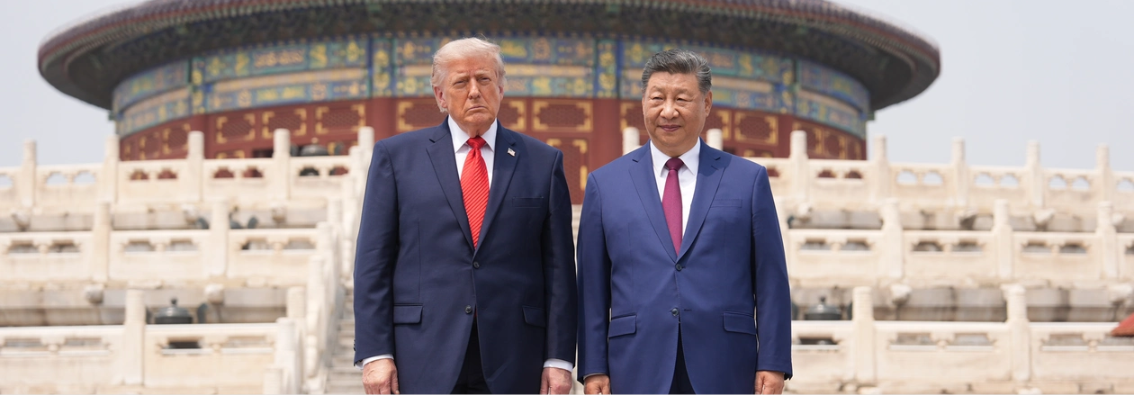


While economists and trade specialists were watching eagerly for developments emerging from the May 13-15 Trump-Xi summit, other sets of eyes were watching the events with apprehension: policymakers in Taiwan, as well as observers of cross-Strait policy in the broader global community. This article will analyze the developments salient to Taiwan that emerged before, during, and after President Donald Trump’s summit meeting in Beijing with Chinese Communist Party (CCP) Chairman Xi Jinping.
Pre-Summit Developments
Ahead of the Trump-Xi summit, there were signs that a USD 14 billion arms sale to Taiwan—announced in January 2026 but later delayed by the White House—would be on the negotiating table. President Trump’s pre-summit interviews suggested that the US leader was receptive to CCP Chairman Xi Jinping’s objections to the arms package, and potentially willing to depart from longstanding American declaratory policy. In an interview with Bloomberg on May 11 (two days in advance of his trip to China), Trump was asked by a reporter whether the United States should still be selling Taiwan weapons. Trump responded by saying he would “have that discussion with President Xi.” This response was an unexpected break from the messaging of previous US administrations.
Historically, Washington has refrained from discussing arms sales to Taiwan with Beijing. This policy was declared in 1982, under the Six Assurances to Taiwan. The second of these assurances was the statement that the United States “has not agreed to consult with the PRC on arms sales to Taiwan.” While the Six Assurances remain declaratory policy—rather than a stipulation of American law— they have been an anchor of US-Taiwan policy since the Reagan Administration. Trump’s willingness to discuss arms transfers with Xi thus marked a distinct departure from this policy.
At a May 13 press briefing, CCP State Council Taiwan Affairs Office Spokeswoman Zhang Han (張晗) commented: “We firmly oppose the US engaging in any form of military ties with China’s Taiwan region, and firmly oppose the US selling weapons to China’s Taiwan region. This position is consistent and unequivocal.” The US government did not formally respond, which could be interpreted as an additional example of deference to CCP objectives regarding US arms sales to Taiwan.
The Great Hall and Beyond
Regardless of pre-meeting posturing, the Trump-Xi summit itself did not result in official changes to the status quo of cross-Strait policies. After the primary meeting of officials in the Great Hall of the People concluded on the morning of May 14, the PRC Ministry of Foreign Affairs (中华人民共和国外交部) provided a readout that cited Chairman Xi’s emphasis that the “Taiwan question is the most important issue in China-U.S. relations.” The readout declared that if cross-Strait policy is not handled properly, “the two countries will have clashes and even conflicts, putting the entire relationship in great jeopardy.” In spite of the veiled yet well-worn threats issued by the PRC Ministry of Foreign Affairs, the US version of the readout did not mention Taiwan at all. Furthermore, Trump Administration officials made a concerted effort during the summit to emphasize that US policy had not changed. After the morning summit talks on May 14, US Secretary of State Marco Rubio told NBC News that “US policy on the issue of Taiwan is unchanged as of today, and as of the meeting that we had here today.”
The Summit Aftermath
The summit wound down with vague promises of business deals between American companies and Chinese counterparts. Overall, the summit was interpreted more as a show of pageantry than a turning point in Taiwan policy.
This sentiment shifted somewhat after Trump participated in an interview on Saturday, May 16, with Fox News. When asked whether he would advance arms sales to Taiwan, Trump stated that “It depends on China. It’s a very good negotiating chip for us, frankly.” The statement raised concerns that Trump was intending to continue his delay on arms sales to Taiwan even after his summit with Xi Jinping.
However, Trump tempered those remarks by saying in the same interview that “Nothing has changed” between the United States and Taiwan. Indeed, some comments that Trump made after the summit may have shifted the scales back in Taiwan’s favor. Responding to a reporter’s question aboard Air Force One, Trump stated “I have to speak to the person that right now is, you know, you know who he is, that’s running Taiwan”—presumably a reference to Taiwan’s President Lai Ching-te. Trump’s suggestion of a conversation with President Lai was not immediately taken at face value. However, on May 20, Trump doubled down on this sentiment. When a reporter asked if he had plans to call President Lai of Taiwan, he responded by saying “Well, I’ll speak to him. I speak to everybody.” If Trump does carry through on his plan to call Lai, it would constitute the first instance that a sitting US president has spoken with a Taiwanese leader since 1979. (Trump pushed the envelope of US-Taiwan policy by accepting a call from then-President Tsai Ing-wen in 2016, after he had been elected president. However, Trump was not a sitting US president at that time).
On the one hand, Trump has become the first president to openly entertain conversation on arms sales to Taiwan with Beijing. On the other, he has suggested multiple times that he will speak to the President of a country that Washington itself does not formally recognize. Simply put, the Xi-Trump summit underlines Trump’s unpredictability and the risk of taking his words at face value. Instead, greater clarity can be found from the other Trump Administration officials. On Monday, May 18, US Ambassador to China David Perdue sought to provide further clarity: “President Trump made it very clear that we are not changing the American policy on Taiwan.” The administration appears keen to signal that although the summit was shrouded in unconventional rhetoric, the underlying principles of America’s policy towards Taiwan remain the same.
Reactions to the Xi-Trump Summit in Taiwan
While President Trump may not have intended for his discussion of arms sales to be read as a shift in US policy, it was nonetheless treated seriously in Taiwan. Following Trump’s Fox News interview, the three major political parties in Taiwan delivered statements reacting to the impression that the American president had criticized the Lai government. The manner in which these statements were delivered—and the language used—gives an indication of varying intended audiences, ranging from Taiwan, to China and the United States.
When President Trump made his second indication that he would like to talk directly with President Lai on Wednesday, May 20, he offered a pathway for the Taiwanese president to regain face after the difficult events around the summit. If Trump and Lai do conduct the first bilateral call between sitting US and Taiwanese presidents since 1979, a challenging week might offer a novel benefit for Taipei.
Democratic Progressive Party (DPP, 民進黨)
On Sunday, May 17, one day after Trump’s Fox News interview, Taiwan’s President Lai Ching-te issued a statement on his official Facebook account, responding to concerns triggered during the Trump-Xi summit and its aftermath. Written in Mandarin Chinese, Lai’s statement was strident and made the explicit case that US policy towards Taiwan was unchanged. He sought to contradict Trump’s perceived criticisms of his cross-Strait policies by arguing that “Taiwan is the maintainer of the status quo of peace and stability in the Taiwan Strait and the wider region” (台灣是台海及區域和平穩定現狀的維護者). Lai deflected blame for a change in the status quo across the Strait, stating that “China is the real source of regional instability and changes in the status quo” (中國才是區域不穩定及改變現狀的根源). Of note, Lai’s use of vocabulary favored by American strategists, such as “First Island Chain” (第一島鏈) and “Indo-Pacific region” (印太地區), indicates that Lai’s statement was not only directed towards the Taiwanese people, but also towards Washington.
In a separate statement, Taiwan’s Deputy Foreign Minister Chen Ming-chi (陳明祺) admitted that Trump’s comments on Fox News had “caused some unnecessary concern” in Taipei. Chen also seized on Trump’s suggestion to “speak to the person that’s … running Taiwan” by proposing a direct call between the US president and Lai. Lai himself echoed an interest in a bilateral call. Following Trump’s second statement on May 20 that he would speak to the Taiwanese president, speculation mounted that the US president might really break precedent and conduct a call. As of writing, the Lai Administration had not issued a public response to Trump’s words.
Kuomintang (KMT, 國民黨)
The Kuomintang was vocal throughout the Trump-Xi summit. The outspoken KMT chair, Cheng Li-wun (鄭麗文), stated before the summit that if Trump publicly opposed Taiwan independence, this would “completely align with the KMT’s position” (完全合乎國民黨的立場). The vice chair of the KMT, Chang Rong-gong (張榮恭) then capitalized on the Fox News interview by asserting that Trump’s remarks constituted “the most serious admonishment of a Taiwanese ruler by a US president” (美国总统对台湾执政者最严厉、最明确的警告) in 20 years. Though Chang’s statement was picked up by Taiwanese media, he curiously published it first in a Hong Kong-based media outlet using simplified Chinese characters. In the article, Chang employed phrases more often used by the CCP than Taiwanese people, such as “leaning on the United States to secretly pursue independence” (倚美谋独) and the “Lai Ching-te authorities” (赖清德当局). Chang’s choice of publisher, and his use of phrases popular only with Chinese policymakers, suggests that the KMT intended for this statement to be received not only by Taiwanese audiences, but also by PRC ones.
Taiwan People’s Party (TPP, 民眾黨)
Reflecting their position as a watchdog of Taiwan’s traditional politicians, the Taiwan People’s Party issued the most analytically-dense statements regarding the Trump-Xi summit. TPP Chair Huang Kuo-chang (黃國昌) questioned whether Trump’s willingness to negotiate with China over Taiwan arms sales constituted a break with the Six Assurances. He urged Taiwan’s Ministry of Foreign Affairs (外交部) to ask the American Institute in Taiwan—the de facto US embassy—whether this policy had changed. The former TPP chair, Ko Wen-je (柯文哲), accused President Lai of “redefining Taiwan independence” (重新定義台灣獨立) in a way that “increases polarization among the Taiwanese people” (加劇了台灣民眾的分裂).
Interpreting the US Hold on Arms Sales to Taiwan
While President Trump’s comments dissuading Taiwan from declaring independence may provide temporary embarrassment to President Lai, they will not have a sustained impact on the ruling DPP government’s strategy. There is no evidence that President Lai plans to declare independence. The majority of DPP voters oppose such action. Therefore, President Trump’s comments on Taiwan independence will only serve to embarrass Lai in the short-term, and send a message to Beijing that Trump is not deaf to PRC talking points regarding Taiwan. Meanwhile, Trump’s statements that he is interested in a bilateral call with President Lai offer the Taiwanese president a chance to offset the embarrassment caused by the Fox News interview. The summit’s impacts on Lai’s political standing are therefore mixed.
Of greater importance is Trump’s statement that he will hold arms sales to Taiwan in “abeyance” and that his decision “depends on China.” Early this year, reports emerged that the Trump Administration had held up an arms package to Taiwan—with a value around USD 14 billion—as a cooperative gesture to Beijing in advance of his summit with Xi Jinping. Many hoped that after the Trump-Xi summit, the US government would quickly approve the arms package and assuage concerns regarding America’s commitment to Taiwan. By reiterating his hold on new arms sales to Taiwan in his Saturday Fox News interview, the US president has only stoked these concerns. However, given that President Trump has often issued contradictory statements about his policies, and has revised his actions ad hoc after announcement, there remain two possible interpretations of his decision to hold back the arms sale to Taiwan.
Arms Sales to Taiwan are a Genuine Bargaining Chip in Negotiations with China
Under this interpretation, President Trump is taken literally. Trump intends to condition arms sales to Taiwan on Beijing’s future behavior. While it is possible that the US president will tie arms sales to Beijing’s policies specifically towards Taiwan—such as a pause on large-scale exercises around the island—it is more likely that Trump would look out for PRC concessions on bilateral trade issues, such as additional commitments to buy American goods. If this interpretation is correct, observers should expect to see unilateral concessions from Beijing reciprocating the existing arms sales pause. Even if the PRC does not issue public concessions, an extended pause in arms sales after this summit might still indicate that President Trump is holding out for a quid pro quo from China. If further arms sales are not approved within one to two months, this would lend credence to the idea that Trump is serious about using them as a bargaining chip.
Trump’s Statements Regarding Arms Sales are Merely a Short-Term Messaging Strategy
Under this interpretation, President Trump does not really intend to negotiate with Beijing over arms sales to Taiwan, and has only held up the package in order to smooth negotiations with Xi Jinping over other bilateral issues, such as trade and technology. If this interpretation is correct, we should expect the White House to approve the arms sales in the near future, such as within 1-2 months. Such a course of events would mean that President Trump intended to signal to Xi Jinping that US support for Taiwan is not unconditional to the point that Washington would support every Taipei policy, such as a declaration of independence (even if such a policy was never planned). However, if President Trump carries through with a bilateral call with President Lai, the United States could reverse the de-escalatory effect of Trump’s previous comments that poured cold water on Taiwanese independence.
The main point: US President Donald Trump issued mixed messages during his May 2026 summit with CCP Chairman Xi Jinping. While statements made by Trump during and after the summit could be interpreted as criticism towards President Lai Ching-te’s cross-Strait policies, the US president’s stated interest in a direct call with Lai might deliver a face-saving opportunity. Nonetheless, Trump’s insistence on delaying arms sales to Taiwan after the summit could represent a more drastic shift in America’s cross-Strait policy.