
Over the years, the Argentine government has taken significant steps to liberalize its mining sector. Under President Javier Milei (2023-present) and through the newly introduced Incentive Regime for Large Investments, Argentina is aiming to attract large-scale foreign direct investment (FDI) in mining, extraction, and processing of critical minerals such as lithium, gallium, germanium, and rare earths. [1] At the same time, there is a rising global demand for minerals in the technology, energy, and semiconductor industries. For Taiwan, which has an economy that is heavily reliant on advanced manufacturing, securing stable supplies for critical minerals is strategically relevant. In this context, Argentina presents an opportunity for Taiwanese investment and trade.
Argentina: Mineral Resources, Policy, Trade & Investment Framework
Argentina is endowed with a wide range of critical minerals. According to the Organization for Economic Cooperation and Development (OECD), beyond sizable lithium reserves, Argentina holds abundant copper, cobalt, chromium, rare earths, graphite, nickel, platinum-group elements, zinc, and other strategic minerals. In particular, Argentina is part of the “Lithium Triangle” (with Chile and Bolivia) and ranks among the world’s top lithium producers. Copper has also become a rapidly emerging focus, as numerous exploration projects are underway and the metal is considered essential for electrification and renewable energy infrastructure.
Following the election of President Javier Milei in 2023, Argentina has advanced a legal and regulatory framework aimed at attracting large-scale mining investment. Key material factors include:
- The Incentive Regime for Large Investments: Offers tax, customs, and foreign exchange benefits for projects exceeding USD 200 million, with 30 years of regulatory stability.
- Export-Duty Reductions: In August 2025, Argentina eliminated export duties on 225 mining products through the Executive Decree No. 563/2025.
- Transparency Commitments: Since joining the Extractive Industries Transparency Initiative in 2019, Argentina has maintained an online platform providing public access to mining, environmental, and cadastre data.
- Institutional Framework: The Argentine Chamber of Mining Firms represents major companies and serves as a key industry interlocutor with the government.
Together, these policies and institutions make Argentina a relatively favourable jurisdiction for mining investment—and one of the more open jurisdictions in the Lithium Triangle. In this regard, Argentina is the only country in the Lithium Triangle that allows private companies to own and commercialize lithium resources, while Chile and Bolivia maintain greater state control.
Furthermore, following the results of Argentina’s October 2025 legislative elections, the current administration is expected to retain stronger control over Congress, reinforcing policy continuity and investor confidence. In this context, characterized by an openness to foreign capital, favorable investment conditions, and a liberalized mining regime, Argentina presents a unique opportunity for Taiwan to strengthen its non-official economic ties while ensuring greater resilience against potential disruptions from the People’s Republic of China (PRC) in its semiconductor supply chain. Additionally, President Milei’s alignment with the United States, the European Union, and other like-minded democracies further enhances the political feasibility of deeper Taiwan-Argentina cooperation.
Taiwan: Dependence on Critical Minerals and Supply-chain Risks
Taiwan’s advanced technology, semiconductor, and electronics industries rely heavily on a stable supply of critical minerals such as rare earth elements, lithium, copper, and germanium. However, due to its limited natural endowments and lack of domestic reserves, Taiwan’s supply chain remains highly dependent on external sources.
Critical minerals are fundamental to advanced technologies. Lithium, nickel, and cobalt underpin battery performance, while rare earth elements are indispensable for components in electric vehicle motors. However, Taiwan remains heavily dependent on external suppliers. In the first half of 2025, imports from the PRC and Hong Kong totaled USD 43.2 billion, with electronic components, information and communication products, and electrical machinery showing particularly strong growth. Taiwan also imported USD 58.1 million worth of mineral raw materials in 2024. Although its dependence on the PRC is significantly lower in the commodities category, accounting for only 1.6 percent of total mineral raw material imports, these figures still underscore Taiwan’s constrained access to the upstream raw materials needed to sustain its high-value manufacturing sectors.
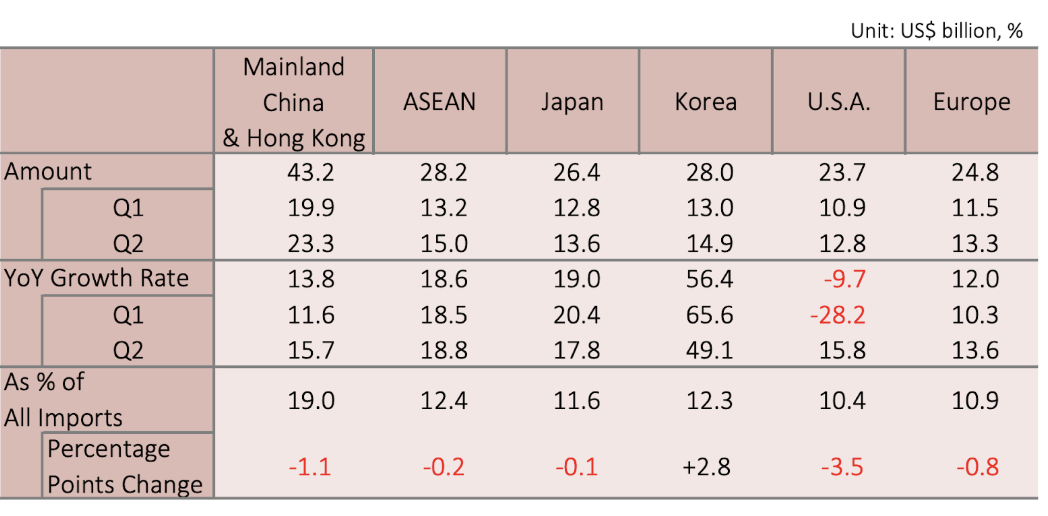
Source: External Trade Report in the First Half of 2025- Taiwanese Ministry of Finance
It is worth noting that the critical minerals supply chain begins with upstream activities, which consist of exploration and extraction. Following extraction, the minerals enter the processing and refining stage, which serves as a bridge between raw mining output and industrial applications. Here, materials are transformed into usable forms. The downstream stages involve the industrialization of refined minerals as they move into manufacturing, where countries have greater opportunities to add value and diversify their production. The chain concludes with end-of-life management, which seeks to close the loop through recycling and reuse, ultimately reducing the demand for virgin materials.
However, the distribution of capabilities across these stages is uneven, and this imbalance creates strategic vulnerabilities. In particular, mineral refining and processing capacity is highly concentrated in the PRC (accounting for almost 70 percent of the market share), posing significant geopolitical risks for Taiwan. Beijing’s imposition of export controls on critical minerals creates vulnerabilities for Taiwan. These factors could potentially lead to an economic blockade, disrupting the upstream of the mining industry and exacerbating supply chain bottlenecks.
A notable example is tungsten, a strategic metal essential to Taiwan’s industrial infrastructure. Taiwan does not produce its own raw tungsten and relies entirely on imports, with approximately 90 percent of its supply originating from China. In February 2025, China added tungsten to its export control list and eliminated value-added tax rebates for raw exports, effectively discouraging global supply and altering market dynamics. Industry managers have warned that a complete disruption in tungsten supply could force “half of Taiwan’s people” to take unpaid leave, highlighting the metal’s strategic importance. Additionally, in October 2025, Beijing introduced sweeping new export restrictions requiring companies worldwide to obtain licenses for any product containing more than 0.1 percent Chinese-origin rare earth elements by value. While Taiwan does not directly rely on China for rare earth elements used in its domestic chipmaking processes, it remains vulnerable through indirect channels—especially via its dependence on semi-finished products and components manufactured in Japan or Southeast Asia that use Chinese-refined rare earth elements.
Hence, diversification is essential for Taiwan to strengthen its industrial resilience and preserve its global competitiveness in high-tech sectors. Critical minerals are indispensable inputs for semiconductors, smart machines, electronics, battery systems, and green technologies. In particular, Taiwan’s semiconductor industry (anchored by firms such as Taiwan Semiconductor Manufacturing Company [TSMC, 台灣積體電路製造公司]), constitutes the foundation of its export economy and strategic position in the international system, given the large market share they hold. Any disruption in the supply of raw materials could pose systemic economic and security risks for not just Taiwan, but for the whole world.
Although Taiwan and Argentina lack formal diplomatic relations, Taipei maintains commercial and cultural engagement through the Taipei Economic and Cultural Office in Argentina (駐阿根廷台北商務文化辦事處). Despite persistent pressure from the PRC, Taiwan has succeeded in promoting economic and institutional cooperation through Memoranda of Understandings (MOUs) between firms, chambers of commerce, and academic institutions. Building on these mechanisms, Taiwan can further advance bilateral ties with Argentina and other resource-rich partners to secure access to critical minerals and enhance the resilience of its industrial supply chains.
Opportunities and Challenges for Taiwanese Investment and Trade
For Taiwan, engaging with Argentina’s critical-minerals sector offers a route to diversify supply chains away from heavy reliance on the PRC and a narrow set of sources. By gaining access to minerals such as lithium, copper, rare earths and germanium from Argentina, Taiwanese firms can strengthen their upstream security of supply for semiconductors, electronics, magnets, battery technologies and smart machines. Given the geopolitical risks associated with China’s dominance in mineral processing and refining, diversification into Argentina is both economically prudent and strategically significant.
Furthermore, instead of being purely downstream manufacturers, Taiwanese firms might explore upstream participation through joint ventures, equity shares, or trade partnerships in Argentina. Notable examples include the memorandum of understanding between the Chinese International Economic Cooperation Association (CIECA) and the Argentine Chamber of Commerce and Services (Cámara de Comercio y Servicios de la República Argentina), as well as the cooperation agreement between CIECA and the Chamber of Industry and Commerce of Mercosur and the Americas (Cámara de Industria y Comercio del Mercosur y de las Américas). This would allow Taiwan to evolve from a passive consumer of raw materials to an integrated actor within the Argentine emerging mining sector, improve value-chain capture, secure supply stability, and reinforce the competitiveness of its high-tech industries.
In the absence of formal diplomatic relations between Taiwan and Argentina, cooperation can advance through provincial and regional levels, particularly in mining-rich provinces, such as Jujuy, Catamarca, and San Juan. Through chambers of commerce, investment promotion agencies, and sister-city agreements, access could be facilitated while circumventing federal-level diplomatic constraints. This decentralized approach would complement existing trade promotion mechanisms and foster ground-level partnerships.
In addition, these engagements may also open doors in neighboring countries for Taiwan to build a regional critical minerals network, strengthen its political and economic position in Latin America’s Southern Cone -Brazil, Paraguay, Uruguay, and Chile-, reduce its diplomatic isolation, and increase its presence in a strategically significant region. Participation in the Argentine mining boom could also enhance Taiwan’s leverage in the global competition over supply chains, particularly vis-à-vis the PRC.
However, the critical minerals sector in Argentina also presents notable challenges for Taiwanese businesses and investors. Geopolitically, the influence of the PRC remains substantial, reinforced by the Belt and Road Initiative (BRI, formerly known as “One Belt, One Road,” 一帶一路) and extensive commercial presence in the country. As of September 2025, China had become Argentina’s second-largest trading partner, with the bilateral trade balance reflecting a USD 6.5 million deficit for Argentina. Moreover, the PRC maintains significant foreign direct investment in strategic sectors including energy, manufacturing, mining, real estate, ICT, infrastructure, agroindustry, and finance.
At the same time, mining operations in Argentina face strict regulations and community opposition, with legislation that limits and restricts mining activity and investment. These issues are compounded by Argentina’s macroeconomic instability, including high inflation and uncertain investment and economic conditions, which may pose financial risks despite recent reforms. Altogether, these geopolitical, environmental, financial, and diplomatic constraints form a challenging landscape that Taiwan must carefully navigate to participate effectively in Argentina’s emerging critical minerals market.
Recommendations
In order to capitalize on the benefits of closer economic relations, Taiwan should:
- Sign an MOU between the Taipei Economic and Cultural Office in Argentina and the Argentine Chamber of Mining Firms [Cámara Argentina de Empresas Mineras]. The MOU should establish a framework for investment and dialogue, including information sharing, high-level reciprocal visits, and matchmaking between Argentine mining firms and Taiwanese investors.
- Direct the Taiwan External Trade Development Council (TAITRA, 中華民國對外貿易發展協會) to organize at least one annual trade mission to the Argentine provinces of Jujuy, Catamarca, and San Juan, focused on identifying trade and investment opportunities in critical mineral sectors. These missions should involve forming a working group among Taiwanese firms interested in diversifying raw material sourcing for semiconductors, as well as relevant Argentine stakeholders (federal, provincial, and regional governments, mining firms, and legislators). Through the Contact Taiwan platform, TAITRA should facilitate linkages between investors and recipients, and specify mining and processing projects suited for Taiwanese participation.
- Coordinate with like-minded partners, such as the United States, Canada, and the European Union (countries that already have significant investments in Argentina) to establish a multilateral forum on critical minerals. The forum would align investment cooperation frameworks and ensure Taiwan’s inclusion in broader supply chain initiatives.
The main point: For Taiwan, the time is ripe to deepen its presence in Argentina’s mining sector; not merely as a buyer of raw materials, but also as a strategic partner in extraction, processing, and supply-chain integration. Doing so would strengthen Taiwan’s techno-industrial base and enhance its economic diplomacy in Latin America.
[1] Critical minerals are defined as any mineral, element, substance, or material designated as critical by the Secretary of the Interior, acting through the director of the US Geological Survey. The Critical Materials List includes the following: Critical materials for energy: Aluminum, cobalt, copper, dysprosium, electrical steel, fluorine, gallium, iridium, lithium, magnesium, metallurgical coal for steelmaking (inclusive of anthracite), natural graphite, neodymium, nickel, platinum, praseodymium, silicon, silicon carbide and terbium. Critical minerals: Aluminum, antimony, arsenic, barite, beryllium, bismuth, cerium, cesium, chromium, cobalt, dysprosium, erbium, europium, fluorspar, gadolinium, gallium, germanium, graphite, hafnium, holmium, indium, iridium, lanthanum, lithium, lutetium, magnesium, manganese, neodymium, nickel, niobium, palladium, platinum, praseodymium, rhodium, rubidium, ruthenium, samarium, scandium, tantalum, tellurium, terbium, thulium, tin, titanium, tungsten, vanadium, ytterbium, yttrium, zinc, and zirconium.