


Winning through Cost Attrition
Since September 2022, Russia has been actively launching Iranian-designed Shahed-136 loitering unmanned aerial vehicles (UAV). Moscow has since domesticated its production (naming its own Shahed drones “Geran-2”), intended to overwhelm Ukraine’s air-defense network and counter the supply of Patriot systems provided by the United States and other key ally states. However, a single Patriot missile costs around USD 3-4 million. Compared to the USD 20,000-50,000 production cost of a Shahed, this presents a clear 100:1 ratio in favor of Russia. [1] This prompted Ukraine to develop its own brand-new GPS-guided loitering UAV titled “The Sting”, costing only USD 2,000 per unit, balancing the unfavorable economic attrition tug-of-war.
In Iran, Washington was unable to adequately counter the launch of several ballistic missiles and Shahed drones targeting American bases or civilian infrastructures. The conflict has pressured the United Arab Emirates, Qatar, Kuwait, and Saudi Arabia to seek purchases of Ukraine’s low-cost interceptor drones rather than the US Patriot system. Moreover, on March 27, 2026, the American Prince Sultan Airbase based in Saudi Arabia was targeted by Iran, damaging a USD 270 million E-3 Sentry AWACS radar aircraft. Thus, Tehran was able to assert pressure on the US ability to monitor and detect future threats from Iran at a relatively low cost.
Both Ukraine and Iran have shown that cheap loitering UAVs have significantly shifted the dynamics of warfare. Taiwan has not been idle throughout the two major conflicts, closely observing the evolution of drone warfare, and reviewing its own existing defense strategy accordingly. Taiwan has planned production of indigenous unmanned surface vehicles (USV) – notably the Sea Shark (海鯊), the Kuai Chi (快奇), and the Endeavor Manta maritime drones – to address the asymmetric challenge it faces from the People’s Republic of China’s (PRC) much larger naval fleet. Drawing inspiration from Ukraine’s use of naval drones, Taipei seeks to counter the People’s Liberation Army Navy (PLAN)’s overwhelming advantage through a similar attritional strategy.
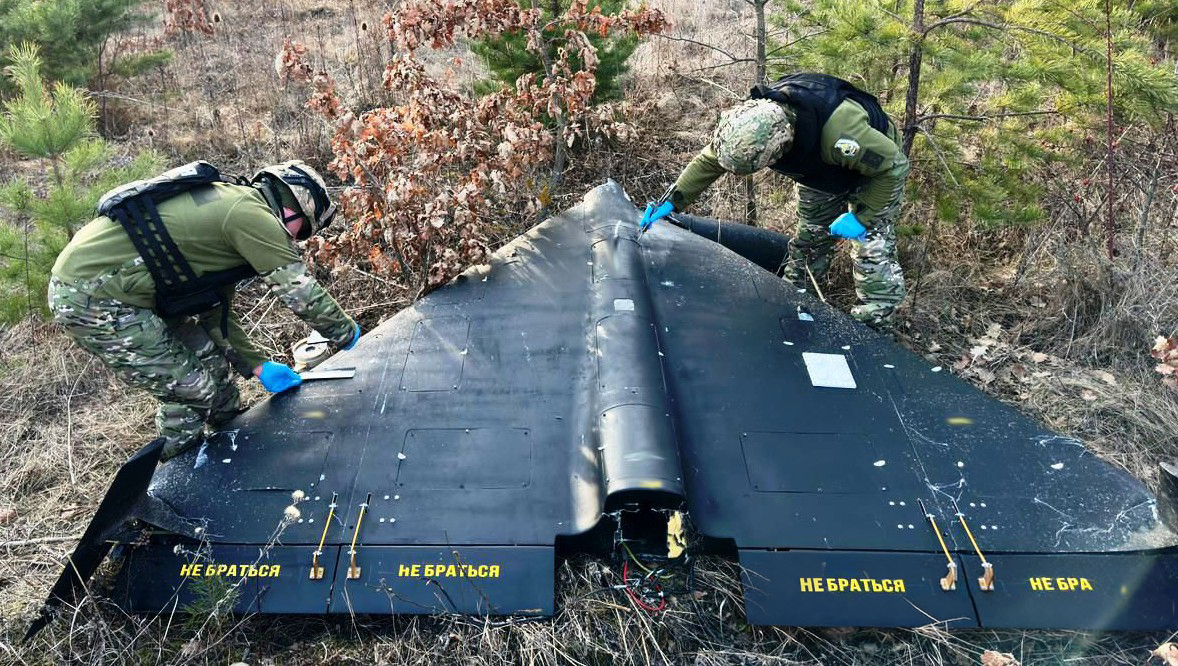
Image: Ukrainian security personnel inspect a Russian Geran drone (modeled on the Iranian Shahed drone) in Vinnytsia Oblast, Ukraine (March 2024). (Image source: Wikimedia Commons / Ukraine National Police)
Funding the Correct War
Given the PRC’s immense material and manpower advantage over Taiwan, the Executive Yuan (行政院) introduced in late 2025 a supplementary defense budget of TWD 1.25 trillion (approximately USD 40 billion). As stated by President Lai Ching-te (賴清德), it included the objective of increasing Taiwan’s defense budget to five percent of its GDP by 2030. Although the decision was welcomed by Washington, critics cited a lack of focus on securing cost-effective capabilities in favor of highly advanced equipment. Taipei’s planned “T-Dome” strategy – which is a multilayered air-defense network inspired by Israel’s Iron Dome – could face a critical vulnerability if China adopts a similar drone-swarm strategy. Even with this backdrop, Taiwan’s drone program remains problematic, mostly covered by promises but little result.
Taiwan’s cheapest air-defense system is the domestically produced Sky Bow (Tien Kung, 天弓). Yet a single Tien Kung-2 or Tien Kung-3 missile costs around USD 600,000. In 2025, Taiwan produced around 100 Tien Kung-3 missiles. The US-supplied Patriot Advanced Capability-3 (PAC-3) comprises a sizable portion of Taiwan’s anti-air arsenal, with a planned reserve of 500 missiles. However, at a cost of USD 3.7 million per missile, it lacks the cost-effectiveness to address a hypothetical Chinese drone swarm strategy. With the People’s Liberation Army Rocket Force possessing an estimated total of 2,000 ballistic missiles and hundreds of land-attack cruise missiles, China can already strain Taiwan’s limited arsenal.
Moreover, Israel’s Iron Dome proved to be out of alignment with the reality of its stockpile: The “Twelve-Day War” in 2025 forced the US to expend 25 percent of its interceptor missiles. In Taiwan, the limited reserve of missiles means that it will likely be selective in intercepting incoming Chinese projectiles. China has already flirted with the concept of a drone swarm to overwhelm Taiwan’s air defenses, using AI to bypass electronic warfare systems. It has also flexed its newly developed Atlas drone swarm operations system, allegedly capable of deploying 48 drones and coordinating 96 drones simultaneously from a single vehicle.
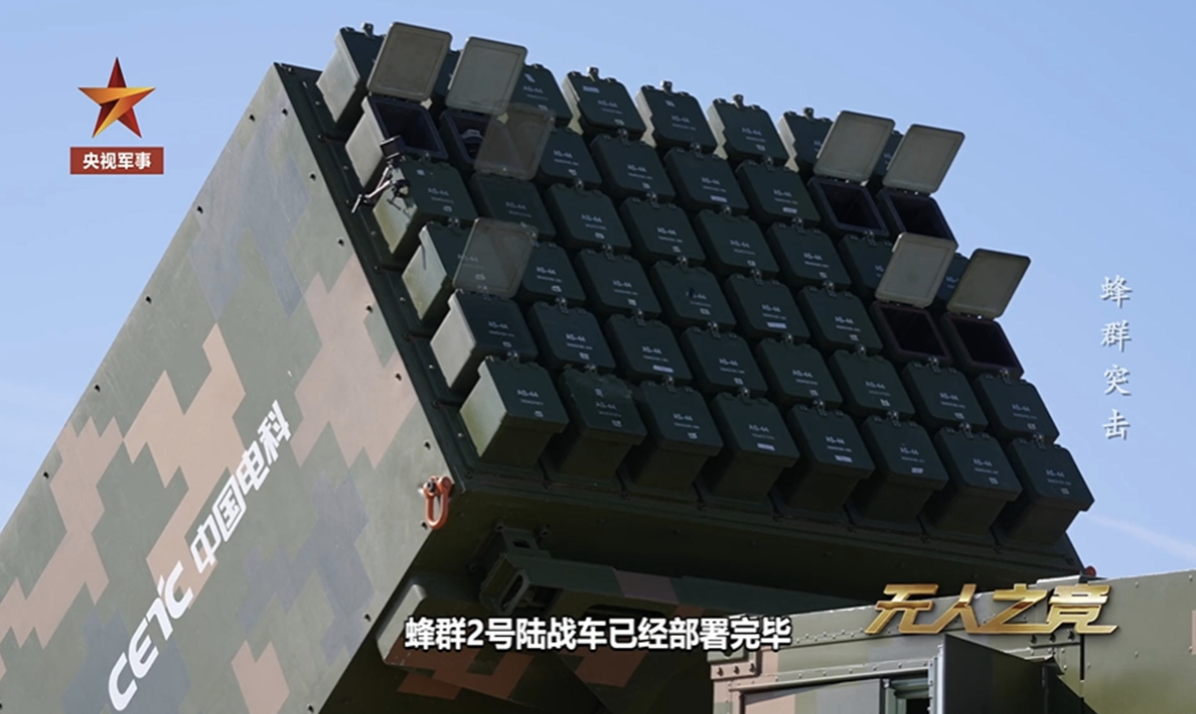
Image: China’s Atlas drone swarm operations system (Swarm-2) in a demonstration video published by CCTV. (Image Source: Global Times)
Adopting Ukraine’s Playbook
Ukraine has had to adapt to the rapidly evolving battlefield landscape, with a key concern that its partners may fail to adequately supply its dwindling arsenal. Moscow’s recent intensification of its winter energy strikes was likely emboldened by the reduction of Patriot missile shipments from the United States under the Trump Administration. Additionally, the continuous, extensive deployment of Geran-2 drones has further strained Kyiv’s ability to counter incoming projectiles, leading to considerable damage to its energy infrastructure and nationwide blackouts.
China’s immense domestic industry suggests it will face few challenges in copying Russia’s and Iran’s drone swarm doctrine. China-based SZ DJI Technology Co., Ltd. (DJI, 深圳市大疆創新科技有限公司) alone accounts for more than half of the world’s commercial drone production, reaching 78.8 percent of the global share since 2019. [2] If required, China’s civilian industries could be relied on to produce one billion weaponized drones annually, a task that would require less than one percent of the PRC’s assembly capacity. Taiwan must rapidly enhance its drone sector amid such an asymmetric race. As of 2026, Taiwan produced approximately 10,000 units per year and aims for an annual production rate of 180,000 by 2028, a figure that presents a daunting reality. Another problem with China’s dominance in the drone market is that Taiwan will also be forced to source components domestically or from alternative partners.
Defense via Procurement and Diplomacy
While Taiwan could secure critical lessons from the conflicts in Iran and Ukraine, it too can adopt essential solutions. Ukraine’s recent low-cost interceptor drones have shown promising results, and Taiwan’s existing technology industry allows it to lay the groundwork for extensive domestic production of similar capabilities. Furthermore, Taipei can also be supplied by foreign partners, as exemplified by the US recent supply of 291 Altius 600M Switchblade loitering drones.
For many years, Taiwan has based its defense doctrine on the “porcupine strategy” (刺蝟戰略), focusing on deterrence through denial by ensuring that a Chinese invasion of the island would prove too costly. A recent report by the Center for a New American Security proposed enhancing Taiwan’s preexisting porcupine defense strategy by adopting the “Hellscape” doctrine, which calls for a high concentration of disposable aerial and maritime drones across the Strait to deter a Chinese amphibious assault. Likewise, steps have been taken to expand Taiwan’s domestic drone production, but the challenge in acquiring components outside of China (“non-red”) has hampered progress. This challenge largely stems from rising costs, with Taiwanese-made drones costing 25 percent more than those produced by DJI.
Taiwan has also deepened its partnerships with key international actors, such as Japan and the Philippines in Asia, as well as Germany, Poland, and the Baltic states. The announcement of a “drone diplomacy” initiative on October 22, 2025, by the Ministry of Foreign Affairs (MOFA, 外交部) paved the way towards greater multilateral cooperation with foreign states to procure and export drones for civilian and military uses. However, closer bilateral agreements with key nations such as Ukraine may provide a better groundwork due to Ukraine’s expertise in drone warfare. The Ukrainian IRON Cluster, a collaborative hub comprising over 200 firms in developing unmanned systems, was invited by the Ministry of Economic Affairs (MOEA, 經濟部) to visit on June 18, 2026, an invitation that symbolized a clear mutual willingness to collaborate. Nevertheless, official dialogues remain closed.
Track II diplomacy, or diplomacy through unofficial and non-state dialogues, is therefore the most feasible option for Taipei to establish crucial supply links and to acquire additional knowledge. The signing of the MOU at the 2025 International Defense Industry Exhibition (MSPO) by Poland, Ukraine, and Taiwan established a third-way link with Ukraine for drone development and research. This success signaled that Taiwan can maintain ties with foreign agencies despite its current limited recognition, while the already established partnership with the United States can continue to serve as a core source of additional components.
The main point: With the rapid dominance of loitering drones, funding in Taiwan’s defense should not be allocated solely to sophisticated weaponry but also to lower-tier capabilities to effectively enhance the island’s porcupine strategy against a much larger China. Whilst Taipei should further intensify its indigenous production to meet the required quota for a hypothetical war against Beijing, it should also continue to pursue cooperation with relevant foreign partners to accelerate development towards a more resilient shield based on cost imposition and a steady lifeline.
[1] Pokorny, Laszlo. 2026. The Economics of Asymmetric Attrition: A Quantitative Analysis of Low-Cost Drone Warfare in the Ukraine and Iranian Shahed Programs (2022-2026). New Jersey: ICL Institute. doi:10.5281/zenodo.18919501.
[2] Chen, Jin. 2023. “Platform Strategies of the Chinese Commercial Drone Manufacturer: A Theoretical and Empirical Study of Ecosystem Development.” International Relations and Diplomacy 11 (4): 145-160. doi:10.17265/2328-2134/2023.04.001.

_(cropped).jpg)