


Introduction
The month of November has seen an extraordinary, and continuing, diplomatic feud between Japan and the People’s Republic of China (PRC): one set off by rival positions over Taiwan, and the implications of a Taiwan conflict for the security of Japan and other Asia-Pacific states. The heated diplomatic rhetoric involved—which has included the PRC foreign minister stating that Japan “crossed a red line,” and even apparent threats of violence made by a PRC diplomat against Japan’s prime minister—has far exceeded in tone the normally cautious and indirect language traditionally employed in Asia-Pacific diplomatic discourse. The timing and circumstances surrounding these events suggest that the PRC leadership has made a conscious decision to press a harder line against Japan: both to gauge the reaction of Japan’s new government, and as a warning to other regional states that might consider offering further security support for Taiwan in the face of Chinese pressure.
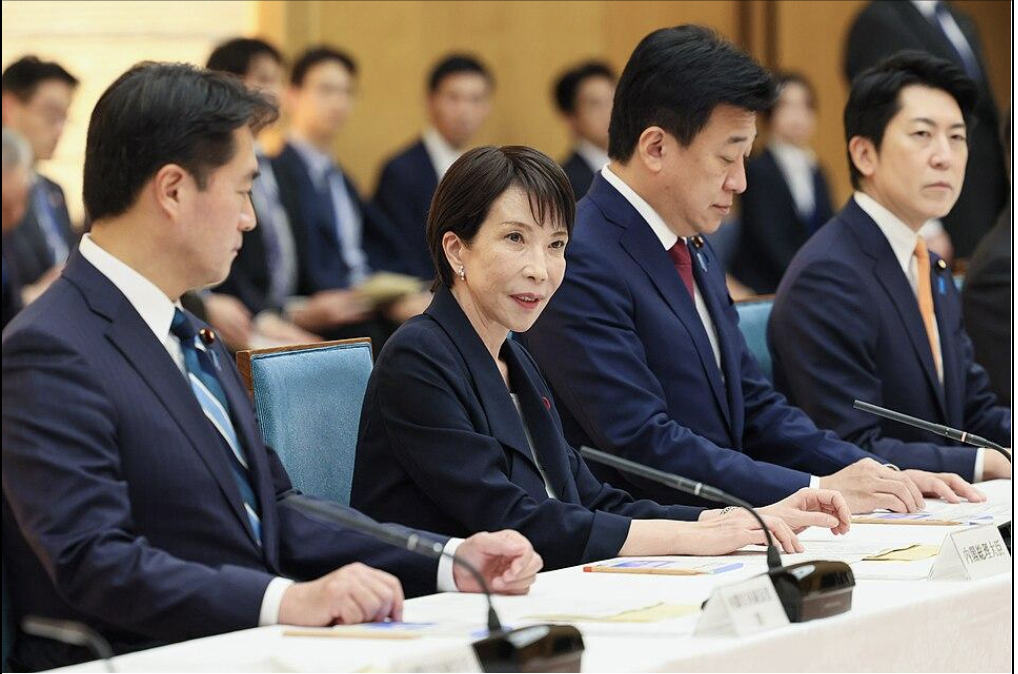
Image: Japanese Prime Minister Sanae Takaichi presiding over her first parliamentary deputy ministers’ meeting after assuming the prime ministership (Oct. 22, 2025). (Image source: Japanese Cabinet Public Affairs Office / Wikimedia Commons)
Japanese Prime Minister Takaichi Stakes Out a Clearer Stance on “Survival-Threatening Situations” Related to Taiwan
The current diplomatic dust-up began on November 7, when Japan’s newly-appointed Prime Minister Sanae Takaichi, while responding to questions during a meeting of the budget committee in the lower house of Japan’s Diet, stated that China’s use of military force against Taiwan—to include a scenario such as a naval blockade—would represent a “survival-threatening situation” (存立危機事態, sonritsu kiki jitai)) that would require a Japanese response.
The language used by Prime Minister Takaichi in this instance was significant: it echoes the text of Japan’s 2003 Act on the Peace and Independence of Japan and Maintenance of the Security of the Nation and the People in Armed Attack Situations, etc., and Survival-Threatening Situations, which states that “the national government has the responsibility to respond to armed attack situations, etc. and survival-threatening situations with all of its organizations and functions, and ensure that all possible measures are taken by the whole nation.” While such language remains vague, a “survival-threatening situation” has been widely interpreted as one that could justify military action. For example, the 2019 edition of the Defense of Japan report, issued by the Japanese Ministry of Defense, stated that:
[A] “Survival-Threatening Situation” [applies] to the situations to which Japan is to respond as an armed attack since even if it occurs against a foreign country it could threaten Japan’s survival as well, depending on its purpose, scale and manner. Following this, the [Self Defense Force] Law was also amended to define responses to such a situation as one of the SDF’s primary duties as unavoidable self-defense measures for Japan’s defense… [1]
Prime Minister Takaichi, who assumed office in mid-October as Japan’s first-ever woman prime minister, was known to represent a trend of increasingly hawkish and China-skeptic thinking within the ruling Liberal-Democratic Party (LDP) (to the extent that the LDP’s long-standing governing partner, the more dovish and China-friendly Komeito Party, abandoned its coalition with the LDP as a result of Takaichi’s ascendency). That said, Takaichi’s comments on November 7 were largely consistent with a pattern in recent years of Japanese political leaders expressing increasing concern about a rising security threat from China, and identifying Taiwan’s security as a serious issue for Japan. [2] The difference in Takaichi’s remarks was less the content of what she said, and more the directness with which she said it. Her comments could perhaps be interpreted as moving further away from Japan’s version of a “strategic ambiguity” policy, by directly linking Japan’s own security with the security of Taiwan.
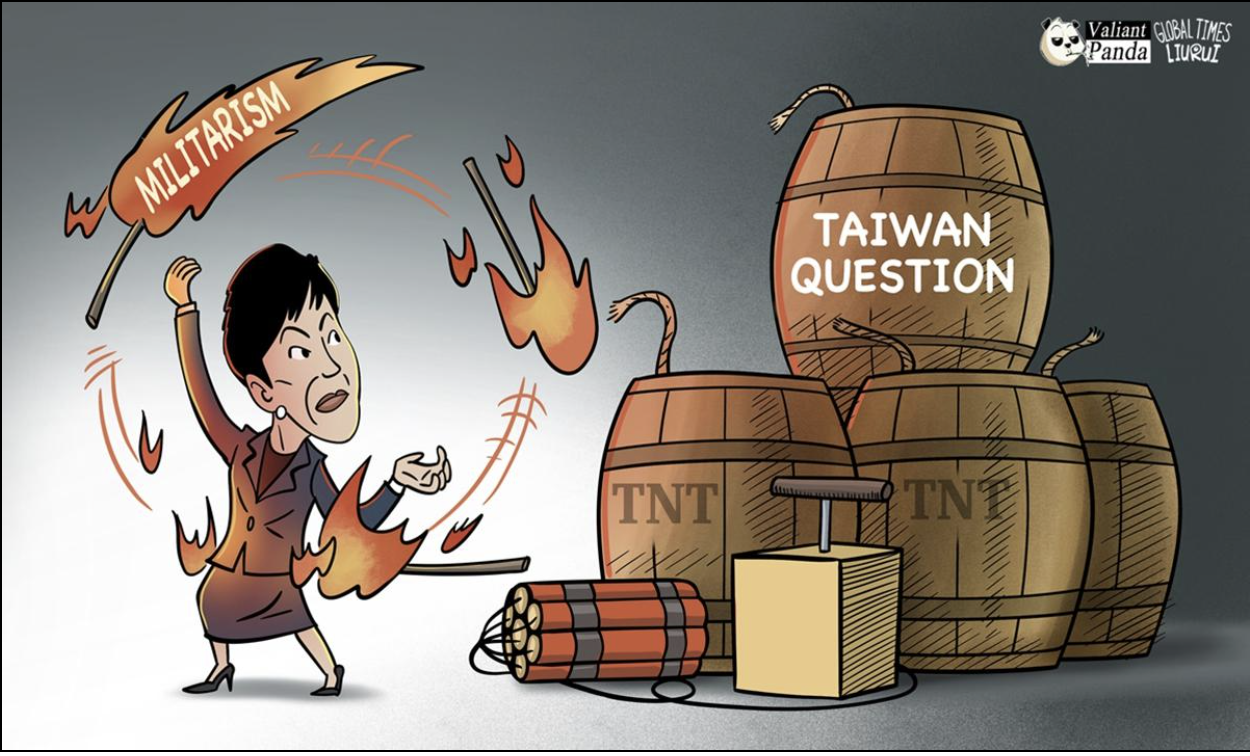
Image: A PRC state media cartoon depicting Japanese Prime Minister Sanae Takaichi literally playing with the fire of “militarism,” and threatening to set off a conflict over Taiwan. (Source: Global Times)
The CCP Leadership Decides to Pick a Fight
While inflammatory nationalist rhetoric is par for the course in the CCP’s current era of “wolf warrior” diplomacy, the ferocity of the response from the PRC exceeded even the normal baseline. On November 8, Xue Jian (薛剑), the PRC consul general in Osaka, referenced Takaichi’s comments in a post on the platform X and declared that “the dirty neck that sticks itself in must be cut off.” While that inflammatory post was taken down, it was followed by a sustained campaign of condemnation directed against Takaichi by official PRC sources, as illustrated below.
“Zhong Sheng” Commentaries in The People’s Daily
The People’s Daily (人民日报), the official mouthpiece publication of the Chinese Communist Party (CCP), commenced publication of a series of editorials under the pseudonym “Zhong Sheng” (钟声) (“bell sound,” but also a homonym for “voice of China”), which is employed to emphasize the CCP’s official position on foreign policy issues. A November 14 “Zhong Sheng” editorial detailed a litany of Japanese historical crimes against China, and asserted that:
Takaichi’s absurd fallacy of interfering on Taiwan is utterly isolating political nonsense; behind this are Japanese right-wing forces breaking through the restraints of the peaceful constitution, conspiring for a bigoted and arrogant “military great power” position. […] Against this background, Takaichi has linked together the “Taiwan problem” and right of collective self defense; this is seeking a pretext for Japanese military expansion, and contains perilous signs of a resurgence of militarism. [3]
Another exemplary “Zhong Sheng” editorial on November 19 stated that:
Japan’s Prime Minister Takaichi has brazenly advocated for the possibility of armed intervention in the Taiwan Strait, crudely interfering in China’s internal affairs, [and] has made no effort to repent and reform [herself], refusing to retract the mistaken speech. […] In the face of fundamental questions of right and wrong, Chinese people will be explicitly clear. The Taiwan problem is a core interest of China; whoever touches this red line, the 1.4 billion people of China, and the entire Chinese race [or nation], will never agree! […] As a country that carried out wars of aggression in past times, and a country that in past times carried out crimes in Taiwan too numerous to record, Japan should learn the lessons of history, and more cautiously handle its involvement with the Taiwan problem. Japan risks universal condemnation if it insists on tying itself to the cart of breaking up China, [and] it will inevitably suffer the results of its own evil actions. [4]
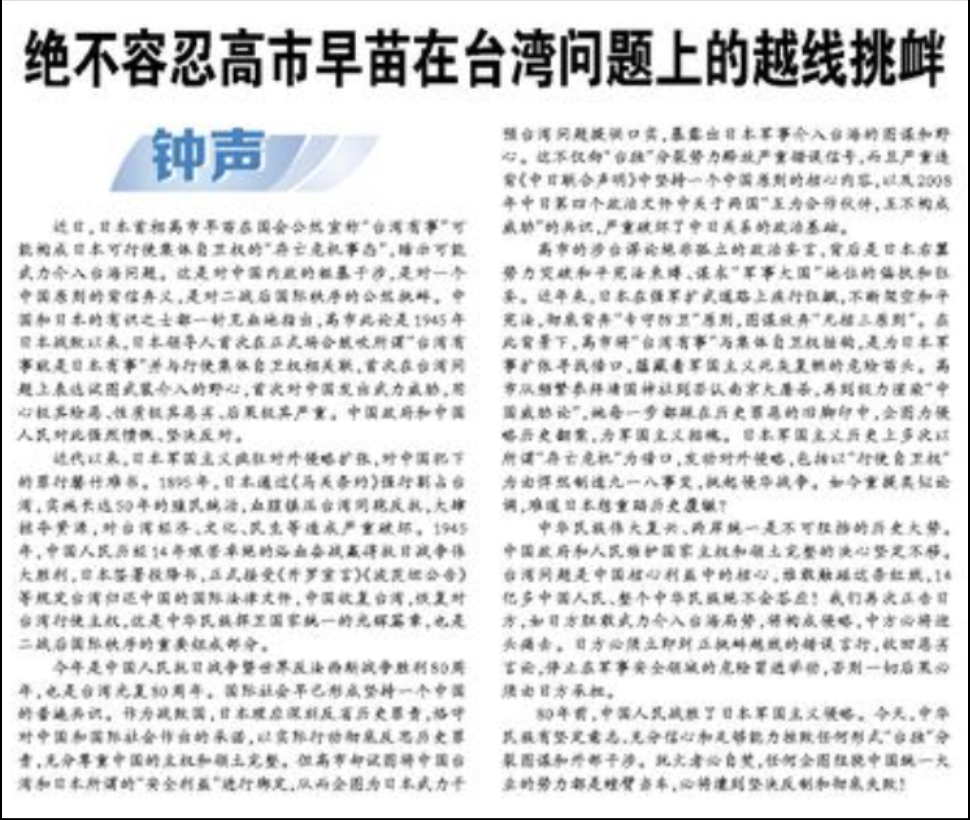
Image: The People’s Daily “Zhong Sheng” editorial of Nov. 14, 2025, titled “Never Tolerate Sanae Takaichi’s Line-Crossing Provocation on Taiwan” (绝不容忍高市早苗在台湾问题上的越线挑衅). The “Zhong Sheng” banner is used to indicate an authoritative CCP position on a foreign policy issue. (Image source: People’s Daily)
Broadsides from the PRC Foreign Ministry
At the official PRC foreign ministry press conference on November 10, spokesman Lin Jian (林剑) declared that “the Japanese leader blatantly made wrongful remarks on Taiwan at the Diet that imply the possibility of armed intervention in the Taiwan Strait. It constitutes a gross interference in China’s internal affairs […] What signal is the Japanese leader trying to send to ‘Taiwan independence’ separatist forces? Is Japan up to challenge China’s core interests and stop its reunification? […] For the leader of Japan to try to wade into cross-Strait affairs is an affront to international justice […] China must and will achieve reunification.”
On November 21, the PRC brought its dispute with Japan to the United Nations (UN) when Fu Cong (傅聪), the PRC ambassador to the UN, sent an open letter to UN Secretary-General António Guterres. The letter posited Japan as an aggressor, stating that Takaichi’s comments represented “the first time Japan has expressed ambitions to intervene militarily in the Taiwan question; and the first time Japan has issued a threat of force against China, openly challenging China’s core interests.” The letter went on to further assert that “Takaichi’s remarks constitute a grave violation of international law and the basic norms governing international relations,” and that “Taiwan is China’s sacred territory. How to resolve the Taiwan question is a matter for the Chinese people and brooks no foreign interference.” Most strikingly of all, the document attempted to lay the blame on Japan for any potential conflict, by stating that “If Japan dares to attempt an armed intervention in the cross-Strait situation, it would be an act of aggression. China will resolutely exercise its right of self-defence under the UN Charter and international law and firmly defend its sovereignty and territorial integrity.”
On November 23, the PRC Foreign Ministry released a statement by Foreign Minister Wang Yi (王毅), which called Takaichi’s comments “shocking,” and stated that she had “crossed a red line” with her comments regarding a Taiwan crisis. This was accompanied by the unveiling of a new official propaganda slogan (宣传标语口号) in PRC state media, using the numerology frequently favored in CCP discourse: in this case, the “Three Never-Allows” ( 三个“绝不允许”) in regard to Japan and Taiwan. These three assertions are:
- “China will never allow Japanese right-wing forces to turn back the tide of history” (中方绝不允许日本右翼势力开历史倒车); and
- “Never allow foreign forces to encroach on China’s Taiwan area” (绝不允许外部势力染指中国台湾地区); and
- “Never allow a revival of Japanese militarism” (绝不允许日本军国主义死灰复燃). [5]
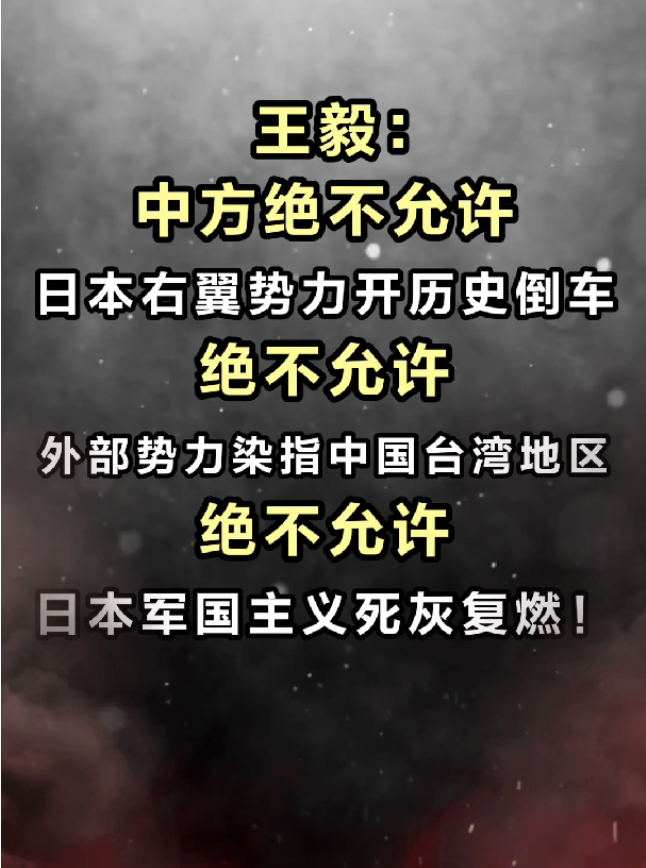
Image: A still image from an animated PRC media video laying out the “Three Never-Allows” nominally formulated by PRC Foreign Minister Wang Yi, and directed at Japan in the wake of Prime Minister Takaichi’s November 7 comments. (Image source: Beijing Daily Online)
Restrictions on Trade and Exchange
The PRC has also made efforts to punish Japan that go beyond the purely rhetorical, by taking steps intended to target the Japanese economy. The Chinese government has restricted tourism, issuing a November 14 advisory against travel to Japan on grounds that Japan was an unsafe environment for Chinese citizens. In the wake of the announcement, many large Chinese travel companies began cancelling tours to Japan, with some also reporting that they had halted applications for processing tourist exit visas intended for travel to Japan.
On November 19, the Chinese government announced a ban on Japanese seafood products. (The PRC had only just lifted an earlier ban on Japanese seafood imposed in August 2023, following the discharge of water from the Fukushima power plant.) At the announcement of the new ban, PRC Foreign Ministry spokesperson Mao Ning (毛宁) claimed that the new ban was related to safety issues, but also asserted that Takaichi’s remarks had created “strong public outrage in China,” and that “Under the current circumstances, even if Japanese seafood was exported to China, there would be no market [for it].”
The Chinese government has also restricted the exchange of cultural products, by freezing licensing reviews for Japanese films and cancelling a large number of planned concerts by Japanese musicians. (On November 29, Japanese singer Maki Otsuki was stopped in the middle of a song during a concert in Shanghai; and the next day, pop musician Ayumi Hamasaki performed to a 14,000 seat empty performance venue after her show was cancelled.) At a November 25 foreign ministry press conference, Mao Ning commented on the restrictions on Japanese cultural products by saying that “Exchanges and cooperation between China and Japan have recently been affected because of the erroneous remarks made by the Japanese Prime Minister Sanae Takaichi on Taiwan. The remarks gravely hurt the sentiments of the Chinese people and poisoned the atmosphere for exchanges between the two countries.”
The Reactions from Tokyo, Taipei, and Washington
Japan
In the face of the multi-faceted rhetorical barrage from the PRC, the response of the Japanese government has been relatively muted. In response to the Fu Cong letter, Japan’s UN Ambassador Kazuyuki Yamazaki called the letter “inconsistent with the facts and unsubstantiated”—a far softer tone as compared to the intemperate accusations made by the PRC. In comments before Japan’s legislature on November 26, Takaichi indicated that it was in Japan’s interests to advance a “constructive and stable” relationship with China through dialogue, and that Japan was open to talks with the PRC.
Takaichi has not, however, withdrawn her comments about “survival-threatening situations” regarding Taiwan and the PRC—and currently, she has little reason to do so. Takaichi maintains very high approval ratings in Japan; and, while it will take time to see how the continuing controversy plays itself out in Japanese domestic politics, it is possible that the PRC’s intemperate attacks on her could actually rebound in her favor—by winning the favor of Japanese voters who admire her forceful stance, and who are angered by the nature of the PRC response.
Taiwan
As the state at the center of the China-Japan dispute, the Republic of China (ROC) Foreign Ministry did issue a forceful statement on November 11, at the outset of the controversy, which took aim at the PRC assertion that discussions of Taiwan represented interference in China’s “Internal affairs.” The statement indicated that:
The Ministry of Foreign Affairs of the Republic of China (Taiwan) solemnly reiterates that the ROC (Taiwan) is a sovereign, independent nation; that its sovereignty belongs to the Taiwanese people; that neither the ROC (Taiwan) nor the People’s Republic of China is subordinate to the other; and that the PRC has never governed Taiwan. […] China has no right to dispute these facts or to interfere in the sovereign actions of other countries. China’s statements underscore its hegemonic mindset and demonstrate that it is a troublemaker intent on unilaterally changing the international order.
Aside from this initial press release, for the following two weeks the reaction of Taiwan’s government was relatively subdued in tone—with the Lai Administration likely making the calculation that, amidst an intensifying diplomatic stand-off, any more direct involvement in the dispute would be self-defeating. The government apparently decided to signal its support for Japan in more subtle ways: as ROC President Lai Ching-te (賴清德) did on November 19, with a social media posting of himself eating sushi (see image below).
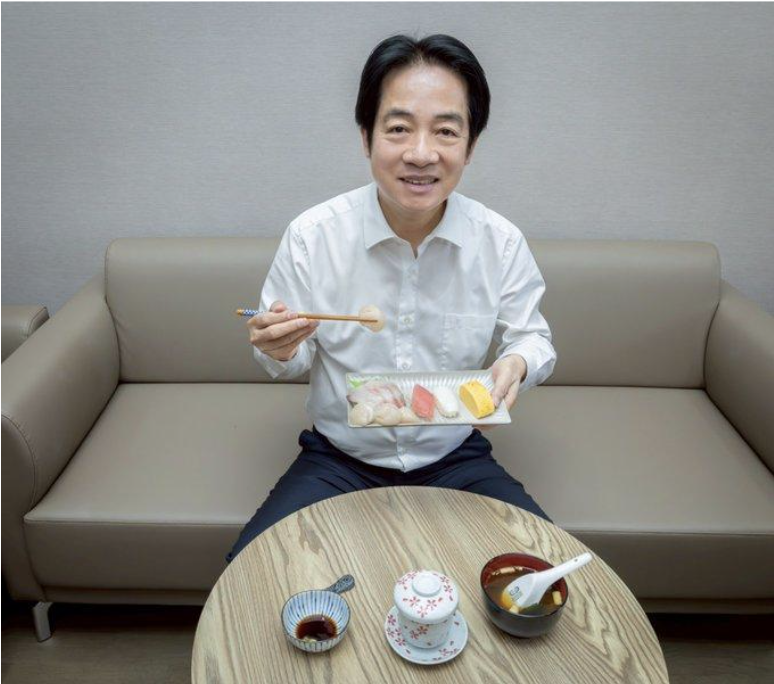
Image: Taiwan President Lai Ching-te eating sushi, in a social media posting intended to signal support for Japan in the midst of the diplomatic dispute with the PRC (Nov. 19, 2025).(Source: Lai Ching-te X Account)
On November 25, in response to reports of a phone call between US President Trump and CCP General Secretary Xi Jinping (see below), ROC Premier Cho Jung-tai (卓榮泰) asserted in comments at the Legislative Yuan that “reunification” with China was “not an option” for Taiwan, and “that the Republic of China, Taiwan, is a fully sovereign and independent country […] The 23 million people of Taiwan do not have a ‘reunification’ option. This is very clear. Taiwan is the world’s Taiwan.”
United States
The government of the United States has largely refrained from any public involvement in the China-Japan diplomatic dispute, as the Trump Administration seeks to balance the traditional US alliance with Japan against Trump’s expressed desires for a trade deal and state visit to the PRC.
The most noteworthy involvement was a Trump-Xi phone call on November 24, in which the issue of Taiwan was reportedly raised, among other topics. (This contrasts with the Trump-Xi meeting in South Korea on October 30—in which, according to official read-outs, Taiwan was not discussed. This was generally regarded by most observers as a positive thing for Taiwan.)
While the specific contents of the November 24 call are unknown, the official PRC summary of the call sought to align the position of the USA with that of China, as victors in World War II: “President Xi outlined China’s principled position on the Taiwan question [and] underscored that Taiwan’s return to China is an integral part of the post-war international order. China and the U.S. fought shoulder to shoulder against fascism and militarism. Given what is going on, it is even more important for us to jointly safeguard the victory of WWII.” President Trump’s own summary of the call, as presented via his Truth Social account, omitted any mention of Taiwan. It stated that he had: “a very good telephone call with President Xi, of China. We discussed many topics including Ukraine/Russia, Fentanyl, Soybeans and other Farm Products, etc. […] Our relationship with China is extremely strong!”
The following day, November 25, President Trump held a phone call with Prime Minister Takaichi. While the contents of that call have not been made public, media reporting has indicated that Trump told Takaichi to avoid further actions that might inflame the dispute with Beijing. For its part, the Japanese foreign ministry issued a vague summary of the call indicating discussion of the “various challenges facing the Indo-Pacific region,” and that “the two countries will continue working closely under the current international situation.”
Conclusions
The intensity of the PRC diplomatic offensive against Japan is striking, even by the standards of the increasingly intemperate “wolf warrior” diplomacy practiced under Xi Jinping. The narrative ferocity of the campaign—including histrionic claims of Japanese “fascism” and revived “militarism”—as well as its sustained endurance (now continuing for three weeks) both indicate that it is unlikely to end soon. The CCP leadership has clearly made a decision to make the geopolitical equivalent of a “brush-back pitch” against the Japanese prime minister: one intended both to deter any further movement by Japan towards security support for Taiwan, as well as to send a warning to other governments in the region.
Some international observers have already stepped forward to criticize Takaichi as bearing responsibility for sparking the crisis, or have even appeared on PRC state media outlets to back CCP narratives about alleged Japanese “militarism.” By completely disregarding the background of steadily escalating PRC coercive military pressure against its neighbors (most particularly Taiwan, the Philippines, and Japan), such commentary blames regional countries for their response to PRC actions—rather than the precipitating PRC actions themselves. It is as if events in World War II, now more than 80 years ago, are directly relevant to the current situation in the Asia-Pacific region—but that events over the past five years are not.
Such interpretations also bear a rough analogy to accepting at face value Russian government narratives that its aggression against Ukraine is a self-defensive move in the face of NATO expansion. Such narratives invert cause and effect: we are led to believe that irredentist aggression on the part of authoritarian states is not the problem; but rather, that efforts at collective defense among liberal-democratic states subject to such threats are the crux of the problem.
Such commentary also reveals naivete regarding the extent to which Beijing’s foreign policy actions are calculated: it takes PRC government actions at face value as emotional expressions of aggrieved nationalism, justified by past historical wrongs committed against China. Rather, such incidents represent occasions in which the Chinese political leadership has chosen to be outraged, as a conscious decision to set off a crisis that the CCP views as serving its interests. In this sense, Beijing’s reaction to Takaichi’s comments is somewhat analogous to the supposedly spontaneous PLA military exercises that followed the visit to Taiwan by then-US Speaker of the House Nancy Pelosi in 2022 (see here and here).
These incidents illustrate a common CCP practice, which I propose to designate “calculated opportunistic strategic outrage” (COSO). COSO plays an important role in the narrative / information manipulation aspects of CCP political warfare. COSO incidents, when backed by Beijing’s diplomatic, economic, and military clout, play a significant role in psychologically conditioning both foreign and domestic audiences to conform to the CCP’s preferred policies.
The effort that Beijing has put into the current diplomatic offensive against Japan indicates a high level of leadership investment in the issue—which in turn is indicative of the high priority that the CCP leadership places on isolating Taiwan from sources of international support. This campaign is likely to continue in the coming weeks—and it will not be the last COSO campaign of its kind.
[1] Japanese Ministry of Defense, Defense of Japan 2019, chapter 5, section 2, p. 248. https://www.mod.go.jp/en/publ/w_paper/wp2019/pdf/index.html.
[2] For example, during a visit to Taiwan in early December 2021, former Prime Minister Shinzo Abe publicly stated in a public speech that a “Taiwan emergency is a Japanese emergency, and therefore an emergency for the Japan-U.S. alliance. People in Beijing, President Xi Jinping in particular, should never have a misunderstanding in recognizing this.” See: “Former Japan PM tells China, ‘a Taiwan emergency is a Japanese emergency’,” CNN, December 1, 2021.
https://edition.cnn.com/2021/12/01/asia/abe-japan-china-taiwan-intl-hnk.
[3] “Never Tolerate Sanae Takaichi’s Line-Crossing Provocation on Taiwan” (绝不容忍高市早苗在台湾问题上的越线挑衅), People’s Daily, Nov. 14, 2025. https://paper.people.com.cn/rmrb/pc/content/202511/14/content_30114836.html. (“高市的涉台谬论绝非孤立的政治妄言,背后是日本右翼势力突破和平宪法束缚、谋求“军事大国”地位的偏执和狂妄。[…] 在此背景下,高市将“台湾有事”与集体自卫权挂钩,是为日本军事扩张寻找借口,蕴藏着军国主义死灰复燃的危险苗头。”) Translation by the author.
[4] “Poisoning China-Japan Relations Will Inevitably Backfire” (毒化中日关系必将自食恶果), People’s Daily, Nov. 19, 2025. https://world.people.com.cn/n1/2025/1119/c1002-40606647.html. (“日本首相高市早苗公然鼓吹武力介入台海的可能性,粗暴干涉中国内政,且不思悔改,拒不撤回有关错误言论。[…] 在大是大非问题面前,中国人绝不含糊。台湾问题是中国核心利益中的核心,谁敢触碰这条红线,14亿多中国人民、整个中华民族绝不会答应!今年是中国人民抗日战争暨世界反法西斯战争胜利80周年,也是台湾光复80周年。作为昔日的侵略战争发动国,作为曾在台湾犯下罄竹难书罪行的国家,日本应该汲取历史教训,更加慎重处理涉台问题。日方冒天下之大不韪,执意将自己绑上分裂中国的战车,必将自食恶果。”) Translation by the author.
[5] “Wang Yi’s Latest Declaration to Japan: The Three Never-Allows” (王毅对日最新表态:三个绝不允许) China News Net, Nov. 23, 2025, https://xinwen.bjd.com.cn/content/s69228463e4b02424b0c35e3f.html.


.jpg)