Non-state actors now play a significant role in international relations, and this undoubtedly includes cities. City diplomacy, a form of subnational diplomacy, is defined as “the conduct of external relations undertaken by official representatives of cities with other actors, particularly other cities, nation-states, NGOs, and corporations.” Due to intensive political pressure from the People’s Republic of China (PRC), Taiwan experiences great difficulties in maintaining its diplomatic presence on the international stage, let alone forging formal relations with other countries. City diplomacy offers Taiwan a strategic solution to stay in the game, by creating a subnational platform that allows foreign countries to circumvent the concerns of formally recognizing Taiwan’s statehood. Such efforts by the city of Kaohsiung provide a great example as to why Taiwan should leverage city diplomacy to advance its foreign policy goals.
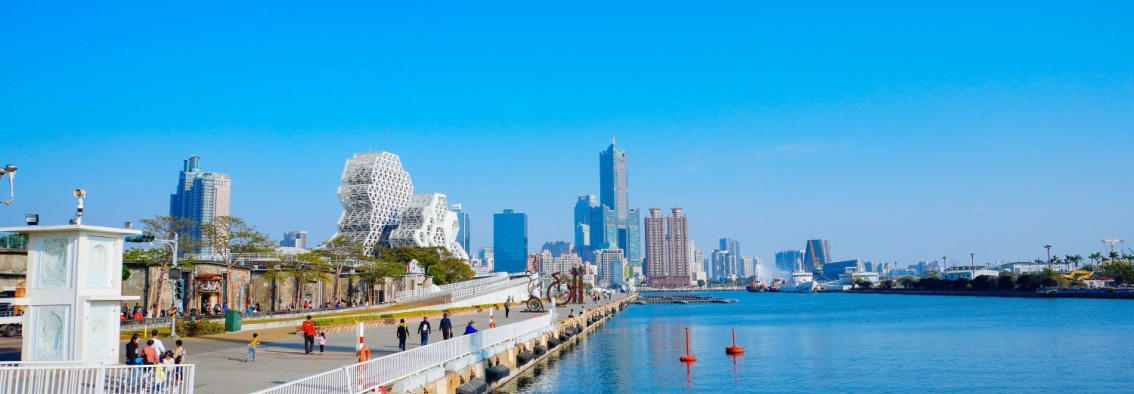
Located in southwestern Taiwan, Kaohsiung is Taiwan’s second largest city with a population of 2.7 million, and boasts a history as the biggest port and heavy-industrial base of the country. As Taiwan rapidly drives its national development towards a high-tech economy, Kaohsiung is also striving to transform from an industrial city into a metropolis based on technology, cultural industries, and tourism. Alongside the focus on industrial transformation, the Kaohsiung City government also demonstrates a strong determination to expand its international engagement. Current Kaohsiung City Mayor Chen Chi-mai (陳其邁) has repeatedly emphasized on different occasions that it is crucial to deepen exchanges with global partners, contribute to international cooperation, and enhance the city’s visibility.
Bilateral Relations Focusing on Education and Industries
City-to-city bilateral relationships, often conducted under the frameworks of “sister cities” or “partnered cities,” constitute an integral part of Kaohsiung’s international outreach. So far, Kaohsiung has 45 sister-city partnerships–ranking No.2 in Taiwan, second only to Taipei’s 53 partners. While having many friends is always better than having none, what truly matters is how much substantial collaboration actually occurs. In Kaohsiung’s case, frequent educational exchange proves the point. Chang Yen-ching (張硯卿), the director-general of the Department of Administrative and International Affairs of the Kaohsiung City government, suggests that educational exchange is central to these sister-city ties. She discloses that every time the Department obtains a new sister city, the next step is always to reach sister-school agreements with institutions in that city. [1] As an article by the Lowy Institute reveals, it only took 2 months for Kaohsiung and Orange County, New York, to announce a school exchange memorandum of understanding (MOU) after they inked a sister-city agreement this April. To this point, Kaohsiung has created 220 sister-school ties. “Politicians will step down and parties will rotate, but collaboration between schools is long-lasting. Once routine communication between schools is established, with the support of parents, the schools will continue this work spontaneously,” said Director-General Chang. [2]
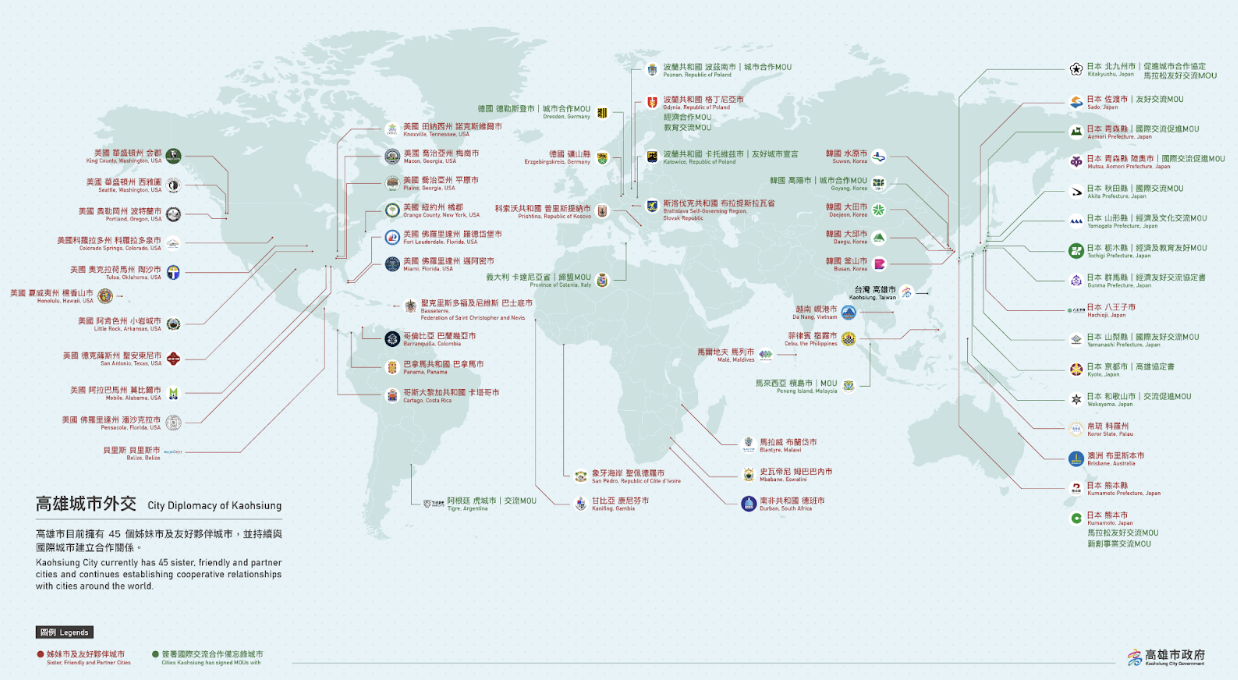
Image: A map of Kaohsiung’s city-to-city partnerships. (Image Source: Kaohsiung City Government)
Kaohsiung also prioritizes exchanges with cities facing similar industrial conditions. Take Gdynia as an example: known for its harbor on the Baltic coast of Poland, Gdynia’s economy centers on port and shipbuilding industries, highly resembling Kaohsiung’s industrial structure. Based on shared interests and experiences, two sides kicked off cooperation in 2023 when Deputy Mayor Bartosz Bartoszewicz visited Kaohsiung to discuss net-zero policies, smart transportation, and port operations. In March 2025, Gdynia Deputy Mayor Bartłomiej Austen spoke at the Kaohsiung Smart City Summit & Expo, sharing perspectives on Gdynia’s data-driven governance and civil participation initiative. Prior to the official agreement being signed in October 2025, senior officials from both cities have already exchanged five visits within two years, underscoring how highly both cities valued this partnership.
In September 2025, an MOU Concerning the Establishment of City Cooperation was inked between the Kaohsiung and Dresden, Germany. Nicknamed the “Silicon Valley of Europe,” Dresden is now the largest semiconductor cluster in Europe. Last year, Taiwan Semiconductor Manufacturing Company (TSMC, 台灣積體電路製造股份有限公司) invested its first European wafer fab in Dresden. Meanwhile, TSMC is leading a plan to construct five wafer fabs in Kaohsiung. Therefore, during Kaohsiung’s trip to Dresden in September, much attention was paid to address shared challenges brought by the semiconductor industry. The delegation visited fabs and schools, exchanging on talent cultivation, energy supply, and broader cooperation on research and development. According to the Kaohsiung city government, the two sides agreed on fostering substantial collaboration based on aligned industrial conditions and development goals.
Leveraging Multilateral Networks to Respond to Global Challenges
Beyond bilateral relationships, Kaohsiung also advances its city diplomacy through participation in multilateral cooperative regimes that tackle transnational challenges. This July, the Head of European Economic and Trade Office in Taiwan (EETO) Lutz Güllner met with Kaohsiung Mayor Chen and invited the city to be a member of the International Urban and Regional Cooperation (IURC), a European Union (EU) initiative promoting sustainable urban development through global city network. After being officially announced as a formal partner in September, Kaohsiung has already participated in two online sessions with dozens of cities, presenting its policy achievements in smart water management, intelligent transportation systems (ITS), and rural shared mobility service. In November, a delegation took part in the IURC Global Thematic Networking Event alongside the Smart City Expo World Congress (SCEWC) 2025 held in Barcelona, Spain. The delegation interacted with over 130 cities and regions, and particularly held two in-depth dialogues with delegations from the Barcelona metropolitan area and Hamburg, Germany, exchanging experiences on smart transportation and AI-driven urban governance. Director-General Chang Yen-ching indicated that having official delegations from Kaohsiung at the IURC event and SCEWC opens up opportunities for Kaohsiung to develop substantial collaboration with European cities.
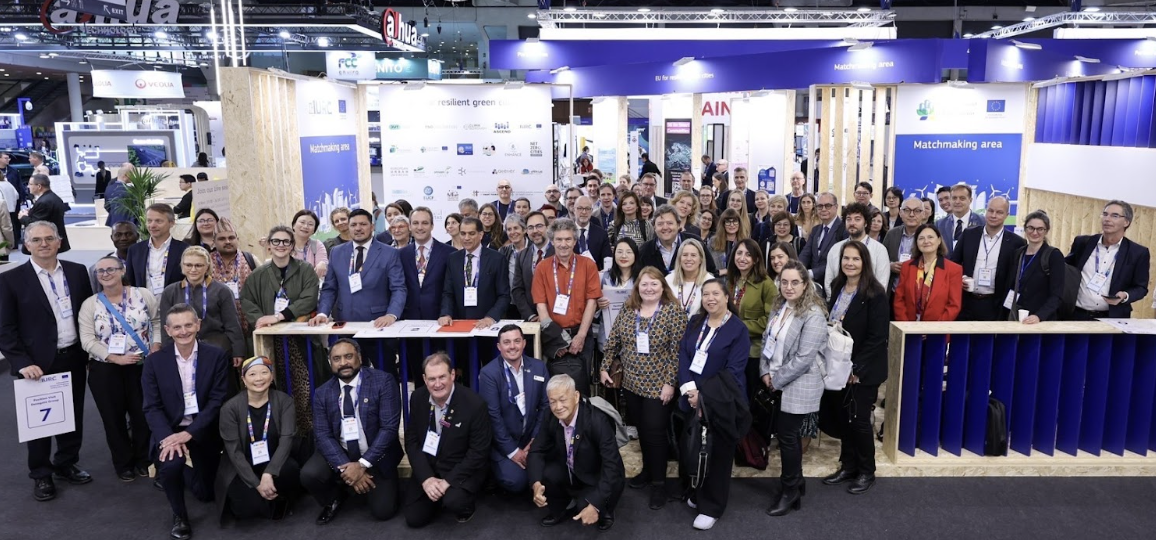
Image: The first IURC Global Thematic Networking Event was held in Barcelona, Spain, where delegations from Kaohsiung participated as a formal partner. (Image Source: Kaohsiung City Government)
In October 2024, Kaohsiung became the first local government in Taiwan to co-host a Global Cooperation and Training Framework (GCTF) International Workshop. Convening experts and representatives from 21 countries, the workshop centered on climate change impacts and marine policies, an area where Kaohsiung possesses strong expertise due to its rich experience in port city governance. In his opening remarks, Deputy Mayor Lo Ta-sheng (羅達生) introduced the city’s climate mitigation and blue economy initiatives such as low-carbon agriculture and fishing practices, ocean carbon sequestration projects, and mangrove plantingLo emphasized Kaohsiung’s desire to facilitate international cooperations on climate and marine issues through this GCTF workshop. GCTF has long been a critical platform for Taiwan to engage with like-minded countries on countering transnational challenges and for the world to learn from Taiwan’s valuable lessons. The presence of the Kaohsiung City Government in this workshop demonstrates that local governments are capable of interacting and collaborating with key partners of Taiwan.
Kaohsiung’s participation in both IURC and GCTF illustrates the significance of multilateral mechanisms for the city’s diplomacy. First, these platforms enable Kaohsiung to apply its governance expertise in meaningful international cooperation. Second, this participation reflects the international community’s growing recognition of Kaohsiung as a vital partner in addressing shared challenges in areas like sustainable urban development and ocean governance. Third, through active involvement, Kaohsiung showcases its unique strengths and identity as Taiwan’s biggest harbor city, thereby amplifying its global influence.
Building Positive Images and Deepening Dialogues through Cultural Engagement
Cultural diplomacy is another linchpin of Kaohsiung’s international outreach. There is a growing discussion of Kaohsiung’s concert economy in the news, as global super stars–like Coldplay, Ed Sheeran, and Bruno Mars–have chosen Kaohsiung, instead of Taipei, as the Taiwan destination of their world tour. Recent coverage of the Asia tour by the K-pop group Blackpink indicated that the two-day concert series at Kaohsiung National Stadium generated over NT$300 million (US$9.8 million) in tourism revenue, with nightmarkets seeing sales jump by 30 percent.
While cultural activities accelerate a city’s tourism and economic growth, their impact extends far beyond just the economic sphere. In recent years, the municipal government has partnered with foreign embassies in Taiwan such as Japan, France, and Spain in organizing large-scale cultural events that promote cultural exchanges. For example, the 2025 Sunshine Island Vibe Fest, in partnership with four representative offices in Kaohsiung–the United States, Japan, the Philippines, and Thailand–gathered over 140 thousand visitors to enjoy food, music, and arts at the Kaohsiung Central Park. The event featured Southeast Asian immigrant communities as its main theme, encouraging local residents to interact with immigrants, meet foreign cultures, and embrace diversity. Such public events not only celebrate friendship with foreign countries and cultural diversity in the city, but they also enable citizens to understand the essence of international engagement by directly involving them in the process. According to Director-General Chang, a survey done by her department shows that over 90 percent of respondents acknowledge Kaohsiung’s growing international visibility and affirm that these events elevate the city’s positive global image. [3]
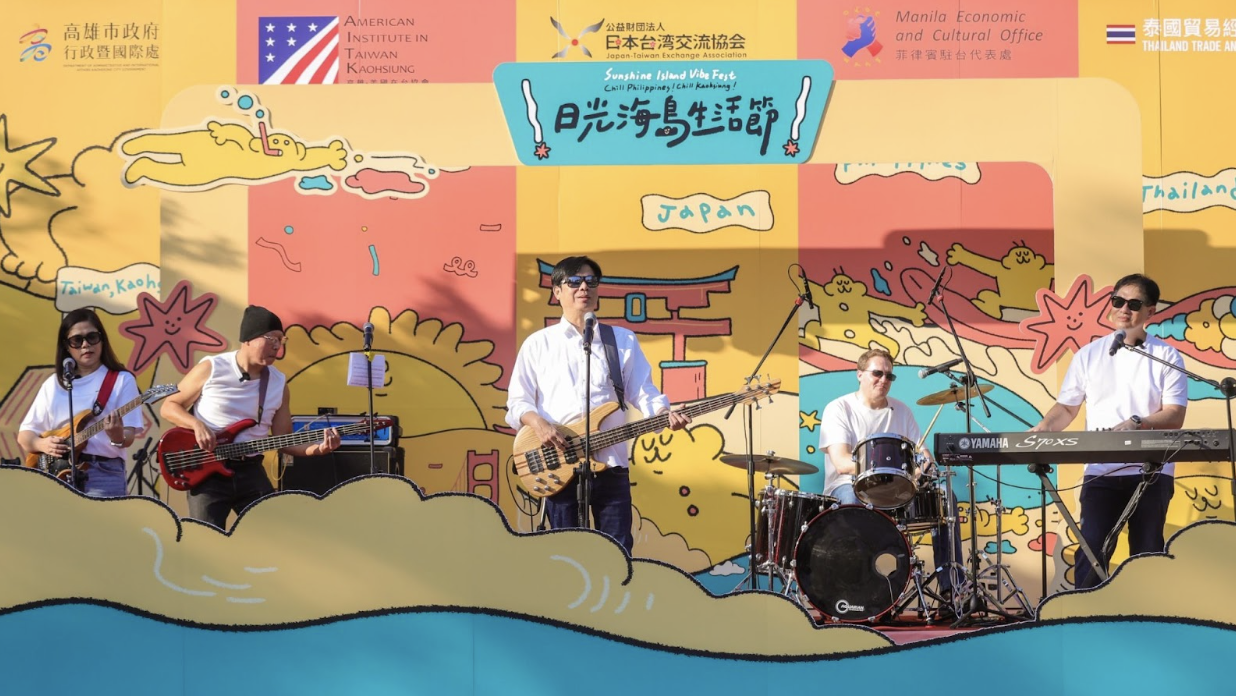
Image: Kaohsiung Mayor Chen Chi-mai, Branch Chief Neil Gibson of the American Institute in Taiwan Kaohsiung Branch Office, Director General Masafumi Oku of the Japan-Taiwan Exchange Association Kaohsiung Office, Director Ma. Karina Bercasio Perida-Trayvilla of the Manila Economic and Cultural Office Kaohsiung Extension Office, and Director Nutchyawach Sanguanchaiyakrit of the Thailand Trade and Economic Office Labor Division formed a band to promote the Sunshine Island Vibe Fest. (Image Source: Kaohsiung City Government)
While authorities handle official cultural exchanges, many more extensive interactions occur at the civil society level. The Pier 2 Artist in Residence (PAIR) program exemplifies the people-to-people ties flourishing in Kaohsiung. Initiated in 2015, the program provides financial support to artists from all over the world and accommodates them at the Pier-2 Art Center. During their residency, artists are able to explore the city, exchange with other artists, and participate in public events organized by the Center. At the end of their residency, artists curate an exhibition that showcases what they have accomplished during their stay, often blending in memories, knowledge or techniques they acquired from the community. For instance, two artists wrote in their final exhibition that the artwork “draws inspiration from Kaohsiung—its architecture, coastal landscape and cultural memory shaped by divine protection—interweaving themes of reverence and shelter.”
In addition to the residency program, PAIR also organizes the Waving Waves Community (WWC) International Art Forum to connect art institutions in neighboring countries, invoking dialogues between arts and global issues. Through attending roundtables, workshops, and public talks, stakeholders–including institutions, curators, and artists–discuss how arts and culture can respond to transnational challenges and forge cooperations. Some topics in the past include port governance, diversity and inclusion, and emerging technologies. By bringing international artists and art organizations together in Kaohsiung, PAIR allows artists to learn the city through physical experience and represent it through their artistic interpretations. The program not only deepens international understanding of Kaohsiung, but also positions the city as a hub for cross-cultural dialogue and collaboration.
Political Pressure from the PRC
Even though municipal engagement usually does not raise Beijing’s alarm, sometimes it still encounters disruption. One such incident dates back to 2013, when Kaohsiung and Male (the capital of Maldives) signed their sister-city agreement. A day after the pact was inked, the Maldivian Ministry of Foreign Affairs declared that the agreement was invalid, due to the government’s “firm conviction of one-China policy.” The declaration underlined China’s role as an important development partner for Maldives, and the Maldivian government’s eagerness to maintain close ties with the Chinese government.
Such disruption against city-to-city ties could be contextualized under the framework of PRC political warfare, where Beijing leverages all kinds of influence to isolate Taiwan’s international standing. The recent case of Edinburgh, Scotland postponing an official partnership with Kaohsiung further illustrates how PRC sways foreign governments to not interact with Taiwanese cities in an official capacity. In June 2024, a draft to establish a formal sister-cityhood between Edinburgh and Kaohsiung was proposed in the Edinburgh City Council. Knowing this, the PRC representative in Edinburgh, Zhang Biao (張飆), soon requested a meeting with the Scottish government and claimed that this proposal “will bring about serious consequences.” At the same time, Edinburgh’s business, tourism and education sectors all expressed their concern regarding potential sanctions by the Chinese government if Edinburgh proceeded with the proposal. Organizations like Edinburgh Airport and Essential Edinburgh warned that they may face a decline in the number of flights from China, as well as the number of Chinese students and visitors. A report by the city council even worried that the risk of cyber-attacks against the council might increase.
The city council eventually put the proposal on hold, but later passed a resolution on “Relationship with the City of Kaohsiung,” indicating Edinburgh’s continued willingness to strengthen cooperation with Kaohsiung in various areas. While exchanges between Kaohsiung and Scotland continue, the entire incident clearly attests to Beijing’s willingness to use every tool it has–political, economic, coercive, and inducing–to restrict Taiwan’s global presence, including sister-city agreements.
Conclusion
Despite occasionally suffering from PRC interference, city diplomacy in most cases functions smoothly for Taiwan, as such engagement focuses on pragmatic issues of municipal governance and prioritizes reciprocal exchanges. As Taiwan continues to flourish in its democratic governance, technological innovation, and economic growth, Taiwanese cities possess valuable lessons to offer like-minded cities and their people. Kaohsiung’s efforts to internationalize itself through expanding bilateral relations, participating in multilateral cooperation, and deepening cultural connections have definitely set a model for other cities. The city has successfully spotlighted its experience in urban transformation, port management and marine governance to advance its diplomatic practices. As Director-General Chang Yen-ching said, “We want to let the world know that Taiwan is more than just Taipei 101. We are telling the world what ‘Kaohsiung experience’ means and what Kaohsiung has to offer the world.” [4]
The main point: As China intensifies pressure on Taiwan’s official diplomacy, city diplomacy presents a strategic avenue for Taiwan to broaden its international engagement. Kaohsiung, a major southern city with a distinctive maritime heritage and expertise in port governance, has emerged as a leader in this effort. The city actively cultivates sister-city ties, partakes in multilateral cooperative frameworks, and hosts international cultural activities. Despite periodic interference by Beijing, Kaohsiung’s global partnership continues to thrive, demonstrating the resilience of municipal-level diplomacy in circumventing national-level constraints.
[1] Author’s interview with the Director-General of Department of Administrative and International Affairs of Kaohsiung City government, Chang Yen-ching, November 16, 2025.
[2] Ibid.
[3] Ibid.
[4] Ibid.