
Since taking office in May of last year, Taiwanese President Lai Ching-te (賴清德) has carried out sweeping military reforms. However, alongside these changes, it may be time for the Taiwanese government to refocus on retention and promotion among its small cohort of US service academy-trained officers—an issue that Taiwan’s Control Yuan (監察院) briefly investigated in 2023. Doing so will foster military leaders who are better prepared to implement Lai’s defense reforms, advance modern military doctrine, and integrate with US military forces—abilities that could help alleviate some of the Pentagon’s operational concerns over a potential US intervention in a Taiwan contingency. To raise retention and promotion, however, the government will need to increase pay and implement a separate accelerated promotion pipeline.
Taiwan’s US Service Academy Officer Program
Military reform in Taiwan has never been easy. The Kuomintang (KMT, 國民黨), which maintained total domination of the military up until 2000, built the armed forces around a mindset of Chinese nationalism, and a focus on a conventional force structure nominally oriented towards reconquering the Chinese mainland. While the military has long since shifted to a defensive posture, much of its nationalist mindset persists—a fact demonstrated by military leadership’s historic resistance to procuring weapons conducive to asymmetric warfare.
To combat this institutional rigidity and modernize military leadership, the Taiwanese government spends hundreds of thousands of American dollars every year to send some of its top cadets to US military academies.
However, despite the Taiwanese government’s best efforts, none of these officers has stayed within the ranks for a full 20-year career after graduation—let alone remaining in service long enough to be promoted to flag officer rank where their US military education would most affect military policy. In fact, most of these officers only stay for the minimum service requirement of ten years.
In response to concerns in the Legislative Yuan (LY, 立法院), the Taiwanese Control Yuan ordered the military in November 2023 to investigate why such officers tend to leave early. In the two years since this investigation began, there have been no reported results and the government seems to have forgotten the issue entirely.
Why Taiwan Needs to Refocus on its US-Trained Officers
In light of the Lai Administration’s focus on military revitalization, Taiwan needs its US-trained officers now more than ever. Retaining these servicemembers and increasing their influence through promotion will help facilitate the administration’s defense reforms, modernize the military, and improve the military’s ability to seamlessly operate with US forces.
Since President Lai begun his term, the Ministry of National Defense (MND, 國防部) has carried out significant military reforms at breakneck speed. These changes, ranging from replacing bayonet training with modern hand-to-hand combat to implementing unscripted drills, all aim to move the military towards becoming a more modern and capable force. However, while reforms are necessary, old habits die hard. Regular officers and non-commissioned officers (NCO) who lack significant off-island training find themselves unprepared to carry out these changes at the rate the administration is making them. This not only hinders modernization, but—according to on-the-ground reports—is causing greater rates of burnout and exhaustion among servicemembers.
While Taiwan-trained leadership and the rank-and-file may find adapting to these reforms difficult, US service academy graduates are well-equipped to carry them out and guide their colleagues. Indeed, they have spent four years in the United States studying and practicing the very military modernization that President Lai seeks to introduce. If Taiwan can better retain these officers, and even promote them to flag officer ranks, they will be able to streamline modernization efforts and address gaps in training and doctrine that other officers may not see.
Better retaining US-trained officers will also alleviate the Pentagon’s logistical concerns when considering whether the American military should intervene in a conflict over Taiwan—intervention that Taiwan’s defense strategy ultimately relies on.
A US intervention to defend Taiwan involves major logistical complications. Breaking up or preventing a People’s Liberation Army (PLA, 中國人民解放軍) blockade of Taiwan would require flawless coordination between the US and Taiwanese militaries, especially in the early stages where both navies would likely focus on creating a maritime corridor to Hualien in eastern Taiwan.
This means both militaries need to improve interoperability and learn how the other fights, which, in an ideal world, requires large-scale joint military drills and rehearsals—something the United States so far is unwilling to do in the face of Beijing’s political pressure. This lack of familiarity poses real risks when conducting large-scale operations. At an event at the Hudson Institute in July, US Navy Rear Admiral (ret.) Mark Montgomery echoed this sentiment and mused, “I have a son stationed in Japan. I jokingly say that my number one worry is his ship gets sunk by a Chinese weapon. My number two worry is a US Army weapon. We’ll set that one aside. But my number three worry is a Taiwan weapon, and I say their Navy should worry about us doing the same to them.”
While US-trained officers cannot replace the need for joint exercises, US service academy graduates intimately understand American strategy and tactical methodologies—know-how that would allow for more effective communication between the two armed forces.
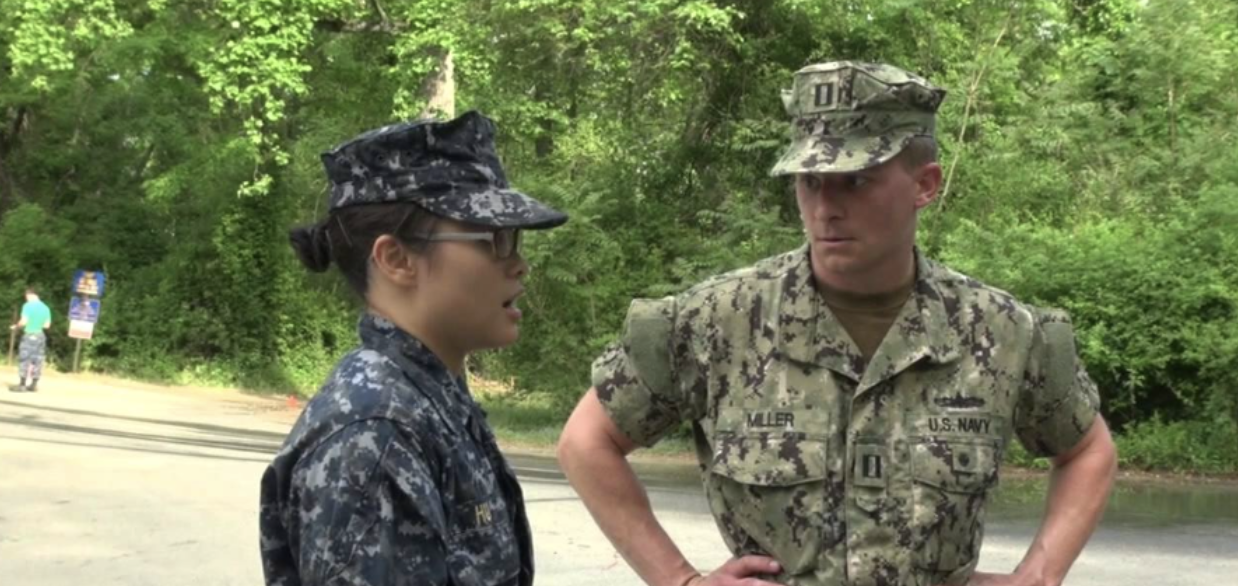
Image: Hu Chao-lin, a cadet from Taiwan training at the US Naval Academy in Annapolis, MD, speaking with a faculty instructor (May 2015). (Image source: CNA / YouTube)
Why Taiwan Struggles to Retain These Officers
For many reasons, Taiwan has long struggled to retain its small cohort of US service academy graduates. Yet, two major factors stand out: historically low pay and poor career mobility. While the Lai Administration has sought to address some of these issues, the government can still go further.
Low Pay
Across the board, below-average pay has persistently disincentivized Taiwanese officers from staying the full 20 years. While the Lai Administration has instituted significant pay increases over the past few months, there is still room for improvement.
As recently as 2024, a newly-minted second lieutenant made about NTD 52,210 (USD 1,626) a month in total pay—about NTD 6,500 (USD 200) below what is considered middle class in Taiwan. Under the 2024 pay scale, an officer’s base pay would not reach the minimum threshold for what is considered middle class until they reach the rank of captain, and would not surpass the 2022 median household income until they become a colonel—a rank that typically requires at least 20 years of service.
Compare these statistics with those of US officers, where a second lieutenant already makes enough in base pay to qualify as middle class. US officers reach the American median income by captain, and attain upper middle-class as lieutenant colonels.
According to one Taiwanese West Point graduate, the pay issue was particularly salient. In a phone interview, Yujen Lien (連于仁), of West Point’s 2009 graduating class, stated that although his time in Taiwan’s military was a generally positive experience, he ultimately decided to leave after the minimum ten years so that he could pursue a career at TSMC with a higher salary and a better work life balance.
Lien is not alone in sharing this sentiment. Indeed, of the 4,172 volunteer service members who opted for early discharge in 2023, 52.2 percent cited better civilian job opportunities as their primary reason.
To its credit, the Lai Administration is taking steps to address low pay. Beginning April 1 of this year, the Lai Administration increased the military’s monthly NTD 10,000 (USD 320) stipends to offset base pay for volunteer service members: with junior, mid-ranking, and flag officers seeing a 50 percent, 40 percent, and 30 percent increase respectively. Front line officers in combat units saw even greater increases.
These increases translate into new second lieutenants earning a total of NTD 58,000 (USD 1,850) a month—just enough to be considered middle class in Taiwan. While this is a positive development, it still only puts servicemembers on par with their US counterparts’ base pay. What’s more, these stipend increases are regressive with rank, which disincentivizes long-term promotion. Additionally, officers who are forced out of direct combat roles due to promotion may risk losing additional combat-related stipends.
Limited Job Opportunities
Though the military offers job stability, Taiwanese society views its armed forces unfavorably. It is therefore difficult for veterans to find employment. This sentiment has two origins: the military’s history of serving as the enforcement arm of KMT authoritarianism; and the general public’s perception of the armed forces’ unprofessionalism.
Taiwanese society has long distrusted the military. Under the KMT’s command, the military enforced martial law on the island for 40 years until 1987. This period, known as the White Terror (白色恐怖), saw the military enforcing KMT repression, including carrying out arrests and executions. While this history may not be as relevant to the younger generations, the older generation remembers this period well—and many of them are employers.
Besides distrust caused by history, the Taiwanese public has historically viewed the military as incompetent. While the government has recently implemented overhauls, conscripted military training has a reputation for being nothing more than glorified summer camp. Due to these impressions, military experience is less impressive to employers than it is in the United States.
Exacerbating this trend, US service academies—despite being comparable in certain metrics to Ivy League schools—do not possess the same name recognition in Taiwan as they do in the United States. Yujen Lien noted that this made it more difficult for him to land job interviews, forcing him to pursue a master’s degree at a Taiwanese university to become more competitive.
Recommendations
If the government hopes to encourage US service academy-educated officers to stay in the military long-term, it will need to increase its financial incentives and improve the armed forces’ reputation in the civilian world.While the administration’s recent stipend increases will likely help improve recruitment and retention at the lower ranks, the government can do more to incentivize long-term retention by implementing progressive stipend increases by rank—a change that would model the US military.
To further incentivize US-trained officers to remain long-term, the Taiwanese government may consider creating a separate pay scale for these officers with an accelerated promotion pipeline. Because there are so few of these officers, higher pay would not significantly burden the defense budget.
Other governments have successfully implemented dedicated pay scales for employees with highly-desired skillsets. The US government, for example, provides separate, higher pay scales from the regular general schedule (GS) scale for professionals in highly sought-after fields (like STEM or law) to try to match what these individuals could earn in the private sector.
Additionally, by creating an accelerated promotion pipeline, the Taiwanese government would not only elevate these officers’ influence in military command but also offer them greater career potential. If the military were to allow these officers to reach higher ranks in a shorter time, it would incentivize US service academy graduates to serve longer. Such a promotion system would also render them more competitive in the civilian world post-retirement.
Finally, in order to further improve post-service employability, the military must also enhance the public perception of its professionalism—a task easier said than done. However, the government has taken positive steps in this area, such as increasing the mandatory conscription period, overhauling military training, and prioritizing asymmetric doctrine. While it is too early to tell if these actions have shifted public opinion, polling from 2023 suggests that the general public overwhelmingly supports such changes.
If the government hopes to change public opinion, the administration will need to press on with these sorts of reforms—progress that President Lai seems resolved to continue.
The main point: As Taiwan continues to rapidly reform its military, its need for US-trained officers will grow. If the MND wishes to incentivize these officers to stay in the military long-term, it will need to increase their pay and improve post-military employability by implementing an accelerated promotion pipeline.