
Few were expecting anything out of the ordinary when Taiwan’s Ministry of Foreign Affairs (外交部) and the Ministry of Culture (文化部) first unveiled its “Taiwan Culture in Europe 2025” initiative. The program, which ran from September to December 2025, featured about 70 lectures, performances, and exhibitions by notable figures from Taiwan’s arts and culture scene. Highlights included the works of Professor Hsieh Sheng-Min (謝省民), whose show, “Gloria: Taiwanese Artist Hsieh Sheng-Min’s Religious and HOPE artworks,” married Taiwan’s folk style with elements of Catholicism. Then there was “100 Treasures, 100 Stories,” a groundbreaking exchange of antiquities between Taiwan’s National Palace Museum (NPM, 國立故宮博物院) and the National Museum of the Czech Republic, which resulted in the European debut of the NPM’s priceless Jadeite Cabbage.
Even though the program made history by introducing NPM artifacts to a new European audience, the programming didn’t exactly make waves like another Taiwanese cultural initiative: the “Formosa : Finland : Fest.” While its name gave little away, the musical event (also known as “F:F:F”) promised to be a milestone in Taiwan’s cultural outreach, because it centered on a genre hardly synonymous with diplomacy: death metal.
Rowdy Diplomacy
It may be difficult to reconcile the idea of heavy, aggressive metal music with the more delicate, nuanced language that characterizes traditional diplomatic outreach—but the organizers were not deterred. Formosa : Finland : Fest, which took place on November 27, 2025 in Finland’s capital Helsinki, brought some of the biggest names in Taiwan death metal to the Scandinavian country. The lineup included Flesh Juicer, Crescent Lament, and Chthonic—whose lead singer, Freddy Lim Tshiong-Tso (林昶佐), currently serves as Taiwan’s Representative to Finland. Taiwan’s homegrown bands were joined by Finnish groups Korpiklaani and Lost Society. In an interview with CNA, Lim stated that the event, which saw many of the songs performed in the Taiwanese language, drew “unusually strong participation from Finnish politicians.”
The elevation of Taiwan death metal onto the global stage might seem a bit discordant for a genre whose fans and performers are used to occupying the fringes of Taiwan’s music society. In an interview with this author, Frank Chu of the Taipei death metal band Second Round pointed out that even though the genre has made waves, “we [metal musicians] are in the minority, you know. The popular music in Taiwan is always pop.”
Nonetheless, it made sense that F:F:F was staged in Finland, a country that is arguably the global ground zero for metal music. Jere Tala, Finland’s Deputy Representative to Taiwan, told this author that “[Finland] is the best platform to experiment with this new language of diplomacy. It has the highest number of metal bands per capita in the world. We have thousands and thousands of different kind of metal bands. And of course, there’s a lots of different subgenres within metal. And for us, metal is definitely not niche—it’s mainstream music.”
Testing the Island’s Metal
Mainstream or not, heavy metal has had a role in Taiwan society for decades—at least since the 1980s, when the band Assassin burst on the scene. As with many fans who view metal as a form of emotional catharsis, musicians like Chu also see the pugnacious tones of death metal as an effective outlet for negative emotions. “Modern people suffer from overwork,” said the musician, whose day job is that of a sales representative for the Taiwan branch of a multinational firm. “Some people are frustrated with what our government is doing … so the more frustration we have, the more angry [we are and the more songs we produce].”
But Taiwan’s metal scene doesn’t just produce music that catalogues society’s grievances. Dharma, one of Taiwan’s best known metal bands today, marries Buddhist sutras and metal music to create an irresistible sound that its band members say demonstrates acts of devotion to the Buddhist religion. In a 2021 interview with Buddhist Door, band founder Jack Tung said, “All of our song lyrics are classic Buddhist mantras. Through our music our audience, our stage crew, or anyone behind their phone/computer screen is blessed by the mantras. Anyone who searches for any of our songs online will inevitably come in contact with Buddhism, and with that we’ve accomplished our goal.”
Spirituality is also a component of the music of Chthonic and Freddy Lim—who likely became Taiwan’s coolest diplomatic representative when he went on stage to perform with his band at F:F:F. Lim weaved his trademark metal sound around the concept of reincarnation by telling the story of a man who relives some of Taiwan’s most traumatic political events in his summer hit, “Endless Aeons.” Lim told this author that the song is a tribute to his grandfather, whom Lim discovered only recently to have been a victim of Taiwan’s White Terror martial law era.
In a May 2025 interview with this author’s International Community Radio Taipei (ICRT) podcast, Lim shared that “in 2017, most of the political archives were opened by the parliament, by the government, and also most of the archives were put online. So in 2023, I decided to check on my grandfather’s names or my relatives names, to see. I was curious to see if there were any names of my family’s in the political archives.” It was then that Lim discovered that the 228 Incident was more personal than he realized: “I just found out that my grandfather was arrested during the 228 Incident and after he was bailed out, he and his family—which means my mother—they escaped from city to city. They moved a lot. My mother and my aunts didn’t know anything about that before I found it.”
“Because I care about, [and] I am so close with those victims and work on all those human rights activities… I thought that I was helping others. But after I found out [about my grandfather] there was a different energy driving around in my heart. I want to write a song about this feeling,” said Lim.
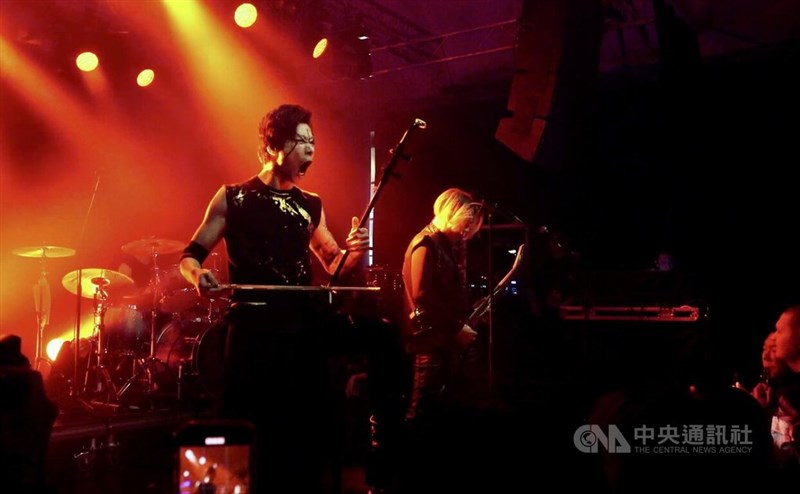
Image: The band Chthonic (閃靈), including Taiwan’s representative to Finland Freddy Lim (foreground), performing at the “Formosa:Finland:Fest” in Helsinki (Nov. 27, 2025). (Image source: CNA)
Heavy Metal, but Light Support
The crossovers between pop culture, history, and metal music in Taiwan has not yet led to more financial support for the fringe music genre—even though the need to support Taiwan’s cultural industries was spelled out by then-Vice President Lai Ching-te (賴清德) in 2021. Indeed, the goal of promoting Taiwan’s music industries lives within the ruling Democratic Progressive Party’s (民進黨) “National Project of Hope.” And while the government’s Development of the Cultural and Creative Industries Act (文化創意產業發展法) highlights the need to support 16 different culture-related industries (including music), budding musicians like Chu bemoan a lack of government financial support for metal. This frustration comes even as it may be possible to obtain subsidies for other forms of Taiwanese art and culture.
This oversight could be explained by certain perceptions of the role metal music plays in Taiwan cultural society. Most of the cultural industries outlined in Taiwan’s cultural policy can be loosely classified as “high culture”—that is, culture which:
“[I]ncludes works that can be appreciated in art museums, are performed by philharmonic orchestras, presented in theaters and operas, memorized in schools, and interpreted in institutions of higher education. If popular culture is said to include productions that are quickly consumed and quickly forgotten, high culture is framed as being demanding. Participating in high culture is supposed to be challenging. You have to rise up to the task, and not everyone can. By contrast, popular culture is easy to understand, and as a result, may not need to much energy to cultivate.”
But this distinction—and disregard—for popular culture subgenres like metal music will likely need to shift as Taiwan finds itself navigating a more challenging diplomatic space in the face of an aggressive China. There is a need to tell the Taiwan story in a wider variety of ways, in order to appeal to a broader range of voices and people. As the Finnish Deputy Representative to Taiwan Jere Tala pointed out, “you have to be open for different types of exchange, and this is just one of them. So in Finland and Taiwan’s case, we already enjoy very warm relations, especially in areas such as technology, innovation, education, and democracy—of course—but this kind of cultural exchange deepens the understanding in a way that politics or economics just alone cannot do. So it definitely reaches and expands the understanding between the two countries.”
And if the formula for the Formosa : Finland : Fest can be successfully replicated, the defiant sound of death metal could well become a way for Taiwan to strike a chord with an even wider audience.
The main point: Taiwan’s recent Formosa : Finland : Fest death metal concert, staged in Finland, exemplifies a new mode of diplomacy based on music often regarded as a fringe genre. Yet the success of the festival, and its performers, reveals that Taiwan can better tell its story to the world by moving beyond traditional forms of cultural diplomacy.