
Producing more than 90 percent of the advanced chips powering AI development, Taiwan Semiconductor Manufacturing Company (TSMC, 台灣積體電路製造公司) has significantly elevated Taiwan’s strategic importance in global affairs. In recent years, cognitive influence operations have nonetheless fueled fears among many older Taiwanese that TSMC’s overseas expansion could cost Taiwan economic benefits, strategic leverage, and talented engineers. Younger Taiwanese like myself, however, may see these concerns as overstated. TSMC has repeatedly emphasized that its most advanced research and development (R&D) capabilities will remain in Taiwan, and that the island will continue to serve as the heart of the company’s technology development and global production network.
Taiwanese should not be concerned about TSMC expanding its production in the United States for three main reasons. Firstly, this expansion allows TSMC to better serve leading-edge US customers and grow its business opportunities. Secondly, diversifying production away from Taiwan helps reduce environmental strains and geopolitical risks, and strengthens the stability of the semiconductor supply chain. Finally, TSMC’s international development plans enhance Taiwan’s global presence and strengthen connections with partners around the world.
Market Access, Government Subsidies, and Downstream Supply Chain Benefits
Although there are valid concerns about the high cost of building and producing semiconductors at TSMC facilities in the United States, it is worth acknowledging the long-term benefit of this activity: providing TSMC with quicker access to customers worldwide. Even though establishing operations abroad entails higher costs, this expansion has proven financially viable, as demonstrated by TSMC Arizona. In 2025 alone, the Arizona fab recorded a net income of NTD 4.232 billion (USD 135.8 million)—income that, at first glance, may appear to have been full-year data, but was actually made in just one quarter.
One key reason why TSMC Arizona has been successful has been changes in the global market for chips. The United States relies primarily on Taiwan for the fabrication of leading-edge logic chips. By building more fabs in the United States, TSMC is better able to satisfy the capacity demands of its key customers, including American companies such as AMD, Apple, Nvidia, and Qualcomm, among others. This enables faster, more personalized customer service, which builds trust and affinity with large companies and encourages them to buy from TSMC in the future.
Beyond customer proximity, the United States government has actively employed legislation to encourage semiconductor companies to build domestically. The US Department of Commerce has awarded TSMC USD 6.6 billion in direct grant funding under the CHIPS and Science Act, along with access to USD 5 billion in low-interest federal loans. This funding helps offset the higher costs of construction and operation in the US compared to Taiwan. Furthermore, TSMC’s American expansion not only builds cross-industry connections, but it also drives a broad chip ecosystem by paving the way for critical Taiwanese suppliers such as the Chang Chun Group and Sunlit Chemical to operate in the United States.
When these anchor fabs move to new land, the entire material supply network also moves with them, leading to more business opportunities. By empowering these suppliers to expand into global markets, such actions ultimately transfer international investment back into Taiwan’s domestic economy. Therefore, continued expansion in the United States represents a strategic investment in TSMC’s long-term financial future.
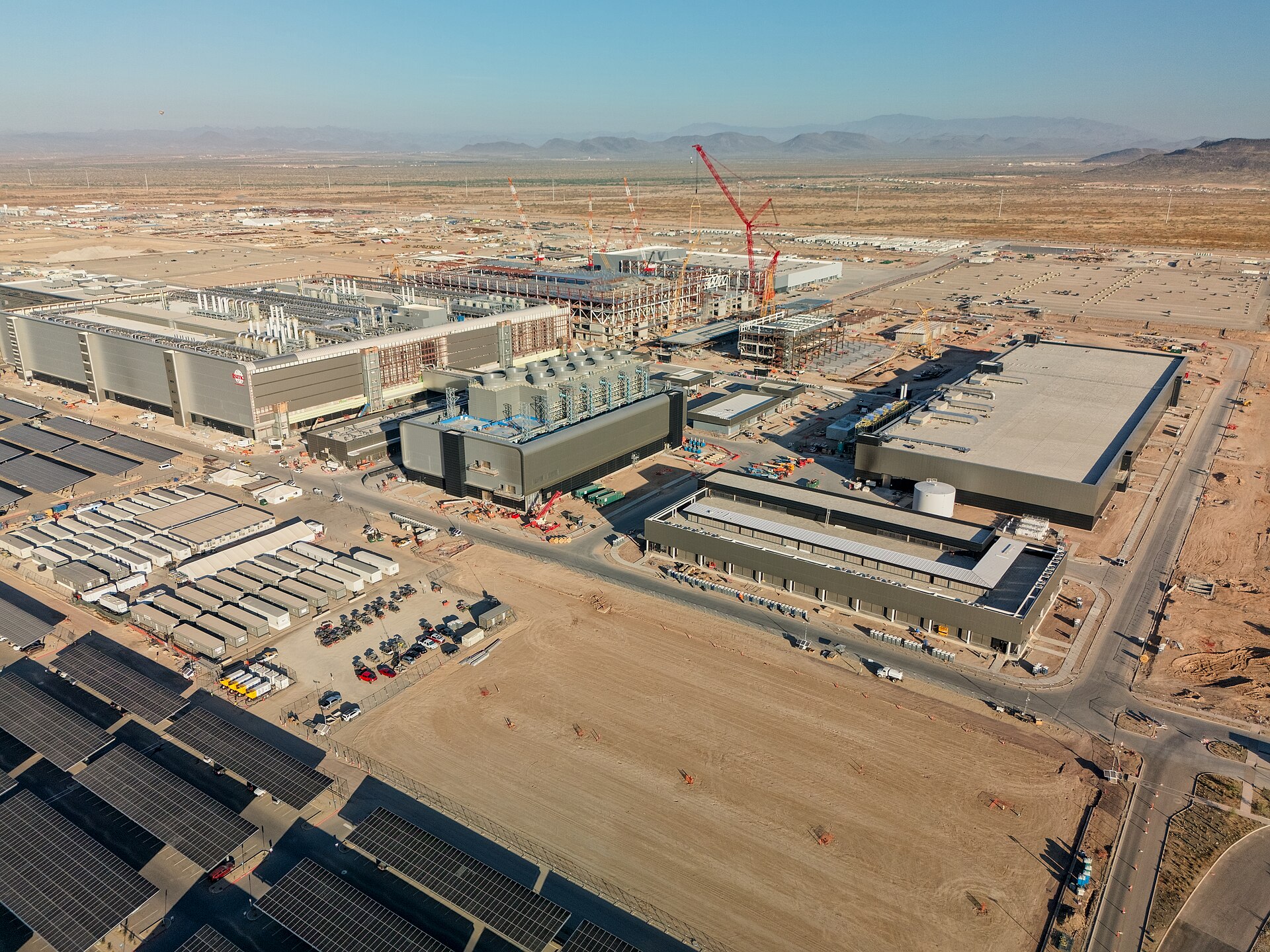
Image: TSMC Fab 21 under construction in Phoenix, Arizona (November 2023). (Image source: Wikimedia Commons)
Environmental Risks and Geopolitics
In order to maintain satisfying relationships with customers, TSMC must operate a stable and unbroken semiconductor production line. Some Taiwanese believe that this stability can be maintained at home, yet growing environmental risks and geopolitical realities indicate that relying on production in Taiwan alone is increasingly fragile. Within this context, TSMC’s expansion to the United States can help maintain a stable semiconductor production line.
As TSMC continues to expand its production capacity, Taiwan is gradually reaching the limits of its environmental carrying capacity. Semiconductor fabs consume vast amounts of water and electricity. Building more and more fabs in Taiwan will put too much pressure on the power grid. Increasing load will risk energy shortages and infrastructure strain, thus destabilizing production lines not only for TSMC but also for other businesses in Taiwan.
By contrast, locations for TSMC’s expansion, such as Arizona, possess far more abundant resources. Arizona has one of the biggest energy grids in the United States, operating over 6,551 megawatts (MW) of installed solar capacity alongside nearly 3,900 megawatts (MW) of battery energy storage systems. Beyond electricity, water is also essential for the semiconductor industry; a single advanced chip factory can consume up to 38 million liters of water per day (an amount approximately equivalent to the daily water usage of a medium-sized city). As a small island with finite resources, Taiwan simply lacks the physical capacity to sustain such immense environmental pressure. Crowding the nation with dozens of new factories would push its fragile water supply to a dangerous breaking point, placing a burden on the everyday lives of Taiwanese citizens.
Moreover, an earthquake that hit eastern Taiwan in 2024 caused TSMC factories in Tainan to shut down temporarily, as chip fabs are designed to automatically cease production when any tremors occur. For instance, EUV chipmaking machines possess sensors that detect infinitesimal movements that cannot be noticed by humans; if the EUV machine senses the floor moving, it will shut down completely. Indeed, continuing to print during tremors can blur the circuit lines and potentially result in significant financial losses as wafers must be discarded. Hence, moving factories to locations like Arizona helps mitigate natural disaster risks such as earthquakes and provides a more controllable environment, rendering chip production lines more efficient.
Given the relative availability of land, water, and electrical resources in North America, building factories in the United States may ultimately be beneficial for maintaining the stability of the Taiwanese production lines. By expanding its manufacturing capacity overseas, TSMC can reduce its exposure to geopolitical risks – and, in the event of war, help sustain the industrial capacity of the “arsenal of democracy.” For more than seven decades, Taiwan has faced persistent tensions across the Taiwan Strait, which have intensified in recent years and created significant geopolitical uncertainty. A war in the Taiwan Strait could severely disrupt global semiconductor supply chains, triggering shortages of advanced chips and inflicting trillions of dollars in economic losses worldwide. If key fabs in Taiwan are damaged or destroyed, rebuilding the lost production capacity could take years. By expanding its manufacturing capacity into the United States, TSMC can help key geopolitical partners like America maintain access to chips during wartime situations.
Soft Power and Continuity
Many Taiwanese argue that TSMC is the “silicon shield” protecting Taiwan against China. Therefore, they claim that the protection of this shield would be forfeited should TSMC build more factories in the United States. However, I believe TSMC’s global expansion can also help Taiwan garner greater international recognition by building stronger connections with local communities overseas. One example is the collaboration between Japan Advanced Semiconductor Manufacturing (JASM) and the TSMC Education and Culture Foundation, which brought Taiwan’s OneSong Orchestra to Kumamoto for a cultural concert. When locals connect with Taiwanese culture through these activities, it transforms Taiwan from an unfamiliar chip supplier into a culturally rich nation that bonds with local communities on a personal level.
Such community bonds naturally encourage local communities to support strong diplomatic ties between their government and that of Taiwan. Additionally, these community investments extend into classrooms, where local universities partner with TSMC to build a new generation of semiconductor professionals who have been trained through Taiwanese resources. In the context of Japan, cultural exchanges between TSMC and the local community not only strengthen the company’s ties with Kumamoto residents, but also help build public support for its overseas expansion. In this sense, TSMC’s overseas expansion does more than diversify production—it can also expand Taiwan’s international presence and strengthen its ties with key partners around the world.
Many Taiwanese refer to TSMC as the nation’s “Guardian Mountain” (護國神山) because of its crucial role in safeguarding Taiwan’s economic prosperity and national security. TSMC’s global expansion can strengthen the resilience of the semiconductor supply chain, bring production closer to its customers, expand its business opportunities, create new possibilities for young Taiwanese, and enhance Taiwan’s international presence. Some Taiwanese elders may worry that sending engineers to the United States represents a loss of human resources for Taiwan. However, these Taiwanese engineers are not abandoning Taiwan. Instead, they are stepping into global leadership roles and establishing important cross-border industry networks. When these professionals eventually return to Taiwan, they will be able to train the next generation of engineers preparing to go overseas and advance Taiwan’s economic prosperity. Expanding into the United States, therefore, does not mark the end of TSMC’s role as Taiwan’s “Guardian Mountain.” Rather, it is a pragmatic step toward ensuring that TSMC can continue to fulfill that role in a rapidly changing world.
One Youth’s Perspective
As a junior in the International Bilingual School at Hsinchu-Science-Park, many of my classmates’ parents are employed at TSMC. Drawing inspiration from their parents, some have also decided to pursue a career at TSMC. The establishment of TSMC Arizona has encouraged even more of them to pursue this track, and many of my peers are excited about the new job opportunities abroad that have been created. Indeed, these new job opportunities appeal to Taiwanese teenagers who had never yet been able to imagine their part in the “American Dream.” Ironically, according to a 2024 ABC News/Ipsos survey of US adults, public confidence in the American Dream has significantly eroded. Yet, new TSMC subsidiaries in the United States not only stabilize the production chain but also help revive the long-faded “American Dream” for Taiwanese youth.
The main point: While many commentators in Taiwan suggest that TSMC’s expansion to the United States weakens Taiwan’s economic and national security, the business decisions may actually prove more economically viable, and relieve pressure on Taiwan’s grid and water supply. Meanwhile, the opportunities to work in the United States revive the long-faded “American Dream” among Taiwanese youth.