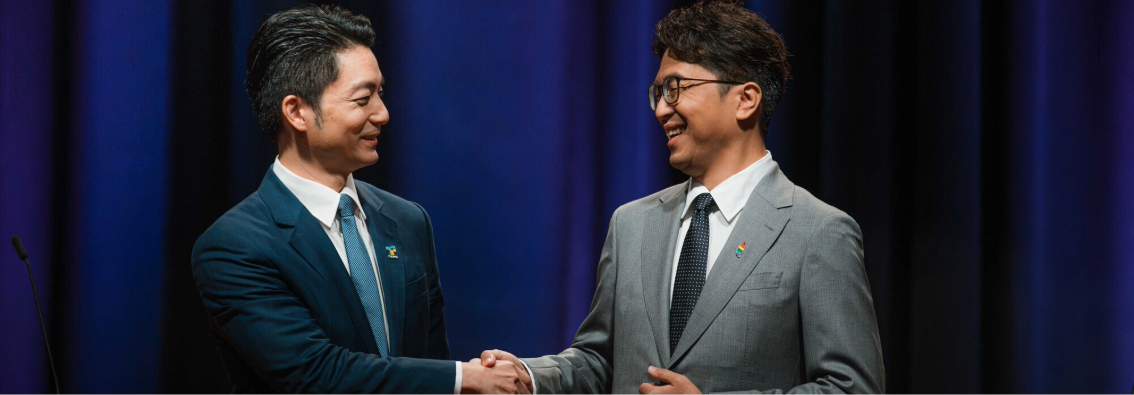

Cover image: Photo provided by the Taipei Mayoral Television Debate organizers (Source: The Reporter)
Editor’s Note: This is the second article in a two-part series. The first article, “Battle for the Capital: Inside the 2026 Taipei Mayoral Race, Part 1,” was published by GTI on October 30.
As the incumbent Taipei mayor, Chiang Wan-an (蔣萬安) of the Kuomintang (KMT, 中國國民黨) faces immense pressure to succeed in his re-election bid against Puma Shen (沈伯洋), the candidate nominated by the Democratic Progressive Party (DPP, 民主進步黨). Despite the similarities in their backgrounds and public image, their political reputations, stances on policy issues, and campaign styles set them apart. As the election (part of Taiwan’s larger “Nine-in-One” local elections) approaches on November 28, the whole island is watching whether the “Ocean Current,” or “Yang Liu” (洋流) (see further below), will lead to a different political landscape over the next four years.
The Background of the Competing Candidates
As the two leading candidates in the Taipei mayoral race—a race now at the center of national and international attention—Chiang and Shen share a few striking similarities in terms of their experience and public image. Both Chiang and Shen have deep ties to Taipei, as they both grew up in the city and attended the famous Chien Kuo High School (建國中學) that is revered as the premier high school for boys in Taiwan. Their prominent higher educational backgrounds also reinforce their elite images: Chiang obtained a Master of Laws (LL.M.) degree and a Juris Doctor (J.D.) from the University of Pennsylvania, while Shen earned a LL.M. degree from the University of Pennsylvania and a Ph.D. degree in Criminology, Law, and Society from the University of California, Irvine.
In Taiwan politics, academic qualifications and educational credentials play a role of “outsized significance.” It is often the case that Taiwanese campaign billboards, flyers, and other promotional materials focus on highlighting the candidates’ educational credentials over other characteristics, since many Taiwanese voters view candidates’ level of education and the prestige of their alma maters as an indicator of their ability to govern. The majority of well-known Taiwan politicians hold a master’s degree at a minimum, and it is quite common to see those with doctorate degrees running for public office at the legislative or mayoral level. Therefore, it is no surprise that, out of the six candidates running for Taipei mayor in 2026, five of them hold either a Ph.D. degree or J.D. (the sixth candidate has a master’s degree).
In addition, both Chiang and Shen represent the middle-age generation of their respective political parties, sharing similar ages and relatively new political resumes. The more prominent figures of both the KMT and DPP tend to be older, and it has been observed that the average age of local politicians is increasing. In contrast, the two Taipei mayoral candidates are considered the “new blood” of their respective parties. Chiang was elected as a legislator in 2015 and won the Taipei mayor election in 2020; Shen first entered the Legislative Yuan (LY) in 2023. Regardless of the 2026 election results, both of them are set to be rising stars within their respective political camps for the next decade.
In spite of the commonalities mentioned above, the two men have quite different political reputations and paths. For example, Chiang’s familial connection has been in the center of public debate for years before the current election cycle. His father, Chiang Hsiao-yen (蔣孝嚴)—who claimed to be the descendant of Chiang Kai-shek (蔣中正) and Chiang Ching-kuo (蔣經國)—was a former minister of foreign affairs and former KMT secretary general. On one hand, the Chiang family name makes the KMT candidate an insider in Taiwanese politics, and the prestige of being the fourth generation of the Chiang family has allowed Chiang Wan-an to enjoy a public reputation following his return from the United States to Taiwan. On the other hand, Chiang’s bloodline credibility has been challenged, as some doubt Chiang’s actual familial connection with Chiang Ching-kuo. Additionally, the incumbent has only apologized to victims of the White Terror (白色恐怖) in his role as Taipei mayor, while some have argued that he should bear the burden as a descendant of the former authoritarian president.
Compared to Chiang’s insider status as part of a prominent political dynasty, Shen has been seen as more of a political outsider, with a previous academic career and extensive experience in the nonprofit sector. He is an associate professor in criminology at National Taipei University, with research interests in the field of white-collar crimes. In 2019, he founded the Doublethink Lab (台灣民主實驗室), an NGO analyzing informational and cognitive warfare; and Kuma Academy (黑熊學院) in 2023, a civic group advocating for civil defense. Some are concerned about Shen’s late entry to Taiwan’s politics and his relative lack of administrative experience. Others are worried that Shen’s expertise in foreign interference and brash political style could make him overly provocative for local governance.
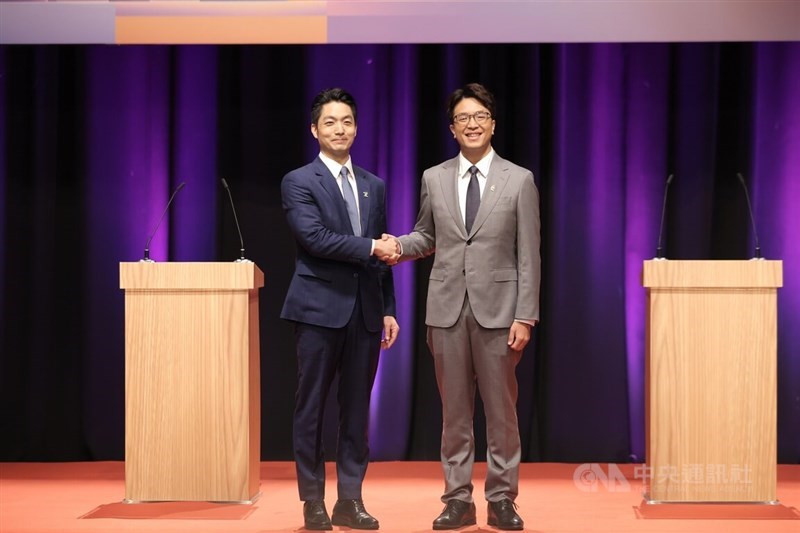
Image: Taipei mayoral candidates Chiang Wan-an of the KMT (left) and Puma Shen of the DPP (right) shake hands before their televised debate on October 31. (Image source: Central News Agency)
Salient Policy Discussions
Throughout the Taipei mayoral campaign, both sides have had heated debates on various policy issues, including drug treatment, school lunch quality, tree trimming, and traffic safety. In terms of the race between Chiang and Shen, the debates surrounding child welfare and the potential relocation of Songshan Airport (松山機場) have drawn the most public attention.
Songshan Airport Relocation
One of Chiang’s main policy proposals is a plan to relocate Songshan Airport and replace it with a Taipei AI park. In the relocation plan, Chiang pledged to build an AI industry zone, public green space, and a sustainable community with residential areas, historical preservation sites, and transportation networks. Chiang envisioned that the new AI park would create a comprehensive industrial network by connecting with multiple neighboring technological parks: Beitou-Shilin Technology Park (北投士林科技園區), Neihu Technology Park (內湖科技園區), National Biotechnology Research Park (國家生技研究園區) and Nangang Software Park (南港軟體園區). The proposal estimates that, over time, the AI park would create an estimated 65 thousand job opportunities, and generate NTD 12 trillion in output value.
However, there is pushback against the plan from both the central government and local governments. The Ministry of Transportation and Communication (MOTC, 交通部) has expressed concern about the feasibility of the plan, as well as air transportation capacity. If the relocation project is carried out, Taoyuan International Airport will have to take on significant additional air traffic; yet, as its original design was intended for international rather than domestic flights, it will take around 10 years to increase Taoyuan Airport’s capacity to a level necessary for the loss of Songshan. The Ministry of Interior (MOI, 內政部) has also pointed out that Songshan Airport is critical for search-and-rescue in northern Taiwan, since it also serves as the Songshan Base for the National Air Service Corps (空中勤務總隊). In addition, Penghu County and Taitung County have opposed the policy proposal, on grounds that Songshan Airport has played an important role in medical transportation for the outlying islands and eastern Taiwan. While Shen also agreed that the Songshan relocation plan is worth discussing, he emphasized the necessity to prioritize issues of national defense, medical transportation from rural areas, and disaster relief.
Child Welfare
Major child abuse cases during Chiang’s current mayorship have sparked public attention on both candidates’ child welfare policy. Since 2022, Taipei has seen eight serious child abuse cases and 115 minor victims. The severity of minor abuse incidents has put the Taipei City government under the spotlight. The Audit Office (審計部) of the Control Yuan (監察院) revealed that Taipei City has not incorporated the assessment system introduced by the central government into its own case screening mechanism, and up to 303 minor welfare reports have been delayed since last August. The Control Yuan has also censured the Taipei City government for negligence on many child abuse cases—including multiple sexual abuse cases at the Piramide pre-school (培諾米達幼兒園) first reported in 2022, the Kaikai Case (剴剴案) in 2023, and a sexual abuse case against a minor employee of McDonald’s restaurant in 2024.
Shen has criticized the minor protection mechanisms of Chiang’s government and pledged to make child welfare a policy priority. He and other DPP legislators held a press conference in July accusing the Taipei City government of failing to contact relevant agencies and carrying out procedures only out of formality, revealing the necessity for systemic adjustment. Along with other social welfare policies, Shen proposed to establish a Children and Teenager Safety Governing Center (兒少安全治理中心) under the Taipei Research Institute (台北研究院) to integrate data from multiple agencies in analyzing major incidents and reviewing policy responses. He has also stated that he will strive to improve the system and well-being of social workers.
In response to Shen and other critics, Chiang affirmed that the Taipei City government has strengthened cross-agency networks regarding childcare management. He also proposed a “7+1 Improvement Plan,” which covers measures such as increasing visitation frequency, strengthening childcare professionals’ training, and providing mental health services.
Shen’s Surprising Performance and the “Ocean Current” (“Yang Liu”)
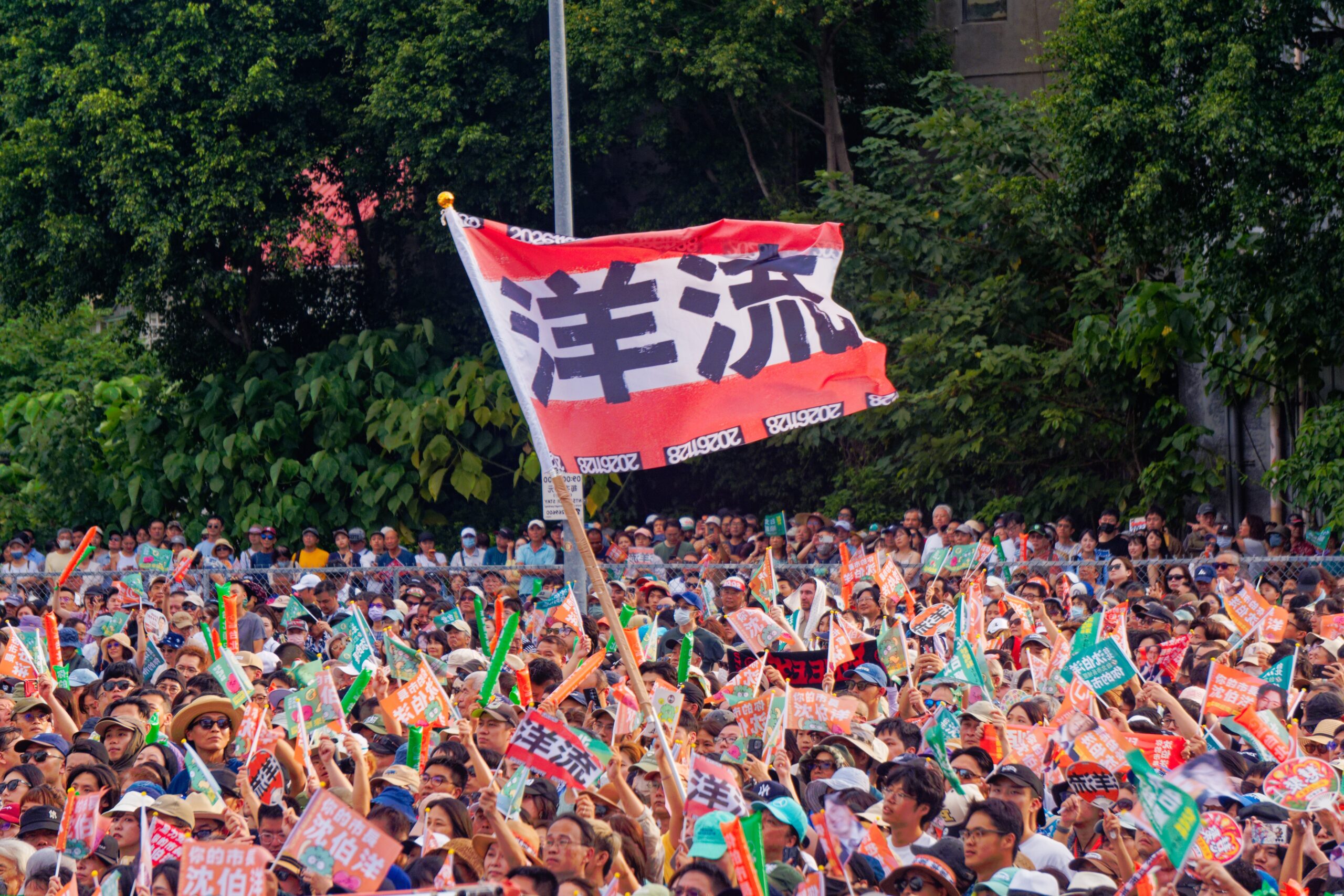
Image: A large flag reading “Ocean Current” (洋流, “Yang Liu”) waves above supporters at the opening of Puma Shen’s Taipei campaign headquarters. The term has been adopted as a slogan by Puma Shen supporters. (Image source: qhfan)
Given Shen’s image as a political outsider, many have been surprised by the level of support he has received. The “Ocean Current,” or “Yang Liu” (洋流), which is derived from Shen’s name, illustrates the island-wide popularity of his campaign. One major attribute to the phenomenon could be the shift of policy focus. This refers not only to particular policy proposals, but also Shen’s entire re-branding in the campaign. During multiple campaigning events and media appearances, he has focused extensively on local issues—such as urban planning, social welfare, and education—while downplaying his usual emphasis on defense and foreign interference.
Another tactic that has successfully built up Shen’s active support base is his interactions with voters of different generations. His campaign has attracted the younger generation with non-traditional measures. The interactive features of his campaign website illustrate policy proposals to the younger population, who are comfortable with and reliant on digital interface. His campaign team also extended the normal scope of public policy discussions by collaborating with writers, poets, and artists to create magazines. Shen also endeavors to reach independent voters who are concerned about economic issues and skeptical of the two major parties. He invites voters to in-person “soapbox” (肥皂箱) events to directly express their concerns and needs in daily life. He has also attended multiple interviews, including those held by “Pan-Blue” hosts, to expand target audiences and break out of partisan echo chambers.
The impressive civic engagement of Shen’s supporters is also a critical factor in the widespread “Ocean Current” phenomenon. It is worth noting that the “Ocean Current” theme started as a grassroot movement initiated by Shen’s supporters. They turned political enthusiasm into community building through designing and distributing campaign merch, coordinating neighborhood gatherings, and participating in policy discussions. The bottom-up mobilization has effectively complemented Shen’s strategy to re-brand and interact outside of the echo chamber, creating an unprecedented political phenomenon.
Can DPP Break the “Blue North and Green South”?
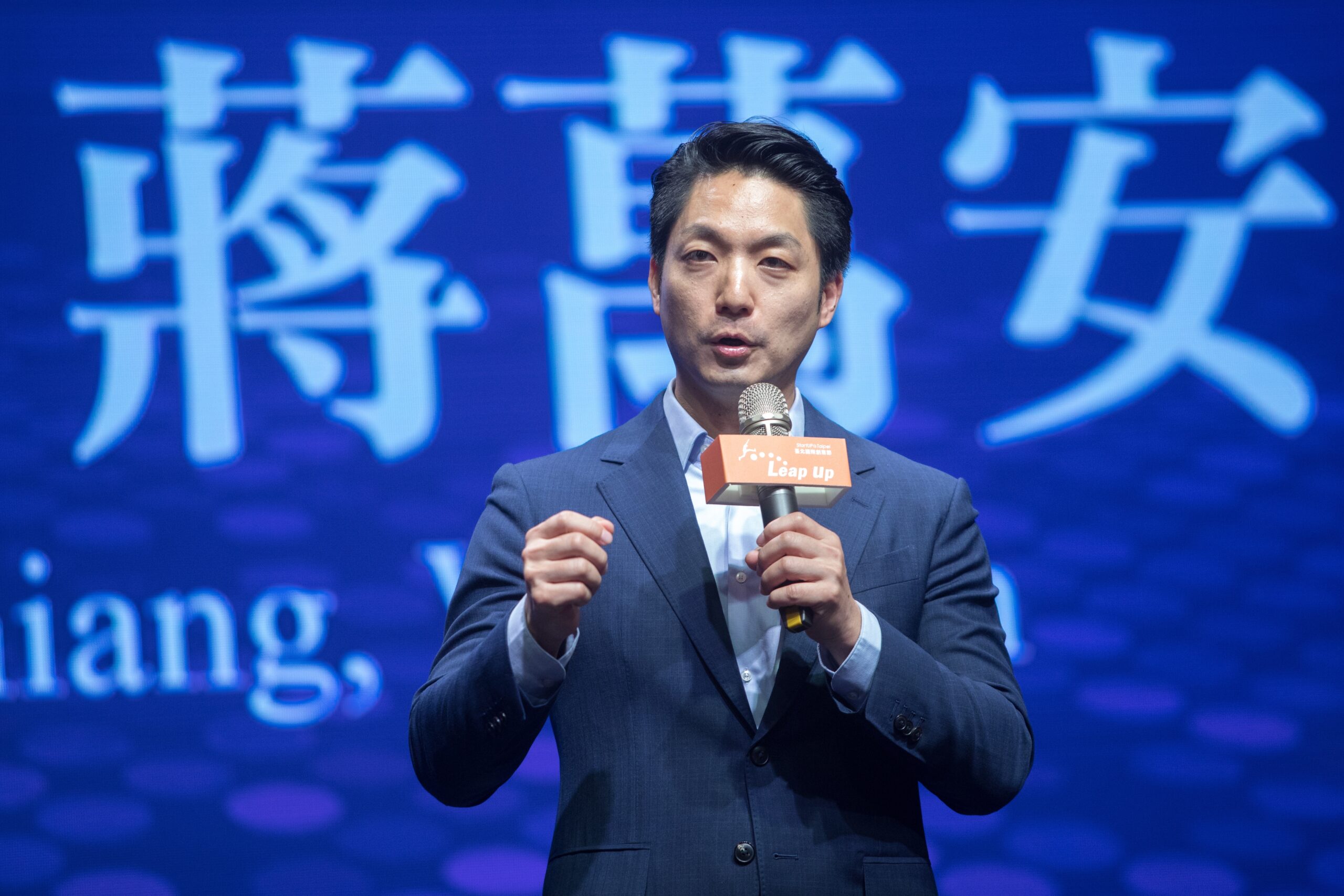
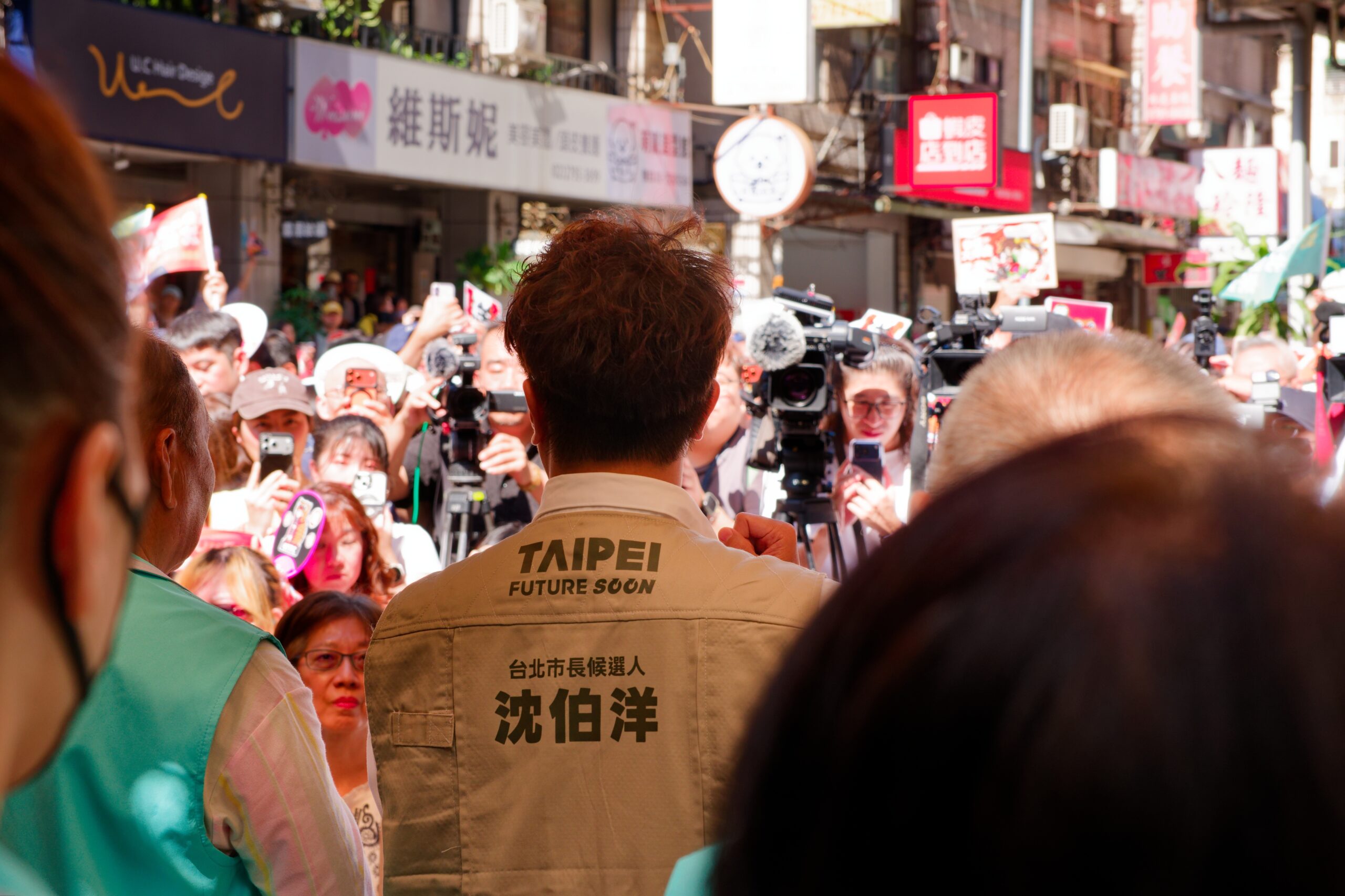
Image: Chiang Wan-an of the KMT (top) and Puma Shen of the DPP (bottom). (Source: jamesonwu1972 and qhfan)
The emergence of the “Ocean Current” movement has surprised the capital city, which has historically been a KMT stronghold. Yet, it remains unknown whether Shen can break the pattern of “Blue North and Green South.” In addition to local governance, the upcoming elections could also alter the national political dynamic in Taiwan. While the DPP holds executive power, it has been facing constant political deadlock in the Legislative Yuan (LY), in which a coalition of the KMT and the Taiwan People’s Party (台灣民眾黨) holds the majority. Tension between the Executive Yuan (EY), the LY, and local government has also reached its height after the LY’s budget cuts earlier this year, as some counties and municipalities receive proportionally less funding than others. The upcoming elections will be an opportunity for the DPP to challenge the KMT’s strong hold on local politics—and a fight for the KMT to defend its base by preventing the spillover effect of Shen’s “Ocean Wave” into other mayoral races.
The main point: In Taiwan’s current round of “Nine-in-One” local elections scheduled for November 28, the highest profile race is the Taipei mayoral election. The current campaign pits incumbent mayor Chiang Wan-an of the KMT (a reputed descendant of Chiang Kai-shek) against challenger Puma Shen (Shen Bo-yang) of the DPP. Although Taipei is traditionally a “blue” KMT stronghold, Shen has mounted a stronger-than-expected campaign for the capital city’s top job. As the Taipei mayorship is arguably the most prominent elected position in Taiwan aside from the presidency, the outcome of the election could have implications for future island-wide politics.